How Brands Use AI Twins for Product Demos
How to build a futureproof relationship with AI
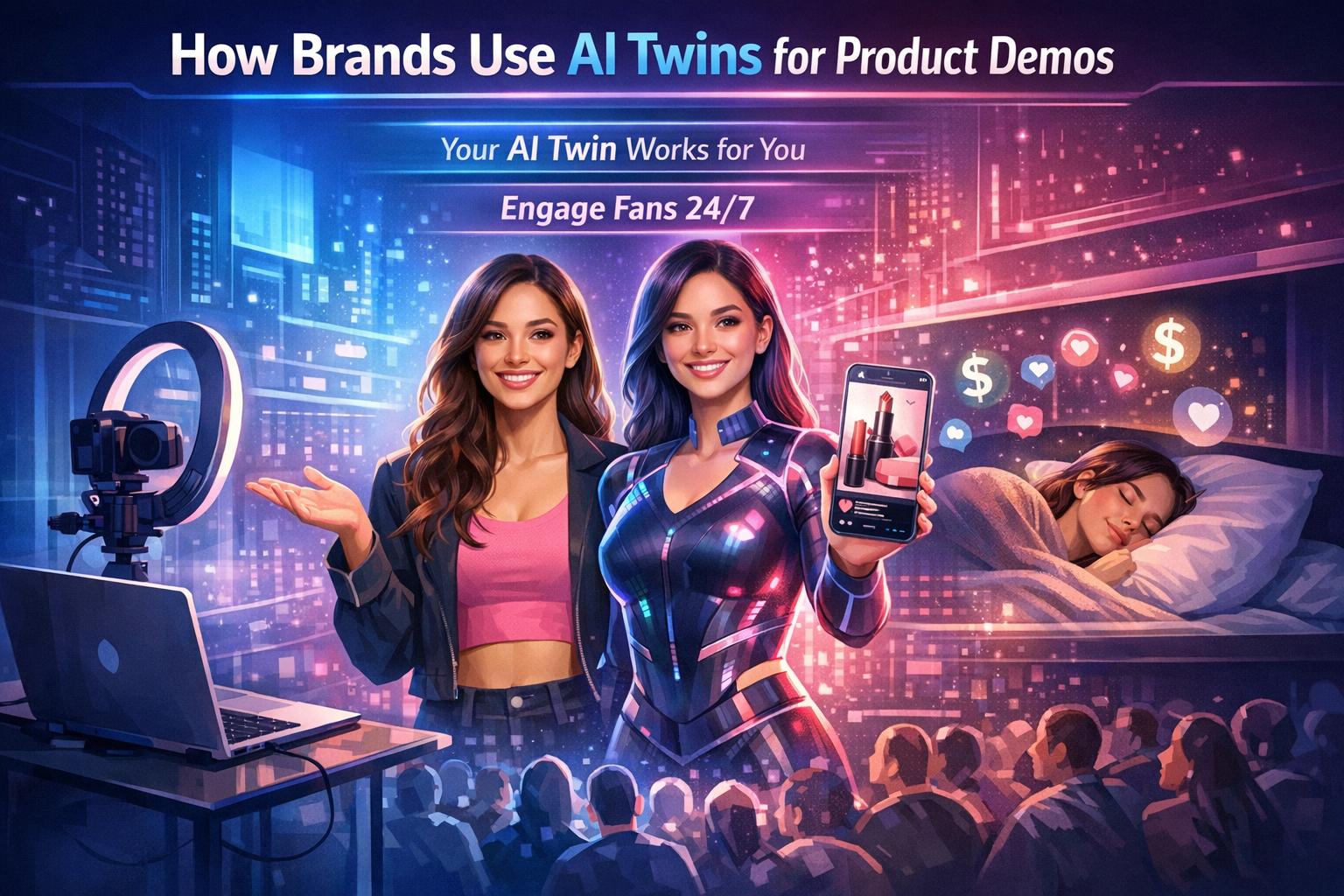
AI twins are changing how brands showcase products. Instead of relying on time-consuming and costly photoshoots, companies now use hyper-realistic digital replicas to create product demos faster and at a lower cost. Key benefits include:
Speed: Content creation is up to 65% faster.
Cost Savings: Production costs drop by 50-87%.
Scalability: Easily produce thousands of variations from a single digital file.
Global Reach: Localize content for multiple markets instantly.
Major brands like Nestlé, Unilever, and Moët Hennessy are already using AI twins to boost efficiency and engagement. Platforms like TwinTone simplify this process, enabling brands to generate user-generated content (UGC) videos, shoppable livestreams, and 3D product demos in seconds. Whether you're a small business or a global enterprise, AI twins offer a smarter way to produce and distribute product visuals.
What Are AI Twins and How Do They Work
Defining AI Twins
AI twins are digital replicas designed to mirror the features and appearance of products or individuals. They provide a single, consistent digital representation that includes all product variations, language formats, and regional adaptations.
This technology goes beyond just maintaining visual consistency. It allows for quick and easy adjustments to meet specific market needs. For example, if you’re planning a European launch with unique packaging or a winter-themed version of a product, you can modify the digital file instead of starting from scratch. This approach speeds up content production across multiple global markets.
The Technology Behind AI Twins
AI twins rely on cutting-edge systems to function. Platforms like NVIDIA Omniverse and OpenUSD enable seamless 3D simulation and integration across various software tools. These systems use advanced AI to automate tasks and generate highly realistic content from a single digital model. Features like real-time 3D rendering allow for instant adjustments to lighting, angles, and environments, while cloud services such as Microsoft Azure provide the computational power to scale production worldwide.
A great example of this in action comes from Nestlé. In July 2025, the company used this technology with 250 digital specialists working in 45 content studios. They converted 4,000 products into 3D digital twins for brands like Purina and Nespresso. This effort cut the time and cost of scaling content by an impressive 70%.
These technological advancements are the backbone of AI twins’ ability to revolutionize product demonstrations.
Core Features for Product Demos
With these technical capabilities, AI twins bring unparalleled opportunities for product demonstrations. On-demand video generation allows marketing teams to produce any shot from any angle in minutes instead of weeks. Multilingual support automatically adapts packaging and labels for different regions, eliminating the need for additional reshoots.
Interactive features take customer engagement to the next level. Shoppers can rotate, zoom, and explore items in 3D. Some applications even let customers visualize how furniture would look in their space using augmented reality (AR). Real-time customization means buyers can see any color, material, or finish instantly, without requiring separate photographs for every variant.
Unilever’s TRESemmé Thailand demonstrated the power of AI twins in March 2025. They cut content creation costs by 87%, increased purchase intent by 5%, and produced content that held user attention three times longer than traditional assets.
How TwinTone Creates Product Demos with AI Twins
TwinTone's AI UGC Creation Process
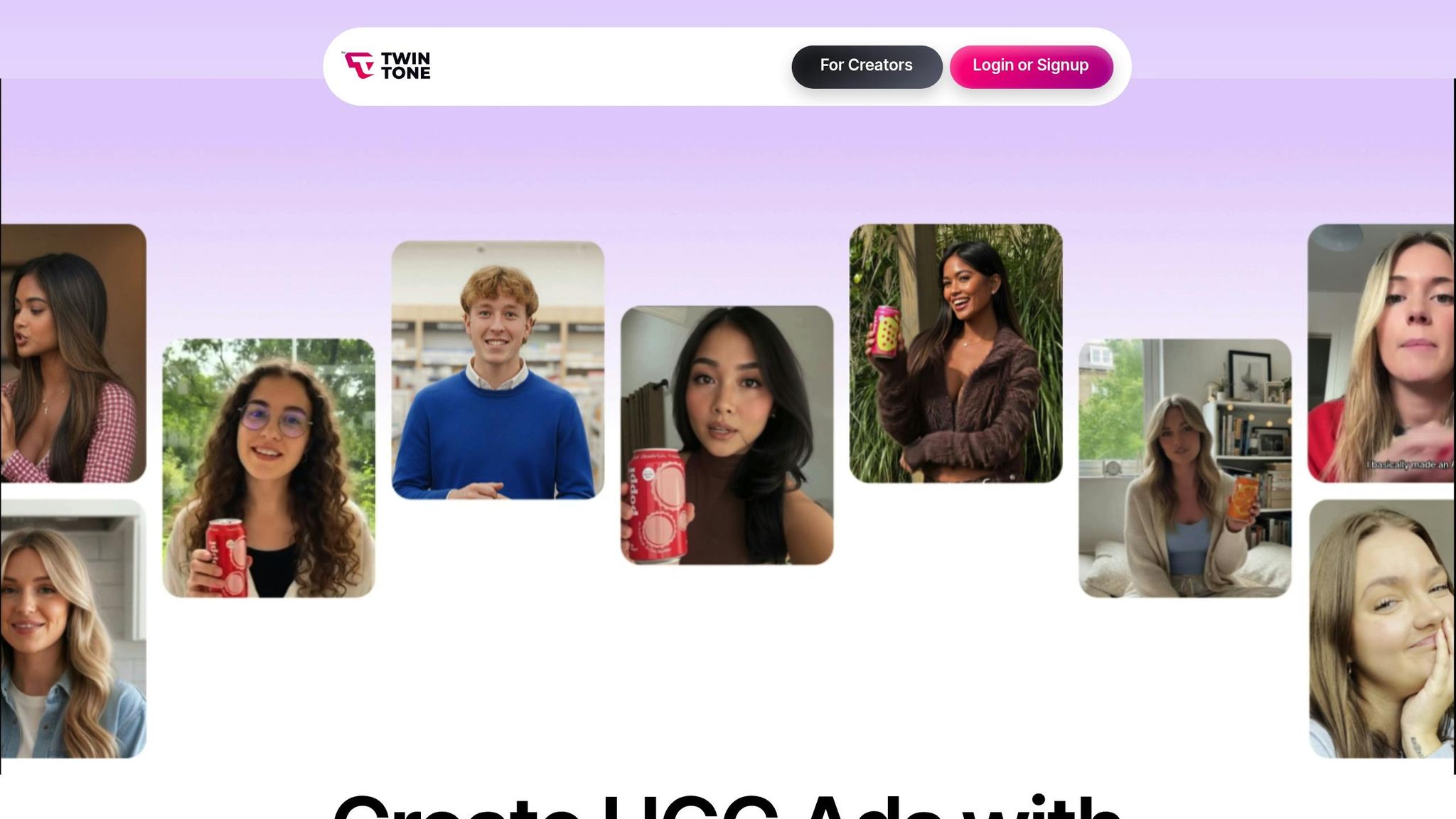
TwinTone works with a network of over 20,000 creators who have been transformed into digital replicas of themselves. These aren't just basic avatars - they're lifelike digital versions that retain the creator's unique tone, style, and personality in every video.
Here's how it works: brands pick a creator, upload product images and a script, and TwinTone generates videos that feel like authentic user-generated content (UGC). The best part? Each video is ready in just 30 seconds. Creators also earn money every time their AI Twin is used, making this a win-win for brands and creators alike.
So far, the platform has produced over 1,247,382 videos for brands. Take Poppi, for example. They used TwinTone’s AI-powered UGC to achieve 63 million impressions and a creator reach of 218 million. Co-founder Allison Ellsworth shared:
"We generated over 63 million impressions and 218 million creator reach! proving that UGC + experiential content can outperform traditional media"
With its efficient process, TwinTone also offers a range of tools that take product demos to the next level.
TwinTone Platform Features
TwinTone’s platform is packed with tools designed to meet the needs of modern product demos. For instance, Product In Hand transforms still images into videos where AI Avatars appear to hold and showcase the product. Meanwhile, AI Live Shopping enables round-the-clock branded livestreams, with AI Twins that can communicate in over 40 languages.
For fashion brands, there’s Dress Your Creator, which allows instant outfit changes on AI creators - keeping content fresh and aligned with trends without the need for new shoots. The platform also offers AI-driven creative testing, helping brands personalize content and boost their return on ad spend (ROAS). These features mark a shift from traditional demos to immersive, AI-powered content.
L'Oréal, for instance, used TwinTone to generate 46 million impressions. According to CMO Asmita Dubey:
"We're building, with AI at the core of brand interactions"
Gymshark also teamed up with TwinTone to create influencer-style content, which led to a 10.2% boost in ROAS. CBO Noel Mack highlighted how their approach focuses on working with influencers who genuinely connect with their audience, creating authentic momentum for the brand.
Multi-Platform Distribution
Beyond content creation, TwinTone simplifies distribution with its "Done For You" system. This automated tool posts videos across platforms like TikTok, Instagram, and YouTube. Using API integration, the platform connects seamlessly with brand tools, enabling large-scale content production for multiple SKUs and campaigns.
Performance tracking is built-in, providing real-time insights into engagement, conversions, and ROI from AI-generated content. This allows marketing teams to quickly tweak strategies based on results. TwinTone also streamlines updates across global markets through a "single digital truth" system - one file containing all product variants, labels, packaging, and language formats, ensuring instant updates wherever needed.
HeyGen’s New Digital Twin SHOCKED Me: Avatar IV Changes Everything
How to Create AI Twin Product Demos
TwinTone’s content creation tools make it easier than ever to deploy AI Twin demos. Here’s how to get started.
Choosing and Training AI Twins
The first step is selecting an AI Twin from TwinTone’s extensive network of over 20,000 creators and 100+ licensable AI Twins. These digital replicas are designed to capture each creator’s personality, gestures, and speaking style, ensuring they feel authentic.
Brands can browse the creator network by niche, audience type, or visual style to find the perfect match for their product. Once a creator is chosen, their AI Twin comes pre-trained and ready to use. TwinTone takes care of all the technical training, so the AI Twin accurately reflects the creator’s unique mannerisms and tone.
Creating On-Demand UGC Videos
Once you’ve selected an AI Twin, producing a product demo video is simple. It’s just three steps: pick your creator, upload your product images and script, and generate the video.
TwinTone’s Product In Hand feature makes your product the star. By uploading a product image, you can instantly create a UGC-style video of the AI Twin holding and showcasing your product. For fashion brands, the Dress Your Creator tool allows you to swap the AI Twin’s outfit to match your campaign’s style.
This quick process means you can experiment with different scripts and creator styles without delays. Just make sure your product images are high quality for the best results. With over 1,247,382 videos already produced for brands, TwinTone’s platform is built to handle high demand without compromising on quality.
Launching Shoppable AI Livestreams
Take it a step further with always-on AI Live Shopping streams that run 24/7, eliminating the need for human hosts. TwinTone supports livestreams in more than 40 languages, helping you connect with global audiences. This is especially powerful since 75% of shoppers are more likely to make a purchase when content is presented in their native language.
Getting started is straightforward: choose your AI Twin, upload your product catalog, and set up the stream schedule. TwinTone’s smart restreaming feature lets you prerecord successful segments and rebroadcast them with a live badge, maintaining audience engagement while cutting production costs. Brands using this approach have reported conversion rates up to three times higher when interactive AI assistants are part of their streams.
To maximize impact, build excitement before going live with social media teasers and email campaigns. During the stream, use flash deals and limited-time discounts to create urgency. TwinTone’s integrated checkout system also allows viewers to make purchases directly within the livestream, streamlining the buying process.
Brand Examples Using AI Twin Product Demos
Big-name consumer brands are already tapping into AI twin technology to reshape how they create and share product demonstrations. Let’s take a look at how Nestlé, Unilever, and Moët Hennessy are putting AI twins to work. These examples highlight how this approach is making product demos faster, more efficient, and easier to scale.
Nestlé: Scaling Product Visuals and Localization
Nestlé is leading the way in using AI twins to streamline and localize product demonstrations. In June 2025, the company launched an AI-powered service to support global brands like Purina, Nescafé Dolce Gusto, and Nespresso. By developing precise 3D virtual replicas of their products, Nestlé gave its 250 marketing professionals in seven global hubs the ability to digitally tweak packaging visuals, labels, and languages for different markets and seasonal campaigns - all without needing physical reshoots. This approach slashed both costs and production time, making it possible to quickly adapt content for markets worldwide.
David Rennie, Head of Strategic Business Units, Marketing and Sales at Nestlé, shared his thoughts on this innovative strategy:
Our new content organization means we can do more with the talented teams we have, leveraging their skills to produce high-quality, consistent, scalable content supported by AI digital assistants and digital twin technologies.
Unilever: Speeding Up Campaign Content Creation

Unilever took a bold step in March 2025 by integrating NVIDIA Omniverse into its workflow. This technology allowed the company to create highly accurate digital replicas of products from major brands like TRESemmé, Dove, Vaseline, and Clear. The result? A production process that’s twice as fast and costs that are cut in half. These AI-powered product twins made it possible to generate campaign content quickly, efficiently, and on a massive scale.
Esi Eggleston Bracey, Chief Growth and Marketing Officer, summed up the impact:
Our product twins can be deployed everywhere and anywhere, accurately and consistently, so content is generated faster and on brand. We call it creativity at the speed of life.
Luxury brands are also jumping on the AI twin bandwagon, using this technology to transform their creative processes.
Moët Hennessy: Real-Time Adjustments for Demos
In 2025, Moët Hennessy, the wine and spirits arm of LVMH, teamed up with Grip to harness NVIDIA Omniverse and the OpenUSD framework. This partnership enabled their teams to tweak composition, lighting, and product details in real time across various demo scenarios - no physical reshoots required. Thanks to this approach, Moët Hennessy produced over 3 million content variations globally, doubling production speed and cutting campaign asset timelines from weeks to just minutes.
These examples show how AI twin technology is not just a futuristic concept - it’s already making a big difference in the way brands create and deliver product demos. From cutting costs to speeding up production, the possibilities are endless.
Benefits and ROI of AI Twin Product Demos
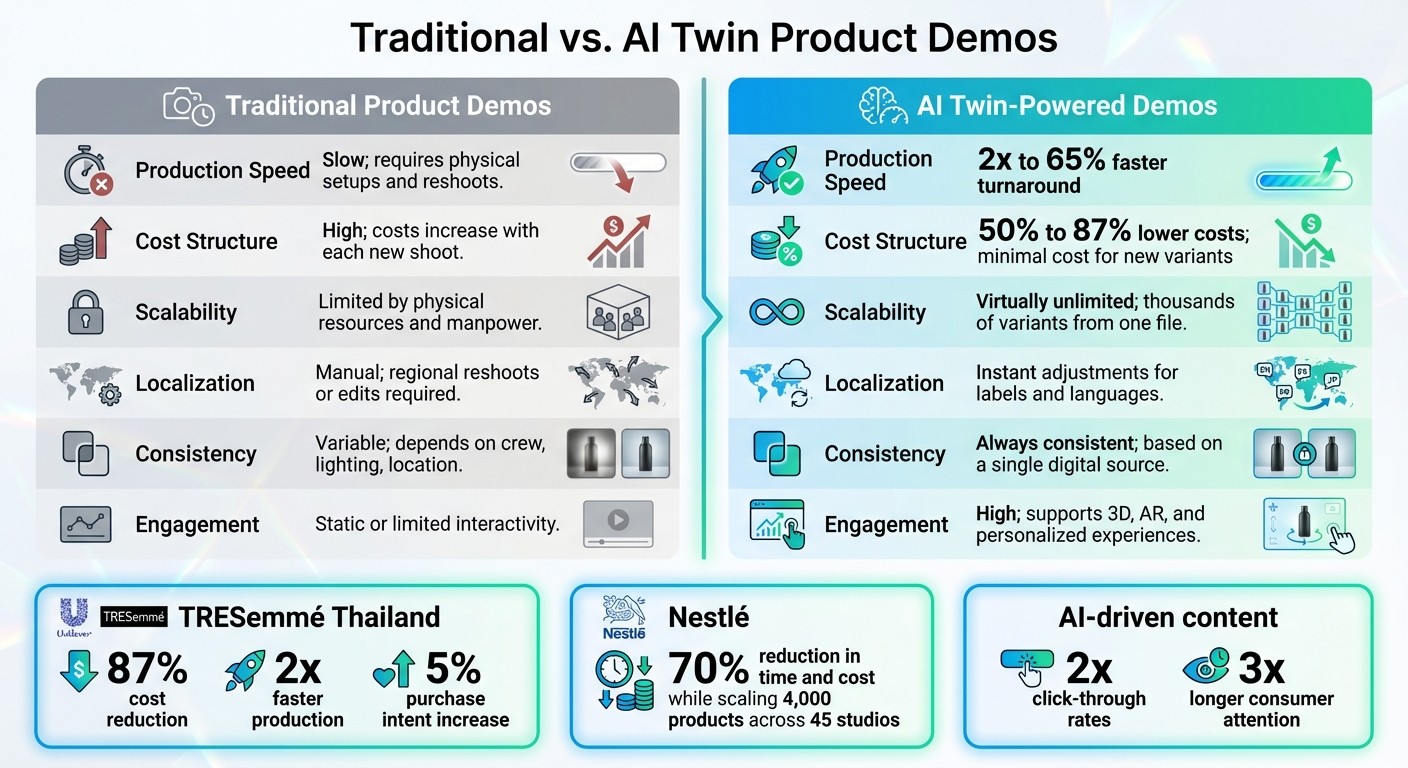
Traditional vs AI Twin Product Demos: Speed, Cost & ROI Comparison
AI twin technology is reshaping the way product demos are created, offering clear advantages in terms of speed, cost, and scalability compared to traditional methods. The numbers speak for themselves.
Traditional Demos vs. AI Twin Demos
Switching from physical shoots to digital twins marks a major shift in content creation. Here's how they compare:
Feature | Traditional Product Demos | AI Twin-Powered Demos |
|---|---|---|
Production Speed | Slow; requires physical setups and reshoots | 2x to 65% faster turnaround |
Cost Structure | High; costs increase with each new shoot | 50% to 87% lower costs; minimal cost for new variants |
Scalability | Limited by physical resources and manpower | Virtually unlimited; thousands of variants from one file |
Localization | Manual; regional reshoots or edits required | Instant adjustments for labels and languages |
Consistency | Variable; depends on crew, lighting, location | Always consistent; based on a single digital source |
Engagement | Static or limited interactivity | High; supports 3D, AR, and personalized experiences |
Take Unilever’s TRESemmé brand in Thailand as an example. In March 2025, they leveraged AI twin technology and saw an 87% drop in content creation costs, production speeds that were twice as fast, and a 5% boost in consumer purchase intent. Esi Eggleston Bracey, Unilever's Chief Growth and Marketing Officer, summed it up perfectly:
We've transformed what was once a complex, slow process into a marketing system that frees up our teams to focus on what they do best – think bigger, be creative, push boundaries and create magic for our brands.
These metrics highlight not just operational efficiencies but also the potential for deeper customer engagement and simplified workflows.
Increasing Conversions with Personalized Content
AI twin technology doesn’t just streamline production - it also boosts engagement. By enabling brands to produce tailored demos for specific audiences, it delivers measurable results. For example, Unilever's Beauty & Wellbeing group reported that AI-driven content doubled click-through rates and kept consumer attention three times longer than traditional content.
Why does this work so well? Because personalization resonates. A single digital twin can store all the product variations - different labels, packaging formats, and languages - allowing marketers to create thousands of targeted iterations instantly. Previously, this level of customization was too costly and time-intensive for most brands. Now, it’s not only feasible but also scalable.
Lowering Costs and Simplifying Workflows
The financial benefits of AI twins go beyond cutting production costs. By creating a "single digital truth" for each product, brands can streamline their processes. Unilever, for instance, reduced the average number of workflow steps from five to just one.
Nestlé provides another compelling example. In July 2025, they rolled out an AI-powered in-house service across 45 global content studios. By converting 4,000 products into 3D digital twins, they reported a 70% reduction in time and cost when scaling these assets. Seasonal updates or regional campaigns can now be managed without the need for new photo shoots - a revolutionary change for global operations.
This newfound efficiency gives teams more time to focus on creativity and strategy. Instead of juggling reshoots and manual edits, they can prioritize big-picture thinking and innovation. With global AI marketing revenue projected to hit $47 billion by 2026 and surpass $107 billion by 2028, it’s clear that AI twins are not just a passing trend - they’re redefining how brands create and distribute product content.
Adding TwinTone AI Twins to Your Ecommerce Strategy
Integrating AI twins into your ecommerce systems can help you scale your content production gradually while staying aligned with your existing workflows.
Integrating TwinTone with Shopify, Amazon, and Social Platforms
TwinTone integrates seamlessly with popular ecommerce platforms, making it easy to deploy AI-powered content across your sales channels. For Shopify users, TwinTone syncs with existing apps, allowing you to create and update product visuals directly within your workflow. This includes features like virtual try-on imagery, which has been shown to increase high-quality views by 60%.
For Amazon and other marketplaces, sellers often struggle with duplicate content issues that can harm rankings or cause pricing conflicts. TwinTone addresses this by allowing you to create channel-specific branded environments using the same 3D asset. For instance, your Amazon listing might feature a clean, studio-style image, while your direct-to-consumer website showcases the product in a lifestyle setting. This approach keeps your branding consistent while avoiding penalties for duplicate content.
On social media, TwinTone’s AI twins can generate short videos, GIFs, and high-quality renders from a single source. You can instantly test different lighting, angles, and backgrounds, making A/B testing a breeze. For example, Misencil was able to increase its content output tenfold, going from 15 photos to 30–40 visuals each month.
With these integrations in place, TwinTone’s flexible pricing and features make it a powerful addition to any ecommerce strategy.
TwinTone Pricing Plans and Features
TwinTone offers three pricing tiers to suit brands of varying sizes and content needs:
Plan | Monthly Cost | AI UGC Videos | Key Features |
|---|---|---|---|
Starter | $110 | 10 videos | Real creator avatars, multilingual output, up to 60-second videos |
Pro | $220 | 20 videos | Expressive gestures, advanced voice styles, multilingual variations |
Enterprise | Custom | 50+ videos | Premium creators, AI livestreaming, priority support, brand-specific training |
The Starter plan is ideal for brands experimenting with AI twins or managing smaller product catalogs. It includes real creator avatars and supports content creation in over 40 languages, making it a cost-effective way to localize without expensive regional shoots.
The Pro plan is better suited for brands that need more dynamic content, like detailed product demonstrations or emotionally engaging stories. With 20 videos per month, this plan supports a consistent content calendar across platforms.
For larger brands, the Enterprise tier unlocks advanced capabilities like AI livestreaming. This allows you to host always-on shoppable streams on platforms like TikTok, Amazon, YouTube, and Shopify. Enterprise users also gain API access for automating content generation, which is particularly useful for managing extensive product catalogs. By switching to AI twins, brands can reduce the cost per image from $50 to just $1, making this plan a smart investment for high-volume operations.
Choose the plan that aligns with your content needs and scale it as your strategy evolves.
Implementation Guide for Marketing Teams
To get the most out of TwinTone, follow these steps to create consistent and on-brand content across your channels.
Start by identifying high-value products, such as complex items or bestsellers that would benefit from 3D visualization. Build a high-quality 3D master model to serve as the foundation for all your content, including high-resolution images, explainer videos, and AR-ready visuals.
Next, establish centralized brand standards by creating virtual scenes and lighting configurations. This ensures consistency across your content without requiring constant adjustments.
Leverage TwinTone’s API to automate localization efforts. For example, you can update packaging visuals for different regions or seasonal campaigns without the need for new physical product shoots. Once your 3D assets are ready, use WebAR to let customers visualize products in their own spaces, which can help reduce return rates.
Monitor performance using TwinTone’s analytics tools to see which product variants or environments drive the most engagement. Use these insights to refine your content strategy and focus on what resonates most with your audience. Brands using AI twins have reported an 80% boost in content creation efficiency, freeing up resources to focus on strategic planning rather than production.
"We can adapt, change decisions, ideas and improve things just with a few clicks!" - Julien, General Manager, Misencil
With TwinTone, you can create, measure, and adapt quickly. This flexibility allows you to test new ideas and respond to market trends in real time, giving your ecommerce strategy a competitive edge.
Conclusion
AI twins are revolutionizing how companies approach product demos. Instead of dedicating weeks to traditional photoshoots and video production, brands can now generate scalable, tailored content in just minutes. By leveraging digital twins - 3D models that act as a single source of truth - businesses eliminate the need for physical reshoots while maintaining consistent branding across global markets.
The advantages go beyond convenience - they deliver measurable results in both cost and efficiency. For instance, Unilever slashed content creation costs by 87%, while Nestlé achieved a 70% reduction in scaling time and costs across 45 global studios.
At its core, this technology simplifies content strategies. TwinTone makes these tools accessible to businesses of all sizes. Whether you're producing on-demand UGC videos with real creator avatars, hosting shoppable AI livestreams, or localizing content into over 40 languages, the platform equips you to scale without losing authenticity.
This isn’t just about cutting expenses - it’s about gaining speed, adaptability, and the ability to test ideas in real time. These tools help brands boost engagement and conversions by creating personalized product demos that keep consumers engaged three times longer. They also allow for quick adjustments, like tailoring packaging for regional campaigns.
For businesses ready to upgrade their product demo approach, TwinTone provides the infrastructure to create, distribute, and measure AI-powered content seamlessly across your ecommerce ecosystem.
FAQs
How do AI twins make product demos faster and more cost-effective?
AI twins simplify product demonstrations by generating lifelike digital replicas of products that can be reused across campaigns. This approach eliminates the need for traditional photoshoots, saving both time and money. In fact, some brands leveraging AI twins have seen production costs drop by as much as 50%, while also doubling the speed of creating content.
These digital models make customization a breeze, allowing brands to easily produce multiple variations of a product. By minimizing dependence on physical assets and streamlining marketing workflows, AI twins empower businesses to launch products more quickly, maintain consistent branding, and scale campaigns with ease.
What technologies are used to create AI twins?
AI twins rely on advanced technologies to craft highly realistic virtual versions of physical objects or entities. Central to this process are 3D modeling tools and platforms like NVIDIA Omniverse, which replicate physical attributes such as dimensions, colors, and textures with precision. These tools allow brands to produce detailed digital twins, complete with lifelike visuals and variations, in a more efficient manner.
On top of that, AI-powered tools simplify workflows by accelerating content creation, maintaining consistent branding, and shortening production timelines. These advancements position AI twins as a game-changer in both marketing and product development.
How can businesses use AI twins to enhance their ecommerce strategies?
Businesses can now use AI twins to transform their ecommerce strategies, offering more dynamic, scalable, and personalized product experiences. These AI-driven virtual replicas let brands present their products in exciting ways, such as immersive demos, virtual try-ons, and customized marketing content. This approach helps customers better visualize and interact with products, adding a new layer of engagement.
By leveraging AI platforms that incorporate digital twin technology, companies can simplify content creation, cut production costs, and boost efficiency. For instance, some brands have successfully used AI twins to generate high-quality product visuals much faster and at a fraction of the cost. This efficiency not only supports scaling marketing campaigns but also enables brands to deliver tailored experiences that resonate with customers. The result? Greater engagement, increased conversions, and improved customer satisfaction.
To begin, businesses can explore tools designed to create realistic digital twins and evaluate how these can seamlessly fit into their ecommerce processes - from interactive product demos to personalized shopping journeys.