Creator Monetisation in 2026: AI-First Strategies
How to build a futureproof relationship with AI
AI is reshaping how creators earn and grow in 2026. With the creator economy projected to hit $250 billion, artificial intelligence is no longer optional - it's a game-changer. From automating repetitive tasks to creating new revenue streams, AI tools are helping creators save time, scale content, and increase earnings. Here's what you need to know:
62% of creators already use generative AI, and 94% of brands working with creators are adopting AI tools.
AI enables creators to license their digital likeness, run 24/7 livestreams, and produce endless content variations.
AI tools reduce costs by up to 35%, with plans starting as low as $600 a year.
Hybrid pricing models and content licensing are creating steady, scalable revenue streams.
AI isn't just about creating more content - it's about smarter monetization with AI access. Whether through automated UGC, livestreaming, or licensing, creators are building systems that work for them, even while they sleep.
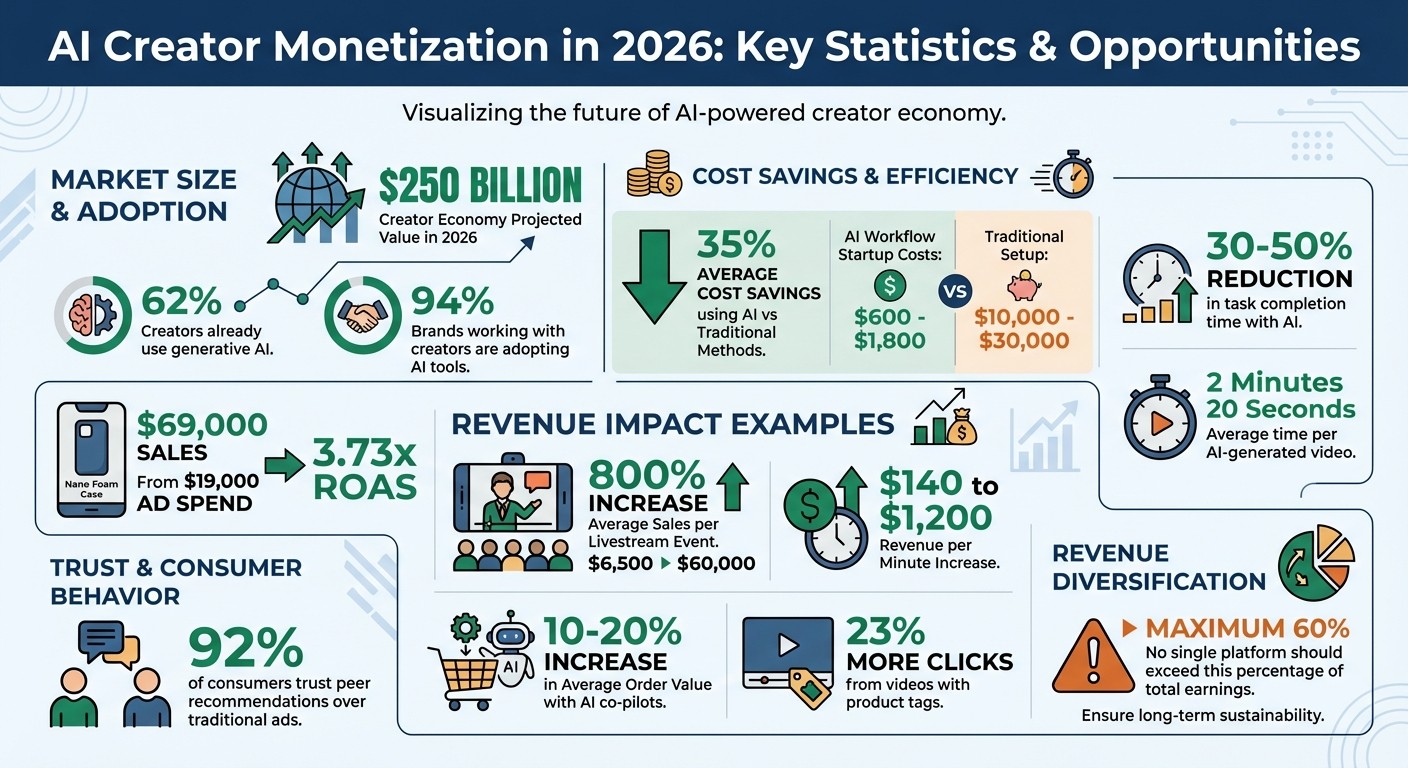
AI Creator Monetization Statistics and Revenue Opportunities 2026
Turn Audio into Profitable Content in Minutes (The 2026 Creator Playbook with Freebeat AI)
AI UGC Generation: Automating Content at Scale
User-generated content (UGC) is a powerhouse for driving sales - 92% of consumers trust peer recommendations over traditional ads. But creating enough UGC to meet demand can feel like an uphill battle. It often involves juggling multiple creators, coordinating shoots, and managing revisions, all of which slow down the process. AI is changing the game by allowing creators to produce content instantly while maintaining their unique style across numerous campaigns.
AI introduces the concept of a digital twin - a hyper-realistic avatar that mimics a creator’s facial expressions, gestures, and voice. With this, creators can record just once and generate countless variations tailored to different products, audiences, or markets, without stepping back in front of the camera. Advanced AI voice cloning tools clone their voice, while lip-syncing software ensures their avatar’s mouth movements align perfectly with new scripts in over 40 languages. This automation opens up a world of possibilities, making content creation faster and more efficient.
Core Features of AI UGC Tools
AI-powered UGC tools come packed with features designed to streamline content creation:
Batch processing lets creators produce multiple videos at once using various avatars and scripts. Meanwhile, video agents analyze the pacing and style of reference videos to generate new versions featuring product images and the creator’s likeness. On average, the process takes just 2 minutes and 20 seconds per video.
Brand asset integration ensures consistency by automatically adding logos, color schemes, and custom backgrounds to every video. Creators can script in a conversational tone, pulling language from real customer reviews and social media feedback. Features like expressive gestures and "Product in Hand" capabilities make avatars more engaging, allowing them to hold or interact with products on screen.
Multilingual support enables creators to launch localized campaigns globally, with native voices and flawless lip-syncing in over 40 languages. This feature makes it easy to tap into international markets from a single platform.
How AI UGC Creates New Revenue Streams
AI-driven tools don’t just simplify content creation - they also open doors to fresh revenue opportunities. For example, creators can offer custom fan requests, such as personalized video shoutouts, birthday messages, or themed photo sets —a process made possible by how AI personalizes content for fans, without needing to film each one individually. They can also create digital asset bundles - collections of their avatar in various settings and styles - which can be sold as stock content for passive income.
Brands benefit too. AI allows creators to deliver entire series of branded visuals efficiently. In May 2025, Jordan Welch, a DTC brand owner, used AI-generated ads featuring green screen avatars layered over B-roll footage to combat ad fatigue. Similarly, Eileen Lee, Senior Marketing Manager at Nano Foam, managed $19,000 in ad spend using AI UGC tools, resulting in $69,000 in sales and a 3.73x ROAS.
The cost savings are hard to ignore. Traditional content creation often requires $10,000 to $30,000 for equipment, software, and studio setups. In contrast, AI-powered workflows can start at just $600 to $1,800, with monthly subscriptions ranging from $50 to $220. Businesses using AI for content creation report an average 35% cost savings compared to traditional methods.
TwinTone Pricing Plans

TwinTone offers tiered pricing plans to cater to creators at every level of experience and scale:
Plan Tier | Monthly Price | Key Features Included | Target Audience |
|---|---|---|---|
Starter | $110 | 10 AI UGC videos, real creator avatars, multilingual support (40+ languages), up to 60-second deliverables | Emerging creators exploring AI UGC |
Pro | $220 | 20 AI UGC videos, expressive creator gestures, enhanced voice options, multilingual variations | Professional creators scaling campaigns |
Enterprise | Custom | 50+ videos, premium creator support, API integration, custom digital twin creation, AI livestreaming access, dedicated account support, brand-specific training | High-volume creators and media agencies |
The Starter plan at $110/month is ideal for creators testing the waters with AI UGC, offering enough capacity to experiment with brand collaborations without a hefty upfront cost. For those scaling up, the Pro plan at $220/month doubles the video output and adds advanced features like expressive gestures and enhanced voice options, making avatars even more lifelike. The Enterprise plan is tailored for agencies and high-volume creators, providing API access for large-scale, programmatic content generation.
By automating up to 30% of repetitive tasks, creators can focus on the creative aspects that build trust and engagement, maximizing their return on investment.
"Creators move beyond branded content deals and begin monetizing their identity itself."
Lyle Stevens, Chief Strategy Officer at Later
AI Livestreaming and Live Shopping: 24/7 Revenue Generation
Livestreaming has always been a powerful tool for creators, but it's typically limited to just a few hours a day. Thanks to AI, that limitation is disappearing. With the help of digital twins, livestreams can now run around the clock in over 40 languages. This creates a revenue stream that works even when creators are busy sleeping, traveling, or tackling other projects.
24/7 Livestreaming with AI Twins
AI Twins are digital avatars that can host livestreams autonomously. These avatars replicate the creator’s voice and appearance, delivering product demonstrations, answering questions, and guiding purchases - all without the creator needing to be present. This technology transforms audiences into active buyers by offering personalized, scalable interactions at any time of day or night.
One standout feature is dual-format streaming, which broadcasts in both horizontal and vertical formats. This approach not only boosts engagement and membership but also increases visibility through platforms like Shorts. AI-generated highlight clips capture key moments, such as product launches or spikes in viewer interaction, and turn them into separate pieces of content that drive traffic back to the main livestream.
"A live event is no longer a single deliverable. It's raw material for Shorts, highlight reels, and commerce placements that compound reach."
Influencer Marketing Hub
AI Twins are reshaping how live content is delivered, offering continuous engagement that feels personal and dynamic.
Connecting AI Livestreams to E-Commerce Platforms
TwinTone takes things a step further by seamlessly integrating with platforms like TikTok, Shopify, Amazon, and YouTube. Through API synchronization, it enables real-time order updates, inventory tracking, and a smooth in-app shopping experience. This streamlined process keeps users engaged within the platform, reducing friction and improving checkout accuracy.
Videos with product tags drive 23% more clicks compared to those relying solely on description links, making this integration a game-changer. Creators can also deploy AI co-pilots, which act as virtual shopping assistants trained on product catalogs and customer reviews. These assistants handle FAQs, address customer concerns, and suggest product bundles in real time, often leading to a 10–20% increase in Average Order Value (AOV) and a 15% rise in assisted checkouts.
For creators looking to expand their reach, TwinTone supports a multi-account strategy. This allows up to four marketing accounts to connect to a single shop, enabling creators to target different audiences with user-generated content (UGC)-style campaigns. When running Live Shopping Ads, setting the optimization goal to "Gross Revenue" rather than views ensures a higher ROI.
With these tools in place, creators can not only streamline their e-commerce operations but also track how their efforts directly impact revenue.
Measuring Performance and ROI
TwinTone’s analytics tools focus on the metrics that matter most for AI-powered live shopping. One standout metric is revenue by the minute, which shows the immediate financial impact of each stream. For example, in 2022, a U.S.-based seller using AI-enhanced livestreaming saw their average sales per event jump from $6,500 to nearly $60,000 - an 800% increase - after incorporating a content creator as the host. This shift also led to a 240% boost in viewership, a 450% increase in total orders, and a rise in revenue per minute from $140 to $1,200.
Other key performance indicators include:
Completion rates of over 70%.
Click-through rates for Shorts ranging between 2.8–4.2%.
Purchase conversions per click falling between 0.8–1.4%.
The platform also tracks chat velocity to conversion, which measures how many messages lead to a sale, and edge latency to ensure features like live chat remain responsive.
"The ROI equation shifts: the stream itself drives real-time engagement, while AI highlights extend discovery into Shorts, and long-form replays build watch hours."
Influencer Marketing Hub
To maintain a balanced revenue stream, creators should monitor their engagement-to-earnings ratio, focusing on how much revenue each engaged viewer generates rather than just follower count. Diversifying income sources is also crucial - no single platform or revenue channel should account for more than 60% of total earnings to safeguard against algorithm changes.
Hybrid Pricing Models: Combining Subscriptions and Usage-Based Fees
By 2026, creators are expected to embrace hybrid pricing models that combine a base subscription with usage-based fees. This approach ensures steady revenue while scaling with customer demand.
Hybrid pricing strikes a balance by pairing predictable subscription income with flexible consumption charges. This setup avoids undercharging heavy users or overcharging light users. For example, a creator might charge $50 per month as a base fee, with an additional $0.10 per video beyond the first 100. Tools like credit bundles, usage tiers, and alerts help align costs with actual usage.
"The solution isn't a single metric or pricing model, but rather a strategy that links technical capability to measurable business results."
One key challenge is the "AI margin trap", where rising compute costs grow alongside revenue. To address this, creators now review and adjust pricing tiers quarterly, using real-time data to stay competitive. Interestingly, only 58% of companies offering AI features have successfully figured out how to monetize them.
This balance between fixed fees and variable charges naturally leads to a comparison of the strengths and weaknesses of different pricing models.
Subscription vs. Usage-Based Pricing
Pricing Model | Advantages | Disadvantages |
|---|---|---|
Flat Subscription | Delivers predictable revenue and easy forecasting | Risks undercharging heavy users or overcharging light ones |
Usage-Based | Aligns charges with actual consumption | Can lead to unpredictable invoices and potential "bill shock" |
Hybrid Model | Combines stable income with scalability | Requires advanced systems for billing and usage tracking |
To protect users from unexpected costs, platforms often include usage caps or send alerts when customers approach their limits. A newer alternative, outcome-based pricing, ties charges to specific results - like successful conversions or leads - rather than raw usage metrics.
Custom Enterprise Plans for High-Volume Creators
For high-volume creators, hybrid pricing evolves into custom enterprise plans, offering even more tailored solutions for scalability and revenue stability.
Take TwinTone’s enterprise solutions, for example. These plans include tailored contracts with features like API access and pricing structures designed to scale predictably. Often negotiated directly, these contracts might include prepaid credit bundles and manual overrides to accommodate strategic partnerships or long-term collaborations.
Enterprise buyers - typically CFOs or COOs - value performance, cost efficiency, and predictable scalability. High-volume creators using these plans can often charge 40–50% more than standard rates. Furthermore, well-calibrated AI models can increase business revenue by 5–8% while boosting customer satisfaction by 15–20%.
Licensing AI-Generated Content: New Income Opportunities
The way creators earn money is evolving. Instead of relying on one-time deals, many are now licensing their identity for ongoing AI use. This approach turns their content into a steady stream of income. By licensing their "AI twin", creators allow brands to produce content modeled on their likeness across multiple campaigns.
The stats are eye-opening: 62% of creators expect to use generative AI for their business by 2026, while 94% of brands collaborating with creators are already using or plan to use generative AI. This shift opens the door to licensing agreements that provide recurring payments rather than a single payout. For instance, a 30-day ad license can range from $150 to $500, while whitelisting (letting brands run ads through your social media handle) typically brings in $100 to $400 per month.
"Many creators don't even know there are avenues today to potentially license their data."
Naeem Talukdar, Cofounder and CEO, Moonvalley
Unused content, like raw footage, can also become a revenue source. AI developers need high-quality video to train their models, and licensing 4K or higher "B-roll" content can earn creators $1 to $6 per minute. To qualify, developers often require at least 1,000 hours of footage from a single creator. This approach transforms archived material into passive income, with automated distribution methods making it easier to scale.
API Integration for Content Licensing
APIs are making content licensing more efficient. TwinTone's API, for example, allows creators to license their AI-generated content to multiple brands simultaneously without the hassle of managing individual agreements. This automation enables a single piece of content to be used across numerous campaigns, boosting revenue without increasing workload.
The API takes care of everything: authentication, content delivery, and usage tracking. Brands access licensed content through standardized API calls, while the system automatically logs usage and calculates fees based on the creator's pricing. For creators managing high volumes of content, this eliminates the need to manually track which brands are using what and when licenses expire.
Platforms like Troveo, Avail's Corpus, and Protege Media further simplify the process by automating distribution. These tools ensure that creators can focus on their work while their content generates income in the background.
Using Analytics to Improve Licensing Deals
Analytics are becoming a game-changer for licensing. Real-time data helps creators refine their deals and justify higher pricing. For example, if you can prove that your AI-generated content increases customer satisfaction by 15–20% and boosts revenue by 5–8%, brands are more likely to pay a premium. Quality engagement is becoming more valuable than follower count.
Tools like TikTok Creative Center and Meta Ad Library help creators monitor whether brands are using their content beyond the agreed licensing period. Since unauthorized usage is a frequent issue in the creator economy, catching these violations early allows creators to renegotiate terms or charge renewal fees.
Analytics also reveal which types of AI-generated content are the most profitable. For instance, if your product demo videos consistently outperform lifestyle content, you can adjust your licensing catalog to focus on what works best. Creators who use data-driven pricing strategies report earning 25–40% more per collaboration, showing that informed negotiations lead to better results.
Conclusion: Adopting AI-First Strategies for Long-Term Growth
By 2026, the creator economy, valued at $250 billion, will reward those who embrace AI-first strategies. The creators thriving in this space aren't just churning out more content - they're leveraging AI to handle repetitive tasks, freeing up their time for creative work that fosters trust and builds thriving communities.
Practical AI tools are reshaping how creators monetize their efforts. For instance, TwinTone simplifies the process by turning minimal inputs into expansive content libraries. This enables creators to generate revenue around the clock through AI-powered livestreams, license their likeness for passive income, and test multiple ad variations without the need for manual production. With AI-assisted workflows cutting task times by 30–50%, creators can focus on the kind of high-value work that truly sets them apart.
"By 2026, the most successful creators will not simply be great at making content. They will be great at building systems, communities, and businesses that compound over time."
Lyle Stevens, Chief Strategy Officer, Later
The real advantage in 2026 won't just come from using AI - it will come from using AI to amplify your unique voice, not replace it. As AI-generated content continues to flood platforms, authenticity and human qualities like taste and judgment will stand out as key differentiators. Creators who automate the routine while preserving their personal touch will earn the loyalty and attention that generic AI content simply can't achieve. These trends highlight the importance of weaving AI into your revenue strategy in a thoughtful, strategic way.
Start small - pick one AI-driven revenue stream, like automated livestreaming, on-demand UGC, or content licensing. As you grow, expand into other areas. By building sustainable systems now, you’ll set yourself up for compounding growth in both earnings and influence for years to come.
FAQs
How will AI help creators save time and boost their income by 2026?
AI is transforming the creator economy by becoming a tireless assistant, available 24/7 to streamline tasks and supercharge content creation. For instance, AI-powered "digital twins" can mimic a creator's voice, appearance, and style, making it possible to produce on-brand videos instantly - no need for filming or editing. There are even AI-driven virtual livestream hosts that can chat with fans in multiple languages, engage audiences nonstop, and handle sales, freeing creators to focus on their big-picture ideas and creative strategies.
By automating tasks like scheduling posts, responding to comments, and analyzing audience sentiment, AI helps creators maintain a consistent and personalized connection with their audience while saving precious time. It also unlocks fresh revenue opportunities, such as licensing a creator's likeness for brand use, and deepens fan engagement through emotionally aware interactions. These advancements not only simplify operations but also amplify earning potential by boosting audience engagement, driving subscriptions, and opening doors to new monetization paths.
How can AI-generated digital twins help creators grow and monetize their content?
AI-generated digital twins are changing the game for creators, making content production and fan interaction quicker and more efficient. These digital replicas mimic a creator’s tone, personality, and even visual style to churn out user-generated content (UGC) in minutes - what used to take days can now happen almost instantly. This not only speeds up production but also slashes costs significantly.
What’s more, these digital twins are always on. They’re available 24/7 to engage with fans, provide personalized responses, and stay true to the creator’s voice - even across multiple languages. They also unlock fresh revenue streams, like offering premium subscriptions or hosting AI-driven live shopping experiences. Meanwhile, creators can step back from the grind of constant content creation and focus on big-picture strategies and creative ideas.
With AI digital twins, creators can scale their content, maintain their authentic voice, connect with global audiences, and turn fan engagement into real income - all while saving time and energy.
What are the benefits of hybrid pricing models for creators using AI tools?
Hybrid pricing models blend a fixed subscription fee with usage-based charges, giving creators a more adaptable way to manage their costs. The subscription guarantees consistent access to essential AI tools, like content-generation platforms or digital assistants, while the usage-based element ensures creators only pay extra when they need additional features or increased output during busier periods. This approach helps avoid unnecessary expenses during slower times while supporting scalability during peak demand.
This setup also opens the door for creators to try out new AI-powered formats - like user-generated content or interactive livestream hosts - without committing to hefty upfront costs. Tiered bundles further enhance flexibility, allowing creators to align their spending with their audience size and specific goals. By tying costs to actual usage, this model empowers creators to optimize their earnings while staying agile in a rapidly evolving digital landscape.