
Building an AI Agent for Content Monetisation
How to build a futureproof relationship with AI
AI agents are transforming how creators and businesses generate revenue by automating complex workflows. Unlike basic tools, these agents handle tasks like audience targeting, personalized outreach, and payment processing, all without constant human input. This approach not only saves time but also increases efficiency and scalability.
Key Takeaways:
AI agents can plan, execute, and optimize monetization tasks like lead qualification, subscription management, and access control.
They integrate with platforms (e.g., payment processors, social media, CRMs) to execute actions in real time.
Businesses using outcome-based pricing (e.g., charging per lead or sale) report revenue growth of 12–40% annually.
AI agents cost 20–30% less than human labor and can achieve gross margins of 70–85%.
Features like reasoning, memory, and API connectivity allow these agents to handle multi-step workflows efficiently.
To succeed, start with clear goals, measurable KPIs, and audience analysis. Use tools like OpenAI’s frameworks or Apify for building workflows, and ensure safety features like PII filters and human oversight for critical actions. With the creator economy projected to hit $480 billion by 2027, leveraging AI agents can significantly boost revenue streams. This shift is also redefining creator-fan interactions through automated personalization and new engagement models.
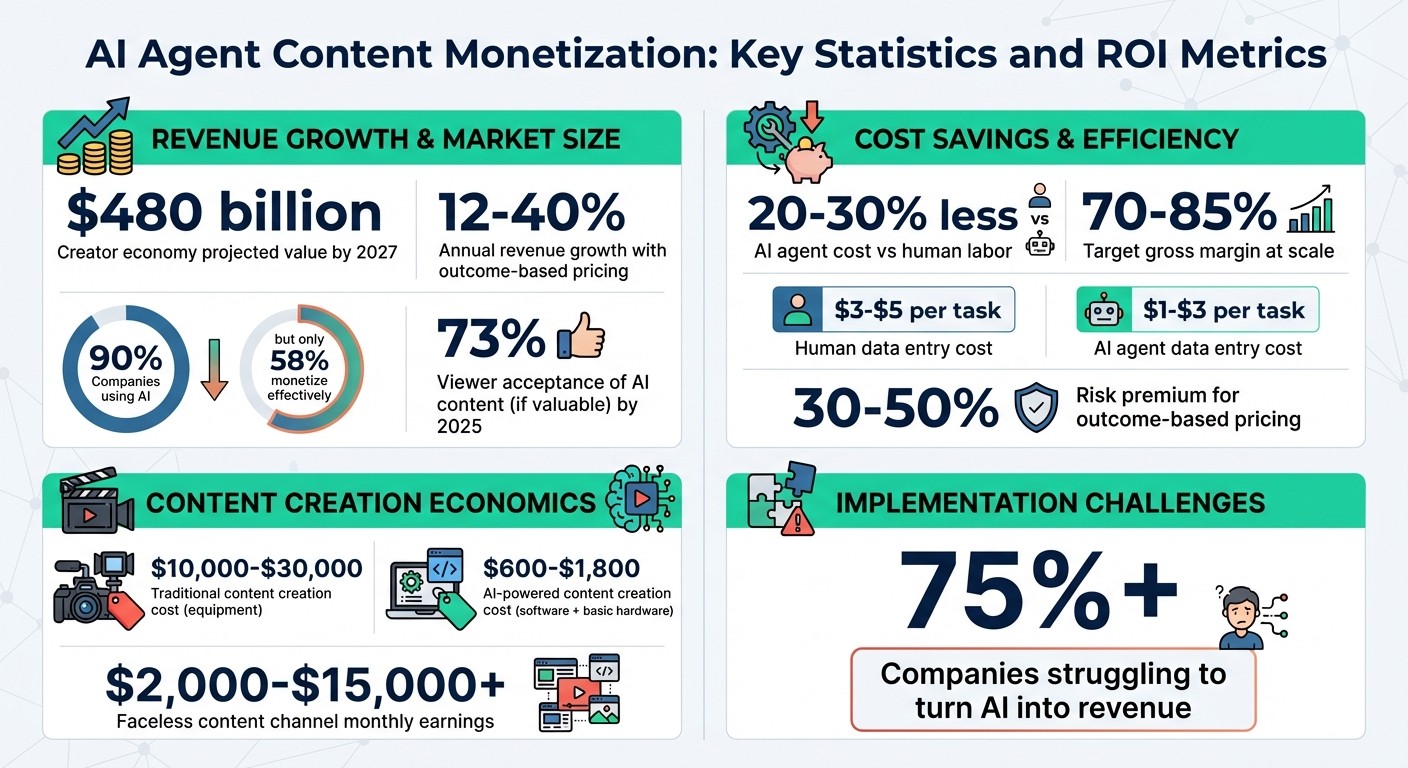
AI Agent Content Monetization: Key Statistics and ROI Metrics
How to Build & Sell AI Agents: Ultimate Beginner’s Guide
Planning Your AI Agent: What to Consider
Before diving into coding, take the time to plan thoroughly. Studies show that more than 75% of companies struggle to turn AI tools into dependable revenue streams. Often, this happens because they rush into implementation without laying the groundwork. The key to creating a profitable AI agent instead of an expensive misstep lies in three critical areas: defining measurable goals, understanding your audience, and choosing the right features. These steps form the backbone of a smooth implementation process.
Setting Monetization Goals and KPIs
Start by identifying the budget your AI agent will target. This helps establish how you'll demonstrate its value. For example, headcount budgets are typically larger than software budgets, making automation a compelling cost-saving alternative to hiring. If your AI agent manages tasks like customer support or lead qualification, position it as a way to reduce expenses. Similarly, automating tasks tied to outsourcing budgets or using ROI-driven budgets for revenue-generating activities - such as recovering abandoned carts or booking sales meetings - can make a strong case for its value.
Next, define your value metric, the unit used to measure success and price outcomes. This metric should be observable, attributable, valuable, and predictable. Instead of pricing based on API calls or tokens, consider charging per lead qualified, per ticket resolved, or per meeting booked. For instance, while human-led data entry might cost $3–$5 per task, an AI agent can do the same for $1–$3, often faster and more efficiently.
"Value is often at the workflow or outcome level, not message or token." - Monetizely
To ensure your AI agent performs effectively, establish a performance baseline using the most advanced models available. This will serve as your accuracy benchmark before optimizing for cost and speed. Monitor the average cost per unit of value, including LLM and infrastructure expenses, and aim for a gross margin of 70% to 85% at scale. If you're adopting outcome-based pricing, include a risk premium of 30% to 50% to cover performance-based billing risks.
Analyzing Your Audience and Content Types
Your AI agent should align with your brand and connect with your audience. Start by defining 3–5 content pillars - core themes that give your agent a consistent identity. For instance, a fitness creator might focus on topics like workouts, nutrition, recovery, mindset, and product reviews.
Conduct a gap analysis to identify areas where your competitors fall short. For example, in the education sector, if beginner-level questions are often overlooked, your agent could stand out by offering personalized onboarding or introductory tutorials.
Platform-specific strategies are also crucial. YouTube is ideal for long-form, evergreen content like detailed explainers, while TikTok thrives on short, attention-grabbing hooks. Instagram, on the other hand, favors visually appealing, brand-focused content. Your AI agent can tailor its monetization strategies to each platform's strengths, such as directing users to appropriate revenue channels.
If you're targeting a global audience, multilingual support is a must. AI agents that communicate in over 30 languages can help creators reach a wider audience while easing the workload. For example, faceless content channels in established markets can earn between $2,000 and $15,000+ monthly through diverse monetization strategies. Additionally, by 2025, 73% of viewers are expected to prioritize value over how content is created, making AI-powered content an accepted norm.
Choosing the Right AI Features
The features you choose will shape what your AI agent can do. For complex tasks like refund approvals, fraud detection, or personalized sales interactions, reasoning and decision-making capabilities are essential. Advanced models use "chain of thought" reasoning to tackle multi-step problems. For simpler tasks, like answering basic customer questions, non-reasoning models offer a cost-effective and faster option.
Action tools are another critical feature. These enable your AI agent to execute tasks like updating CRMs, sending messages, or processing purchase orders directly within workflows. For instance, an AI agent designed to recover abandoned carts might need API access to email platforms, payment processors, and inventory systems. Many modern AI platforms now include built-in tools for tasks like document retrieval, data analysis, and real-time updates.
Checkout integration is becoming a must-have for monetization agents. Features like "Instant Checkout" allow users to complete purchases directly within the AI interface using payment providers like Stripe, Adyen, or PayPal. This streamlined process helps maintain user engagement and can significantly improve conversion rates.
Safety features are equally important to protect your brand. Use PII filters to prevent sensitive data from being exposed, and apply safety and relevance classifiers to block inappropriate prompts and keep interactions focused. For high-risk actions, implement triggers that require human approval.
For fan engagement, consider features like multimodal interaction - combining video, voice, and text - and emotional intelligence. AI Digital Twins that respond with empathy and nuance can operate around the clock, reducing burnout for creators while maintaining a personal touch.
"Agents are systems that independently accomplish tasks on your behalf." - OpenAI
The features you prioritize should align with your goals. If your focus is productivity, emphasize task automation and structured outputs. For revenue generation, prioritize capabilities like checkout integration, personalized recommendations, and tracking outcomes. A well-planned approach to feature selection can boost revenue by 12% to 40% annually.
Building the AI Agent: Tools and Implementation
Once you've outlined your goals and features, it's time to build your revenue-generating AI agent. The tools and frameworks you choose here can determine whether your idea becomes a simple prototype or a fully functioning system that drives revenue. This stage involves selecting the right technical foundation, designing automated workflows, and ensuring your agent integrates seamlessly with platforms your audience already uses. Essentially, this step bridges your strategic planning with the actionable development process.
Selecting an AI Platform and Framework
Your AI agent needs three core components: a framework for managing agents, an intelligence layer for decision-making, and a reliable execution system. Frameworks like CrewAI, OpenAI Agents SDK (available in Python and TypeScript), and AgentKit are excellent for creating multi-agent systems. These frameworks let you assign specialized agents to specific tasks, such as personalized recommendations or checkout management.
The intelligence layer is what powers your agent's reasoning and responsiveness. For tasks requiring advanced planning and multi-tool workflows - like personalized sales strategies - models such as OpenAI's o1 or o3-mini are ideal. On the other hand, for simpler tasks like answering FAQs or handling basic requests, faster models like gpt-5-mini can reduce costs and latency.
"An AI system that has instructions (what it should do), guardrails (what it should not do), and access to tools (what it can do) to take action on the user's behalf" - OpenAI
For execution, serverless platforms like Apify allow agents to run as "Actors", offering scalability and built-in monetization options. Apify's Pay-Per-Event (PPE) model lets you charge users for specific outcomes, such as $0.10 for an "Actor start" or $0.40 for a "task-completed" event. This approach aligns your costs with the value provided, helping you maintain healthy profit margins.
Another option, TwinTone, simplifies social commerce automation by combining AI Twins, on-demand UGC generation, and shoppable livestream integration. It provides API access for generating programmatic content across campaigns and SKUs, along with real-time analytics to track engagement and conversions through AI feedback loops. This eliminates the need to build custom infrastructure for creator-fan interactions and checkout processes.
To ensure safety and reliability, implement layered guardrails. Use tools like relevance classifiers, PII filters, and safety classifiers to block harmful prompts and maintain brand safety. For sensitive actions, such as approving refunds or large purchases, set up triggers that require human approval.
Creating Monetization Workflows
Monetization workflows are essentially measurable tasks that generate revenue. Start by tying each workflow to a unit of value - this could be a completed task (like a lead qualified), a workflow (such as launching a campaign), or a specific outcome (like revenue generated). This clarity not only helps you price your agent's services but also demonstrates ROI effectively.
For managing complex workflows, use a manager pattern. A central "manager agent" can oversee sub-agents, delegating tasks like trend analysis to a "Research Agent", content creation to a "Content Agent", and checkout management to a "Sales Agent." This structure prevents overlap when your agent handles multiple functions.
To capture revenue efficiently, implement event-based charging. For instance, when your agent completes a task - like generating a product video, recovering an abandoned cart, or booking a sales meeting - trigger a charge immediately. Companies that use systematic pricing for AI services have reported annual revenue growth of 12% to 40%.
For direct transactions, integrate financial tools. The Stripe Agent Toolkit, for example, allows your agent to create payment links, manage product catalogs, and handle usage-based billing events dynamically. For most ChatGPT-like applications, an external checkout system is recommended, where users are redirected to a merchant-hosted domain for secure payments, tax handling, and compliance. This approach gives you control over the user experience while limiting liabilities.
Keep a close eye on your gross margin. Monitor your average cost per unit of value - including expenses for LLMs and infrastructure - and aim for margins between 70% and 85% at scale. If you're using outcome-based pricing (e.g., charging a percentage of revenue generated), include a risk premium of 30% to 50% to account for performance-based billing risks.
These workflows can then integrate with your existing platforms to drive revenue effectively.
Connecting with Existing Platforms
Once your workflows and tools are defined, the next step is connecting your agent to the platforms where your audience interacts. Your agent must access the platforms where your content lives and where your audience shops. This requires defining tool access - APIs or external functions that allow your agent to pull data, update records, and trigger actions across systems like CRMs, social media platforms, and ecommerce stores.
For social commerce, use the Agentic Commerce Protocol (ACP). Merchants can share a product feed, build an Agentic Checkout API with REST endpoints, and set up webhooks for order events. This lets your agent handle product discovery and checkout directly within conversations, avoiding the need to redirect users. Secure payment handling can be achieved by integrating with providers like Stripe, Adyen, or PayPal using Delegated Payment specifications.
Platform-specific integrations open up new revenue streams. For instance, serverless cloud programs like Apify Actors can run scrapers and data processors that interact with web content. An Instagram Scraper Actor could identify trending posts and suggest shoppable content ideas, while a Shopify integration could sync inventory and process orders in real time.
Security is critical. Use allowlisted IP addresses and enforce TLS 1.2+ on port 443. Prevent duplicate charges caused by network issues by implementing idempotency keys. Webhooks with HMAC signatures can keep your agent synchronized with backend systems - events like order_created and order_updated ensure your agent always has the latest transaction data.
Start with built-in tools before creating custom logic. Many platforms offer ready-made capabilities, such as web search, file search for retrieval-augmented generation (RAG), and image generation. These tools simplify development, allowing you to focus on the monetization logic that sets your agent apart.
Improving Performance and ROI
After deploying your AI agent, the work doesn’t stop. Regular monitoring is critical to ensure it performs efficiently while keeping costs in check. This section dives into how you can track meaningful metrics, refine your processes, and scale your monetization strategies effectively.
Tracking Data and Metrics in Real Time
To keep your operations running smoothly, real-time tracking is key. Use tracing and logging to monitor tool usage, identify triggered guardrails, and spot any stalled workflows. Focus on metrics that truly matter - such as leads qualified, campaigns launched, or revenue generated - rather than superficial ones. For example, if you’re charging $1.50 per resolved support ticket but spending $1.20 per ticket, you’ll need to optimize fast to avoid shrinking margins.
One way to stay efficient is by using smaller, faster models for routine tasks. You can also tighten guardrails to block off-topic queries that waste tokens. For high-stakes actions, like authorizing large refunds or retrying payments multiple times, set up human-in-the-loop triggers to ensure proper oversight.
Testing and Refining Your AI Agent
Testing isn’t a one-and-done process - it’s ongoing and essential for profitability. Start by creating evaluation datasets with at least 30 cases per agent, covering everything from success scenarios to edge cases and failures. Dive into trace logs to understand how your agent makes decisions, from choosing tools to handling vague requests. This level of analysis can reveal inefficiencies like unnecessary API calls or redundant steps that drive up costs.
The size of your model also plays a big role in ROI. Begin testing with flagship models like GPT-5 or o1 to establish performance benchmarks. Once you hit accuracy goals, switch to smaller, faster models like GPT-5-mini for everyday tasks. Structured outputs - like responses formatted in strict JSON schemas - help avoid billing errors or glitches in workflows like CRM updates or order processing. To test your monetization flows, use sandbox environments and mock payment cards (e.g., the 4242 test card) to ensure everything from taxes to checkout logic works without risking real funds.
"It's not the prompts that break. It's everything around them. Error handling, context management, tool contracts, traceability." - Alina Capota, Senior Manager, Forward Deployed Engineering, UiPath
Keep a close eye on regression metrics, and don’t release updates unless performance thresholds are met. If accuracy drops after an update, roll back quickly. A/B testing can also help you fine-tune prompts, models, or workflows. By comparing conversion rates or revenue per session, you’ll identify what works best for your goals.
Once your testing is fine-tuned, you’ll be ready to expand and explore new revenue streams.
Expanding Your Monetization Efforts
With your agent performing well, it’s time to scale up and diversify your revenue. Look into opportunities like affiliate marketing, brand sponsorships, digital product sales, or even offering "Content as a Service" to business clients. The creator economy, projected to hit $480 billion by 2027, is increasingly embracing AI-powered content creators.
Repurposing content across platforms can help you reach broader audiences without extra effort. For example, break down a long-form video into bite-sized clips for TikTok, Instagram Reels, Pinterest, and LinkedIn to engage different demographics. Use AI to brainstorm 30–50 content ideas in a single session, ensuring you maintain a consistent upload schedule that platforms favor.
As you scale, consider outcome-based pricing models. Instead of flat fees, charge for specific results - like leads qualified or meetings booked - to align costs with delivered value. Hybrid pricing models, combining a base fee with usage-based overages, can also help cover fluctuating compute costs while maintaining predictable revenue streams.
Focus on producing high-value content in niche areas like education, storytelling, or industry insights. This approach not only sets you apart but also aligns with audience preferences - 73% of viewers are fine with AI-generated content as long as it’s useful. Implement relevance and safety classifiers to keep interactions on-brand and avoid reputational risks.
To protect your margins, set usage caps and alerts for customers. Options like prepaid credit bundles or automated notifications when thresholds are reached can prevent unexpected charges. Review your pricing model quarterly to adapt to changes in compute costs. While nearly 9 in 10 companies now use AI in some capacity, only 58% have figured out how to monetize it effectively. The difference between success and failure lies in systematic tracking and continuous improvement.
Conclusion: Using AI to Increase Content Revenue
Using an AI agent can turn your content into a powerful revenue engine. While this idea has been touched on earlier, the real shift happens when you start seeing your AI as a tool for driving income, not just cutting costs.
Main Steps for Building an AI Agent
First, pinpoint a clear monetization hurdle, like lead qualification or chasing overdue payments. Define your value metric upfront - will you charge based on tasks completed, automated workflows, or outcomes achieved? Start simple with one agent and scale up as needed. Many begin this way before moving to more advanced setups.
To protect your brand, implement safeguards like relevance classifiers and safety filters, and include human oversight for critical actions - think approving large refunds or retrying failed payments. From day one, make billing a key feature by tracking real-time usage and costs. This ensures that higher activity directly boosts your bottom line.
Keep an eye on your cost per unit of value to maintain a healthy 70–85% gross margin. As AI costs and capabilities evolve, regularly revisit your pricing model to stay competitive. The combination of strategic planning and ongoing refinement is what drives success in these workflows.
With these steps in place, it’s time to look at how AI will continue shaping the creator economy.
What's Next for AI in the Creator Economy
Once your AI is up and running, the next step is scaling your revenue streams. The creator economy is expected to hit $480 billion by 2027, with AI playing a critical role in this growth. As the costs of large language models (LLMs) drop by 10 to 100 times, the focus will shift from "cheaper than human" to "far more capable than human". Future AI agents won’t just answer questions - they’ll plan, execute, and drive revenue autonomously.
"As AI costs approach zero, outcome-based pricing maintains margins by focusing on value delivered, not resources consumed." - Paid.ai
Forward-thinking creators will adopt outcome-based pricing, charging for results like booked meetings or recovered revenue instead of just usage. Additionally, multi-agent orchestration - where specialized AI agents handle tasks such as brainstorming, fact-checking, and execution - will become the norm. With the cost of professional content creation dropping from $10,000–$30,000 for traditional equipment to just $600–$1,800 for AI software and basic hardware, the big question is: are you ready to harness the revenue potential AI offers for content monetization?
FAQs
How do AI agents help creators monetize their content?
AI agents are transforming the way creators monetize their content by taking over repetitive tasks and boosting audience engagement. They can handle things like scheduling posts, managing messages, and distributing content, giving creators more time to focus on crafting top-notch material. On top of that, AI tools offer real-time analytics and support communication in multiple languages, making it easier for creators to reach audiences worldwide and fine-tune their monetization approaches.
With AI-powered interactions, creators can deepen their relationships with fans through features like video calls, live streams, and personalized messages. These connections not only strengthen loyalty but also unlock new income streams, such as subscriptions, exclusive content, and merchandise sales. Plus, AI agents allow creators to maintain a steady presence by scaling engagement - even when they’re not available around the clock. This ability to streamline and enhance engagement makes AI an essential asset for maximizing revenue in the digital content world.
What key features should I include when creating an AI agent for content monetization?
When designing an AI agent for content monetization, it's essential to prioritize automation, personalization, and analytics to maximize efficiency and revenue potential.
The agent should handle repetitive tasks like content creation, audience engagement, and tracking revenue streams. This not only saves time but also ensures a smoother workflow. Adding personalization features - like emotional intelligence and real-time interactions - can help deepen audience connections, opening doors to fresh monetization possibilities.
Analytics tools are another key component. They give insights into audience behavior, helping you fine-tune content strategies, offer tailored recommendations, or even implement dynamic pricing models to boost income.
Lastly, make sure the AI agent is built to scale while maintaining high levels of security and compliance with platform policies. This includes adding strong safety protocols and dependable billing systems to avoid errors and support sustainable growth.
What are the advantages of using outcome-based pricing with AI agents?
Outcome-based pricing lets businesses pay only for the actual results delivered by AI agents. This means companies invest in measurable success, reducing financial risk while encouraging the AI to perform at its best.
By tying costs directly to tangible outcomes, businesses can get more value for their money and build a results-focused relationship with AI solutions.