How Brands Are Using AI Twins to Scale Influencer Marketing
How to build a futureproof relationship with AI
AI twins, digital replicas of real-life influencers, are transforming influencer marketing by enabling brands to produce content faster, at lower costs, and on a global scale. These AI-powered doubles replicate a creator’s likeness, voice, and style, allowing for 24/7 content creation without the need for physical presence. Major brands like Nestlé, H&M, and Shapermint have already seen impressive results, including:
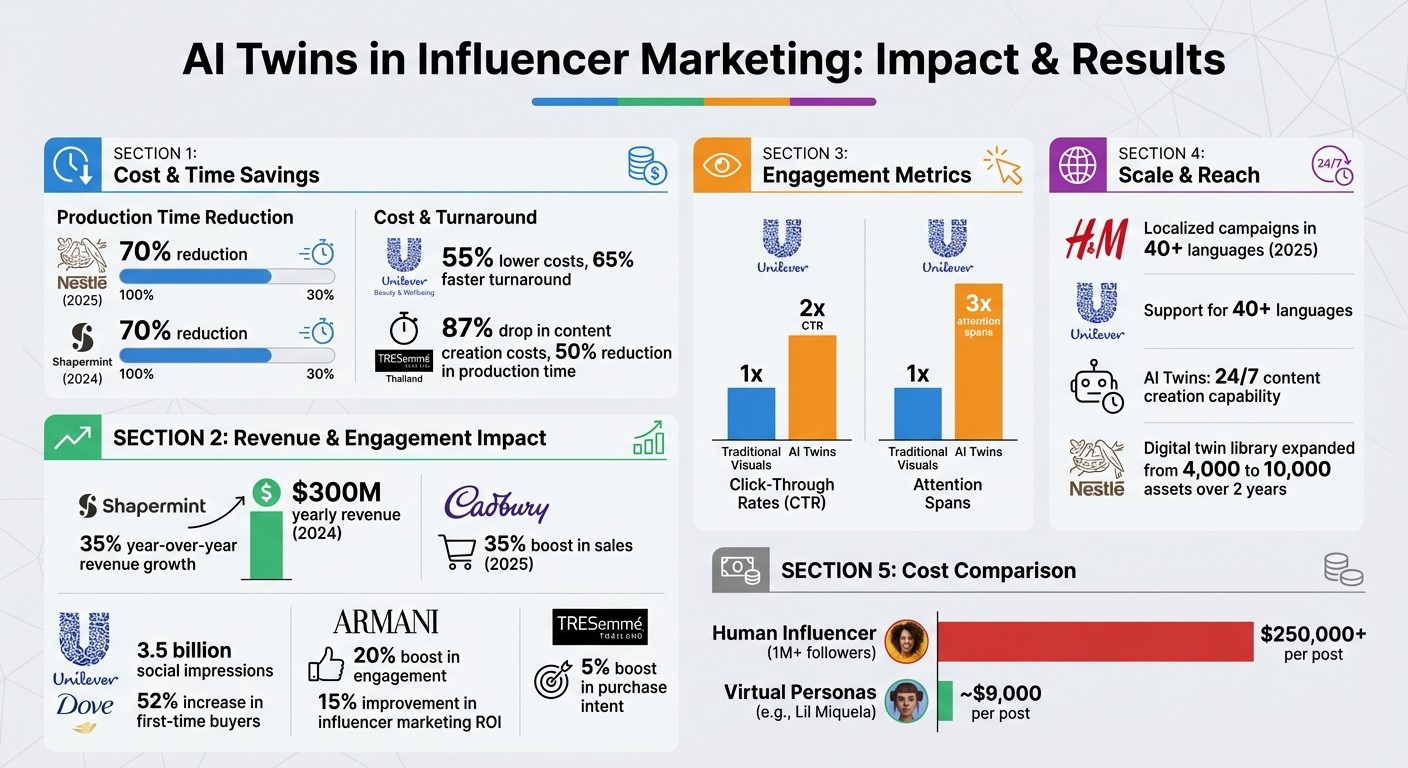
70% reduction in production time and costs (Nestlé, 2025).
35% year-over-year revenue growth (Shapermint, 2024).
Localized campaigns in 40+ languages (H&M, 2025).
AI twins maintain trust by tying digital replicas to real creators, who retain ownership and are compensated for their likeness. They’re used for user-generated content, e-commerce visuals, and live shopping, offering a scalable, efficient solution for modern marketing needs. However, ethical practices, transparency, and creator consent remain key to ensuring their responsible use.
AI Twins in Influencer Marketing: Key Statistics and Benefits
What Are AI Twins and How Do They Work?
What AI Twins Are
AI twins are digital doubles of real-life creators, models, or celebrities. Unlike virtual influencers created entirely from scratch, AI twins are rooted in the identity of an actual person. They’re designed to mirror an individual’s tone, behavior, and appearance. What sets them apart is their connection to a real person’s established image and reputation.
This technology allows brands to produce content at scale without needing the creator to be physically present for every project. AI twins can appear in various languages, wear different outfits, and exist in diverse settings - all while the original creator retains control over their likeness and earns compensation.
Technologies Behind AI Twins
The realism of AI twins is made possible by cutting-edge technologies. Their creation involves digital scanning, motion capture, and facial mapping. These techniques, combined with generative AI, machine learning, and 3D rendering, produce lifelike digital versions that often feel indistinguishable from real footage. Platforms like NVIDIA Omniverse handle 3D simulations, while generative AI models analyze a creator’s past movements and behaviors to ensure the digital twin acts naturally.
Machine learning is essential for fine-tuning these digital replicas. AI twins are trained using thousands of past social media interactions, documented behaviors, and other measurable data to recreate a creator’s unique voice and interaction style. For example, in September 2025, Nike launched its "Never Done Evolving" campaign featuring a digital twin of Serena Williams. By analyzing Williams' movements and behavior from her past matches, Nike used machine learning to create a virtual match where the tennis star faced off against her younger self.
AI Twins vs. AI-Generated Personas
The distinction between AI twins and fully synthetic personas lies in their authenticity. AI twins are digital replicas of real people with established audiences and reputations. On the other hand, AI-generated personas - like Lil Miquela or Aitana López - are entirely fictional characters created without any real-world human counterpart.
This difference is particularly important in influencer marketing. A human influencer with over a million followers might charge $250,000 or more per post, while top-tier virtual personas like Lil Miquela charge closer to $9,000. However, AI twins offer something synthetic personas cannot: the trust and connection that comes from being tied to a real person. As model Vanessa Moody explained:
"It's not here to replace everyone. It's here to be combined with what we're already doing".
Benefits of Using AI Twins for Influencer Marketing
Lower Content Production Costs
AI twins are shaking up influencer marketing by drastically cutting down content production costs. They eliminate major expenses like travel, lodging, and studio rentals, allowing brands to create high-quality digital content from a single master file.
Take Nestlé, for example. In July 2025, the company launched an in-house service powered by NVIDIA Omniverse to produce 3D virtual replicas of products for brands like Purina and Nespresso. Under David Rennie, Head of Strategic Business Units, this initiative cut content scaling costs and time by 70%. Over two years, Nestlé expanded its digital twin library from 4,000 to 10,000 assets, proving how AI twins can help brands scale efficiently.
The savings don’t stop there. Between March and July 2025, creator Katie Cross generated six-figure revenue in just 115 days using her AI twin for content and licensing. Her digital twin allowed her to extend her reach without increasing her physical workload, creating a passive income stream for her while giving brands access to her likeness at a fraction of traditional influencer costs. This kind of cost efficiency makes scaling campaigns easier and more practical.
Scalability and Consistency
One of the biggest challenges in traditional influencer campaigns is coordinating schedules, managing logistics, and ensuring consistent messaging. AI twins solve these issues by operating 24/7, seamlessly creating content across time zones without delays.
A great example is Shapermint, a DTC fashion brand, which introduced an AI tool called "Altair" in July 2024. Altair was designed to generate scripts and storyboards for nearly 1,000 creators. By connecting to the Meta ad library, a single staff member could plan 15 campaigns - totaling 60 to 90 videos - in less than a day. Previously, that same task would have taken an entire week.
AI twins also ensure consistent messaging and visual identity across thousands of assets, something that’s nearly impossible to achieve with a large group of human influencers. David Rennie from Nestlé highlighted this advantage:
"Our new content organization means we can do more with the talented teams we have, leveraging their skills to produce high-quality, consistent, scalable content supported by AI digital assistants and digital twin technologies."
Faster Campaign Launches
Speed is another game-changer when it comes to AI twins. Brands can test creative ideas instantly and update visuals for different seasons or markets using a single digital master file. What used to take weeks or even months can now be done in just hours or days.
In September 2025, Cadbury demonstrated this with an AI-generated digital twin of Bollywood star Shah Rukh Khan. Using geotargeting, Cadbury’s twin promoted local businesses in real-time, leading to a 35% boost in sales.
Similarly, H&M leveraged AI digital twins to roll out localized imagery quickly across multiple cities while ensuring models’ digital rights were protected. These faster campaign launches give brands a competitive edge in today’s fast-paced market.
How Brands Are Using AI Twins
Companies across various industries are tapping into the potential of AI twins to run campaigns that deliver measurable results on a large scale. From creating user-generated content (UGC) to hosting live shopping events around the clock, these digital replicas are reshaping how brands connect with their audiences.
Here’s a closer look at how AI twins are making an impact in different marketing strategies.
AI Twins in UGC Campaigns
Unilever has been leading the charge in using AI twins to expand its influencer marketing efforts. For example, in March 2025, TRESemmé Thailand launched a campaign powered by NVIDIA Omniverse. The results were impressive: an 87% drop in content creation costs, production times cut in half compared to traditional methods, and a 5% boost in purchase intent.
Looking ahead, Unilever plans to scale its influencer marketing by 10 to 20 times within the year, growing from tens of thousands to hundreds of thousands of creators. Esi Eggleston Bracey, Unilever's Chief Growth and Marketing Officer, highlighted the benefits of AI twins:
"Our product twins can be deployed everywhere and anywhere, accurately and consistently so content is generated faster and on brand. We call it creativity at the speed of life!"
In Unilever’s Beauty & Wellbeing division, AI twins have delivered significant advantages: 55% lower costs, a 65% faster turnaround, double the click-through rates, and triple the attention spans compared to traditional visuals. Additionally, these digital replicas support multilingual localization, enabling content creation in over 40 languages. This feature lets brands adapt campaigns for global markets without needing to reshoot.
But the use of AI twins isn’t limited to UGC - they’re also changing the game for e-commerce visuals.
AI Twins for E-Commerce Content
H&M has embraced AI twins by creating digital versions of approximately 30 real-life models, including Vanessa Moody, Mathilda Gvarliani, and Vilma Sjöberg, as of July 2025. What’s unique about this approach is that the models retain full ownership of their digital counterparts and earn payment for their usage rights. This ownership model allows them to appear in campaigns across multiple locations simultaneously - no travel required - creating new revenue opportunities while enabling fast, localized imagery rollouts.
Jörgen Andersson, H&M's Chief Creative Officer, explained the company’s forward-thinking approach:
"AI is coming either way, and nobody is served by ignoring it. We saw that as a way... to lead a conversation that takes the model, the agency and the best interest of the fashion industry into consideration."
This innovative strategy not only ensures visual consistency but also speeds up campaign execution. With digital tools, brands can now "dress" AI twins in various outfits or place products in their hands, allowing for the instant creation of high-conversion video ads.
AI Twins in Live Shopping
AI twins are also revolutionizing live shopping experiences by enabling real-time, global interactions. These digital replicas can host live streams 24/7 on platforms like TikTok, Instagram, and YouTube, eliminating the need for physical presenters and reducing production costs. Even when human teams are offline, AI twins ensure localized engagement, making them ideal for global audiences. They also bring a UGC-style authenticity to product showcases, allowing brands to localize live events instantly and connect with viewers worldwide.
How to Implement AI Twins in Your Marketing Strategy
Integrating AI twins into your marketing strategy can seamlessly complement your existing influencer campaigns. The trick is to start small, track the results, and expand what works. Here's a practical guide to help you incorporate AI twins into your workflow, along with examples of how top brands are successfully using them.
Selecting Creators and Building Digital Twins
The first step is identifying the right creators to transform into digital twins. Focus on creators whose style and tone naturally align with your brand values. Evaluate their past content performance, audience engagement, and how effectively they've integrated products in the past.
Once you’ve chosen your creators, the next step is to develop a "persona blueprint." This blueprint outlines the AI twin’s purpose - whether it’s to educate, entertain, or promote products - along with its personality traits and communication style. For example, in August 2025, H&M used digital replicas of real models while ensuring the models retained ownership of their digital likenesses and received fair compensation.
The technical process is relatively simple: select your creator, upload product visuals and scripts, and use AI tools to generate user-generated content (UGC) videos or live streams. The challenge lies in defining your AI twin’s identity. Decide whether to go for hyper-realistic or stylized visuals, establish a consistent tone of voice, and create signature phrases that resonate across platforms.
Once your digital twins are ready, the focus shifts to distributing their content efficiently.
Distributing Content Across Platforms
AI-powered distribution tools make it easy to release content across platforms like TikTok, Instagram, and YouTube simultaneously. With AI tools for localized influencer campaigns, AI twins can produce content in over 40 languages without the need for additional reshoots, making global campaigns faster and more cost-effective.
One standout example involves an AI agent that streamlined campaign planning, enabling a single employee to plan 15 campaigns in a single day.
To maximize effectiveness, connect your AI tools to real performance data. By linking them to ad libraries via APIs, you can ensure future scripts and storyboards are informed by what’s already working in the market. And while AI handles much of the heavy lifting, human oversight is crucial to review the final content for tone, style, and brand consistency.
Tracking Performance and Optimizing Campaigns
AI twins provide more than just likes and shares; they offer insights into efficiency and revenue metrics. Start by tracking efficiency metrics like content production time and cost savings compared to traditional methods. Then, monitor business outcomes such as click-through rates, conversions, and return on ad spend. For instance, Nestlé reported a 70% reduction in time and costs after incorporating digital twins into their content creation process in July 2025.
Brands like Nestlé and Unilever demonstrate the power of effective tracking. Unilever’s 2025 campaign for its Crumbl cookie-scented Dove range used NVIDIA Omniverse to remix over 100 influencer posts into platform-specific formats. The result? Over 3.5 billion social impressions and a 52% increase in first-time buyers for the Dove brand.
One of the biggest advantages of AI twins is real-time monitoring. Sentiment analysis tools can gauge audience reactions as content goes live, enabling you to adjust formats or messaging mid-campaign if needed. Armani, for example, used AI-driven sentiment analysis to track customer conversations on TikTok and Instagram, achieving a 20% boost in engagement and a 15% improvement in influencer marketing ROI.
Metric Category | Key Performance Indicators | What to Track |
|---|---|---|
Efficiency | Production time reduction, cost per asset, content volume | Compare AI twin output speed and costs to traditional methods |
Engagement | Sentiment changes, brand affinity, engagement rate | Analyze real-time audience reactions and emotional responses |
Financial | ROI, ROAS, conversion rate, pipeline impact | Link AI twin-generated content to sales and revenue |
Integrity | Fraud detection, brand safety compliance, ad disclosure compliance | Ensure genuine audience engagement and proper ad disclosures |
To get started, conduct a maturity assessment to identify the most time-consuming manual tasks in your process, such as content review or reporting. Automate one function at a time, beginning with a single product line or region, to validate ROI and refine your strategy before scaling up.
Future Trends and Ethical Considerations
Emerging Trends in AI Twin Marketing
AI twin marketing has come a long way, evolving from fictional virtual influencers to digital replicas of real creators. This shift allows for campaigns that feel more genuine while offering scalability. By keeping creators actively involved, this model addresses concerns about job displacement while ensuring creative control remains intact.
One of the most exciting developments is 24/7 fan engagement. AI twins now make it possible for creators to interact with their audience through text, voice calls, and even live streaming - anytime, anywhere. This constant availability is reshaping live shopping experiences with emotion feedback, enabling real-time customer engagement across multiple platforms.
Another game-changer is hyper-personalization. By combining AI-generated content with real-time consumer data, brands can now deliver highly targeted experiences, such as virtual try-ons and tailored visuals. This approach allows companies to scale their content while maintaining the personal touch that audiences expect from real creators.
Predictive campaign modeling is also gaining traction. By simulating audience behavior, brands can forecast campaign results before they even go live, optimizing their ad spend. For instance, in July 2024, the direct-to-consumer brand Shapermint introduced an AI agent named "Altair" to create scripts and storyboards for its 1,000 creators. Under the guidance of CMO Massimiliano Tirocchi, this tool cut production time by 70% and contributed to a 35% revenue increase, bringing the company to $300 million in yearly earnings.
Additionally, AI twins are breaking language barriers by supporting over 30 languages, making global campaigns faster and more efficient. While these advancements are impressive, they also highlight the importance of ethical practices to maintain trust and transparency.
Ethical AI Usage
When it comes to AI twins, transparency and creator consent are non-negotiable. A cautionary tale comes from influencer Caryn Marjorie, whose "Caryn AI" faced backlash in May 2023 due to inaccuracies in its content. This prompted her to pause the project and revisit her policies.
On the flip side, ethical applications of AI twins can benefit both creators and brands. In July 2025, H&M launched its first AI-generated campaign featuring digital twins of real models, such as Vanessa Moody. Overseen by Chief Creative Officer Jörgen Andersson, the project ensured models retained control over their digital likenesses and received fair compensation. Vanessa Moody herself remarked:
"It's not here to replace everyone. It's here to be combined with what we're already doing".
Rob Stone, Head of Innovation and Digital at Citypress, echoed this sentiment:
"Digital twins are not the enemy. When used ethically, as H&M has shown, they can scale creativity, not replace it."
For brands, clear contracts are essential to define the ownership and usage of AI replicas, safeguarding against misuse. Equally important is fair compensation - creators should be paid at rates comparable to traditional, human-led work. This ensures trust and reinforces the idea that AI should complement, not replace, human creativity.
Ethical practices also help maintain a human-centered approach. By automating repetitive tasks like scriptwriting and localization, AI frees up time for creators to focus on strategy, storytelling, and building emotional connections. As Jörgen Andersson from H&M put it:
"We see this technology as something that will enhance our creative process and how we work with marketing but fundamentally not change our human-centric approach in any way".
Conclusion
AI twins are changing the game in influencer marketing by making it possible to create authentic content at scale. With marketing budgets expected to shrink by 15% between 2023 and 2024, brands are increasingly turning to digital replicas of real influencers. These AI-powered personas can engage fans around the clock in more than 30 languages, all while maintaining the emotional connection that audiences value.
Real-world examples highlight the impact of this technology. Shapermint’s Altair reduced production time by 70% and contributed to $300 million in revenue. Nestlé cut content scaling costs by 70% through its AI initiatives, and Cadbury saw a boost in sales thanks to its AI-driven campaign. These successes show the tangible benefits of anchoring AI twins in real human identities.
What sets AI twins apart is their deep connection to real creators. For instance, when H&M launched its digital twin campaign in July 2025, model Vanessa Moody retained full control over her digital likeness and received fair compensation. As she explained:
"It's not here to replace everyone. It's here to be combined with what we're already doing."
This creator-first approach ensures that authenticity remains intact while unlocking new levels of scalability. Striking the right balance between genuine representation and efficient operations is now a cornerstone of modern influencer marketing.
Beyond the content itself, AI-driven automation is freeing up creative teams to focus on more impactful work. Tasks like scriptwriting, localization, and storyboarding can now be handled by AI, allowing teams to prioritize strategy and storytelling. As Jens-Christian Jensen of Plan.Net Group put it:
"Generative AI is a creative co-pilot - not a replacement for human imagination."
For brands looking to scale their influencer marketing efforts without sacrificing authenticity, TwinTone offers a practical solution. Starting at $110 per month, TwinTone provides on-demand AI UGC videos, with enterprise options that include livestreaming and API access. It’s a chance to combine the reach of AI technology with the genuine connection of human creators, making it easier than ever to deliver authentic content across major platforms. Embrace AI twin technology to take your campaigns to the next level.
FAQs
How do AI twins ensure authenticity and build trust with audiences?
AI twins maintain credibility by being honest and staying true to the influencer's personality and tone. It's essential for brands to clearly disclose when content is created using an AI twin, ensuring audiences understand its role and purpose. This openness helps maintain trust.
By reflecting the influencer's voice, visual style, and storytelling techniques, AI twins act as a complement rather than a replacement for the human creator. This approach keeps campaigns feeling authentic and consistent with the influencer's established identity. When used to boost engagement and expand content reach, AI twins can build trust - provided transparency and alignment with audience expectations are prioritized.
What ethical concerns should brands consider when using AI twins in influencer marketing?
Using AI twins in marketing brings up several ethical challenges that brands must navigate carefully. Transparency stands at the forefront. It’s essential for companies to openly disclose when content is produced by an AI twin. This honesty helps build and maintain trust with consumers. At the same time, the original creators of these digital replicas should have a say in how they’re used. They need to give informed consent, retain control over their likeness, and receive fair compensation. Plus, they should have the right to approve or deny any partnerships involving their AI twin.
Another critical aspect is avoiding the reinforcement of harmful biases or stereotypes. To achieve this, brands should thoroughly audit the training data powering AI twins. Ensuring diverse and inclusive representations is not just ethical - it’s also a way to connect with a broader audience.
Then there’s the matter of data privacy. Since creating AI twins often involves using personal data like images or voice recordings, companies must secure explicit permission from individuals. Beyond that, they need to safeguard this data in line with U.S. privacy laws to prevent misuse or breaches.
By tackling these issues head-on, brands can integrate AI twins into their marketing strategies responsibly while upholding ethical principles and earning consumer trust.
How can brands start using AI twins to enhance their influencer marketing strategies?
To bring AI twins into your influencer marketing strategy, start by setting clear objectives. Are you aiming to craft personalized social media posts, expand your campaigns, or create influencer-style videos? Tools like TwinTone can assist by generating digital replicas of influencers that capture their distinct appearance, voice, and personality.
The next step involves gathering high-quality data from your selected influencer to develop and fine-tune the AI twin. Start small - run test campaigns to measure engagement and conversions against traditional content. This approach ensures you maintain authenticity and achieve a solid return on investment before committing to larger-scale efforts.
Once you've confirmed its effectiveness, roll out the AI twin across platforms like TikTok, Instagram, or even email marketing. This allows you to generate consistent, on-demand content while saving time and resources. Keep a close eye on performance metrics and make adjustments as needed to stay aligned with shifting consumer preferences. This ongoing refinement can help you maximize the potential of AI in your campaigns.