
How brands leverage UGC
How to build a futureproof relationship with AI
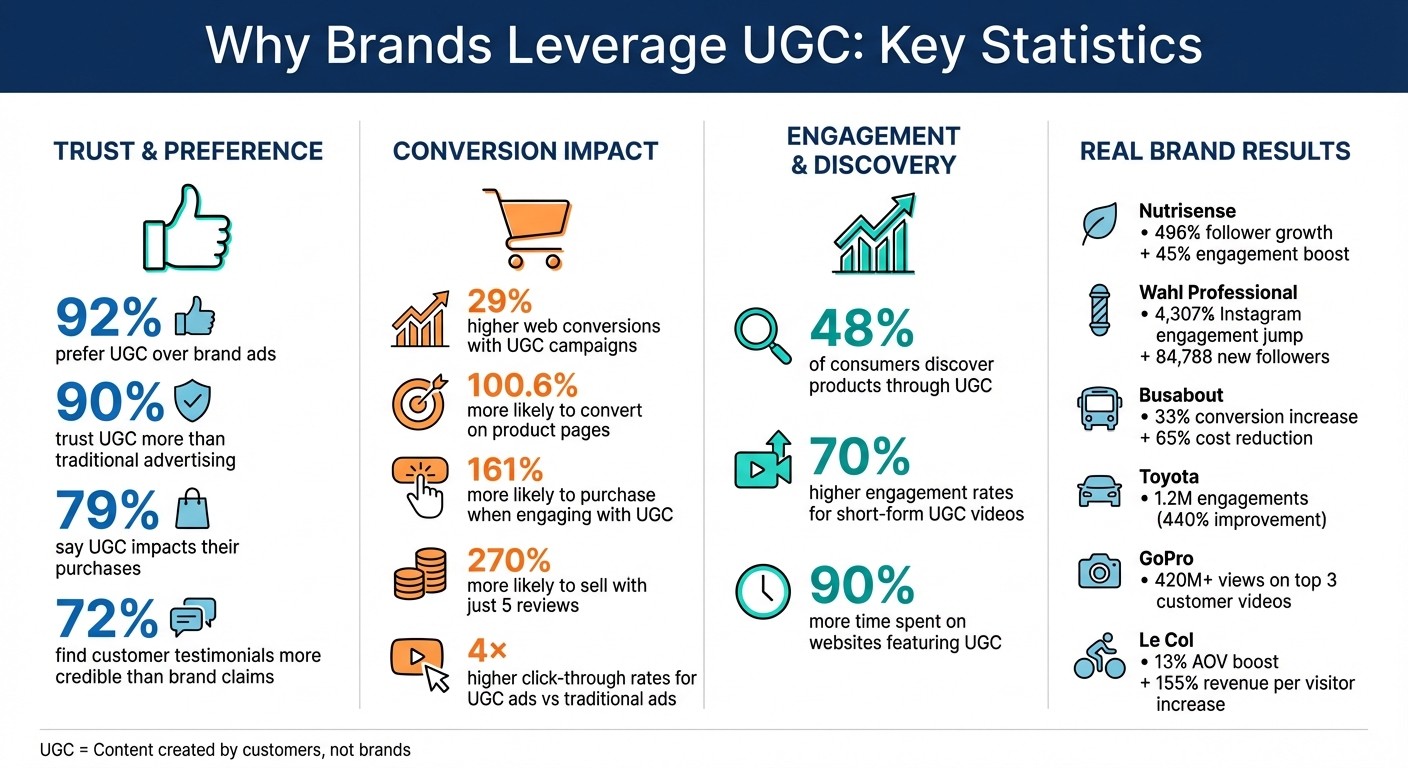
92% of people prefer user-generated content (UGC) over brand ads because it feels more relatable and trustworthy. UGC - like photos, reviews, and social posts created by customers - directly influences buying decisions, with 79% of shoppers saying it impacts their purchases. Campaigns featuring UGC drive 29% higher web conversions and are 100.6% more likely to convert on product pages.
Here’s why UGC works:
Trust: Shoppers trust peer recommendations more than ads. Products with just five reviews are 270% more likely to sell.
Engagement: UGC boosts social media interaction. For instance, Nutrisense grew followers by 496% with customer stories, and Wahl Professional achieved a 4,307% jump in Instagram engagement.
Sales Impact: Ads featuring UGC have 4× higher click-through rates than traditional ads.
Brands like GoPro, Toyota, and Busabout have successfully used UGC to increase conversions, cut costs, and grow their audiences. AI tools and UGC content idea generators now simplify sourcing, creating, and distributing UGC, making it easier to scale campaigns and measure results. Start small by using customer testimonials and social proof on high-traffic pages and track metrics like conversions and engagement to refine your approach.
User-Generated Content Statistics and Impact on Brand Performance
What is UGC and Why It Matters
Defining User-Generated Content
User-generated content (UGC) refers to any type of content - whether it's photos, videos, reviews, testimonials, or social media posts - that's created by customers instead of the brand itself. Imagine it as the online equivalent of a friend raving about a product they love. Unlike the polished, high-budget content produced by marketing teams, UGC comes straight from real people sharing their honest experiences.
The difference between UGC and brand-created content is striking. While brand-created content is carefully crafted, polished, and produced by professionals, UGC is raw and unfiltered, created by customers who have no financial incentive tied to the brand's success. For instance, a customer recording a quick product demo on their phone is UGC. On the other hand, a professional photoshoot with perfect lighting and models? That’s your classic brand content.
Feature | User-Generated Content (UGC) | Traditional Brand Content |
|---|---|---|
Creator | Customers, fans, and advocates | Brand employees or agencies |
Production Value | Raw and authentic | Polished and high-quality |
Cost | Minimal to none | High (production and placement fees) |
Trust Level | High (peer-to-peer validation) | Lower (seen as biased or sales-driven) |
This unfiltered authenticity is what makes UGC stand out. It earns trust in ways that traditional advertising often struggles to achieve.
Why UGC Builds More Trust Than Traditional Ads
The trust gap between UGC and traditional ads is huge. Research shows that nine out of 10 consumers trust UGC more than they trust traditional advertising. Even more striking, 92% of people trust recommendations from someone they know. Genuine, unpaid endorsements simply feel more believable than glossy ad campaigns.
And this trust leads to action. Shoppers who engage with UGC are 161% more likely to make a purchase than those who don’t. Products with at least five reviews are 270% more likely to be purchased compared to those with no reviews. On top of that, 72% of consumers find customer testimonials more credible than a brand’s own claims.
Take Nutrisense, a health tech company, as an example. Between July 2021 and late 2022, they shifted their focus to UGC by sharing customer stories and community-driven content. This strategy boosted their social media engagement by 45% and grew their follower count from 25,000 to over 130,000 - a staggering 496% increase. Similarly, Wahl Professional used hashtags like #Wahl and #WahlPro to feature real barbers and stylists using their products. Starting in June 2015, this approach skyrocketed their Instagram engagement by 4,307% and added 84,788 new followers.
"The voice of the brand is not always the same as the voice of the customers. We're moving closer to times where a brand's identity is the same as their customers' identity." - Sabine Schwirtz, Former Community Manager, LUSH Cosmetics
This level of trust doesn’t just inspire confidence - it fuels every step of the buyer’s journey.
How UGC Drives Social Commerce
UGC plays a pivotal role in product discovery and purchase decisions. Nearly half (48%) of consumers discover products through UGC. Seeing real people use a product in their daily lives eliminates doubt and builds the confidence needed to hit that “buy” button.
Short-form UGC videos are especially powerful, with engagement rates 70% higher than other formats. Ads featuring UGC also outperform traditional ads, achieving four times higher click-through rates. Social platforms are leaning into this trend by integrating shopping features directly into user feeds, making it easier than ever for consumers to shop without leaving the app.
GoPro is a prime example of this strategy in action. As of September 2025, their top three YouTube videos - created entirely by customers - had racked up more than 420 million combined views. Every day, users upload around 6,000 GoPro-tagged videos, providing a constant stream of authentic content that drives both brand awareness and sales.
Busabout, a tour operator, took this concept to heart by replacing their professional website visuals with user-generated photos. The result? A 33% increase in online conversions and a 65% cut in content creation costs. Toyota saw similar success with their "Feeling the Street" Facebook campaign, which used UGC to target younger audiences. Over six weeks, the campaign generated 1.2 million engagements - a 440% improvement compared to the previous year’s traditional ads, all without increasing their budget.
How to Source and Create UGC for Your Brand
Finding UGC with AI-Powered Tools
Gone are the days of endlessly scrolling through hashtags and manually sifting through content to find user-generated content (UGC). Now, AI-powered tools simplify this process by using machine learning to scan social media and identify content that aligns with your brand's style and tone. These tools allow you to upload reference images, helping them flag visuals that match your brand’s identity, filter out irrelevant material, and even detect products to make the content shoppable.
Take TwinTone, for example. This platform uses "AI Twins" - virtual avatars modeled after real creators - to generate UGC videos on demand. This eliminates the need for searching entirely, making the process faster and more efficient. But it doesn’t stop there - AI video generation takes UGC creation to the next level.
Generating UGC Videos on Demand
Creating UGC videos the old-fashioned way often meant coordinating with multiple creators, waiting for scripts, and managing timelines. With AI video generation, those headaches are a thing of the past. Platforms can now take a simple product URL and transform it into a fully produced UGC video ad in just minutes, complete with scripts and visuals.
TwinTone, for instance, allows brands to generate shoppable videos by inputting product details and specifying the desired style and length. The AI Twin then demonstrates the product in realistic, hands-on scenarios. Even better, these videos can be created in over 40 languages, making it easier to connect with diverse audiences.
The speed is impressive - what used to take weeks can now be done in 2 to 10 minutes. And the results speak for themselves. One campaign generated $69,000 in sales from just $19,000 in ad spend, achieving a return on ad spend (ROAS) of 3.73×. Another brand saw a 40% increase in reviews and a 22% boost in conversions.
But the innovation doesn’t end with pre-recorded videos. AI is also revolutionizing real-time engagement through livestreams.
Running AI Livestreams for Real-Time Engagement
AI-powered livestreams are pushing UGC into new territory, offering 24/7 streaming capabilities on platforms like TikTok, Amazon, YouTube, and Shopify. These automated live shopping sessions provide continuous interaction through video, voice, and text, creating an engaging and dynamic shopping experience.
With TwinTone, brands can select an AI Twin, integrate their product catalog, and launch nonstop, shoppable livestreams in over 30 languages. Real-time analytics track viewer behavior, allowing brands to adjust content on the fly and deliver personalized prompts that inspire viewer-generated content.
What’s more, creators maintain full ownership of their AI Twins and keep 80% of the revenue earned from fan interactions. This setup benefits both brands and creators, making AI livestreams a game-changer for UGC and real-time engagement.
Check How THIS Brand Uses User Generated Content (UGC)
Curious about the ROI of your own content? Use our UGC Value Estimator to see what your brand's assets are worth.
Automating UGC Distribution Across Channels
Creating user-generated content (UGC) is just the first step - getting it onto the right platforms is where the real work begins. The process of manually downloading, reformatting, and uploading content across platforms like Instagram, TikTok, your website, and email can eat up hours. That’s where automation tools come in, seamlessly connecting your UGC library with content management systems (CMS), scheduling tools, and ad platforms to save time and effort.
Today’s tools use AI-powered aggregators to simplify the process. These tools scan social media for brand mentions, hashtags, or even your product packaging - no need to be tagged directly. They automatically curate posts, weed out low-quality content, and flag the most engaging pieces for your approval. Once approved, you can quickly push UGC to product pages, cart abandonment emails, or paid ad campaigns without any hassle.
Adapting UGC for Different Platforms
Every platform has unique content requirements. For instance, a vertical TikTok video won’t work as a horizontal YouTube banner, and a detailed testimonial might need trimming to fit Instagram Stories. This is where automation shines - it can resize videos, crop images, and even generate platform-specific captions instantly.
Imagine taking a single customer unboxing video and transforming it into multiple formats: a 15-second Instagram Reel, a square Facebook ad, and a shoppable pin on Pinterest. With tools that offer direct CMS integration, you can even upload this content straight to ecommerce product pages, giving shoppers real-time social proof when they’re deciding whether to buy. And here’s the kicker - shoppers who engage with UGC are 161% more likely to make a purchase than those who don’t.
Manual Coordination vs. AI Automation
To see how much time automation saves, let’s compare manual coordination with AI-powered automation. The difference is night and day. Manual coordination involves combing through hashtags, messaging creators for permissions, downloading files, editing them in separate tools, and then uploading them to each platform individually. AI automation takes care of all of this behind the scenes.
Feature | Manual Coordination | AI-Powered Automation |
|---|---|---|
Content Sourcing | Searching hashtags and mentions manually across platforms | Automated social listening and multi-platform aggregation |
Curation & Quality | Reviewing each post for quality and brand fit | AI filters for high engagement and relevance |
Distribution | Manual editing and uploading to each platform | Direct integration with CMS, email tools, and schedulers |
Scalability | Limited by team size and available hours | Handles thousands of assets effortlessly across regions |
Permission Handling | Manual outreach and tracking | Automated workflows for rights requests and digital logs |
"By leveraging the right technology, you can automate much of the UGC management process, freeing up your time to focus on building relationships with your customers and growing your brand." - Ben Salomon, Growth Marketing Manager, Yotpo
Take Lola's Fine Hot Sauce as an example. In 2024, they partnered with local influencers through the Hummingbirds platform to promote their bloody mary mix and hot sauce. The results? Their average weekly sales tripled in target markets, and some locations experienced a staggering 16x growth. Even better, 80% of this boost was sustained for three months after the campaign. Achievements like this are only possible when automation eliminates the friction of manual processes.
Tracking and Improving UGC Campaign Performance
Creating and sharing user-generated content (UGC) is just the beginning. The real value lies in measuring its impact and using that data to refine and expand your efforts. Without tracking, you're essentially flying blind - spending time and money on content that might not deliver results. Data-driven insights are the backbone of a successful and scalable UGC strategy.
Key Metrics to Monitor
Start by zeroing in on conversion metrics. For example, track how many visitors who engage with UGC on your product pages end up making a purchase versus those who don’t. Keep an eye on your return on ad spend (ROAS) for UGC campaigns, overall revenue, and average order value (AOV). Consider the case of premium cycling brand Le Col: after integrating customer reviews and lifestyle photos across their site and retail partner platforms via Bazaarvoice, they saw a 13% boost in AOV, a 155% jump in revenue per visitor, and a 125% increase in conversion rates.
Next, focus on engagement metrics to see if your UGC is actually connecting with your audience. Metrics like dwell time (how long users stay on your site), bounce rates, and social shares can reveal whether your content is holding attention. For instance, websites featuring UGC often see visitors spending up to 90% more time on the site, which also helps improve search engine rankings. Additionally, monitor organic traffic, click-through rates, and keyword rankings to assess how UGC is contributing to your SEO efforts.
Don’t overlook sentiment analysis either. Tools powered by natural language processing (NLP) can help you dig deeper into customer reviews to understand emotions and feedback beyond simple star ratings. This can uncover recurring pain points or praises hidden in detailed reviews. Also, analyze how efficiently you're collecting reviews - timing your requests right can make a big difference.
"Content marketing has outgrown its 'throw-it-on-the-wall-and-see-what-sticks' phase. Without a data-driven strategy, you're wasting your time." - Aimee Millwood, Director of Content, Yotpo
By keeping an eye on these metrics, you can fine-tune your UGC efforts and build a smarter, more effective strategy.
Scaling Your UGC Strategy
Once you’ve nailed down the basics, scaling your UGC strategy becomes the next step. Leverage machine learning to enhance post-purchase email campaigns and repurpose successful UGC across multiple channels. For example, a popular Instagram Reel can be transformed into paid ad content, email visuals, or even product page enhancements.
GoPro offers a masterclass in scaling UGC. As of September 2025, the action camera brand had built its YouTube channel almost entirely on user submissions. Its top three videos - created and uploaded by customers - have collectively amassed over 420 million views. To keep the momentum going, GoPro runs daily photo challenges and an awards program, ensuring a steady flow of high-quality content. For larger brands, enterprise solutions with custom training and API access can streamline content creation across thousands of SKUs, eliminating manual bottlenecks and ensuring your catalog keeps pace with demand.
Experimentation is key to scaling effectively. Use A/B testing to find out which UGC formats - like unboxing videos, testimonials, or product demos - perform best. UGC ads, for instance, boast a click-through rate (CTR) that’s 400% higher than traditional ads. Add schema markup to customer reviews to generate rich search snippets, which can further boost organic CTR. Lastly, keep an eye on behavioral metrics like dwell time on pages with embedded UGC to ensure your content is keeping visitors engaged and interested.
Conclusion
User-generated content (UGC) isn’t just another marketing tool - it’s a powerful way to build trust and turn your customers into your best advocates. Studies show that people trust peer recommendations far more than branded messages. In fact, ads featuring UGC deliver 4x higher click-through rates compared to traditional ads, and shoppers who engage with UGC are 161% more likely to make a purchase.
The real game-changer is blending genuine customer voices with the efficiency of AI. Tools like TwinTone allow brands to create UGC videos on demand, run AI-driven livestreams, and automate content distribution - all without the usual production delays. This means you can easily repurpose content, test different messages, and scale campaigns without adding to your production costs. It’s a smart way to maximize impact while keeping things efficient.
To get started, think strategically but start small. Use social listening tools to track organic mentions of your brand, get permissions from creators, and test UGC on high-traffic areas like product pages and checkout screens. Keep an eye on key metrics like engagement, conversion rates, and sentiment analysis to learn what resonates most. Once you identify top-performing content, repurpose it across email campaigns, paid ads, or even shoppable galleries.
FAQs
How can AI tools help brands create and share user-generated content (UGC)?
AI tools are reshaping how brands handle user-generated content (UGC), making both the creation and distribution processes more efficient. These tools can automatically craft captions, suggest edits, and transform raw user content into polished posts or videos that match a brand's unique style. The result? A consistent, professional look across social media, e-commerce platforms, and beyond - all while saving valuable time.
Beyond content creation, AI takes the guesswork out of identifying high-performing UGC. By analyzing engagement metrics like likes, comments, and conversions, it highlights the content that resonates most with audiences. Brands can then amplify this impactful content, building trust and driving sales. Plus, AI ensures compliance by flagging content that might require permissions or could involve copyright concerns, simplifying the management of large-scale UGC campaigns and reducing potential risks.
Why is user-generated content (UGC) considered more trustworthy than traditional brand content?
User-generated content (UGC) stands out as more trustworthy because it comes directly from real customers sharing their honest experiences. Unlike marketing materials designed to sell, UGC feels genuine and relatable, giving potential buyers a more transparent view of what they can expect.
Since UGC is typically created voluntarily, it exudes a level of sincerity that polished brand advertisements just can’t match. People naturally trust recommendations from peers more than corporate messaging, and UGC delivers that social proof. Whether it’s through customer reviews, photos, or videos, this type of content helps build confidence and encourages purchasing decisions. By leveraging UGC, brands can strengthen their connection with their audience and foster trust.
How can brands evaluate the success of their UGC campaigns?
Brands measure the success of their user-generated content (UGC) campaigns by looking at a combination of engagement metrics and business outcomes. Key engagement metrics include likes, comments, shares, video views, and how often a campaign hashtag is used. Metrics like reach and impressions indicate how many people saw the content, while the number of user-submitted photos, reviews, or videos reflects participation levels.
To tie engagement to actual results, brands monitor metrics such as click-through rates (CTR) on shoppable UGC posts, conversion rates, average order value (AOV), and total sales during the campaign. Tools like UTM-tagged links and attribution software make it easier to calculate the revenue driven by UGC, offering a clear view of return on investment (ROI). Adding sentiment analysis to the mix helps brands understand how their campaigns impact public perception, enabling them to fine-tune strategies and improve future campaigns.