
UGC vs AI UGC
How to build a futureproof relationship with AI

User-Generated Content (UGC) has been a trusted tool for brands to build credibility through real customer experiences. But in 2026, AI-Generated UGC (AI UGC) is rewriting the playbook with faster, cheaper, and scalable content production. Here's the main takeaway:
UGC: Created by real people, it builds trust and emotional connections but takes time and costs $350–$1,000 per video.
AI UGC: Simulates UGC using AI, producing videos in 45 minutes for $198, making it ideal for quick, high-volume campaigns.
Key Differences:
UGC is better for trust and long-term relationships.
AI UGC excels in speed, cost-efficiency, and scaling.
Combining both approaches offers the best results.
Quick Comparison:
Factor | UGC | AI UGC |
|---|---|---|
Cost per Video | $350–$1,000 | $198 |
Production Time | 4–12 hours (or weeks) | 45 minutes |
Scalability | Limited | Unlimited |
Trust Level | High | Medium |
Engagement Lift | Baseline | 25–35% higher |
For brands, the choice depends on goals: use UGC for trust-building campaigns and AI UGC for rapid experimentation and global outreach. Together, they can deliver both authenticity and efficiency.
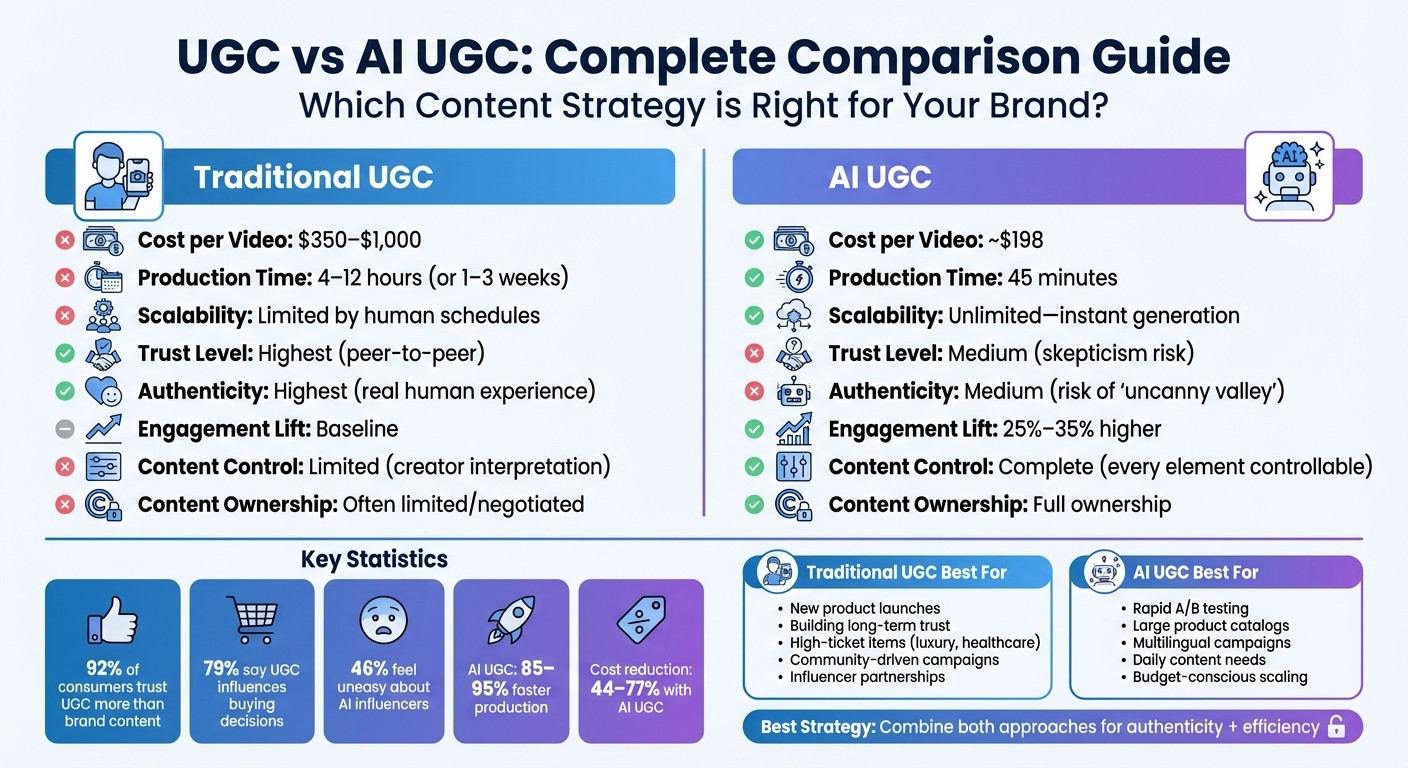
UGC vs AI UGC: Cost, Speed, and Performance Comparison
Choosing Between UGC and AI Actors
What is Traditional UGC?
Traditional UGC, or user-generated content, refers to content created by real customers, fans, or advocates - not by the brand itself. Think product reviews, social media posts, unboxing videos, testimonials, or customer photos. Essentially, it's the digital version of word-of-mouth, where genuine customer experiences are shared for others to see [10, 11]. This type of content lays the foundation for understanding how AI is reshaping UGC.
What makes traditional UGC so impactful is its authenticity. It's unscripted and created by everyday people, making it more relatable than polished brand content. Real customer experiences can validate a brand's promises in ways that traditional advertising simply can’t [11, 14].
The trust factor here is huge. For example, 47% of shoppers say user reviews on retailer websites are the most influential content when researching products - far outweighing the 11% who rely on branded social content. Plus, products with at least five reviews are 270% more likely to be purchased than those with none. As Laura DeGomez, Director of Partnerships & Brand Marketing at Well Traveled, perfectly sums up:
"No one tells our story better than our members."
Characteristics of Traditional UGC
What sets traditional UGC apart is its human element and personal connection. Unlike influencer content, it’s created purely from genuine consumer experiences, regardless of whether the creator has a large following [10, 2, 15].
This content often feels raw and unpolished - think honest reviews, casual social media posts, and spontaneous videos. It’s this unfiltered quality that makes it so relatable and trustworthy. In fact, 79% of consumers say UGC influences their buying decisions, and brands that incorporate UGC see 29% higher web conversions.
Some common formats include:
Written product reviews
Video testimonials
"Get Ready With Me" (GRWM) videos
Before-and-after transformations
Community forum discussions [18, 12, 6]
To encourage this kind of content, brands often reach out directly to their customers, run hashtag campaigns, host contests, or simply ask their community to share their experiences. These strategies help foster participation and keep the content authentic.
Challenges of Producing Traditional UGC
Despite its benefits, creating traditional UGC isn’t without its challenges. One of the biggest hurdles is time-consuming coordination. Brands have to monitor mentions, secure permission to reshare content, and maintain communication with creators - a process that can stretch over days or even weeks for just a handful of usable pieces [10, 13, 14].
Then there’s the issue of cost and inconsistency. While organic UGC is often free, professional UGC creators typically charge between $150 and $200+ for a 30-second video (as of 2025). Even with paid content, the quality can vary widely - from blurry photos to posts riddled with typos that don’t align with brand standards. Additionally, 53% of consumers prefer clear instructions on what to create, meaning brands need to invest time in setting guidelines and actively managing their communities.
Scaling traditional UGC is another tough nut to crack. Without active solicitation, high-quality organic content can be slow to surface. And coordinating with multiple creators across different time zones makes it nearly impossible to produce the volume of content needed for testing ad variations or launching time-sensitive campaigns.
Next, we’ll explore how AI-driven UGC tackles these challenges head-on.
What is AI UGC?
AI UGC refers to AI-generated content designed to resemble traditional user-generated content (UGC) - often in video format. Instead of working with real creators, brands use AI-driven platforms to create videos featuring digital replicas, mimicking the casual, relatable style of organic social media posts.
While traditional UGC is based on real experiences, AI UGC relies on technology to craft similar content. As AKOOL explains:
"The goal is to replicate the authenticity and tone of UGC without relying on real influencers or customers."
This method blends the trustworthiness of UGC - 92% of consumers perceive it as more credible than standard advertising - with the efficiency and scale of AI. Brands can now produce hundreds of content variations in minutes, bypassing the lengthy coordination process with creators. Platforms like TwinTone make this possible by transforming real creators into AI Twins. These AI Twins can generate product demos, testimonials, and shoppable videos on demand, eliminating the need for creators to be physically present for every shoot. Let’s dive into what makes AI UGC so powerful and scalable.
Key Features of AI UGC
AI UGC platforms offer capabilities that traditional creator workflows simply can’t compete with. At their core is automation - brands can produce content in minutes by uploading a product URL or script, removing the need for extensive creator outreach.
Scalability is another standout feature. TwinTone’s API allows for automated content creation at scale, from personalized product videos to diverse hooks for entire product catalogs.
Multilingual support is a game-changer for global campaigns. For instance, in 2025, Malaria No More used a digital version of David Beckham to deliver a campaign in nine different languages, reaching audiences worldwide - without requiring Beckham to learn or film in those languages. Similarly, TwinTone supports over 40 languages, preserving the original creator’s voice and syncing lip movements for seamless localization. It also integrates directly with ecommerce platforms like TikTok, Shopify, Amazon, and YouTube, enabling brands to create shoppable videos with direct checkout links.
The platform doesn’t stop there. It offers real-time analytics to track engagement, conversions, and ROI, giving brands immediate insights into what resonates with their audience.
How AI UGC Works
AI UGC platforms streamline production by removing traditional bottlenecks. Here’s how platforms like TwinTone create AI UGC:
Choose an avatar or create an AI Twin: Brands can select from pre-built avatars or work with real creators who license their likeness. TwinTone ensures each AI Twin mirrors the creator’s unique facial expressions, gestures, and personality traits.
Prepare a script: You can either write your own script or let TwinTone’s AI analyze product URLs to generate multiple script variations with emotional hooks. To make the content feel more genuine, phrases from customer reviews can also be incorporated.
Generate natural-sounding dialogue: Voice AI delivers dialogue in a conversational tone. Brands can select from various voice styles and even add emotional cues like [excited] or [thoughtful] for a more authentic feel.
Render and sync: The AI combines all elements, syncing facial expressions, lip movements, and gestures with the audio. The final product is a polished video, complete with captions and overlays, formatted for vertical 9:16 social media feeds.
TwinTone’s platform supports high-volume production. For example, its Starter plan offers 10 AI UGC videos per month for $110, while Enterprise plans accommodate 50+ videos and include AI livestreaming capabilities.
What used to take weeks - often involving back-and-forth communication and high costs - now happens in minutes at a fraction of the price. This streamlined process reduces costs by about 90%, making AI UGC a faster and more cost-effective alternative to traditional UGC. As we move forward, we’ll explore how this approach stacks up against traditional methods.
UGC vs AI UGC: Key Differences
When deciding between traditional User-Generated Content (UGC) and AI-generated UGC, the choice often boils down to five main factors: cost, speed, scalability, authenticity, and return on investment (ROI). Traditional UGC thrives on real people sharing genuine experiences, which builds trust but comes with higher costs and logistical challenges. On the other hand, AI UGC leverages technology to replicate user content at a fraction of the time and cost.
Cost is where AI UGC leads the pack. Traditional UGC involves higher production expenses, while AI UGC averages just $198 per video - a cost reduction of 44% to 77%. For instance, in 2025, a Shopify beauty store boosted its weekly content output from 5 to 25 posts (a 400% increase) while cutting production costs by 65%. This affordability makes AI UGC an attractive option for brands aiming to maximize their marketing budgets.
Speed and scalability are other areas where AI UGC excels. Traditional UGC can take 4–12 hours or even weeks to coordinate and produce, whereas AI UGC delivers polished videos in just 45 minutes - a time savings of up to 95%. This efficiency allows brands to test multiple messaging variations, translate content into different languages, and create personalized videos for various audience segments - all without the delays tied to human schedules.
Authenticity is where traditional UGC still shines. Real human experiences resonate deeply with audiences, which is why 84% of consumers are more likely to trust brands that use UGC in their marketing. Traditional UGC is seen as 2.5 times more authentic than brand-created content. However, AI UGC, despite becoming more advanced, faces skepticism - 46% of consumers report feeling uneasy about brands using AI vs. human influencers or synthetic content. As Maria Volina, Head of Marketing at Fourmeta, explains:
UGC isn't always as 'authentic' as it looks... with the rise of generative AI, the mirage is getting more convincing.
ROI presents a mixed picture. AI UGC often delivers stronger short-term results, especially for performance marketing. For example, in 2025, Dunkin' Donuts launched an AI-driven UGC contest, leading to a 57% spike in mobile app downloads - far exceeding their traditional contest benchmarks. AI UGC also drove a 25% to 35% increase in engagement rates on TikTok and Instagram that same year. However, traditional UGC is better suited for building long-term brand trust and emotional connections by leveraging synthetic relationships and engagement metrics, particularly for high-value or trust-sensitive products. Many successful brands combine the two approaches: AI UGC for rapid experimentation and scaling, and traditional UGC for core storytelling and deeper connections.
Comparison Table: UGC vs AI UGC
Factor | Traditional UGC | AI UGC |
|---|---|---|
Average Cost | $350 – $1,000 per video | ~$198 per video |
Production Time | 4 – 12 hours (or 1–3 weeks with creators) | 45 minutes |
Scalability | Limited by human schedules | Unlimited - instant generation |
Authenticity | Highest (real human experience) | Medium (risk of "uncanny valley") |
Trust Level | Highest (peer-to-peer) | Medium (skepticism risk) |
Engagement Lift | Baseline | 25% – 35% higher (via AI optimization) |
Content Control | Limited (creator interpretation) | Complete (every element controllable) |
Content Ownership | Often limited/negotiated | Full ownership |
Advantages and Challenges of Each Approach
This section dives into the strengths and hurdles of both traditional and AI-generated user-generated content (UGC), offering a closer look at their trade-offs.
Advantages of Traditional UGC
Traditional UGC thrives on its ability to create genuine human connections. When real customers share their experiences, it resonates with audiences. And the numbers don’t lie - 93% of marketers agree that consumers trust content created by other customers more than brand-generated material. Plus, 79% of people say UGC strongly influences their buying decisions. This trust directly impacts revenue, with UGC-based ads achieving four times higher click-through rates and 50% lower cost-per-click compared to standard branded ads.
What sets traditional UGC apart is its raw, unpolished authenticity. The shaky camera work, unscripted moments, and less-than-perfect lighting make it relatable in a time when 71% of consumers are skeptical about what they see due to AI. As Rickie Sherman, UX Lead at Averi.ai, explains:
The shaky camera work, the genuine enthusiasm, the unscripted reactions… these aren't bugs, they're features.
This kind of "awkward authenticity" fosters emotional bonds and builds long-term loyalty. A great example is Frankies Bikinis, which showcased top-performing customer content on its site. The result? UGC accounted for 19% of total orders and over 23% of online revenue.
Another benefit of traditional UGC is the creative freedom it offers. Customers can make bold claims like "This changed my life!" - statements that brands are legally restricted from using in their own ads. Beyond promoting products, UGC creators often feel like they’re contributing to a community. As Chad Hetherington, Content Marketing Specialist, puts it:
UGC's sole purpose isn't just to boost brands... people post because they want to contribute to a community of like-minded folks.
However, this approach isn’t without its challenges, particularly when it comes to scaling and logistics.
Challenges of Traditional UGC
The biggest hurdle for traditional UGC is the logistics and cost involved. Creating this kind of content isn’t cheap - production costs range from $350 to $1,000 per video, and it takes 4–12 hours to produce. Add in the complexities of managing creators and coordinating schedules, and scaling this type of content becomes a real headache. For brands that need dozens of variations for different audiences or want to run rapid A/B tests, traditional UGC simply can’t keep up.
Advantages of AI UGC
AI-powered UGC builds on the strengths of traditional UGC by addressing its operational limitations. For starters, production is much faster and cheaper. Creating a video takes about 45 minutes - a time savings of 85% to 95% - and costs average just $198 per video. This efficiency enables brands to test multiple messaging variations, personalize content for different audiences, and even translate videos into various languages - all without waiting on human schedules.
Another major advantage is the level of creative control. Brands can fine-tune every detail, from visuals to messaging, ensuring everything aligns with their identity. Plus, with full ownership of the content, brands can skip the licensing and negotiation hurdles that come with traditional UGC. For example, the edtech startup Headway used AI tools to create localized video ads mimicking user testimonials. These ads generated 3.3 billion impressions and boosted ROI by 40% - all without hiring a videographer.
AI also excels at rapid iteration. Brands can quickly produce unlimited variations of content tailored to different platforms, demographics, and campaign goals. This approach has proven effective, with AI-driven UGC boosting engagement rates by 25% to 35% on platforms like TikTok and Instagram in 2025.
Challenges of AI UGC
The biggest challenge for AI UGC lies in trust and authenticity. While AI can replicate the look of user-generated content, it often falls short of capturing the human connection. In fact, 46% of consumers report feeling uneasy about brands using AI influencers or synthetic content. The "uncanny valley" effect - where content looks almost human but feels slightly off - can make viewers uncomfortable. As Maria Volina, Head of Marketing at Fourmeta, points out:
AI can mimic authenticity, but it can't fully recreate the human connection behind true UGC.
Transparency is another critical issue. Brands face increasing scrutiny from regulators, including FTC crackdowns on undisclosed AI endorsements and mandatory labeling laws in the EU and China. Without clear disclosures, such as hashtags like #AIgenerated, brands risk losing consumer trust and facing legal repercussions. Over-reliance on AI tools also brings the risk of creative fatigue, with ads starting to look so similar that audiences tune them out.
Generational differences further complicate the picture. While Gen Z spends more time on short-form videos and UGC than other groups - about 50 minutes more per day - only 24% trust AI tools offered by major brands. To address this skepticism, brands need to ground AI-generated content in real customer feedback or FAQs and intentionally include small imperfections to make it feel more genuine.
When to Use Traditional UGC vs AI UGC
Deciding between traditional and AI-generated user-generated content (UGC) depends on factors like trust, content needs, budget, and where your brand stands in its growth journey. The right balance comes down to your goals and brand maturity.
Here’s a general guideline: for early-stage brands, around 80% AI UGC works well for quick testing. Brands in the growth phase might go for a mix - 60% AI and 30% traditional UGC. Established brands often lean on about 50% traditional UGC to build trust, while using AI to scale content efficiently.
For high-ticket items like luxury goods or healthcare, traditional UGC is crucial to establish trust. On the other hand, lower-risk products can benefit from the speed and scalability of AI UGC. As Aastha Kochar from Invideo puts it:
Traditional advertising screams 'This is an ad.' Strategic UGC whispers 'This is a recommendation from someone like you'.
Now, let’s dive into situations where each type works best.
Use Cases for Traditional UGC
Traditional UGC is all about building trust and fostering long-term connections. It’s especially effective for new product launches. When customers are unfamiliar with your brand, seeing real people share authentic experiences builds the kind of social proof that overcomes hesitation. Take GoPro’s "Million Dollar Challenge" - they invited users to submit raw clips for a chance to win part of $1 million. The result? 42,000 submissions from 170 countries, 25,000 product transactions, and a conversion rate three times higher among those who engaged with the content.
This approach also works wonders for community-driven campaigns. For example, Petco’s "Spotted" program sent products to a select group of pet owners, achieving a 90% response rate and increasing review volume by 405%. This led to a 48% boost in revenue per visit for the featured products. Similarly, traditional UGC shines in influencer partnerships, where authenticity is key. Consider Rhode Skin’s early 2024 campaign: they gifted their "Lip Phone Case" to micro-influencers without any paid scripts. The result? $8.3 million in Earned Media Value and a 31.9% average engagement rate on Instagram.
Another strength of traditional UGC is its ability to provide diverse representation. Real customers showcasing various body types, skin tones, and lifestyles lend credibility that AI avatars just can’t replicate. It’s also the best option when you want creators to make personal claims, like "this changed my life", which brands themselves might be legally restricted from saying.
Use Cases for AI UGC
When speed, volume, and control are top priorities, AI UGC is your go-to solution.
AI UGC is unbeatable for rapid iteration and scaling content. Need to test multiple hooks or calls-to-action quickly? AI makes it possible to churn out dozens of variations in hours rather than weeks. GoPro, for instance, now produces half of its marketing videos using AI-curated UGC, doubling their output without adding to their team.
For brands with large product catalogs on platforms like Amazon or Shopify, AI UGC is a game-changer. Instead of coordinating hundreds of creators to showcase individual products, AI can generate consistent demos at scale. It’s also perfect for multilingual campaigns. A standout example is Malaria No More’s campaign featuring David Beckham speaking in nine languages using AI technology. This allowed them to deliver a unified message globally without requiring Beckham to learn new languages.
If you’re managing daily content across platforms like TikTok, Instagram Reels, or YouTube Shorts, AI UGC can help avoid delays that often come with human creators. At an average cost of $198 per video - compared to $350–$1,000 for traditional production - AI UGC is a budget-friendly option for brands needing frequent updates. It’s ideal for product demonstrations, feature tutorials, and seasonal campaigns where fresh content is needed quickly. Just remember to disclose AI-generated content to maintain transparency and comply with platform policies.
Implementing AI UGC with TwinTone

When you opt for AI UGC, TwinTone offers a seamless way to generate unlimited videos using AI Twins - digital replicas of real creators that maintain their personality, style, and tone. This method not only speeds up content production but also underscores the cost-efficiency and scalability advantages of AI UGC.
Here’s how it works: choose an AI Twin that aligns with your target audience, input your product URL (TwinTone extracts the details automatically), and customize options such as background music, language, and subtitles. The result? Videos that capture the natural vibe of user-generated content, featuring AI personas in relatable settings like home offices, bathroom mirrors, or casual outdoor environments. Start by identifying your top-performing formats before scaling with AI Twins. Let’s dive into how you can kick off your AI UGC journey with TwinTone.
Getting Started with TwinTone
TwinTone offers three straightforward plans tailored to different needs:
Starter plan ($110/month): Includes 10 AI UGC videos featuring real creator avatars, multilingual output in over 40 languages, and videos up to 60 seconds long.
Pro plan ($220/month): Doubles the video count to 20, adds expressive gestures and advanced voice styles, and supports multilingual campaigns for broader reach.
Enterprise plan (custom pricing): Designed for brands requiring scale, offering 50+ videos, premium creators, AI livestreaming, and priority support with brand-specific training.
Most brands can produce their first AI UGC video in under 10 minutes. This efficiency reshapes content creation, offering significant cost savings compared to traditional UGC production.
Scaling Content with TwinTone
TwinTone’s API access makes scaling effortless. By integrating AI UGC directly into your marketing systems, you can create thousands of content variations in hours instead of weeks. This is particularly useful for businesses with extensive product catalogs on platforms like Amazon or Shopify. Instead of managing countless creators, you can generate consistent, high-quality demos at scale.
The AI livestreaming feature takes things further, enabling continuous shoppable streams on platforms like TikTok, Amazon, YouTube, and Shopify. A notable example is H&M’s 2025 campaign, which used hyperrealistic digital twins of 30 real models to shoot in multiple locations and styles simultaneously. This approach eliminated the logistical challenges of physical shoots while ensuring the models retained their image rights and received compensation.
TwinTone also simplifies A/B testing. You can generate dozens of variations for as little as $99, a fraction of the cost of traditional methods. Experiment with different AI actors, backgrounds, and outfits to keep your content dynamic. For a more relatable feel, scripts can include natural pauses or “ums” to mimic authentic speech. Once your content is scaled, use TwinTone’s analytics to measure its impact.
Measuring ROI with AI UGC
TwinTone’s performance analytics provide insights into engagement, conversion rates, and cost per acquisition, helping you fine-tune your campaigns. The platform tracks metrics like engagement depth and ROI across channels such as TikTok and Instagram.
Run A/B tests with AI UGC variations and evaluate performance within 48–72 hours. Scale the most effective versions by creating additional variations. Measure key business metrics like customer lifetime value and revenue per AI UGC asset. For example, ChargeHub, an EV charging app, achieved a 46% lower cost per install in 2025 using AI UGC compared to traditional banner ads. Similarly, Viluu, a social platform, saw significant budget efficiencies by adopting AI UGC.
"The breakthrough isn't just in cost savings. It's in the ability to maintain authentic engagement at scale. AI-powered UGC filtering delivered a 25–35% lift in engagement rates for brands on TikTok and Instagram in 2025." - Single Grain
Conclusion: Choosing the Right UGC Strategy
Deciding between traditional and AI-driven user-generated content (UGC) comes down to your goals and priorities. Traditional UGC offers a level of trust and connection that’s hard to beat - 92% of consumers trust peer recommendations over traditional ads. But let’s face it, it’s not always the fastest or easiest to scale. On the flip side, AI-generated UGC can churn out content 85–95% faster, allowing brands to create hundreds of video variations in just a few hours, all while keeping messaging consistent.
The most successful brands don’t pick one over the other - they combine both. Use traditional UGC to strengthen social proof and build loyal communities. Then, turn to AI UGC when you need to experiment with messaging, break into new markets, or scale up content production without stretching your budget. Take Dunkin' Donuts, for example: in 2025, they used AI UGC to boost mobile app downloads by 57%. Meanwhile, Frankies Bikinis leaned on organic UGC galleries to drive 19% of their total orders.
When deciding how to implement these strategies, it’s all about what you need. AI UGC is perfect for things like international campaigns, quick A/B testing, or creating multilingual content. And with plans like TwinTone's starting at $110/month for 10 videos, it’s a far more affordable option compared to the $350–$1,000 price tag and weeks of work that traditional UGC often requires.
While speed and cost savings are huge perks, don’t forget the importance of transparency. Always disclose when content is AI-generated to maintain trust. Pair that with genuine customer testimonials, and you have a winning strategy. Brands that successfully balance the speed of AI with the authenticity of real customer voices will see the best returns as the market continues to evolve.
FAQs
How does AI-generated UGC affect consumer trust compared to traditional UGC?
AI-generated UGC has its perks, like quicker production and tailored content. However, it often misses the mark when it comes to the genuine feel that makes traditional UGC so relatable. Shoppers tend to trust the raw, unfiltered nature of real user content much more than polished, brand-created materials. In fact, studies consistently show that peer recommendations carry significantly more weight with consumers.
Over-relying on AI to produce or mimic UGC can backfire by damaging credibility and eroding consumer trust. The key is to use AI as a tool, not a replacement. When AI's speed and personalization are thoughtfully paired with authentic customer input, brands can create content that not only engages but also builds trust - leading to stronger connections and better returns.
How does AI-generated UGC save time and reduce costs for content creation?
AI-generated UGC is a game-changer when it comes to saving both time and money in content creation. Forget the hassle of organizing traditional photoshoots or video shoots - no more hiring creators, booking locations, or juggling complex production schedules. With AI, brands can generate top-notch images and videos on demand, slashing production timelines from weeks to mere minutes.
On top of that, brands have reported cutting 44% of their content creation costs by making the switch to AI-generated UGC. This means businesses can churn out the same amount of engaging, trust-building content at a fraction of the usual cost, freeing up budgets while still delivering high-quality results.
When should a brand use traditional UGC instead of AI-generated UGC?
Brands should opt for traditional user-generated content (UGC) when their campaign goals hinge on authenticity and building trust. Content created by real customers - like reviews, photos, and videos - connects with audiences on a deeper level because it feels honest and relatable, unlike AI-generated options.
Here’s when traditional UGC works best:
Boosting trust for significant purchases: For products like health and beauty items or big-ticket goods, authentic customer experiences can drive stronger conversions by showcasing real-world results.
Maintaining compliance and credibility: Real content steers clear of issues like deep-fakes or ethical concerns, making it especially valuable in tightly regulated industries.
Strengthening community bonds: Genuine customer voices foster a sense of belonging and inspire peer recommendations, which are essential for community-driven strategies.
When authenticity, trust, or compliance are essential, traditional UGC remains the go-to solution.