
UGC vs AI-Generated Content: What Converts Better?
How to build a futureproof relationship with AI

UGC (User-Generated Content) and AI-generated content both have strengths, but they work best in different contexts. Here’s the key takeaway:
UGC drives higher conversions and builds trust. Shoppers engaging with UGC convert 102.4% more than average visitors, and ads featuring UGC see 28% higher click-through rates. Consumers trust UGC more, with 84% saying it influences their decisions. However, it’s more expensive, costing around $150–$212 per video and taking weeks to produce.
AI-generated content is faster and cheaper. It can be created in 16 minutes for about $2 per video and is ideal for testing and scaling campaigns. Brands using AI content have cut acquisition costs by 46% and achieved engagement rates 350% higher on platforms like TikTok. However, trust levels for AI content are lower at 63% compared to UGC.
Quick Comparison
Metric | UGC | AI-Generated Content |
|---|---|---|
Conversion Rate | 10.38x higher than non-UGC | 2–4x ROI |
Trust Level | 84% | 63% |
Production Cost | $150–$212 per video | ~$2 per video |
Production Time | 2–3 weeks | ~16 minutes |
Engagement (TikTok) | 5.3% | 18.5% |
Conclusion: Use UGC for trust and conversions, especially at critical decision points. Leverage AI for cost-effective testing and scaling. A 70-30 hybrid strategy (70% AI, 30% UGC) offers the best balance for maximizing ROI.
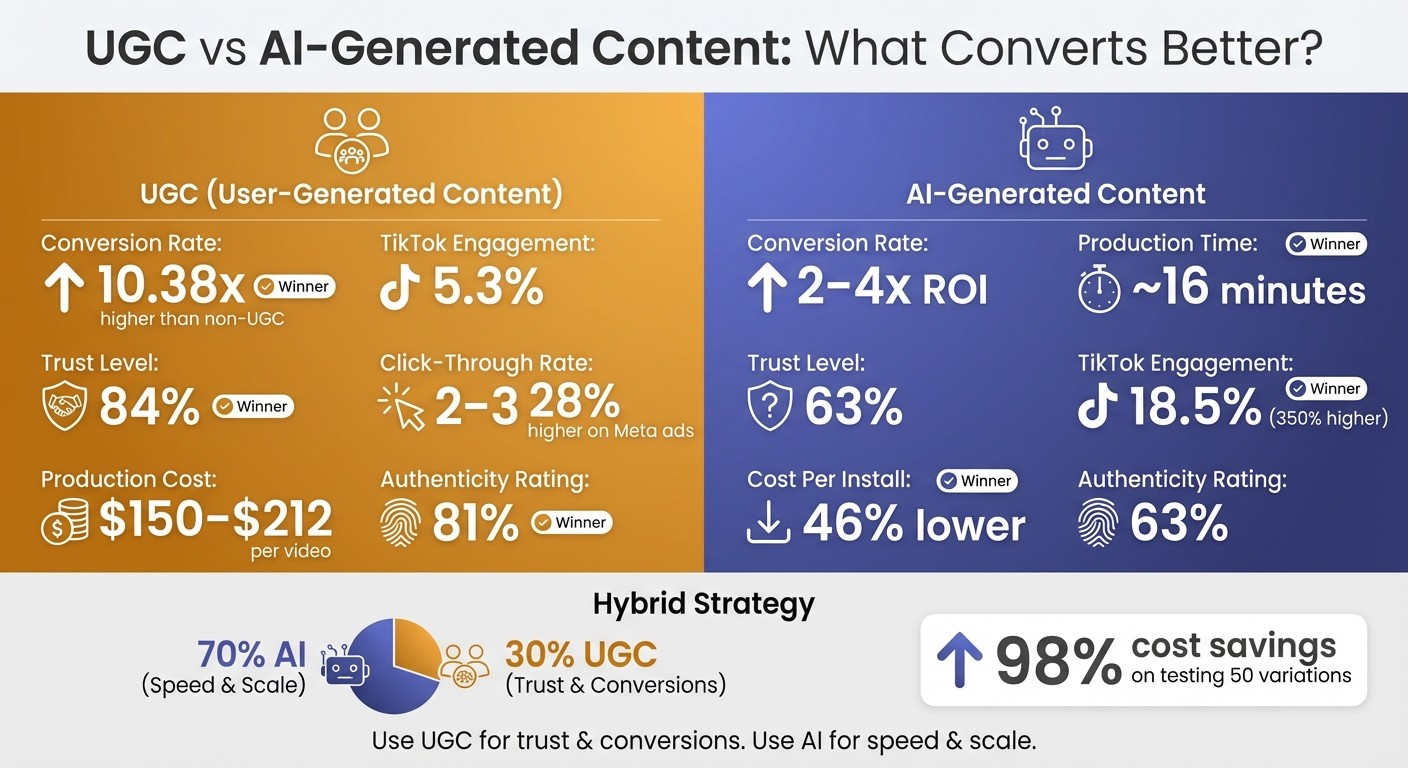
UGC vs AI-Generated Content: Performance Metrics Comparison
AI Ads vs Human Creators: Which Performs Better? (UGC Expert & AI Engineer Reveal Data)
What is UGC and AI-Generated Content?
Before diving into performance metrics, it’s crucial to understand the differences between User-Generated Content (UGC) and AI-Generated Content - and why these differences matter when it comes to driving results for your business. Let’s break it down.
User-Generated Content (UGC) Explained
User-Generated Content includes media like reviews, photos, videos, and Q&A responses created by real customers. This type of content typically comes from three main groups: everyday shoppers sharing their experiences, loyal fans advocating for the brand without compensation, and employees giving a glimpse into company culture.
Brands often encourage UGC through creative campaigns such as contests, giveaways, product sampling, branded hashtags, and influencer gifting. A standout example is GoPro’s "Million Dollar Challenge", which collected over 42,000 video clips from 170 countries between 2022 and 2023. The campaign led to approximately 25,000 product transactions, with shoppers who interacted with the UGC converting at a 3x higher rate. What makes UGC so impactful? Its raw, unpolished feel - it showcases real people using products in their everyday lives, not staged scenarios on a studio set.
UGC has clear marketing benefits. It builds trust and social proof when used in formats like customer photos on product pages, user videos in retargeting ads, or shoppable galleries in email campaigns. The numbers back this up: 55% of shoppers won’t purchase a product without reviews or customer photos. This authenticity is what makes UGC a powerful tool for boosting conversions and maximizing ROI.
AI-Generated Content Explained
AI-Generated Content, on the other hand, is created by artificial intelligence systems trained on vast datasets to replicate human creativity. Key technologies include Natural Language Processing (NLP) for text, Generative Adversarial Networks (GANs) for visuals, and advanced models like GPT-4, which predict word sequences to generate human-like responses.
The biggest strength of AI-generated content is its speed and scalability. It can be produced in just 16 minutes, compared to the 2–3 weeks it typically takes for traditional content. This allows brands to test multiple messaging strategies at a fraction of the cost - around $2 per video, compared to $150–$212 for traditional UGC. AI-generated content is also proving effective in certain areas: mobile apps using AI-driven UGC see a 63% higher likelihood of user installation, and some AI-generated videos on TikTok achieve engagement rates as high as 350% more than human-made UGC (18.5% vs. 5.3%) because of their ability to quickly adapt to trends.
However, AI content faces a trust challenge. While 81% of marketers are using generative AI, only 4% highly trust the output. Consumers are also hesitant - 30% of U.S. adults say seeing AI in advertisements makes them less likely to choose a brand. Despite its technical precision, AI lacks the relatable social proof that resonates with audiences. This is why AI-generated content scores a 63% perceived authenticity rating, compared to 81% for traditional UGC.
These distinctions highlight how UGC and AI-generated content serve different purposes and set the stage for a deeper dive into their performance metrics. Both have unique strengths, but understanding when and how to use them is essential for achieving the best results.
Conversion Performance: UGC vs AI-Generated Content
Let’s dive into how user-generated content (UGC) stacks up against AI-generated content when it comes to driving conversions.
UGC Conversion Data
When it comes to turning browsers into buyers, UGC leads the way. In Q3 2025, social media posts featuring UGC drove 10.38x higher conversion rates compared to non-UGC posts. On-site interactions with UGC - like customer photos, reviews, or Q&A sections - can boost conversions by as much as 177.2%. Visitors who engage with these elements convert at rates 102.4% higher than those who don’t. Even shoppers who filter for one-star reviews see a 71.9% lift in conversions.
"Shoppers on your site know that you're gonna say your products are awesome, but what's going to get them to convert is seeing that your past customers said it."
– Talia Shani, Head of UK Marketing, Yotpo
UGC doesn’t just shine on websites - it’s a game-changer in advertising too. Ads featuring authentic customer content on platforms like Meta see 28% higher click-through rates and 19% lower cost per acquisition compared to AI-generated or branded visuals. For example, Parachute’s retargeting ads that incorporated UGC achieved a 35% higher click-through rate and a 60% lower cost per click. Similarly, Iconic London experienced a 126% increase in conversion rates and an 11% boost in average order value within a year by integrating UGC.
The return on investment (ROI) from UGC is hard to ignore. MICHI reported a 51x ROI just 30 days after integrating shoppable Instagram posts and UGC. Frankies Bikinis saw UGC drive 19% of total orders and generate over 23% of online revenue. Petco’s "Spotted" sampling program increased review volume by 405% and boosted revenue per visit by 48% for sampled products.
While UGC dominates in trust and conversions, AI-generated content brings its own set of advantages in speed and scalability.
AI-Generated Content Conversion Data
AI-generated content stands out for its efficiency and cost-effectiveness. Producing a single piece of AI content takes about 16 minutes and costs around $2 per video, compared to $150–$212 for traditional UGC. This efficiency allows brands to test numerous messaging angles for the price of one traditional video.
In specific contexts, AI content can deliver impressive engagement. On TikTok, for instance, AI-generated UGC has achieved engagement rates as high as 18.5%, compared to 5.3% for human-created content - a 350% increase. For mobile app marketing, ChargeHub used AI-generated content to lower its cost per install by 46% compared to traditional banner ads.
Platforms like TwinTone make it even easier to scale AI content, offering unlimited AI-generated videos starting at $110/month for 10 videos. This enables brands to quickly produce product demos, shoppable content, and performance creatives across various platforms.
However, AI content faces a trust gap. While it scores 63% for perceived authenticity and 71% for brand trust, traditional UGC performs better, with 81% authenticity and 83% trust ratings. This gap can impact conversions, especially on product detail pages where social proof is critical to overcoming hesitation.
Direct Comparison: UGC vs AI
The data paints a clear picture: UGC thrives on trust and authenticity, while AI content excels in speed and scalability. Traditional UGC drives stronger trust-based conversions and builds lasting customer relationships. On the other hand, AI-generated content is ideal for top-of-funnel campaigns and rapid experimentation. In fact, 79% of consumers report that UGC heavily influences their purchase decisions, compared to only 12% for brand-created visuals.
While AI content offers cost-per-impression advantages, UGC provides the social proof shoppers need to make purchasing decisions. Case in point: 55% of shoppers won’t buy a product without reviews or customer photos.
Performance Comparison Table
Metric | Traditional UGC | AI-Generated Content |
|---|---|---|
Conversion Rate | 10.38x higher vs. non-UGC | 2–4x ROI |
Click-Through Rate | 28% higher (Meta ads) | Varies by platform |
Trust Level | 83% | 71% |
Authenticity Rating | 81% | 63% |
Production Cost | $150–$212 per video | ~$2 per video |
Production Time | 2–3 weeks | ~16 minutes |
TikTok Engagement | 5.3% | 18.5% |
Cost Per Install (Apps) | Traditional methods | 46% lower |
User Retention | 23% higher | Lower long-term retention |
The takeaway? Use AI for quick testing and broad reach, but lean on UGC to close sales and build trust. Many brands are adopting a 70-30 hybrid strategy: 70% AI-generated content for rapid experimentation and reach, paired with 30% traditional UGC to seal the deal at critical stages.
Using UGC and AI Together: A Hybrid Approach
Brands are increasingly combining User-Generated Content (UGC) with AI to get the best of both worlds. This hybrid strategy builds on the strengths of each, creating a powerful approach to boost conversions and engagement.
"The most successful app marketers we've studied don't debate AI vs traditional, they use both strategically. They leverage AI's speed and cost efficiency to identify winning messages, then amplify those insights with authentic creator content." – Muzammil, Growth at Superscale
A popular formula for this approach is a 70-30 split: 70% AI-generated content for rapid testing and scalability, paired with 30% traditional UGC to build trust at key conversion points. The cost difference is staggering - testing 50 video variations costs about $99 with AI, compared to $7,500–$10,600 for traditional UGC, offering a 98% savings. AI helps pinpoint which hooks, messages, and formats resonate, allowing brands to invest in high-quality creator content for strategies that are already proven to work.
The roles of AI and UGC are distinct but complementary. AI is perfect for quickly testing ideas, creating technical demos, and localizing content in over 175 languages. On the other hand, traditional UGC excels at emotional storytelling, testimonials, and high-consideration purchases where trust is critical. For instance, on TikTok, AI content can achieve engagement rates of 18.5% by adapting quickly to viral trends. Meanwhile, platforms like Instagram and YouTube tend to reward the authenticity of traditional UGC.
How TwinTone Enables Hybrid Content

TwinTone is a great example of how brands can merge AI efficiency with creator authenticity. The platform uses "AI Twins", which are digital replicas of real creators, to produce unlimited AI-powered UGC videos while maintaining the creators' unique style and personality. With plans starting at $110 per month for 10 videos, TwinTone can produce each video in about 16 minutes. It also supports over 40 languages, making it easy to localize content without managing global creator networks. Plus, its AI livestreaming feature allows brands to run continuous shoppable streams on major platforms.
TwinTone also offers tools to streamline the creative process. Its competitor research feature identifies winning trends, helping brands go from concept to published ad in under 30 minutes. API access enables programmatic content generation across product catalogs, while built-in analytics highlight which AI-generated content converts best - making it easy to decide which pieces deserve amplification with traditional UGC.
Real-World Applications for Hybrid Content
This hybrid approach can be applied throughout the customer journey. For top-of-funnel awareness campaigns, where speed and volume matter most, AI-generated content is a game-changer. For example, ChargeHub reduced its cost per install by 46% using AI-generated UGC instead of traditional banner ads.
For product launches and seasonal campaigns, a mix of AI and UGC works wonders. AI-generated demos can showcase technical details and use cases through customizable avatars, while real customer unboxing videos provide the social proof and emotional connection that audiences trust.
At the conversion stage, traditional UGC - like customer photos, video reviews, and Q&A content - can drive up to a 177.2% lift in conversions. AI supports this process by automatically tagging and categorizing submissions, surfacing the best-performing assets for maximum impact. Meanwhile, authentic UGC delivers the trust signals needed to close sales.
For retention and community building, authentic customer content takes center stage. Brands that prioritize genuine UGC have seen a 23% increase in retention rates compared to those relying solely on AI-driven campaigns. AI can still play a role here by translating testimonials, drafting product updates, or generating personalized follow-ups, allowing authentic customer stories to strengthen loyalty. Together, AI and UGC create a seamless customer experience that drives both immediate results and long-term engagement.
Conclusion: Which Converts Better?
When used thoughtfully, both user-generated content (UGC) and AI can deliver impressive results - but in different ways. UGC shines when it comes to building trust. It boasts an 81% trust rating, delivers an 8–15x ROI, and can increase conversions on product pages by 161%. On the other hand, AI focuses on efficiency, offering a 2–4x ROI with a 63% trust rating. Plus, AI's cost-effectiveness is hard to ignore: brands can test 50 creative variations for just $99, compared to the $7,500–$10,600 typically required for traditional methods. For instance, ChargeHub managed to cut its cost per install by 46% using AI-generated UGC.
Looking ahead to 2026, a hybrid strategy seems to be the winning formula. A 70-30 split - using AI for high-volume testing and trend-based content (like achieving 18.5% engagement on TikTok) while reserving authentic UGC for crucial conversion points - strikes the perfect balance between efficiency and trust. Tools like TwinTone make this approach even easier, offering scalable AI-powered content production. For example, their plans start at $110/month, producing 10 AI-powered videos in just 16 minutes.
"CGC isn't just cheaper content - it's trusted content. And in marketing, trust always beats polish." – Jay Baer, Marketing Strategist
In today's fast-moving digital world, blending UGC's authenticity with AI's speed and scalability is the smartest way to drive conversions and connect with audiences effectively.
FAQs
How can brands use UGC and AI-generated content together for better results?
Brands can blend User-Generated Content (UGC) with AI-generated content to craft a dynamic marketing strategy. UGC, created by actual customers, adds a layer of trust and relatability that naturally boosts engagement and conversions. AI tools can take this a step further by analyzing and curating UGC - picking out the most impactful reviews, photos, or videos to ensure the audience sees the most relevant and engaging content.
AI-generated content can also complement UGC by producing tailored assets like product descriptions or social media posts informed by customer data. Transparency is key here - brands should openly communicate when AI is involved and stick to ethical practices. By combining the authenticity of UGC with the precision and speed of AI, brands can drive deeper engagement and see better results.
What are the cost differences between User-Generated Content (UGC) and AI-generated content?
The cost of User-Generated Content (UGC) and AI-generated content depends on what you’re aiming to achieve and how you plan to execute your strategy. Generally, AI-generated content is easier on the budget. It enables brands to churn out a high volume of content quickly and at a relatively low cost. On the other hand, UGC often requires a bigger investment. This could include offering incentives to customers or managing the process of gathering and curating content manually.
That said, while AI content is more budget-friendly, UGC often delivers better returns on investment (ROI). Why? Because it fosters trust and connects with audiences on a personal level. Authentic photos, reviews, and testimonials from real customers tend to resonate more, driving stronger engagement, loyalty, and ultimately, sales. When choosing between these two approaches, weigh your budget, how much authenticity matters to your audience, and the specific objectives of your marketing campaigns.
How does trust influence the performance of UGC and AI-generated content?
Trust plays a huge role in determining how effective both User-Generated Content (UGC) and AI-generated content can be. Consumers often view UGC - like customer reviews, photos, and testimonials - as more credible and relatable. This sense of realness often translates into higher engagement and better conversion rates.
AI-generated content, however, tends to face more skepticism. Concerns about authenticity can make audiences wary, especially if the content feels overly automated or impersonal. While AI is undeniably useful for scaling content production, relying too heavily on it without adding a human touch can erode trust and hurt campaign results.
To truly connect with audiences and achieve better outcomes, brands should lean into genuine, user-created content. It’s this authenticity that builds trust and strengthens the bond between brands and their customers.