Smart Contracts for Creator IP Monetization
How to build a futureproof relationship with AI

Smart contracts are changing how creators earn from their intellectual property (IP). By automating licensing, payments, and royalties on the blockchain, these digital agreements eliminate middlemen, reduce delays, and simplify complex processes. Here’s how they work:
Tokenized IP Ownership: Converts IP rights into digital tokens, enabling fractional ownership, secondary sales, and built-in royalties.
On-Chain Licensing & Pay-Per-Use: Automates licensing terms and micro-payments for each use, like streaming or downloads.
Automated Royalty Splits: Instantly divides earnings among collaborators based on pre-set percentages.
These systems promise faster payments, transparent transactions, and reduced disputes. However, creators must navigate legal challenges like U.S. copyright laws and potential securities regulations. Platforms like TwinTone are already helping over 20,000 creators monetize AI-driven content through these smart contract models.
Key Takeaways:
Faster Payments: Real-time transactions replace manual delays.
Revenue Control: Creators keep up to 80–95% of earnings.
Legal Alignment: Compliance with U.S. laws remains essential.
Smart contracts are reshaping how creators manage and profit from their work, offering new tools for monetization while addressing long-standing industry pain points.
1. Tokenized IP Ownership
Rights Representation
Tokenized IP ownership takes intellectual property (IP) rights and converts them into blockchain-based digital tokens, essentially creating digital certificates of ownership. These tokens, often structured as NFTs, come with usage terms embedded directly into the asset. This allows smart contracts to automatically enforce licensing rules. Platforms like Monegraph showcase how this works by turning digital art into scarce, tokenized assets with built-in licenses. Thanks to blockchain's immutable ledger, ownership disputes and ambiguities common in traditional IP management are nearly eliminated. For creators, this means copyright, trademark, or patent rights are encoded directly into the token, ensuring their rights are protected and automatically enforced. This clear and reliable system opens up new opportunities for monetization.
Monetization Flexibility
Tokenization introduces revenue opportunities that go beyond what traditional licensing can offer. Creators can sell fractional ownership of their IP, enabling multiple investors to own shares of a music track, artwork, or patent. Tokens can also include pay-per-use licensing, ensuring that every time a photo is accessed or a design is used, payments flow directly to the creator's wallet. Beyond initial sales, tokenization supports secondary markets and recurring royalties. Smart contracts make this possible by facilitating direct, transparent payments, cutting out intermediaries who would typically take a share. This streamlined approach helps creators maximize earnings and manage revenue more efficiently across platforms.
Legal and Technical Fit
For tokenized IP ownership to thrive, its legal and technical framework must align with existing U.S. IP laws. Smart contracts align with copyright and patent laws by offering timestamped, enforceable proof of ownership that courts recognize. Technically, this system depends on efficient blockchains and widely used standards like ERC-721 or ERC-1155. These are often paired with Oracle systems to verify off-chain data. This combination allows independent creators to automate licensing and payments while staying compliant with legal requirements. As blockchain technology evolves, the integration of immutable ledgers and programmable IP rights promises to enable global, automated enforcement of creative rights.
Empowering Creators: The New Era of Programmable IP With Story Protocol

2. On-Chain Licensing and Pay-Per-Use
On-chain licensing takes the idea of programmable intellectual property (IP) a step further, enabling real-time, usage-based monetization through smart contracts.
Rights Representation
On-chain licensing embeds specific usage rights directly into smart contract code, turning traditional licenses into self-executing agreements. For instance, a photographer could define terms like "web-only, 12-month, non-exclusive use in the United States", and the smart contract would automatically block unauthorized uses, such as printing the image or extending the timeframe beyond 12 months. Buyers can choose from pre-defined rights packages - like personal use, standard commercial, or enterprise buyout - with the smart contract ensuring compliance. The content is only released when the buyer's wallet, payment, and requested rights match the contract's conditions.
For AI-driven creations, such as virtual influencers or synthetic voices, these contracts also define IP rights with additional AI-specific rules. For example, a creator might tokenize the right to use their likeness with conditions like "short-form social video ads in the U.S., up to 50,000 impressions per month, excluding political or adult content". Platforms like TwinTone, which convert real creators into AI Twins for generating on-demand content, integrate these smart contracts to log every use - whether it’s a video clip or a livestream - as a discrete event that triggers payments. As of December 2025, TwinTone manages over 20,000 creators, with their AI Twins collectively amassing over 1 billion views across platforms like TikTok, Instagram, and YouTube.
Monetization Flexibility
Pay-per-use smart contracts turn every individual use - whether it’s streaming a song, downloading an image, or generating AI content - into a billable event that triggers an automatic micro-payment. For example, a music creator might charge $0.005 per stream, with payments processed for each verified play. Similarly, image licensors could charge $1.00 per download, while AI-content platforms might bill $0.02 for each use of a licensed dataset or voice model. By cutting out intermediaries, these systems allow creators to keep 80–95% of their revenue - far more than the 40–60% typical of traditional distribution methods. However, network gas fees and platform commissions can reduce these margins slightly.
Smart contracts also support tiered licensing options, offering flexibility for different use cases. Templates range from non-commercial personal use to extended commercial licenses and global buyouts. These licenses can include one-time purchases or subscriptions with volume caps and overage pricing. For example, a monthly subscription might revoke usage rights if payments lapse, much like how SaaS billing works for software licenses.
Legal and Technical Fit
In pay-per-use models, platforms log each usage event - such as a view, stream, or download - and batch these events into smart contract calls for processing. For example, a streaming service might tally all plays of a track within a specific timeframe (e.g., hourly) and then trigger the smart contract to settle payments based on the total count. Fraud prevention measures include account authentication, watermarking, rate limiting, and using on-chain oracles to validate metrics from trusted sources. Cryptographic access keys, released only after a successful contract interaction, also ensure that each asset consumed corresponds to a recorded licensing event.
In the U.S., smart contracts must align with copyright and contract law, functioning as legally valid agreements with clear terms, mutual consent, and consideration. To support legal interpretation, many implementations include a human-readable license text alongside the on-chain code, often referenced in the contract metadata. These contracts can also handle complex conditions, such as time-limited campaigns, geographic restrictions, or dynamic pricing. For instance, a smart contract might store start and end timestamps in UTC to enforce expiration dates or use oracles to manage region-specific licenses. TwinTone’s collaboration with Story Protocol ensures its AI Twins are legally recognized and technically enforceable, allowing brands to instantly generate "Product In Hand" videos while guaranteeing creator payments.
This system lays the groundwork for more advanced revenue-sharing models, like automated royalty splits, which will be explored in the next section.
3. Automated Royalty Splits and Revenue Sharing
Smart contracts have taken automated licensing a step further by simplifying revenue sharing, making the process seamless for creators and collaborators.
Rights Representation
With smart contracts, ownership stakes and revenue percentages are encoded directly into blockchain code. This ensures that payment distributions are immutable and transparent. For example, when a team of creators - like a photographer, graphic designer, and music producer - collaborates on a digital project, the smart contract automatically allocates revenue based on pre-agreed splits. This eliminates the need for manual payment processing. A practical use case is in digital art, where royalties are automatically distributed whenever a piece is resold or used, turning what was once easily replicable art into assets with scarcity and value. In creator-driven AI systems, platforms like TwinTone integrate with Story Protocol to manage these processes. Whether it’s generating a "Product in Hand" video or running a 24/7 livestream, the smart contract backend ensures that licensing and revenue distribution occur automatically, with no manual oversight required.
Monetization Flexibility
Automated royalty splits give creators the freedom to adopt various revenue-sharing models. These can range from fixed splits to tiered arrangements that adjust based on performance metrics. Payments are divided in real time among contributors, supporting not only one-time transactions but also recurring models like subscriptions or secondary market resales. In cases where a creator’s work changes hands, smart contracts ensure the original creator continues to earn royalties. By routing payments directly to digital wallets and bypassing traditional intermediaries, creators can keep a larger share of their earnings. TwinTone demonstrates this efficiency by connecting brands with verified creators. When content is deployed across platforms, the smart contract takes care of everything: brands receive the content they need, and creators are paid automatically.
Legal and Technical Fit
From a technical perspective, smart contracts use predefined algorithms to track usage events - such as views, streams, or resales - and calculate royalties in real time. To ensure accuracy and reliability, best practices include code audits, integration of oracles for off-chain data verification, and multi-signature wallets for managing intricate splits. For instance, oracles can pull usage data from external platforms, like streaming services, to verify metrics and enable precise billing.
On the legal side, smart contracts must comply with U.S. copyright and contract laws, functioning as enforceable agreements with clearly defined terms and mutual consent. While blockchain provides an immutable record of ownership and transactions, disputes may still need to be resolved off-chain through arbitration or traditional legal methods. Hybrid models are often used, combining code-enforced terms with readable license text for easier interpretation. TwinTone addresses these legal and technical challenges by working with legal experts and adhering to established intellectual property protocols, ensuring that royalty splits are not only efficient but also legally sound.
This automated revenue-sharing system showcases how smart contracts are reshaping the monetization of intellectual property, laying the groundwork for a more streamlined and creator-friendly economy.
Pros and Cons
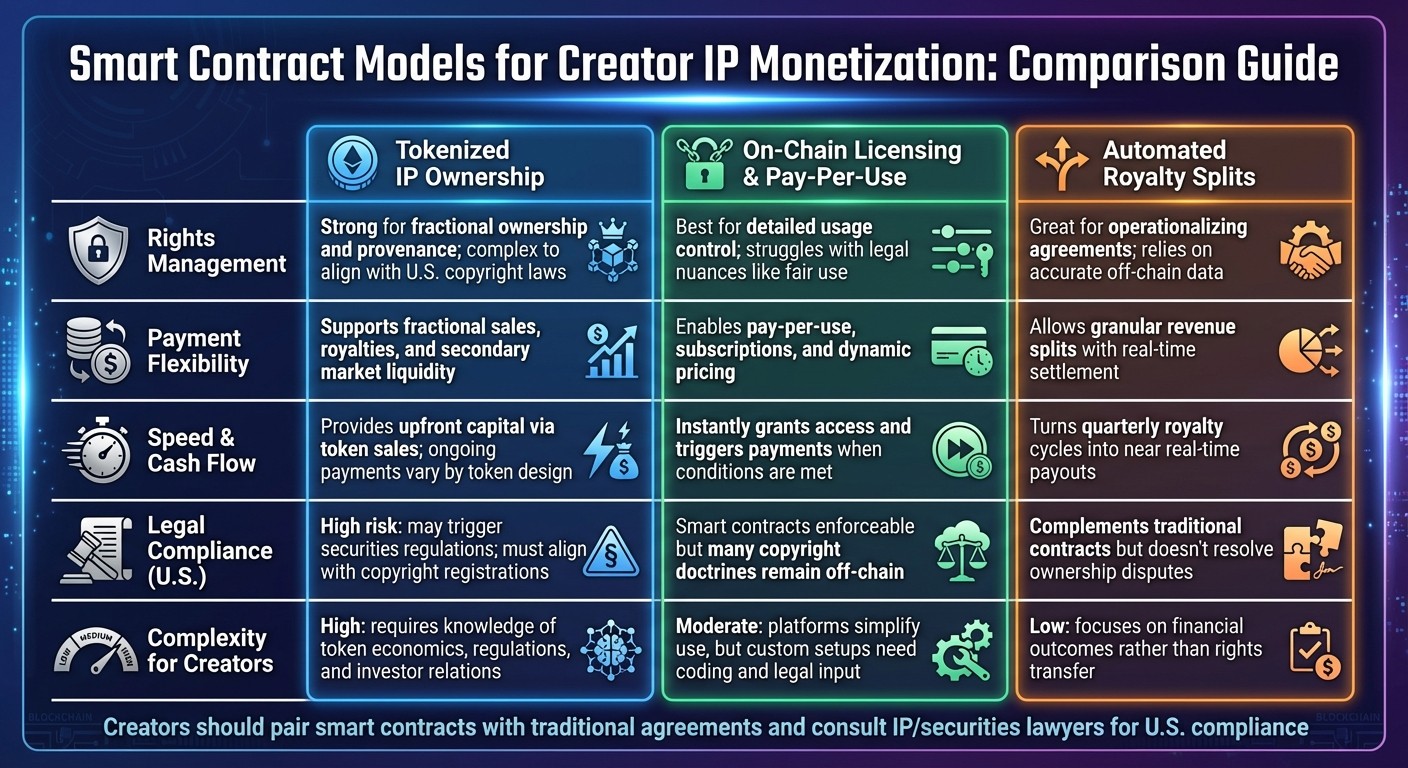
Smart Contract Models for Creator IP Monetization: Comparison Guide
Smart contract models bring a mix of opportunities and challenges for U.S. creators. Knowing the strengths and limitations of each approach can help creators align the right model with their content and business goals. Below, we break down the key advantages and drawbacks of three popular smart contract frameworks, summarized in the table at the end.
Tokenized IP Ownership is a powerful way to raise upfront funds and create liquidity in secondary markets. By fractionalizing rights, creators can sell portions of their work to fans or investors while embedding provenance directly on the blockchain to reduce disputes over ownership. However, this model comes with legal hurdles. Tokens marketed as investments may fall under SEC regulations, requiring securities registration. Additionally, because U.S. IP laws don’t fully integrate with blockchain records, off-chain agreements are still needed to clarify what rights each token conveys. Creators also face challenges with valuation and tax reporting for token sales. In short, while this model reimagines licensing, it introduces its own set of complexities.
On-Chain Licensing and Pay-Per-Use offers creators precise control over how their content is used. Smart contracts can define license terms - like personal versus commercial use, geographic restrictions, or time limits - and automatically grant usage rights when conditions are met. This model also enables microtransactions, something traditional systems struggle to handle efficiently. However, smart contracts don’t replace U.S. copyright or contract law. Cross-border transactions add layers of complexity, and creators still need off-chain records, KYC/AML checks, and clear terms of service. Despite these limitations, this approach simplifies rights management for creators dealing with intricate licensing needs.
Automated Royalty Splits and Revenue Sharing shine when it comes to distributing earnings transparently and in real time. Creators can predefine revenue shares for collaborators in a smart contract, ensuring instant payouts whenever revenue is generated. This eliminates delays, reduces administrative costs, and avoids disputes over revenue distribution. However, the rigidity of smart contracts can be a double-edged sword. Errors in the split require redeploying the contract or unanimous consent to fix, and reclaiming funds in cases of fraud or chargebacks is far more difficult compared to traditional systems. While this model has its risks, its ability to streamline payouts highlights the growing shift toward automation in revenue sharing.
Here’s a summary of how these models compare across key criteria for U.S. creators:
Criterion | Tokenized IP Ownership | On-Chain Licensing & Pay-Per-Use | Automated Royalty Splits |
|---|---|---|---|
Rights Management | Strong for fractional ownership and provenance; complex to align with U.S. copyright laws | Best for detailed usage control; struggles with legal nuances like fair use | Great for operationalizing agreements; relies on accurate off-chain data |
Payment Flexibility | Supports fractional sales, royalties, and secondary market liquidity | Enables pay-per-use, subscriptions, and dynamic pricing | Allows granular revenue splits with real-time settlement |
Speed & Cash Flow | Provides upfront capital via token sales; ongoing payments vary by token design | Instantly grants access and triggers payments when conditions are met | Turns quarterly royalty cycles into near real-time payouts |
Legal Compliance (U.S.) | High risk: may trigger securities regulations; must align with copyright registrations | Smart contracts enforceable but many copyright doctrines remain off-chain | Complements traditional contracts but doesn’t resolve ownership disputes |
Complexity for Creators | High: requires knowledge of token economics, regulations, and investor relations | Moderate: platforms simplify use, but custom setups need coding and legal input | Low: focuses on financial outcomes rather than rights transfer |
To minimize risks, U.S. creators should pair smart contracts with traditional written agreements, consult IP and securities lawyers, and work with platforms designed for U.S. compliance. It’s also wise to budget for smart contract audits and follow basic security practices, like using multi-signature wallets and tested templates, to prevent hacks or errors that could misroute funds permanently.
Conclusion
Tokenized IP ownership offers creators with valuable intellectual property a way to secure upfront funding by selling fractional shares. Meanwhile, on-chain licensing and pay-per-use models work perfectly for high-volume content, replacing lengthy negotiations with seamless microtransactions. For collaborative projects, automated royalty splits guarantee transparent and real-time payouts, cutting out disputes and tedious manual accounting.
TwinTone builds on these concepts by using smart contracts to streamline licensing and payments for AI-generated content. For instance, when brands use a creator's AI Twin to produce product demos or shoppable videos, a smart contract takes care of everything - issuing licenses, processing payments in USD or stablecoins, and recording transactions on-chain. This eliminates the need for manual paperwork or coordination. Automated royalty splits are embedded into the smart contracts, ensuring revenue is distributed precisely between creators, the platform, and brands. Creators benefit significantly, keeping 80–90% of revenue compared to the traditional 50% split.
TwinTone also includes an on-chain registry of creator permissions, which clearly defines how each AI Twin can be used. This registry specifies details like which products the Twin can promote, the languages it can operate in, the platforms it can appear on, and the pricing model - whether it's per video, per campaign, or based on revenue sharing. This setup not only provides legal clarity for U.S. brands but also empowers creators to maintain control over their digital likeness.
FAQs
How do smart contracts help creators comply with U.S. copyright laws?
Smart contracts offer creators a practical way to navigate U.S. copyright laws by automating licensing agreements and safeguarding intellectual property rights. These contracts generate clear, unchangeable records of ownership and usage, which helps minimize the chances of disputes or infringement.
By embedding legal terms directly into their code, smart contracts ensure that payments, permissions, and rights are handled automatically, all while adhering to U.S. copyright regulations. This approach simplifies the process, giving creators a reliable and efficient method to protect and profit from their work.
What challenges might creators face when using tokenized intellectual property?
Creators face a range of challenges when working with tokenized intellectual property (IP). One major issue is confirming ownership of the IP itself, as disputes over who holds the rights can complicate the process. On top of that, tokenizing IP rights often requires navigating complex legal systems, which can differ significantly depending on the jurisdiction.
There are other obstacles as well. The value of IP tokens can be highly unpredictable due to market fluctuations, and the regulatory landscape for digital assets remains uncertain. These factors can introduce significant risks for creators aiming to monetize their IP through tokenization. To tackle these challenges, careful planning and seeking advice from experts are often crucial steps.
What are automated royalty splits, and how do they benefit collaborative projects?
Automated royalty splits make sharing revenue in collaborative projects a breeze. They work by dividing income according to agreed-upon percentages, ensuring that whenever earnings roll in, each contributor gets their share automatically - no spreadsheets, no manual calculations.
This system cuts down on administrative tasks, eliminates confusion, and builds trust among team members. With the financial side handled seamlessly, everyone can focus more on what truly matters: bringing creative ideas to life.