
Scaling UGC Without Hiring More Creators
How to build a futureproof relationship with AI

Creating high-volume user-generated content (UGC) no longer requires hiring more creators. AI and automation now allow brands to produce hundreds of custom videos in hours, cutting costs by up to 90%. Instead of spending $100–$500 per video and waiting weeks for production, businesses can generate content for as little as $2–$10 per video, all while maintaining consistency and speed.
Here’s how AI is changing UGC production:
Cost Savings: AI-generated videos cost significantly less than human-created ones.
Speed: AI tools can produce 100+ video variations in a single day.
Scalability: A single marketer can oversee large-scale content creation and testing.
Automation: AI systems handle UGC collection, organization, and distribution across platforms like TikTok, Instagram, and YouTube.
Customization: AI avatars and multilingual features allow brands to create tailored content for diverse audiences.
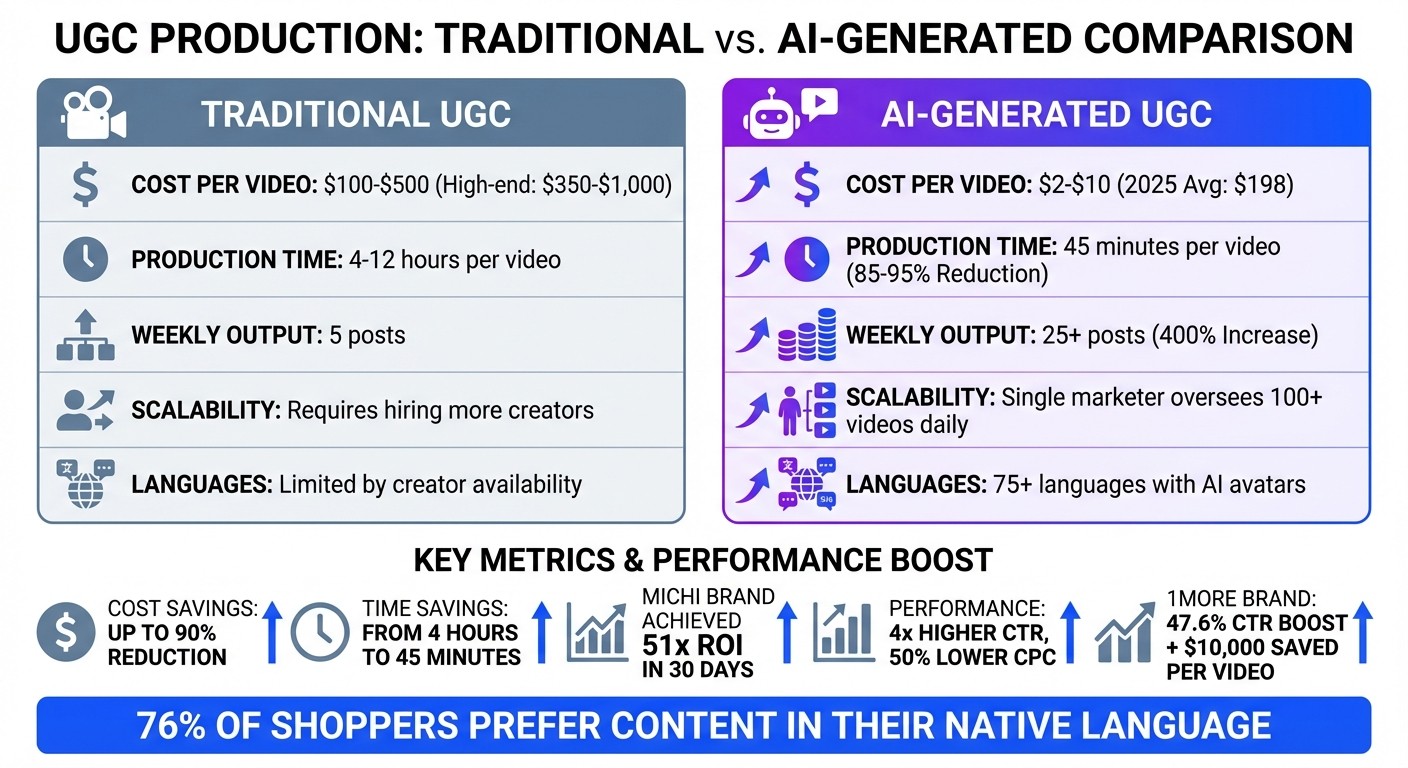
AI-Generated UGC vs Traditional UGC: Cost, Speed, and ROI Comparison
How to Use AI for UGC Content Creation - The COMPLETE 2025 Framework
Automating UGC Workflows
Managing user-generated content (UGC) manually can be a massive time drain. Marketers often spend hours digging through hashtags, sorting submissions, and trying to organize scattered files. But automation changes the game by taking over tasks like collecting, organizing, and distributing content - without the need for constant human involvement. This is where AI-driven systems come into play.
Automated UGC Collection and Organization
AI tools are designed to work around the clock, scanning platforms like Instagram, TikTok, and YouTube for mentions of your brand, hashtags, and tags. These systems surface relevant content in real time, while automatically filtering out anything inappropriate or off-brand. They even use visual recognition to identify products in posts and tag them with metadata, making the content easy to retrieve and manage.
"An AI UGC platform is a next-generation system that uses artificial intelligence to automate how brands collect, organize, and display user-generated content." - Dushko Talevski, SEO & Content Editor, EmbedSocial
Take the example of fashion brand MICHI. In 2025, they integrated an automated shoppable UGC system and saw a 51x ROI within just 30 days - far outperforming their previous manual content management approach. Similarly, a Shopify-based beauty store boosted its weekly content output from 5 to 25 posts - a 400% increase - while slashing production time from 4 hours to just 45 minutes per post. These results show how automation not only saves time but also allows brands to scale their UGC strategies without needing more creators.
Multi-Platform UGC Distribution
Once your UGC is collected and organized, the next step is distributing it across platforms. Automation tools make this seamless by reformatting content for each platform automatically. For instance, a single video can be resized to 9:16 for TikTok and Instagram Reels, 1:1 for Instagram feeds, and 16:9 for YouTube - all without manual editing. This ensures your content looks polished and native, no matter where it’s posted.
Automation also enables batch generation, creating multiple versions of content at once. You can test different hooks, visuals, and calls-to-action easily. Performance data from ad platforms syncs back into your content library, highlighting which variations deliver the best click-through rates and return on ad spend. TwinTone's API, for example, allows brands to programmatically generate and distribute content across entire product catalogs at scale, eliminating the need for manual uploads. This streamlined process makes it easier - and cheaper - to scale UGC efforts.
AI-Powered Performance Tracking
Automation doesn’t stop at distribution. AI tools also monitor performance in real time, ensuring your campaigns stay optimized. Sentiment analysis evaluates how people feel about your brand by analyzing thousands of reviews and mentions automatically. Advanced analytics track key metrics like ROAS, engagement, and creative fatigue, helping you pinpoint which hooks or creators yield the best results.
When an asset starts to underperform, automated systems flag it and replace it with fresh content right away. AI agents even manage routine customer feedback across platforms, keeping your brand voice consistent while ensuring every comment or query gets a response. By leveraging these automated workflows, brands can significantly cut down on content creation costs while maintaining high levels of engagement.
AI-Generated Content Creation
AI is transforming the way brands create content, making it faster, cheaper, and more efficient. By leveraging automated workflows, businesses can now generate and refine user-generated content (UGC) on a massive scale. For example, AI tools can take product pages and customer reviews and turn them into polished videos in just minutes. This eliminates the need to coordinate with multiple creators while still delivering UGC-style content with the personal, relatable feel that drives conversions. This shift highlights the evolving debate between AI vs. human influencers in modern marketing. The cost savings are significant too: AI-generated videos now average $198 per video, marking a 44% drop from last year, compared to the $350 to $1,000 per video price tag of traditional production methods. These numbers highlight just how quickly AI is reshaping the content landscape.
On-Demand AI UGC Generation
Platforms like TwinTone have revolutionized UGC creation by instantly converting product pages and customer reviews into natural-sounding scripts. By pulling language directly from real customer feedback - like reviews and support tickets - this process ensures the final script sounds authentic, not like a corporate ad. Brands can choose from over 1,500 AI avatars, customizing them by age, ethnicity, and style to match their audience. They can even fine-tune emotional expressions, like adding tags for laughter or excitement, to keep the content engaging and relatable.
The time savings are remarkable. While traditional content creation can take 4–12 hours, AI cuts this down to just 45 minutes, representing an 85–95% reduction in production time. TwinTone’s API takes it a step further, allowing brands to automate content creation across entire product catalogs and even batch-test multiple versions of a video’s opening seconds. This lets companies quickly identify the hooks that grab attention most effectively. With such speed and scalability, AI is redefining how brands approach content creation.
AI Content Curation
AI doesn’t just stop at creating content - it also helps determine what will perform best. Predictive curation tools analyze engagement data to rank UGC submissions, helping brands focus on the styles, messages, and creator types that are most likely to resonate with their audience. By combining content creation with data-driven insights, AI ensures that every piece of content is optimized for success before it even goes live.
AI Twins and Virtual Creator Technology
AI Twins are another game-changer. These digital replicas of real creators mimic their style, personality, and voice, allowing brands to scale content production without the need for additional filming. TwinTone uses minimal footage to train these digital twins, ensuring that their tone, gestures, and overall delivery stay consistent. Voice cloning adds another layer of personalization, replicating approved voice actors or generating realistic AI voice cloning tools for multilingual content in over 75 languages. This multilingual capability is a big deal, as 76% of online shoppers prefer to buy products when the information is presented in their native language.
"AI isn't replacing creative thinking - it's compressing the production bottleneck between idea and execution." - Creatify Team
Ensuring authenticity is key. AI tools are designed to mimic natural speech patterns and gestures, avoiding the robotic feel that might turn off viewers. Transparency also plays a crucial role; clearly labeling content as AI-generated (e.g., “This video features an AI avatar”) helps build trust and aligns with platform policies. By combining digital twins with intentional design choices, brands can produce scalable, cost-effective UGC that still feels personal and engaging.
Repurposing Existing UGC
You can make existing user-generated content (UGC) work harder by tailoring it for different platforms and audiences. By reworking UGC to fit various formats, brands can expand their content reach without increasing production costs. Pairing this strategy with AI-driven tools and automation ensures every piece of UGC delivers maximum value.
Adapting UGC for Different Platforms
Once you've collected and distributed UGC, repurposing allows you to get even more out of it by customizing assets for different platforms. For instance, a single high-performing video can be transformed into multiple pieces of content. You could pull a 15-second highlight for TikTok, create a LinkedIn carousel from a key insight, or reformat a testimonial for Instagram Stories. The key is to avoid simply copying and pasting - each piece should feel like it belongs on the platform it's shared on.
"Repurposing isn't about doing more work. It's about doing better work once and making it work harder for you later." – Courtney Howard, Hummingbird Agency
AI tools make this process faster and more efficient. For example, TwinTone's batch mode can generate multiple variations of the same content by adjusting aspect ratios (like 9:16 for Stories, 16:9 for YouTube, or 1:1 for feed posts) without the need for manual editing. Global brands can also benefit from AI-powered localization, which transforms English UGC into versions in over 75 languages. This includes accurate lip-syncing and native-speaking avatars, eliminating the need for additional filming. Localized ads, in particular, can boost conversion rates by up to 70% compared to English-only campaigns. Importantly, this approach keeps the "real person" vibe intact by embracing natural imperfections like casual lighting and conversational tones.
Adding UGC to Shoppable Content
Incorporating UGC into shoppable content on your website can create seamless pathways to purchase. Embedding shoppable galleries on homepages, product detail pages, or even in email campaigns turns customer testimonials into revenue-driving tools. By tagging products in images and videos, you make it easy for customers to shop directly from the content.
The impact is undeniable. For example, women's fashion brand MICHI saw a 51x ROI within just 30 days of integrating shoppable Instagram content with UGC. This shows how repurposing social content into shoppable experiences can turn existing assets into powerful sales drivers.
Tracking UGC Performance and ROI
Show that your scaled UGC efforts are bringing in revenue. The right metrics can reveal whether your AI-generated content, repurposed assets, and automated workflows are truly driving results - or just filling up your schedule. It’s not about vanity stats like total views. The focus should be on identifying which pieces of content influence customer decisions and how their costs stack up against their earnings.
Core UGC Performance Metrics
Start by tracking metrics that directly connect to revenue. Return on Ad Spend (ROAS) measures how much revenue you earn for every dollar spent on UGC ads. Conversion Rate (CVR) shows how many viewers actually make a purchase after engaging with your content. Cost Per Acquisition (CPA) helps you understand how much you’re spending to gain each new customer. Keep an eye on Average Order Value (AOV) to see if UGC inspires larger purchases, and monitor add-to-cart rates to identify where customers might drop off before completing their purchase.
Engagement metrics are also important, but only if they relate to sales. For instance, Click-Through Rate (CTR) measures how often viewers take action after seeing your UGC. The "thumb-stop rate" - how many people watch beyond the first three seconds - indicates if your content grabs attention. Hold rate and total watch time gauge whether your content keeps viewers engaged. UGC-based ads often outperform traditional formats, delivering 4x higher click-through rates and 50% lower cost-per-click.
Efficiency metrics are equally crucial. Track content production costs (comparing AI-generated UGC to human-created content), average approval time, and content volume per week. For long-term results, measure Customer Lifetime Value (CLV), repeat purchase rates, and churn reduction to see whether UGC builds lasting customer loyalty. Combine these metrics with real-time data to fine-tune your campaigns.
Real-Time AI Analytics
AI-powered analytics tools go beyond basic dashboards, offering insights down to the clip level - pinpointing which specific hook, scene, or call-to-action in a video delivered results. For example, they can identify the exact three-second intro or product angle that resonated with viewers. This level of detail transforms every campaign into a learning opportunity.
"You know exactly which hook, angle, or CTA moved the metric - and can do it again on purpose." – Sophia Carter, Uplifted.ai
Predictive analytics take it a step further by evaluating creative assets before you spend any money, leveraging billions of data points to estimate a video’s performance. This allows you to allocate your budget to content that’s likely to succeed. Automated fatigue detection monitors how often ads are shown and flags when performance starts to decline, so you can refresh your content before ROI suffers. Tools like TwinTone’s analytics dashboard provide real-time attribution tracking, linking specific UGC videos directly to sales and conversions, so you know exactly which AI-generated content is driving revenue.
In 2025, audio brand 1More used AI-powered UGC tools to generate multiple video variations from product URLs. The outcome? A 47.6% boost in CTR and an estimated $10,000 saved per video compared to traditional production methods. That same year, Twist Digital shifted to UGC-style video ads and saw a 200% jump in CTR, outperforming their polished, traditional assets.
Conclusion
Scaling user-generated content (UGC) has entered a new phase, thanks to smarter, AI-driven platforms. These tools can turn a single product URL into dozens of video variations - complete with unique hooks, avatars, and scripts - all in just minutes. No more waiting around for shipping, briefings, or managing contracts. The result? You can generate over 100 videos daily for as little as $2–$4 each, compared to the $100–$500 price tag of traditional UGC workflows. This efficiency is reshaping how brands approach content production.
AI-powered systems also bring data-driven iteration into the mix, allowing for rapid testing and smarter budget allocation. Real-time analytics ensure you're only investing in what delivers results. On top of that, AI avatars can create hyper-realistic videos in 75+ languages, complete with perfectly synced lip movements. This means brands can launch global campaigns without the need to hire local talent.
Platforms like TwinTone are pushing these capabilities even further. By transforming real creators into AI Twins, they enable on-demand UGC creation, live shopping streams, and seamless content scaling across platforms like TikTok, Shopify, Amazon, and YouTube. And they do all this while maintaining each creator's unique tone and style. Starting at $110/month for 10 AI-generated UGC videos, these platforms offer an affordable way for brands to experiment without overhauling their entire content strategy.
The most successful brands today are producing 20–50 new assets every week, consistently refreshing their content, and turning every campaign into a treasure trove of data for future improvements. If you're still relying solely on manual creator workflows, you're already playing catch-up.
FAQs
How does AI create authentic content without feeling robotic?
AI helps content feel more natural and less robotic by using sophisticated techniques that mimic human creativity and communication. It studies patterns in user-generated content to understand what connects with audiences, then applies that knowledge to create visuals or text that feel relatable and engaging.
It also leverages tools like synthetic media, including virtual influencers or avatars, which are designed with lifelike expressions and behaviors to make the content seem more authentic. By crafting precise prompts and offering clear context, AI can produce content that feels personal and conversational. Being upfront about AI's role in the process further fosters trust, ensuring the material stays engaging and believable while maintaining a human-like quality.
What are the key advantages of using AI to create user-generated content (UGC)?
AI-generated user-generated content (UGC) brings some clear advantages compared to traditional approaches. For one, it allows brands to create content much faster, helping them meet tight deadlines and scale their efforts with ease. Plus, it’s budget-friendly, cutting down on the costs of hiring additional creators while still delivering quality content.
Another key perk is the ability to generate high volumes of content that feel genuine and relatable to audiences. AI tools can even customize this content to fit specific campaigns or target demographics, which can boost engagement and drive conversions. For businesses aiming to expand efficiently, AI-powered UGC is a game-changing resource.
How can brands make sure AI-generated content matches their unique brand voice?
Brands can make sure AI-generated content mirrors their unique voice by leveraging tools designed for customization and fine-tuning. These tools let companies define the exact language, tone, and messaging that align with their identity, helping maintain a consistent style across all content.
Another way to reinforce authenticity is by incorporating avatars or visual elements that reflect the brand's personality. This adds a relatable and cohesive layer to the content. It's also crucial to regularly review and tweak AI-generated outputs to ensure they meet quality standards and stay aligned with the brand's guidelines. By combining these approaches, businesses can scale user-generated content effectively without compromising their distinct voice.