Scaling Personalization for DTC Brands
How to build a futureproof relationship with AI

Personalization is no longer optional for DTC brands - it’s expected. Consumers demand tailored experiences, and brands using AI to deliver these interactions are seeing major benefits: higher revenue, reduced costs, and improved loyalty.
Key takeaways:
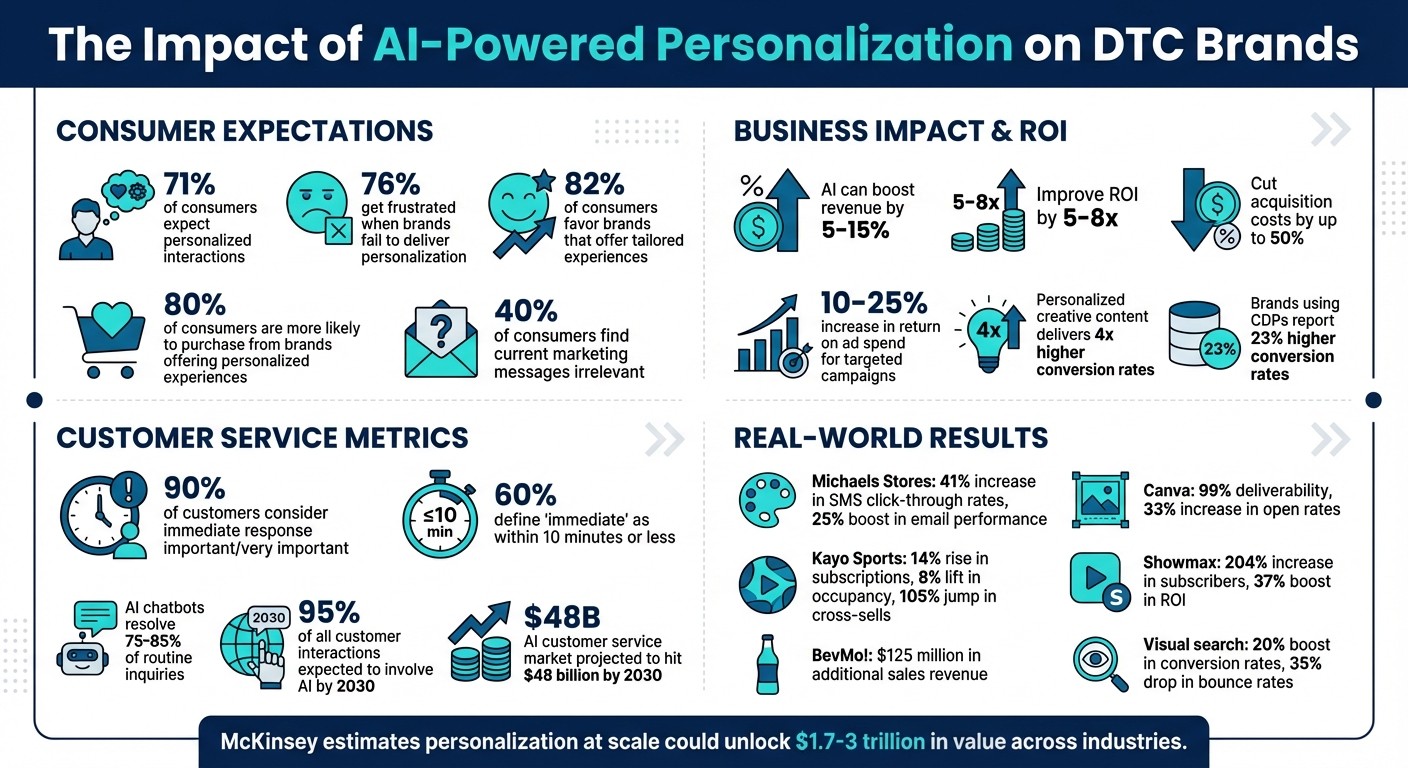
71% of consumers expect personalized interactions, while 76% get frustrated when brands fail to deliver.
AI can boost revenue by 5–15%, improve ROI by 5–8x, and cut acquisition costs by up to 50%.
Tools like generative AI and recommendation engines allow brands to scale personalized content, emails, and product suggestions without increasing team size.
AI-powered personalization is reshaping how brands connect with customers - from dynamic product recommendations to real-time content adjustments. Whether it’s using predictive analytics, automated messaging, or AI-driven livestream shopping, the focus is on making every interaction relevant and timely. For DTC brands, this isn’t just about marketing - it’s about sustainable growth.
AI-Powered Personalization Impact on DTC Brand Performance and ROI
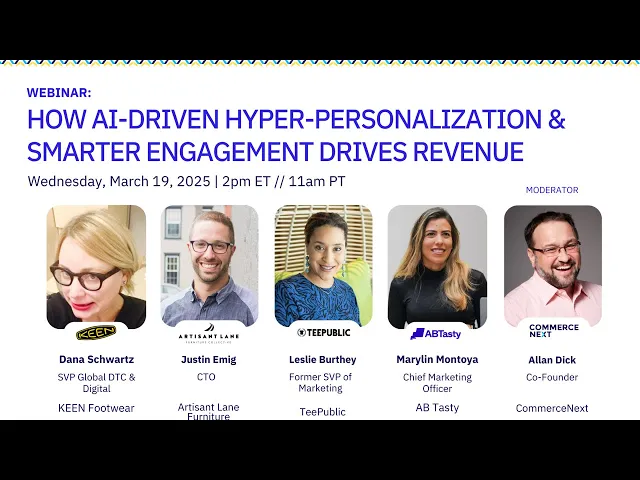
How AI Driven Hyper Personalization & Smarter Engagement Drives Revenue
Using AI to Scale Personalization
DTC brands face the challenge of delivering personalized experiences to vast audiences without ballooning their marketing teams. To tackle this, many are turning to what McKinsey refers to as "content factories". These systems leverage generative AI to automatically create personalized copy, images, and videos. This approach speeds up content production by up to 50 times compared to manual methods. For instance, Michaels Stores used a generative AI platform to scale personalized email campaigns from 20% to 95% of their total sends, resulting in a 41% increase in SMS click-through rates and a 25% boost in email performance. This shift sets the stage for a deeper exploration of AI-driven personalization.
AI-Powered Content Creation and Personalization
AI has transformed the way brands create and tailor content. Instead of producing fully finished assets for broad audiences, brands now focus on creating modular content pieces - like headlines, descriptions, and images - that AI combines dynamically based on the viewer.
Take Canva as an example. By using AI-powered localization, the platform scaled its weekly email volume from 30 million to 50 million messages. This effort achieved 99% deliverability and a 33% increase in open rates.
AI also adapts content in real time. By analyzing live signals - such as scroll depth, search behavior, and product comparisons - it can adjust website layouts and calls-to-action while customers browse. A North American retailer applied this strategy to replace generic holiday discounts with AI-driven targeted offers, leading to a 3% increase in annualized margins within just three months.
As content creation becomes more modular and responsive, recommendation systems enhance personalization further by refining customer interactions in real time.
Dynamic Product Recommendations
AI-powered recommendation engines have evolved far beyond basic suggestions like "customers who bought this also bought that." Modern systems use propensity scoring to predict specific customer actions, such as making a purchase, canceling a subscription, or responding to an offer. This allows brands to automate the "next best action" without relying on manual segmentation.
Kayo Sports, an Australian streaming service, offers a compelling example. In fiscal year 2024, they introduced a "Customer Cortex" personalization engine that used reinforcement learning to analyze individual behavior. This system scaled from 300 communication variations to 1.2 million personalized messages, resulting in a 14% rise in subscriptions, an 8% lift in average annual occupancy, and a 105% jump in cross-sells.
The shift from static rules to adaptive learning is key. Instead of relying on rigid "if this, then that" logic, AI can distinguish between casual browsers and repeat buyers in real time. Grubhub showcased this capability in their 2020 "Taste of 2020" campaign, which pulled 32 unique attributes per user - like favorite restaurants and order frequency - to craft thousands of personalized "year in review" emails. This effort led to a 100% increase in social media mentions and an 18% boost in word-of-mouth referrals.
The potential for personalization extends further with AI-generated user-generated content (UGC) and interactive livestreams.
AI-Generated UGC and Livestreams with TwinTone

Scaling authentic user-generated content has long been a challenge due to the complexities of creator partnerships - negotiations, production timelines, and ongoing coordination. TwinTone addresses this by using AI to create "AI Twins" of content creators. These AI Twins produce on-demand UGC videos and host 24/7 interactive livestreams, enabling brands to instantly generate product demos, shoppable videos, and personalized content in over 40 languages.
What makes TwinTone stand out is its ability to preserve each creator's unique tone, style, and personality while producing unlimited variations of content tailored to specific audience segments.
The platform's AI-powered livestreaming is particularly impactful for social commerce. Brands can run continuous, interactive video streams on platforms like TikTok, Amazon, YouTube, Twitch, and Shopify. These streams adapt to viewer preferences in real time, addressing a critical need: 80% of consumers are more likely to purchase from brands that offer personalized experiences. Personalized creative content also delivers four times higher conversion rates.
"Personalization is the holy grail of modern marketing." - George Forge, SVP Client Technology and Product Development, Rise
TwinTone's API allows brands to programmatically generate content across entire product catalogs and campaigns while providing real-time analytics to track engagement, conversions, and ROI. Early trials of this AI-powered personalization approach have shown a 10% to 25% increase in return on ad spend for targeted campaigns.
Automating Customer Interactions with AI
AI-generated content might draw customers in, but it's the automated interactions that keep them engaged and satisfied. For direct-to-consumer (DTC) brands, the challenge lies in offering fast, personalized responses at scale. Modern AI systems excel at handling routine tasks while seamlessly passing more complex issues to human agents. Here's a telling statistic: 90% of customers consider an immediate response important or very important when they have a service question, and 60% define "immediate" as within 10 minutes or less. This demand for speed and efficiency has made AI chatbots a cornerstone for delivering 24/7 personalized support.
AI Chatbots for 24/7 Customer Support
Today's AI chatbots are more than just scripted responders - they're autonomous agents capable of resolving 75% to 85% of routine inquiries. Whether it's checking an order status, processing returns, issuing refunds, or updating subscriptions, these bots leverage real-time data from platforms like Shopify and WooCommerce to handle tasks seamlessly. Take Intercom's Fin AI agent as an example: it resolves 70% of tier-one support tickets before a human agent ever gets involved.
To ensure a human touch, AI integrates real-time sentiment analysis to monitor customer emotions. If frustration is detected, the system can escalate the issue to a human agent immediately. Solutions like Crescendo.ai even break language barriers, offering support in over 50 languages with an impressive 99.8% accuracy rate.
The financial upside of AI in customer service is hard to ignore. By 2030, the market is projected to hit around $48 billion, with 95% of all customer interactions expected to involve AI. For DTC brands, this means cutting support costs while potentially boosting customer satisfaction. Beyond chat, AI also takes personalization to another level with proactive email and messaging automation.
Personalized Email and Messaging Automation
AI doesn't just wait for customers to reach out - it anticipates their needs. By analyzing real-time behavioral signals like abandoned carts, product views, loyalty milestones, or even signs of potential churn, AI can trigger personalized messages at just the right moment.
Using techniques like propensity scoring, AI determines not only the best message to send but also the ideal timing and channel - be it email, SMS, push notifications, or in-app messages. Brands that add a second messaging channel see a 4.5x increase in purchases per user.
Consider the case of Showmax, an African streaming service. In December 2025, it adopted Braze to send personalized, cross-channel messages tailored to each user's viewing history and lifecycle stage. The results? A 204% increase in subscribers, a 37% boost in ROI, and a 12% higher win-back rate for users who had previously churned.
Generative AI takes personalization a step further by combining modular content with reinforcement learning, constantly testing and refining message variations in real-time. This approach can improve ROI by up to 25%. And it addresses a major pain point: while 71% of consumers expect personalized interactions, 76% feel frustrated when those expectations aren't met. Worse, 40% of consumers find current marketing messages irrelevant. By aligning every communication with individual customer behavior and preferences, AI automation helps DTC brands scale personalization effectively, turning what could feel generic into something truly tailored to the customer.
Data-Driven Personalization Strategies
Automated interactions only succeed when they’re built on a solid foundation of data. For DTC brands, the real challenge isn’t just gathering customer data - it’s bringing together scattered data points into one cohesive, actionable view. McKinsey estimates that personalization at scale could unlock between $1.7 trillion and $3 trillion in value across various industries. But achieving this requires mastering what experts call the "4Ds": Data, Decisioning, Design, and Distribution. AI-powered content and automation are crucial, but without unified data, personalized marketing falls short.
Unified Customer Data Platforms
A Customer Data Platform (CDP) serves as the brain behind personalization efforts, combining behavioral data (like clicks and product views), transactional data (such as purchase history and abandoned carts), demographic details, and contextual signals from all touchpoints - web, mobile, email, and SMS - into a single, unified stream. Brands using CDPs report a 23% higher conversion rate compared to those relying on fragmented data.
As highlighted in earlier discussions on AI-driven recommendations, having a unified customer view is essential for scaling personalization. Identity resolution takes this even further. CDPs can match anonymous identifiers, like cookies or mobile device IDs, with known customer profiles to create a seamless view across devices. For instance, a shopper browsing on their phone during lunch and later on a laptop is recognized as the same person - not two separate users. Advanced CDPs also allow data scientists to enhance these profiles with predictive signals through machine learning, enabling ultra-targeted microsegments for one-to-one marketing.
Predictive Analytics for Personalization
Unifying data is only the first step - turning it into actionable insights through predictive analytics is where the magic happens. Predictive analytics acts as the decision-making engine, using data to generate insights like churn risk, purchase intent, or interest in specific product categories. This allows brands to engage customers proactively, often before they even consider leaving.
Predictive models also help optimize marketing budgets. Instead of blanket discounts that cut into profits, predictive AI determines the smallest incentive needed to convert each customer. For example, it can identify which shoppers will buy at full price and which ones need a nudge.
Take BevMo!, the alcohol retailer, as an example. By leveraging predictive analytics, the company generated $125 million in additional sales revenue through personalized interactions across its website, email, and SMS channels. During the pandemic, BevMo! boosted e-commerce sales by 5.3% and saw a 51% year-over-year sales increase.
"Personalization at scale relies on an organization's ability to orchestrate the 4Ds - Data, Decisioning, Design, and Distribution." – Sean Flavin and Jason Heller, McKinsey
Predictive analytics transforms unified data into actionable strategies, delivering the right message to the right customer at precisely the right time and through the best channel.
New Trends in Personalization for DTC Brands
As artificial intelligence continues to shape personalization, direct-to-consumer (DTC) brands are finding fresh ways to engage their customers. Three standout technologies - AI-driven livestream shopping, visual search with augmented reality (AR), and voice commerce - are transforming how brands connect with shoppers. These tools deliver tailored experiences on a larger scale, all while minimizing manual effort.
AI-Driven Livestream Shopping
In the past, livestream shopping meant hosting scheduled events with plenty of manual coordination. Thanks to AI, brands can now offer always-on shoppable content, engaging customers 24/7. This real-time approach eliminates time zone issues, answers customer questions instantly, and reduces cart abandonment rates.
Take TwinTone, for example. This technology creates AI-powered "Twins" of content creators, enabling brands to run continuous livestreams on platforms like TikTok, Amazon, YouTube, Twitch, and Shopify. These AI Twins replicate the original creator’s tone and style, producing content in over 40 languages, which allows brands to expand their global reach.
This shift transforms livestream shopping from being an occasional event into a continuous shopping experience. Shoppers can now interact with AI-powered livestreams whenever they're ready to make a purchase. But livestream shopping is only one piece of the puzzle - visual search tools are also redefining how customers discover products.
Visual Search and Augmented Reality
Visual search is changing the way customers find products by letting them use images instead of text. In fact, 62% of millennials prefer visual search, as it captures intent that words often fail to express. For example, a shopper could snap a photo of a stylish couch at a friend’s house and instantly find similar options online.
This technology works by analyzing a product’s "digital fingerprint" to understand a shopper's preferences and suggest highly relevant recommendations.
"Visual search reveals intent that keywords fail to capture." – Codilar Technologies
Augmented reality (AR) enhances this experience by allowing customers to visualize products in their own space or even on themselves. IKEA’s "Place" app combines visual search with AR, enabling users to virtually position furniture in their homes. This helps ease concerns about style and fit.
One major home décor retailer adopted a hybrid AI visual search solution for its massive catalog of over 50,000 products. By focusing on details like finishes (e.g., brushed nickel versus chrome), the retailer saw a 20% boost in conversion rates, a 35% drop in bounce rates, and a 50% faster product discovery process. Experts predict that visual search could increase online retail revenue by up to 30% by 2025.
H&M is another example of a brand using visual search effectively. Through its mobile app, customers can upload or take photos to find similar items in its catalog. The app even offers outfit suggestions based on past purchases and current fashion trends. While visual tools enhance product discovery, voice commerce is simplifying how customers complete their purchases.
Voice Commerce for Personalized Shopping
Voice commerce takes personalization to the next level by letting customers shop through spoken commands rather than typing or scrolling. AI voice assistants can search product inventories, provide tailored recommendations, and even process purchases - all hands-free.
This technology is particularly powerful in multimodal shopping. For instance, a customer could point their phone at a couch and say, "Find me a sofa like this, but in navy blue". By combining visual inputs with voice commands, AI delivers highly specific results.
Voice commerce is part of the broader trend of conversational commerce, where tools like Adobe Experience Platform Agents help customers shop using natural language prompts. Instead of navigating through menus, shoppers can simply describe what they’re looking for, much like they would with a trusted sales associate.
What’s more, voice commerce enables hyper-detailed segmentation. AI can analyze not just what customers say but also their tone and urgency to better understand their intent. For example, a question like "Do you have this in stock?" signals a readiness to buy, while "Tell me more about this product" suggests the customer is still researching. The AI adapts its responses accordingly.
Together, voice commerce, visual search, and AR create a seamless shopping experience. From sparking inspiration to building confidence and completing purchases, these technologies make personalized shopping journeys effortless - all without the need to type a single word. These advancements are enabling DTC brands to deliver real-time, tailored experiences at scale.
Conclusion: Scaling Personalization with AI
Personalization has become a game-changer - 82% of consumers now favor brands that offer tailored experiences. For DTC brands, the real challenge has always been delivering that level of personalization on a large scale. This is where AI steps in, moving beyond simple segmentation to adaptive and predictive models that continuously learn from every customer interaction.
The results speak for themselves: AI-driven personalization can deliver 5–8× ROI, boost sales by over 10%, and improve returns on ad spend by 10–25%.
"AI-powered personalization isn't just another plug-and-play technology. It empowers a strategic shift - the ability to align every message and interaction with the retailer's identity, voice, and unique value proposition." – Bain & Company
Achieving this kind of transformation starts with a solid data foundation. Combining CRM data, purchase histories, and onsite analytics provides the unified view needed to fuel AI. From there, focus on impactful touchpoints like dynamic product recommendations or AI-generated content that resonates with individual customers. Tools like TwinTone make it easier to scale creator-driven content across platforms efficiently.
AI is redefining how brands connect with their audiences, amplifying reach while maintaining authenticity. TwinTone enables brands to deliver genuine, creator-led experiences without the usual logistical headaches. With 89% of CPG marketers considering AI essential for engaging customers, the brands that embrace these tools today will lead the way in shaping the future of personalization.
FAQs
How does AI help DTC brands scale personalization?
AI is giving direct-to-consumer (DTC) brands the ability to create highly personalized, real-time shopping experiences for every customer. By analyzing data like browsing habits, purchase history, and contextual details (such as time of day or location), AI can instantly suggest the most relevant products, offers, or content. This approach moves beyond generic messaging, creating dynamic, one-on-one interactions that evolve as customers interact with your brand.
Generative AI pushes this personalization even further by creating custom content - like text, images, or videos - on demand. This allows brands to produce creative assets at scale for millions of users without the need for manual input. For instance, tools like TwinTone make it possible to turn real creators into AI-powered "twins" who can generate tailored UGC (user-generated content) videos, host AI-driven livestreams, and deliver shoppable content with ease. The outcome? A smooth and engaging customer journey that feels personal, boosts interaction, and often leads to higher sales, with average order values frequently rising to $75–$120 or more per purchase.
How can AI recommendation engines benefit DTC brands?
AI-powered recommendation engines enable DTC brands to offer personalized shopping experiences by analyzing real-time data such as browsing habits and purchase histories. These systems suggest products tailored to individual tastes, making recommendations 4.5 times more likely to lead to purchases compared to generic options. What’s more, the AI keeps learning over time, building detailed customer profiles that enhance personalization across emails, websites, apps, and social media platforms.
With 71% of shoppers expecting tailored interactions, meeting these expectations helps brands reduce churn, boost average order value, and improve customer satisfaction. For DTC brands using user-generated content, tools like TwinTone use AI to connect visitors with authentic, on-demand videos and shoppable livestreams, allowing brands to scale content effortlessly and without delays.
In essence, AI recommendation engines drive sales, simplify marketing, and help DTC brands stay ahead in today’s fast-moving market.
How does AI-generated content enhance customer engagement for DTC brands?
AI-generated content is transforming how DTC brands connect with their customers by making it easier to deliver personalized, timely, and relevant messages on a large scale. Tasks like crafting ad variations, localized pages, and product descriptions can now be automated, allowing brands to experiment and fine-tune their marketing strategies faster. This approach often leads to higher click-through rates, improved conversions, and reduced acquisition costs.
At the heart of this transformation is personalization. AI can analyze customer behavior in real time, ensuring that the right product demo or offer appears exactly when it’s most likely to resonate. Pairing this with relatable content - like AI-powered user-generated videos or livestreams - takes engagement to the next level. Tools like TwinTone make this even more seamless, enabling brands to use AI-driven “creator twins” to deliver round-the-clock shoppable content and tailored experiences that grab attention, encourage interaction, and drive real results.