Platform-Specific Branding for DTC Livestreams
How to build a futureproof relationship with AI
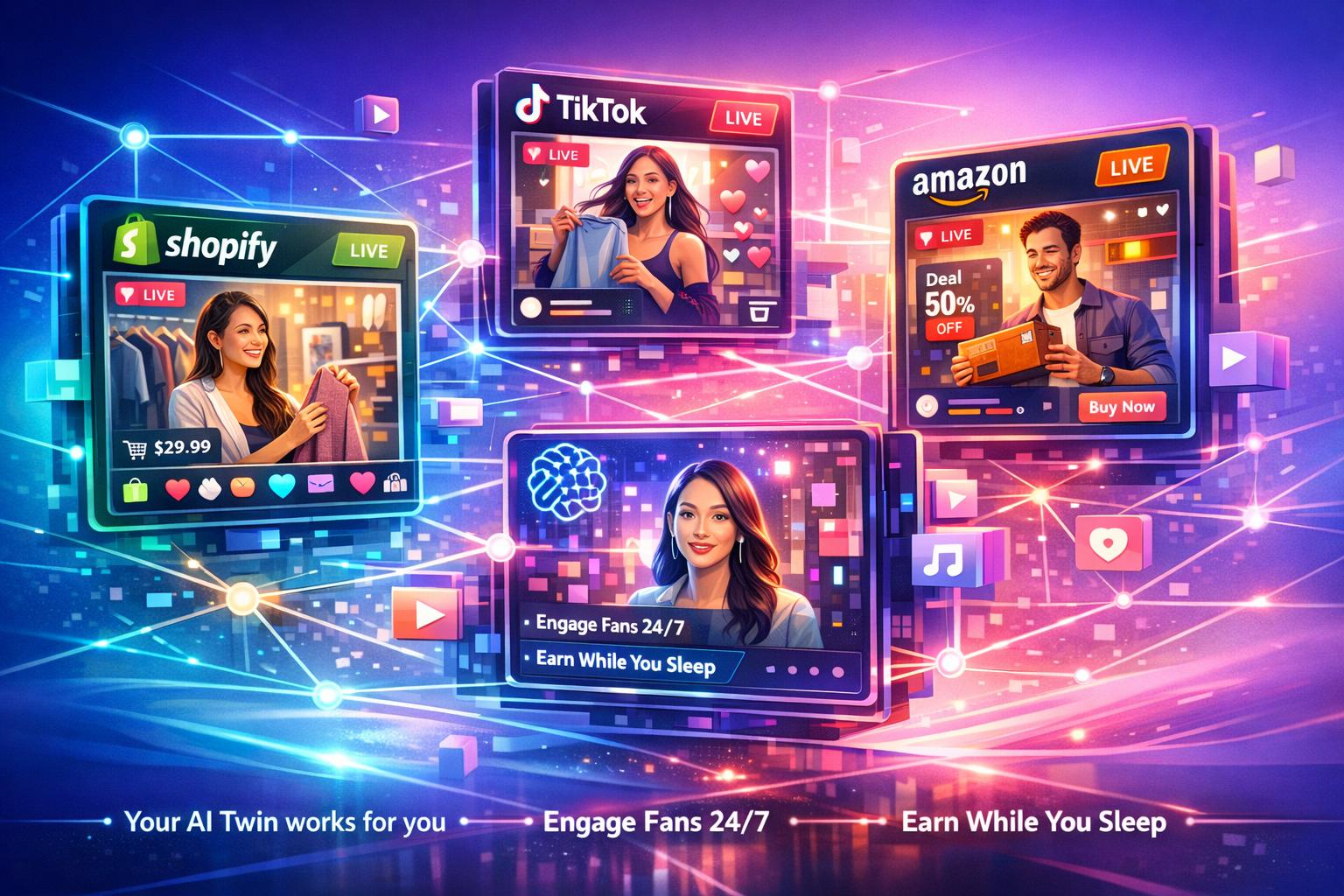
When it comes to livestream shopping, one size doesn’t fit all. Each platform - Shopify, TikTok, Amazon Live, and TwinTone - requires a tailored approach to branding. Why? Because platforms serve different audiences, offer unique features, and play distinct roles in the customer journey. For instance:
Shopify: Gives brands full control over their livestreams, from design to checkout, making it ideal for building direct customer relationships.
TikTok: Focuses on casual, creator-driven content that resonates with Gen Z and Gen Alpha, driving discovery and viral sales.
Amazon Live: Targets high-intent shoppers with engaging product demos, leveraging Amazon’s massive user base for immediate conversions.
TwinTone: Uses AI to scale creator-like content across platforms, ensuring consistent messaging and global reach without the need for live creators.
Livestream shopping is growing fast, with U.S. revenue expected to hit $67.8 billion by 2026. To succeed, brands must align their branding with platform-specific expectations. This article breaks down strategies for each platform, helping you connect with your audience and maximize sales.
1. Shopify
Branding Customization
Shopify gives you complete control over your livestream's branding. Unlike social platforms with rigid layouts, hosting your livestream on your Shopify store means you can customize every detail - from the content itself to the checkout process. Apps like Bambuser, TalkShopLive, and LiveMeUp can enhance your stream with overlays and interactive features.
The platform's native checkout system strengthens brand trust, allowing customers to complete purchases through a secure and familiar process. For international shoppers, tools like Shopify Markets and Shopify Payments make it easy to display local currencies and rounded pricing. This is crucial, as 92% of shoppers prefer seeing prices in their local currency, and 33% will abandon their cart if only U.S. dollars are shown.
With this level of customization, Shopify creates a seamless and branded shopping experience that resonates with digitally savvy consumers.
Audience Fit
Shopify's audience is made up of tech-savvy shoppers who value authenticity and interactive experiences. These customers enjoy AI-enhanced live shopping streams, live product demonstrations, Q&A sessions, and behind-the-scenes content that foster trust and community.
Take the example of natural skincare brand Three Ships Beauty. In 2025, they hosted a one-hour pre-launch livestream for their "Dream Night Cream" directly on their Shopify site. The event attracted 1,200 unique viewers and resulted in 356 orders - a 26% conversion rate that generated $25,000 in revenue. Another success story is Moonglow Jewelry, which used Shopify Payments' multi-currency features to expand its reach from 20 to 84 countries. This led to remarkable conversion rate increases: 428% in Germany, 581% in the UK, and 397% in Saudi Arabia.
Integration Options
Shopify makes it easy to integrate your livestream across platforms like TikTok, YouTube, Instagram, and Facebook. For instance, YouTube integration allows you to import your product catalog, making tagging products during streams effortless. Additionally, automation tools like Shopify Flow and Shopify Scripts simplify backend operations by handling tasks like tagging international orders or creating real-time discounts during live events. You can even integrate loyalty programs to reward viewers with exclusive coupons or bonus points, encouraging them to make immediate purchases.
Scalability
Whether you're hosting weekly livestreams or expanding into new markets, Shopify adapts to your growing business. For example, Doyoueven used Shopify's multi-currency features to achieve an 89% year-over-year growth and a 122% sales boost in just one month. Shopify supports both large-scale "one-to-many" broadcasts and personalized "one-to-one" video calls through apps like Bambuser.
Hosting livestreams directly on your Shopify site also allows you to gather valuable customer data. This data can be used for tailored follow-up campaigns, helping you maintain customer engagement long after the livestream ends.
2. TikTok
Branding Customization
TikTok’s branding strategy leans into the platform’s casual, unpolished vibe, steering clear of overly corporate aesthetics. Brands can leverage AR filters, branded effects, and take control of hosting accounts to showcase their personality and stay true to their identity. The platform’s features - multi-guest hosting, interactive chat, and LIVE gifts - allow brands to connect with audiences in real time. This engagement is further enhanced by how AI personalizes content for viewers. Interestingly, content shot on smartphones often outshines polished studio productions. Savannah Sanchez, Founder of The Social Savannah, highlights this perfectly:
"TikTok is all about getting genuine feedback from the community and sharing products that people genuinely love. So that's how your ads have to come across, it can't look like an ad."
Audience Fit
TikTok’s reach is staggering, with over 1.5 billion monthly active users spending an average of 95 minutes daily on the app. Even more impressive, 39% of users have purchased products they discovered on TikTok. The platform primarily attracts Gen Z and Gen Alpha, who treat TikTok as a discovery hub. Its impact is hard to ignore: in 2024, Canvas Beauty’s founder Stormi Steele raked in over $2 million in sales during a single livestream. Similarly, David Protein sold more than 50,000 protein bar packs in just nine months by hosting regular livestreams on TikTok Shop. Meanwhile, furniture brand Snug teamed up with comedian Katherine Ryan, leading to a 160% boost in virtual consultation bookings and a whopping 450% increase in sales. TikTok’s engaged audience seamlessly transitions from discovery to purchase, thanks to the frictionless shopping experience offered by TikTok Shop.
Integration Options
TikTok simplifies the shopping journey with built-in e-commerce tools that make purchases quick and easy. TikTok Shop integrates directly into the app, eliminating the need for external websites. It syncs inventory, pricing, and orders with major e-commerce platforms, ensuring a smooth setup. As of July 2025, GMV Max became the default campaign type for TikTok Shop Ads, using AI to automate bidding and optimize both product and LIVE shopping campaigns. Tools like the TikTok Pixel and Events API also enable brands to track conversions and retarget users who may have watched a stream but didn’t purchase immediately.
Scalability
TikTok offers unmatched growth potential for brands looking to scale quickly. The platform’s creator-driven ecosystem generates around $10 million daily in livestream revenue. Brands can tap into this by collaborating with influencers through the TikTok Creator Marketplace, allowing creators to showcase products during their streams. For advertising, TikTok requires a minimum daily budget of $50 at the campaign level and $20 per ad group. New brands are advised to invest $1,000 to $3,000 monthly for testing and optimization. What’s more, TikTok livestream shopping boasts conversion rates up to 10× higher than traditional e-commerce channels, making it a powerful tool for driving sales.
3. Amazon
Branding Customization
Amazon's livestreaming solutions are designed to resonate with its shopping-focused audience, offering tools for brands to create engaging, tailored experiences, such as AI grouping for live shopping events to personalize viewer interactions. There are two main options for livestreaming: a self-service app for DIY broadcasts and a managed service for professional production support. The Creator app provides three default design themes, each featuring six graphics, such as "Follow Me", "Starting Soon", and "Be Right Back". For more advanced customization, brands can use tools like OBS or Restream to add personalized elements like intros, outros, lower-thirds, and motion graphics. The Streaming TV Studio tool takes it a step further, offering customizable templates, overlays, and trusted Amazon features like star ratings. Additionally, Amazon's AI-powered creative tools help generate high-quality background images and display assets at no extra cost.
Audience Fit
Amazon's audience is primed for shopping, making it a powerful platform for livestreaming. Shoppers are 7.6× more likely to make a purchase after watching influencer content on Amazon. Supporting this, 90% of Amazon Live viewers discover new products during streams, and 73% feel more confident in their buying decisions. For instance, Samsung's U.K. launch of the Galaxy S25 Series through Amazon Live between October 2024 and February 2025 drove 32% of the campaign's total sales. Similarly, in 2024, Tree Hut used a branded livestream to introduce a hand wash collection, hitting its sales target 41% faster than usual and achieving a 1.5× higher click-through rate.
Integration Options
Amazon simplifies livestream integration with features like a shoppable carousel that appears alongside the video player, using Amazon IVS Timed Metadata for real-time product updates. Brands can also embed a Live Shopping Widget in their Brand Store to showcase live or archived content for up to 60 days. Livestream content is prominently displayed on product detail pages, the Amazon homepage, and even the Amazon Live FAST channel available on Prime Video and Fire TV. To maximize exposure, the Social Overlay feature allows brands to repurpose short-form vertical content from platforms like Instagram or TikTok for use across Sponsored Brands video ads, Twitch, and Fire TV ads. This strategy has been shown to drive a 17× higher purchase rate when combined with other ad formats.
Scalability
Amazon's tiered system - Rising Star, Insider, and A-list - rewards consistent livestreamers with better visibility and placement opportunities. The Creator app is free for brand-registered sellers, while managed-service livestreams typically require a $50,000 minimum spend. To expand reach, brands can boost their livestreams with Amazon Ads, which has been shown to increase search volume by 10%. For example, during a back-to-school campaign from July to September 2024, a CPG grocery brand achieved a 74% higher click-through rate and a 14% higher return on ad spend compared to industry benchmarks. Amazon's platform also reaches over 300 million monthly ad-supported users in the U.S., providing significant opportunities for brands to scale their livestreaming efforts. This comprehensive system creates a strong foundation for platforms like TwinTone to further enhance branding through livestreams.
4. TwinTone

Branding Customization
TwinTone gives direct-to-consumer (DTC) brands the power to fully control their livestream branding by embedding streams directly on their websites. This approach removes external distractions and ensures a consistent brand experience. Brands can tweak layouts, colors, and visuals to align perfectly with their identity. It also transforms creators into AI-powered "Twins" that maintain the original tone while delivering consistent brand messaging.
Audience Fit
TwinTone addresses the challenge of scaling creator content without the hassle of extended coordination. Instead of dealing with time-consuming outreach and production schedules, brands can instantly generate user-generated content (UGC) videos on demand. The platform’s AI-driven features create personalized shopping experiences, including product recommendations tailored to individual customer preferences. Livestreaming combines product details, reviews, and live demonstrations into one high-engagement event, cutting down the research effort typically required by shoppers.
Integration Options
TwinTone supports shoppable AI livestreams across platforms like TikTok, Amazon, YouTube, Twitch, and Shopify. This allows brands to maintain consistent branding while connecting with audiences on their preferred channels. The platform also offers API access, making it easy to integrate with existing tools for programmatic content creation across entire product catalogs and campaigns. Brands can track performance instantly with real-time analytics, monitoring engagement, conversions, and ROI from AI-generated content.
Scalability
Every livestream can be repurposed into highlight reels, social media clips, blog posts, or even ad content. With support for 40+ languages, TwinTone enables brands to expand globally without the need to hire creators for specific regions. Operating 24/7, the platform produces unlimited content that would be impossible to achieve with traditional creator partnerships. Pricing starts at $110 per month for 10 AI-generated UGC videos, with enterprise plans offering 50+ videos and access to dedicated AI livestreaming. These features fit seamlessly into a multi-platform livestream strategy, maximizing reach and efficiency.
Live Shopping Crash Course for Ecommerce Brands | Hosted by Marcy McKenna
Pros and Cons
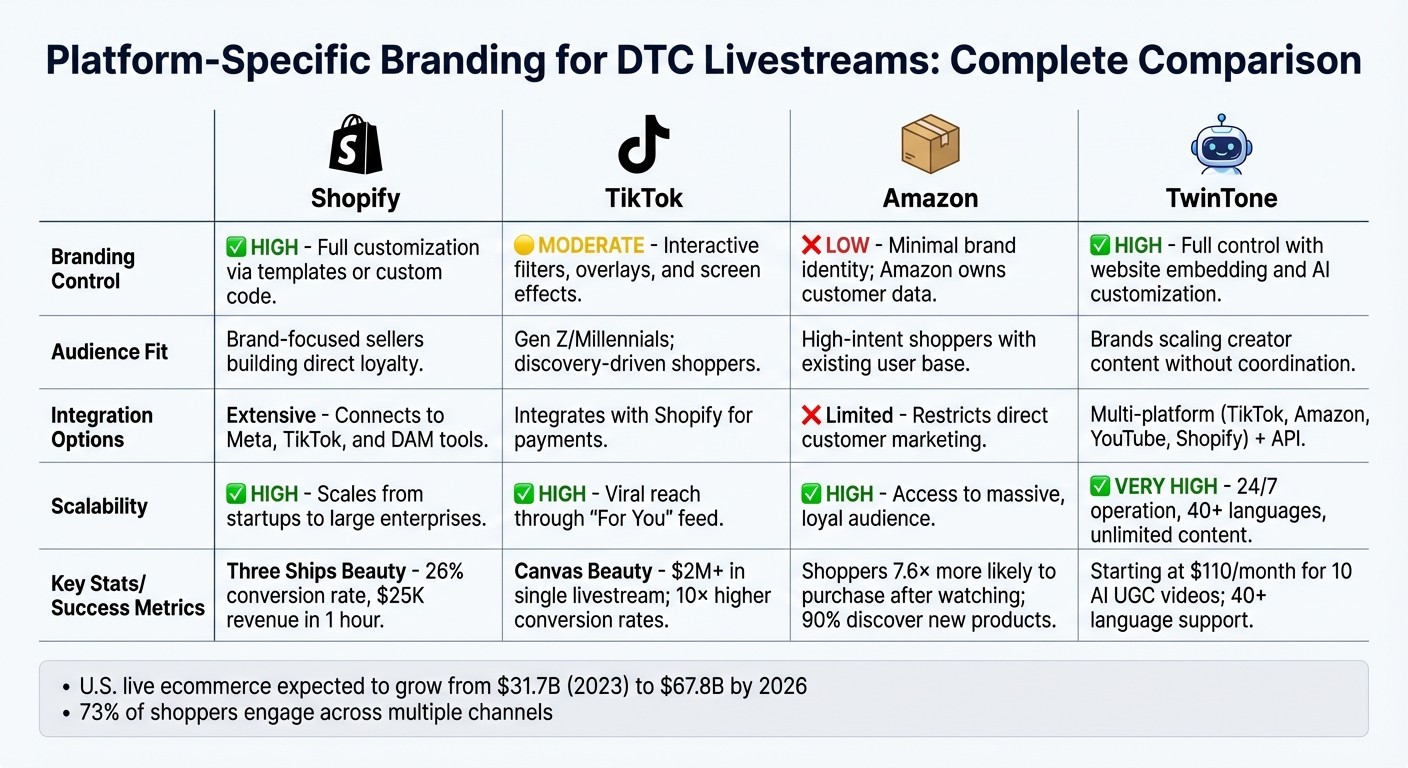
Platform Comparison for DTC Livestream Shopping: Shopify vs TikTok vs Amazon vs TwinTone
Based on the platform breakdowns above, here's a quick look at the strengths and challenges each solution brings to the table. The choice ultimately depends on what matters most to your DTC livestream branding - whether it's control over your brand, access to customer data, audience reach, or the ability to scale operations.
Shopify stands out for giving brands full control over their identity, which helps build strong, lasting customer relationships. However, since Shopify isn't a marketplace, you'll need to generate your own traffic. As Josh Baltzell, Senior Director of Technology, puts it:
"Most retail and marketplace sales give you a delivery address at best. When you have full access to customer data via your own DTC site, you're able to do much more to expand the lifetime value of a customer".
TikTok is excellent for discovery and viral reach, with creators collectively earning an estimated $10 million daily through livestreaming. In one impressive example, Stormi Steele drove over $2 million in sales for Canvas Beauty during a single TikTok Shop livestream. The downside? You sacrifice control over customer data and follow-up engagement.
Amazon offers unmatched reach - over half of all product searches start there. However, branding options are limited, and Amazon retains ownership of customer data, making it harder to build long-term relationships or re-engage customers outside the platform.
On the other hand, TwinTone combines high branding control with round-the-clock scalability. It leverages AI to maintain consistent branding across platforms in over 40 languages, addressing many of the limitations seen in other platforms.
Here’s a side-by-side comparison of the platforms:
Platform | Branding Control | Audience Fit | Integration Options | Scalability |
|---|---|---|---|---|
Shopify | High: Full customization via templates or custom code | Ideal for brand-focused sellers building direct loyalty | Extensive; connects to Meta, TikTok, and DAM tools | High: Scales easily from startups to large enterprises |
TikTok | Moderate: Offers interactive filters, overlays, and screen effects | Appeals to Gen Z/Millennials; discovery-driven shoppers | Integrates with Shopify for payments | High: Viral reach through the "For You" feed |
Amazon | Low: Minimal brand identity; Amazon owns customer data | Best for high-intent shoppers and an existing user base | Limited; restricts direct customer marketing | High: Access to a massive, loyal audience |
High: Full control with website embedding and AI customization | Perfect for brands scaling creator content without coordination | Multi-platform (TikTok, Amazon, YouTube, Shopify) + API | Very High: Operates 24/7, supports over 40 languages, and handles unlimited content |
Each platform has its own strengths. Whether you're looking for brand autonomy, viral potential, massive reach, or seamless scalability, there's an option tailored to your goals.
Conclusion
Direct-to-consumer (DTC) brands face the challenge of balancing control, reach, and ease of use across platforms. Shopify offers full control over branding and ownership of customer data. TikTok excels at viral discovery but limits access to data. Meanwhile, Amazon connects brands with high-intent buyers, though it comes at the cost of reduced brand control. This highlights the importance of adopting a multi-channel strategy to remain competitive in today’s market.
The numbers speak for themselves: live ecommerce in the U.S. is expected to grow from $31.7 billion in 2023 to $67.8 billion by 2026, with early adopters seeing revenue increases of up to 25%. Additionally, 73% of shoppers now engage across multiple channels, making a diverse platform strategy not just beneficial but necessary.
Amid this complexity, tools like TwinTone simplify the process. TwinTone enables brands to scale creator-led content seamlessly across platforms like TikTok, Amazon, YouTube, and Shopify. With AI-powered livestreams running 24/7 in over 40 languages, it ensures consistent branding on a global scale.
To succeed, brands must focus on authenticity, scalability, and efficiency. Look for platforms that provide access to first-party data, automated content distribution, and messaging tailored to each channel. By aligning content with the unique preferences and technical nuances of each platform, brands can maximize livestream sales. As Ilia Mundut, Founder and CEO of HeftyBerry, advises:
"You need to prioritize authenticity and engagement above all else... you create a sense of community around your brand that drives loyalty."
The future of DTC livestreaming isn’t about choosing a single platform - it’s about meeting your customers wherever they are with content that feels genuine and scales effortlessly.
FAQs
How can DTC brands customize their branding for livestreams on different platforms?
To create a strong and recognizable brand presence during livestreams, DTC brands need to fine-tune their content to align with each platform’s unique features while staying true to their overall brand identity. Platforms like TikTok, Shopify, and Amazon each have their own formats and tools that can help brands craft an engaging and seamless experience.
Start by aligning your visuals and messaging with the platform’s style. For instance, TikTok works best with full-screen vertical videos that incorporate quick, interactive overlays. Shopify allows you to embed shoppable product cards right on your storefront, while Amazon Live offers built-in features like "Buy Now" buttons and product carousels. Even your calls to action should reflect the platform’s tone - think phrases like "Tap to Shop" on TikTok or "Add to Cart" on Amazon.
Take full advantage of the commerce tools each platform provides. Shopify’s live-shopping widgets make real-time inventory syncing a breeze. Amazon Live’s integrated discount codes simplify the checkout process, and TikTok’s shopping stickers let viewers jump straight to product pages. These tools not only enhance the shopping experience but also help drive conversions.
For scaling your efforts while keeping your branding consistent, AI-powered tools like TwinTone can step in. TwinTone automates the creation of UGC videos and AI-driven livestreams, tailoring content to fit each platform’s specific format. By blending tailored visuals, platform-native tools, and AI-generated content, brands can deliver a polished livestream experience that feels both professional and platform-specific.
What makes Shopify a great platform for livestream shopping for DTC brands?
Shopify provides DTC brands with an integrated platform for livestream shopping by embedding live video directly on their online storefronts. This setup allows shoppers to watch livestreams, browse featured products, and make purchases - all without ever leaving the video. The result? A streamlined checkout process that can significantly improve conversion rates. Plus, Shopify syncs live-shopping activities with its inventory, order management, and analytics tools, giving brands instant insights into sales performance and stock levels - all accessible from a single dashboard.
To make the livestream experience even more engaging, Shopify includes built-in personalization options. Brands can highlight recommended products, roll out exclusive discounts, and interact with viewers through real-time chat. On top of that, Shopify’s app marketplace offers tools to take livestreams to the next level, such as AI-driven product demos, shoppable video overlays, and automated content repurposing. Together, these features turn livestream shopping into a dynamic and efficient sales channel that boosts engagement, encourages quick purchasing decisions, and simplifies backend operations - all within Shopify’s ecosystem.
How does TikTok influence shopping behavior during livestreams?
TikTok’s livestreams turn shopping into a dynamic, real-time experience. With TikTok Shop Live, brands can showcase product demos, tutorials, and unboxings, all while letting viewers make purchases directly within the app. This streamlined process eliminates unnecessary steps, making it easier for users to act on impulse and buy instantly.
TikTok’s algorithm plays a big role in boosting the visibility of these livestreams by featuring them on the For You feed. Streams that include limited-time offers, countdowns, or exclusive discounts often get extra attention, creating a sense of urgency that drives higher conversion rates. On top of that, creators serve as engaging hosts, interacting with viewers, answering questions, and showing off product benefits. This personal touch helps build trust and encourages sales.
For direct-to-consumer (DTC) brands, TikTok’s live-shopping tools - combined with AI-powered features like creator twins that can generate on-demand videos and host livestreams - offer a scalable way to tap into this impulse-driven shopping trend. With these tools, brands can provide shoppable content around the clock without the hassle of scheduling or delays.