Multi-Screen Sync for Social Commerce
How to build a futureproof relationship with AI
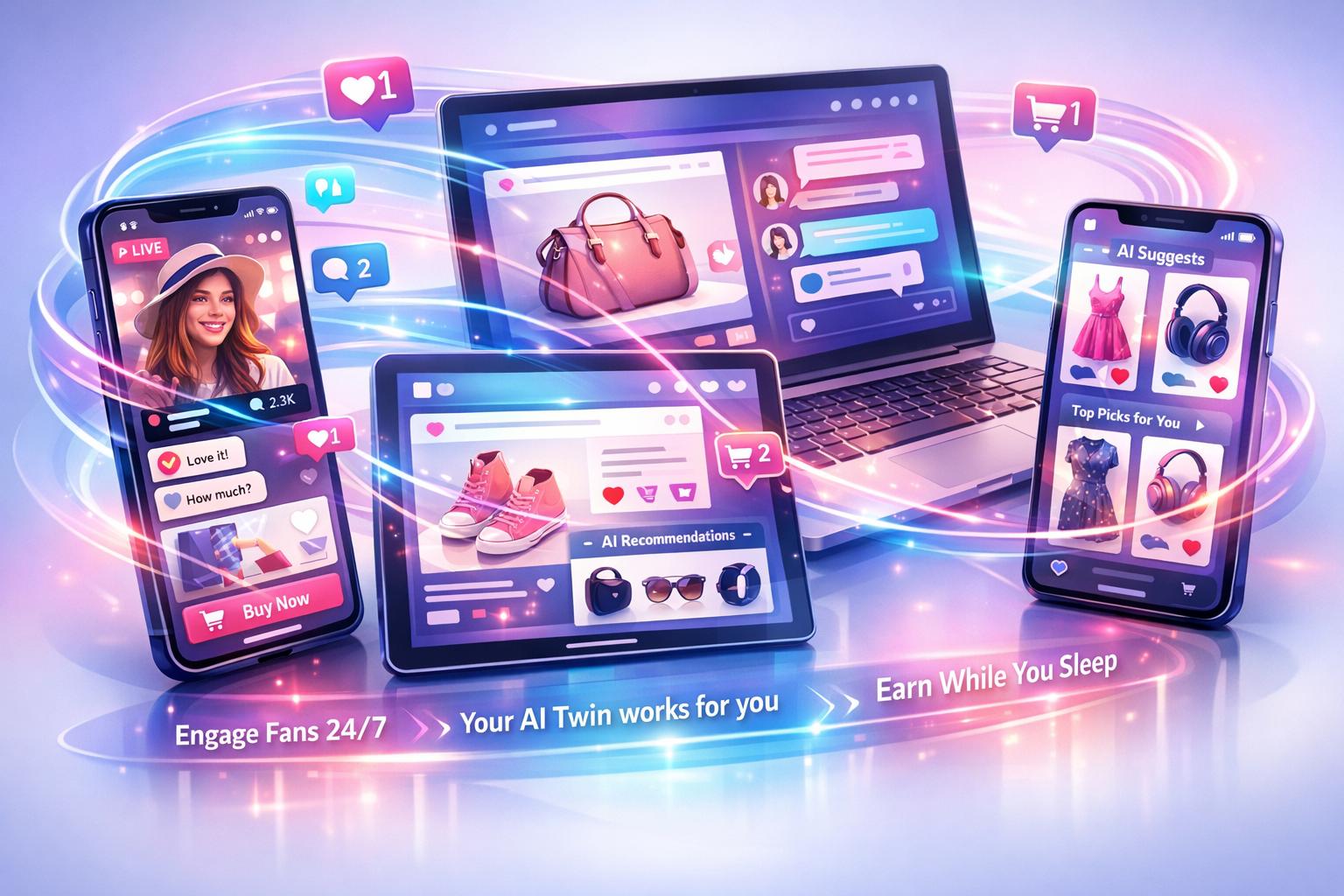
In 2025, shopping across multiple devices has become the norm. People often discover products on one screen (like TikTok on their phone), research them on another (like a tablet), and complete purchases on a third (like a laptop). This shift has made multi-screen synchronization essential for brands to create smooth shopping experiences. Here's what you need to know:
What It Is: Multi-screen sync ensures consistent, real-time product info, inventory, and messaging across devices. For example, watching a shopping livestream on TV while instantly purchasing on your phone without interruptions.
Why It Matters: Social commerce sales in the U.S. are set to surpass $100 billion in 2025, with global figures hitting $1.2 trillion. Consumers are 2.5x more likely to buy when exposed to synchronized ads.
Core Components:
Real-Time Inventory: Accurate stock updates across platforms, ensuring no delays or errors during purchases.
Consistent Product Details: Unified catalogs prevent mismatched information across screens.
Aligned Messaging: Branding and promotions remain uniform across TikTok, Instagram, and other platforms.
Live Shopping: Multi-screen sync enhances events by linking livestreams with shoppable content, driving conversions up to 30% - 10x higher than standard e-commerce.
AI is also transforming this space. From real-time personalization to AI-powered hosts, brands can now deliver tailored experiences that follow customers across devices. For instance, AI Twins can host livestreams or answer questions 24/7, keeping shoppers engaged without human intervention.
In short, multi-screen sync is reshaping the way we shop, ensuring every device works together for a seamless journey from discovery to purchase.
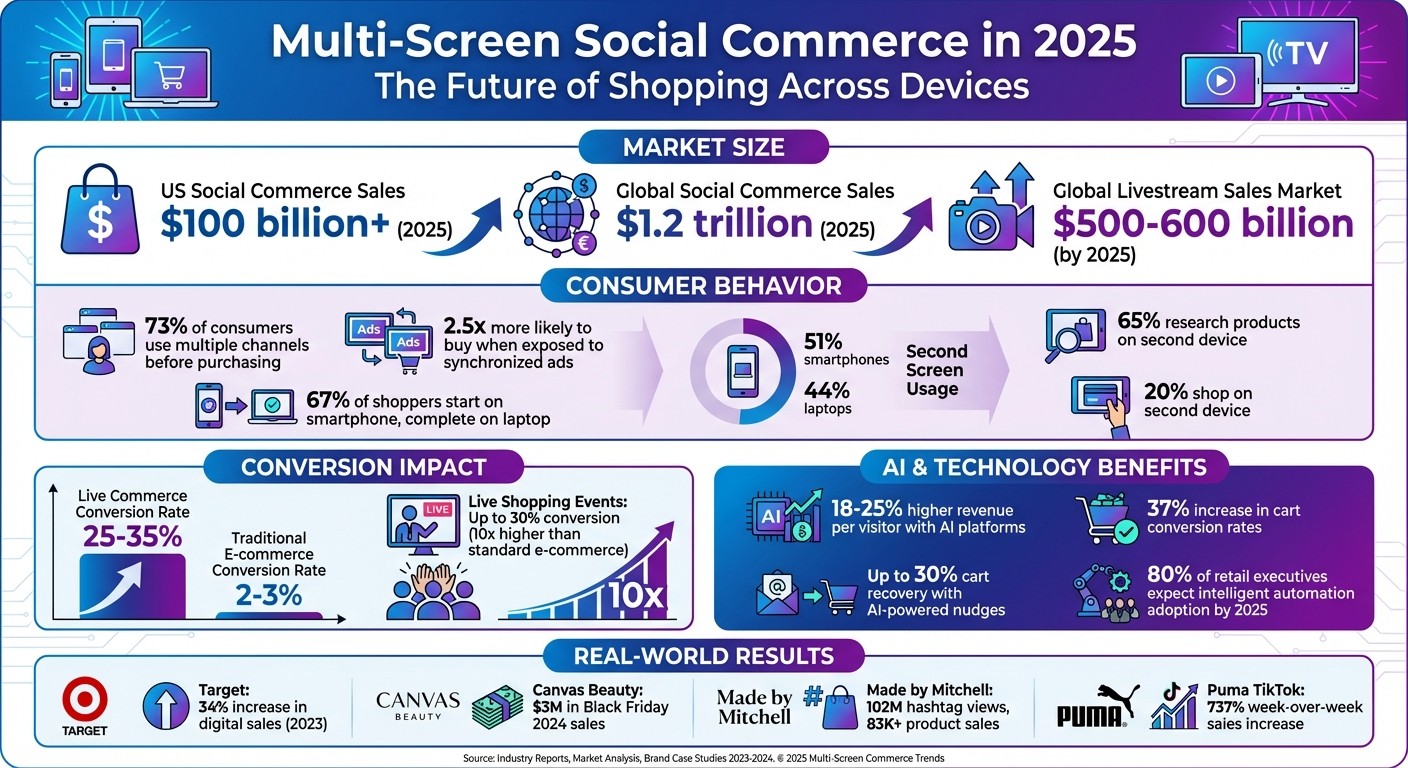
Multi-Screen Social Commerce Statistics and Impact 2025
Why Live Shopping Is Disrupting Social Media Forever (And Why It Matters) | GaryVee CNBC Squawk Box
Core Components of Multi-Screen Sync for Social Commerce
Creating a seamless multi-screen experience for social commerce hinges on three key elements: real-time inventory integration, consistent product information, and unified messaging. These components work together to ensure customers enjoy a smooth journey across devices. Let’s dive into each one.
Real-Time Inventory Integration Across Platforms
At the heart of multi-screen synchronization lies real-time inventory updates. Imagine this: a customer watches a TikTok livestream on their TV, spots a product they love, and switches to their phone to complete the purchase. For this to work, the system must display accurate stock levels instantly. Using API-driven push mechanisms like Meta's /items_batch endpoint ensures updates happen in near real-time. In fact, many platforms now consider updates every 15 minutes the minimum standard for fast-changing details like stock and pricing.
To manage this effectively, adopt a three-tiered sync approach:
Near real-time updates for fast-changing data
Hourly updates for smaller adjustments
Daily full catalog synchronization for comprehensive accuracy
That said, synchronization isn’t without its challenges. Delays between systems like Shopify and social platforms can range from 15 to 60 minutes. To counter this, brands often use inventory buffers - marking items as sold out when stock falls below five units, for example. Zara offers a great example with its "Smart Retail" strategy. By implementing RFID tagging across its stores worldwide, Zara’s mobile app provides real-time updates on stock availability and delivery options, bridging the gap between physical and digital inventory.
Consistent Product Information Across Screens
To maintain a cohesive shopping experience, ensure product details are uniform across every platform. A centralized catalog can serve as a single source of truth, feeding accurate information to platforms like TikTok, Instagram, and Pinterest. Product feed management systems play a crucial role here, cleaning and formatting data before distribution.
For items with multiple variants - like different sizes or colors - tools like item_group_id (to group variants) and retailer_id (as a persistent product tracker) help ensure accurate stock and detail displays across devices. Additionally, automated error checks that poll APIs hourly can catch issues like low-quality images or missing fields before they disrupt the customer experience. This prevents problems like inconsistent displays or "value flapping", where product information changes unexpectedly when a page refreshes.
One brand saw significant gains by aligning its catalog across platforms, highlighting how consistency can directly impact performance. When every touchpoint delivers the same information, customers are more likely to trust the experience.
Unified Messaging Across Channels
Once your technical systems are in sync, the next step is aligning your brand’s messaging across platforms. While each platform has its unique style - Instagram often favors polished, high-quality visuals, while TikTok thrives on raw, authentic content - the core brand message and product details should remain consistent. For example, a TikTok video showcasing a product should seamlessly lead to a product page that reinforces the same narrative.
As Sanjiv Raman, Principal of Technology Modernization Services at Grant Thornton, puts it: "Customers expect the same brand experience online and in-store, and that requires AI-fueled consistency across systems."
A helpful strategy for maintaining this balance is the 70/20/10 content mix:
70% value-driven content: Think product demos and how-to videos.
20% community-focused content: Challenges, Q&A sessions, and user-generated contributions.
10% promotional content: Limited-time offers and discount codes.
This approach has proven effective. Take Puma’s TikTok Shop UK "April Deals" event in April 2024, for instance. The campaign generated $37,100 in gross merchandise value, a 737% week-over-week sales increase. Notably, 60% of the revenue came from affiliate creators who maintained consistent messaging while tailoring their content to the TikTok platform. Unified messaging like this ensures that no matter the device or platform, customers feel connected to the same cohesive shopping experience.
Using Multi-Screen Sync for Live Shopping Events
Live shopping thrives on the interplay between multiple devices. Smartphones (51%) and laptops (44%) are the most popular second-screen options, with 65% of users researching advertised products and 20% shopping for them on their second device. This creates a golden opportunity for brands to deliver seamless, synchronized experiences across devices. By tapping into multi-screen principles, live shopping events can offer smoother, more engaging purchase journeys.
Creating Complementary Experiences Across Screens
The best live shopping events don’t just stream content - they create dynamic, multi-layered experiences that connect across devices. For example, while viewers watch a livestream on one screen, they can take part in live polls, enter contests, or access exclusive offers on another. This keeps the interaction lively and avoids turning the event into a simple sales pitch.
Take Walmart’s December 2020 collaboration with TikTok for the "Holiday Shop-Along" event. Influencers showcased fashion items, and viewers could watch on their TV or computer while shopping on their phone. This synchronized approach racked up over 7 million views and significantly boosted sales. Each screen had a distinct role, making the experience fluid and engaging.
Brands like TwinTone are scaling this strategy with AI-powered livestreams that deliver interactive shopping experiences 24/7. Their AI Twins host events across platforms like TikTok, Amazon, and YouTube, ensuring consistent engagement without the logistical headaches of coordinating with multiple creators.
UK beauty influencer Cariad Ryan showcased the potential of immersive, multi-screen events during a 12-hour live session featuring 26 brands. The event, complete with a carnival-themed set and synchronized giveaways, kept viewers hooked as they switched between entertainment and detailed product browsing.
On the other hand, TV2 Denmark offered a unique twist during the May 2012 Giro d’Italia cycling race. Viewers could scan QR codes on their TV to access real-time stats, rider bios, and weather updates on their phones. These examples highlight how multi-screen sync can work across diverse contexts - from beauty to sports - enhancing engagement without disrupting the main broadcast.
"Attendees are so glued to their devices, even while watching a live presentation... that marketers are supplying them with a simultaneous engagement tool they can access on that device."
– Robin Stanley, VP-design and creative, GES
The technology driving these experiences has come a long way. Now, when a product appears on the main screen, systems can trigger corresponding shoppable content or coupons on the viewer’s mobile device. This seamless integration bridges the gap between product discovery and purchase, removing the need for manual coordination.
Reducing Friction in the Purchase Journey
Turning viewers into buyers remains a big challenge, but multi-screen synchronization helps by cutting out the delays that often derail conversions. Real-time data sync enables clickable product tags that update instantly as items are featured. This allows shoppers to browse and learn about products without leaving the video stream.
"The real-time data sync that powers clickable product tags makes these sessions truly dynamic. As hosts feature an item, details update instantly on-screen - no reloads or lag - allowing shoppers to browse, click, and learn more without leaving the experience."
– Michelle Krasniak, PubNub
Live commerce conversion rates can soar to nearly 30%, which is up to 10 times higher than traditional e-commerce. For example, in 2024, UK sofa company Snug teamed up with comedian Katherine Ryan for a live shopping event. The result? A 160% boost in virtual consultation bookings and a 450% increase in sales after 6,000 users tuned in. The key was allowing viewers to watch on their TV while completing purchases on their phone, eliminating the need to switch apps or search manually.
Consistency across devices is equally important. About 67% of online shoppers begin their journey on a smartphone but complete it on a laptop. Multi-screen sync ensures that progress is saved, so users can start shopping on a mobile livestream and finish on a desktop later using "continue shopping" features.
Beauty brand Made by Mitchell showcased this seamless approach on TikTok Shop in 2024. Their live events, centered around “mystery beauty bundles,” generated over 102 million hashtag views and led to more than 83,000 product sales. Viewers could add items to their cart while watching and complete their purchase without ever leaving the app, reducing the friction that often leads to cart abandonment.
For brands looking to adopt these strategies, the technical requirements are clear. Sub-second latency is critical to ensure there’s no lag between what the host displays and what shoppers see on their devices. Real-time inventory accuracy is also essential to synchronize limited-time offers or "only X left" prompts across screens, avoiding the frustration of attempting to buy out-of-stock products.
TwinTone's API takes this a step further by generating shoppable content for SKUs and tracking real-time engagement, allowing brands to fine-tune their strategy mid-stream.
AI-Powered Personalization Using Multi-Screen Data
Today's multi-screen shopping habits generate a treasure trove of behavioral data - think clicks, hovers, how long someone watches a product video, emojis, comments, and cart activity. This data pours in from a mix of devices: smartphones, laptops, and even smart TVs. AI steps in to connect the dots, transforming this scattered information into real-time personalized experiences that follow shoppers seamlessly across devices. The payoff? E-commerce businesses using AI platforms report 18% to 25% higher revenue per visitor, with cart conversion rates climbing by as much as 37%.
Take this example: a shopper browses sneakers on their phone during lunch. That evening, AI might suggest a styled recommendation on their smart TV, keeping the shopping journey alive. During live shopping events, AI analyzes live comments and emojis to understand emotions like excitement or hesitation. Pairing this with behavioral data - like clicks or viewing time - it delivers instant, tailored product recommendations. This ability to read and respond to context is what makes AI-powered personalization so effective.
Real-Time Content Recommendations
AI doesn’t just react; it anticipates. For instance, if someone hesitates - spending too much time on a product page or leaving items in their cart - AI can step in with context-aware nudges. These might include limited-time discounts or social proof messages, which can recover up to 30% of abandoned carts.
The most advanced systems take things a step further by unifying data from web, mobile, and even offline sources into a single hub. This allows for "Affinity Allocation", a system that treats each shopper as a unique individual rather than lumping them into broad categories. It’s no wonder that by 2025, 80% of retail executives expect their companies to adopt intelligent automation technologies like this.
"AI systems interpret live comments, questions, and emojis to gauge customer sentiment - identifying excitement, curiosity, or hesitation - and correlate these insights with behavioral cues like clicks, hover actions, and viewing duration to uncover individual preferences."
– Shantha Farris, Sales and Commerce Offering Strategy Leader, IBM Consulting
AI also has the power to break down language barriers during live shopping events. It can translate viewer comments in real time across 40+ languages, making it easier for global brands to connect with audiences from different regions without needing manual moderation. This multilingual capability ensures that personalization works on a global scale.
And this isn’t the end of the story. AI-powered tools like AI Twins are taking personalization even further.
AI Twins for Social Commerce
AI Twins are essentially digital personas that adapt and grow with every interaction, offering increasingly accurate suggestions based on factors like a user’s style, budget, or even mood. These digital companions follow users across devices, ensuring a consistent shopping experience.
Enter TwinTone, a platform that creates AI Twins of real creators. These AI-powered personas can generate on-demand user-generated content (UGC) videos, host livestreams, and drive social commerce for brands. The best part? These AI Twins maintain the creator’s tone, style, and personality while working 24/7 on platforms like TikTok, Amazon, YouTube, and Shopify. Brands no longer have to deal with the logistical challenges of coordinating with creators - they can instantly produce product demos and shoppable videos.
"And now, with the capabilities enabled by generative AI, people can continue to interact with that livestreaming host long after the livestream event ends."
– Shantha Farris, Sales and Commerce Offering Strategy Leader, IBM Consulting
AI-powered chatbots, designed to mimic the style of specific hosts, take this a step further. After a livestream ends, these bots can answer questions, assist with payments, or provide product details - all while keeping the brand’s tone consistent. This "always-on" approach shifts social commerce from occasional influencer posts to a constant stream of shoppable content with built-in checkout options.
AI Capability | Business Impact | Multi-Screen Application |
|---|---|---|
AI Twins | Higher order values and emotional engagement | Personas follow users across devices |
Predictive Engagement | Up to 30% cart recovery | Real-time nudges based on hesitation signals |
Sentiment Analysis | 10x higher conversion rates | Dynamic recommendations during live broadcasts |
Affinity Allocation | Hyper-personalized experiences | Real-time personalization across all screens |
By combining AI-driven insights with multi-screen synchronization, brands can create a shopping experience that feels seamless and engaging, no matter where or how customers interact.
This isn’t just about adopting new tech - it’s about running smarter operations. AI Twins, for instance, help brands predict demand and fine-tune inventory by analyzing shopping trends in real time. The result? The right products, at the right time, on the right device.
Best Practices for Implementing Multi-Screen Synchronization
Integrating technology, consistent messaging, and precise measurement is the key to successful multi-screen synchronization. Brands that get this right can achieve impressive results. For example, Target saw a 34% increase in digital sales in 2023 after rolling out omnichannel strategies like curbside pickup and mobile app integrations.
Choosing the Right Technology Stack
A smooth multi-screen experience starts with the right tools. Your tech stack should sync inventory in real time, stream video without delays, and track user actions across devices. An API-first architecture - using RESTful or GraphQL APIs - ensures data flows seamlessly between platforms like social media, CRM systems, and inventory management tools. For live shopping, WebRTC technology provides ultra-low latency (under 50ms for broadcasters and under 100ms for viewers), keeping interactive features like polls and Q&A engaging and immediate.
Scalability is non-negotiable. With the global live shopping market expected to hit $600 billion by 2025, your infrastructure must handle sudden spikes in viewers. Auto-scaling cloud services like AWS or Google Cloud, combined with global CDNs such as Cloudflare, ensure smooth streaming for audiences ranging from 100 to 10,000 viewers. Adaptive bitrate streaming further enhances the experience by adjusting video quality based on each viewer's bandwidth, reducing buffering and improving conversions.
For reliable performance, broadcasters should use a hardwired ethernet connection with at least 10 Mbps upload speed and keep a 4G/5G mobile hotspot as a backup.
Take Revolve as an example. The brand uses a network of over 3,500 influencers to drive 70% of its total sales, leveraging shoppable links that connect social media feeds directly to synchronized checkout processes.
Once your technology is in place, the next step is to ensure your messaging stays consistent across all screens.
Aligning Messaging and Content Across Screens
Consistency is everything. Since 73% of consumers use multiple channels before making a purchase, every touchpoint must deliver the same message and product details.
Standardize shoppable elements like tags, links, and discount codes across platforms such as Instagram, YouTube, and your website. Operational alignment is just as important. Your IT, marketing, and e-commerce teams need to work from shared goals and metrics. Building a compliance library with pre-approved phrases, visuals, and guidelines ensures that creator-led content stays on-brand.
A great example comes from BIC UK, which partnered with PHD in 2024 to create lookalike audiences using first-party data. This effort led to a 12% increase in ROAS and a 3.0x higher Purchase Intent Rate on Meta platforms.
Once your messaging is unified, it's time to measure its effectiveness with data-driven analytics.
Measuring Success with Performance Analytics
Tracking performance is crucial. Use closed-loop attribution to follow the customer journey from the first impression to the final sale, leveraging in-app checkouts and native affiliate features. Dive into metrics like Purchase Intent Rate and SKU-level sales to pinpoint what's driving revenue.
Engagement metrics - such as comments, reactions, and shares during live events - offer real-time insights into how your content is resonating. Live shopping conversion rates average 25-35%, significantly higher than the 2-3% seen in traditional e-commerce.
To boost urgency and manage inventory effectively, set up real-time "low stock" notifications across all synchronized screens. Use incrementality testing - AI-powered lift tests - to uncover the true impact of your social commerce investments, beyond just last-click attribution.
A case in point: In 2024, Remy Martin UK expanded its use of MikMak to include shoppable media campaigns. By linking social and website traffic to retailer conversions, they achieved a 3.2x increase in website sales and a 3.7x boost in attributable sales on Amazon.
"I would really focus on the data. Making everything shoppable is critical, but also what we can learn from that."
– Dawn Puskas, Digital Engagement at Church & Dwight
Conclusion
In today’s social commerce landscape, multi-screen synchronization isn’t just a nice-to-have - it’s a necessity. With 73% of consumers using multiple channels before making a purchase and US social commerce sales projected to exceed $100 billion by 2025, the brands that succeed will be those that deliver smooth, connected experiences at every touchpoint. When strategies are aligned, the journey from discovery to purchase becomes seamless, creating a direct path for consumers to follow.
Key elements like real-time inventory updates, native in-app checkouts, and AI-powered personalization are now the baseline for staying competitive. For instance, Canvas Beauty demonstrated the power of these tools by achieving $3 million in sales during Black Friday 2024, thanks to TikTok Shop’s integrated creator affiliate links. Results like these underscore how removing friction and engaging customers across multiple screens can drive significant growth.
"Retailers must ask themselves two key questions: What AI experience do you want to deliver? And can your infrastructure support it?" – Kevin O'Connell, Principal of Business Consulting, Grant Thornton
AI is proving to be a game-changer in this space. By integrating AI with multi-screen synchronization, brands can replicate winning strategies on a larger scale. Tools like TwinTone are revolutionizing the way brands approach content and live shopping. For example, TwinTone’s AI Twins enable brands to produce on-demand UGC videos and host 24/7 livestreams, eliminating the delays associated with traditional creator outreach. With the global livestream sales market expected to reach $500 billion by 2025, automation isn’t just helpful - it’s essential for keeping pace.
To thrive in this fast-evolving market, brands need to invest in the right technology, maintain consistent messaging, and track performance metrics closely. Those who master multi-screen synchronization today will shape the future of social commerce.
FAQs
How does multi-screen synchronization improve the social commerce shopping experience?
Multi-screen synchronization lets shoppers effortlessly transition between devices - whether it’s a phone, tablet, or laptop - while staying on the same shopping journey. This means no interruptions, just a smooth and continuous experience that fits perfectly with the way we use multiple devices today. For example, someone might find a product on their phone during a break and later finish the purchase on their laptop at home, without losing their spot.
When combined with live shopping events, having a second screen can boost engagement by offering interactive tools like real-time polls, Q&A sessions, or even AR try-ons - all while keeping the main broadcast uninterrupted. This setup helps shoppers make quicker and more confident choices by letting them compare product details, watch user-generated videos, or view AI-powered demos alongside the livestream.
With TwinTone, brands can elevate this experience even more. Using AI-powered creator “twins,” they can provide instant product demos, shoppable videos, and creator-led content available around the clock across all devices. This ensures a seamless and engaging shopping journey tailored to every screen, ultimately increasing conversions and customer satisfaction.
How does AI enhance multi-screen shopping experiences?
AI is revolutionizing the way we shop by delivering smooth, personalized experiences across all our devices. By diving into real-time data - like how users interact with products, their buying habits, and preferences - AI crafts tailored product suggestions, adjusts prices dynamically, and even serves up exclusive deals. It doesn't stop there. AI also keeps everything in sync, from inventory to cart status to checkout, making it effortless for shoppers to switch between devices - whether they're on a smartphone, laptop, or even a TV - without missing a beat.
TwinTone pushes this concept even further by turning real creators into AI-driven "Twins." These Twins can produce on-demand shoppable videos and host livestreams, ensuring a seamless and engaging experience on every screen. This automation not only keeps the content flowing 24/7 but also enhances the social commerce journey, driving higher conversion rates along the way.
How can brands maintain consistent messaging across platforms and devices?
To keep your messaging consistent across platforms and devices, it's important to centralize how content is created and shared. Begin by crafting a brand style guide that outlines your tone, visuals, hashtags, and call-to-action (CTA) language. Then, use a single content hub to distribute these assets automatically, ensuring every platform and device delivers the same cohesive message.
Tools like TwinTone can make this process easier. They can generate user-generated content (UGC) videos on demand, host AI-powered livestreams, and create shoppable content - all while staying true to your brand's identity. On top of that, syncing product data, pricing (in $USD), and inventory across all channels ensures a smooth shopping experience, whether customers are on your website, social media, or other marketplaces.
To stay on track, use a unified analytics dashboard to monitor engagement, conversion rates, and other critical metrics. This allows you to spot inconsistencies, adjust your messaging, and maintain a strong, unified brand presence everywhere your audience interacts with you.