Live Shopping Platforms: Emotional Metrics Review
How to build a futureproof relationship with AI
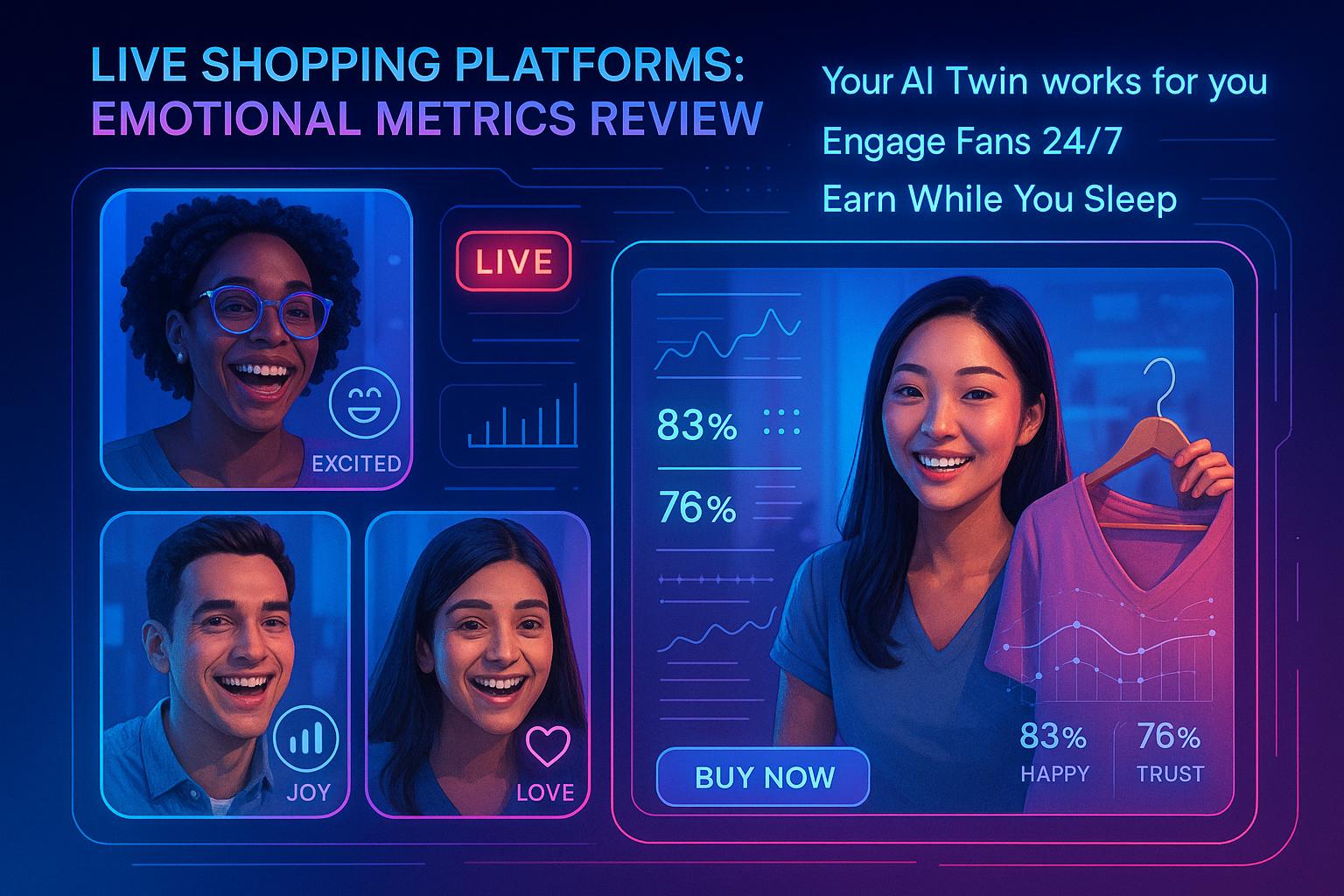
Live shopping is reshaping online shopping in the U.S., combining live demos, real-time interaction, and instant purchasing. Emotional metrics like trust, interactivity, and engagement are key drivers behind its success. Here's what you need to know:
63% of shoppers prefer live video over static pages for its engaging nature.
40% make purchases after watching live demos.
Emotional triggers - like trust in hosts, real-time feedback, and sensory-rich presentations - boost conversion rates to up to 30% (compared to 2-3% for traditional eCommerce).
AI tools now analyze viewer emotions in real time, helping brands fine-tune their approach.
Platforms such as Amazon Live, TikTok, and YouTube are leveraging emotional cues to drive sales, with AI-powered tools like TwinTone further enhancing engagement through personalized, 24/7 live streams.
Emotions matter in live shopping. Understanding and measuring them can transform passive viewers into active buyers.
AI-Powered Emotional Ad Matching Lifts Ad Metrics: Wurl's Crofut
Key Emotional Metrics That Drive Engagement
Exploring emotional metrics in live shopping reveals how they not only build trust but also drive sales. By understanding which emotions resonate most with audiences, brands can transform casual viewers into loyal buyers. Research highlights three key areas that shape consumer emotions - and ultimately influence purchase decisions.
Emotional Trust and Streamer Professionalism
Trust is the cornerstone of live shopping success, and streamer professionalism plays a huge role in building it. When hosts present products clearly, address questions thoroughly, and maintain a polished demeanor, they help reduce the perceived risks of buying products online. Studies show that hosts who actively engage with viewers foster both cognitive trust and emotional excitement, which can lead to more impulsive purchases.
Brands should focus on key trust indicators like return-viewer rates (how often viewers come back for more streams), refund and complaint rates linked to specific hosts, and in-stream trust polls where viewers rate their confidence in the host's recommendations on a 1-7 scale. High repeat-viewer percentages and low refund rates are strong signs of a trustworthy host. Additionally, hosts who consistently start on time, maintain clear video and audio, and respond promptly to questions are often seen as more credible, which further boosts engagement and sales.
Real-Time Interaction and Feedback
One of the unique advantages of live shopping is the ability to create real-time feedback loops that traditional e-commerce lacks. Metrics like chat velocity (messages per minute), Q&A participation, and reaction bursts (sudden spikes in likes or emojis) are strong indicators of impulse buying behavior. When viewers see others actively engaging and getting immediate answers, it builds social proof and minimizes hesitation.
To maximize this, brands should monitor conversion rates and order values during moments of heightened engagement, such as the 2-3 minute spikes after a flurry of chat activity or reaction bursts. Leveraging FOMO (fear of missing out) during these moments can significantly boost sales. Real-time sentiment dashboards also allow hosts to adjust their approach on the fly, addressing viewer confusion or hesitation before it impacts conversions.
Next, we’ll delve into how a host’s charisma and sensory elements can elevate these effects even further.
Influencer Appeal and Sensory Engagement
The appeal of an influencer can dramatically shape the success of a live shopping stream. This appeal hinges on three factors: on-camera attractiveness, credibility and expertise, and relatability. Charismatic hosts who are visually engaging naturally draw more attention and create emotional excitement around the products they showcase. Research, particularly in fashion and beauty streams, shows that knowledgeable and honest hosts can significantly increase purchase intent.
Sensory engagement adds another layer to this. High-quality visuals, clear audio, and dynamic demonstrations make products more tangible to viewers. For example, multi-camera setups and close-up shots can highlight product details, reducing uncertainty and boosting confidence in the purchase. Hands-on demos are especially effective, as they create a sense of immediacy and allow viewers to see the product in action, often paired with live reactions from other viewers. To optimize these elements, brands should track metrics like drop-off points during technical glitches and monitor changes in conversion rates when switching from static presentations to live demonstrations.
Research Methods and Key Findings
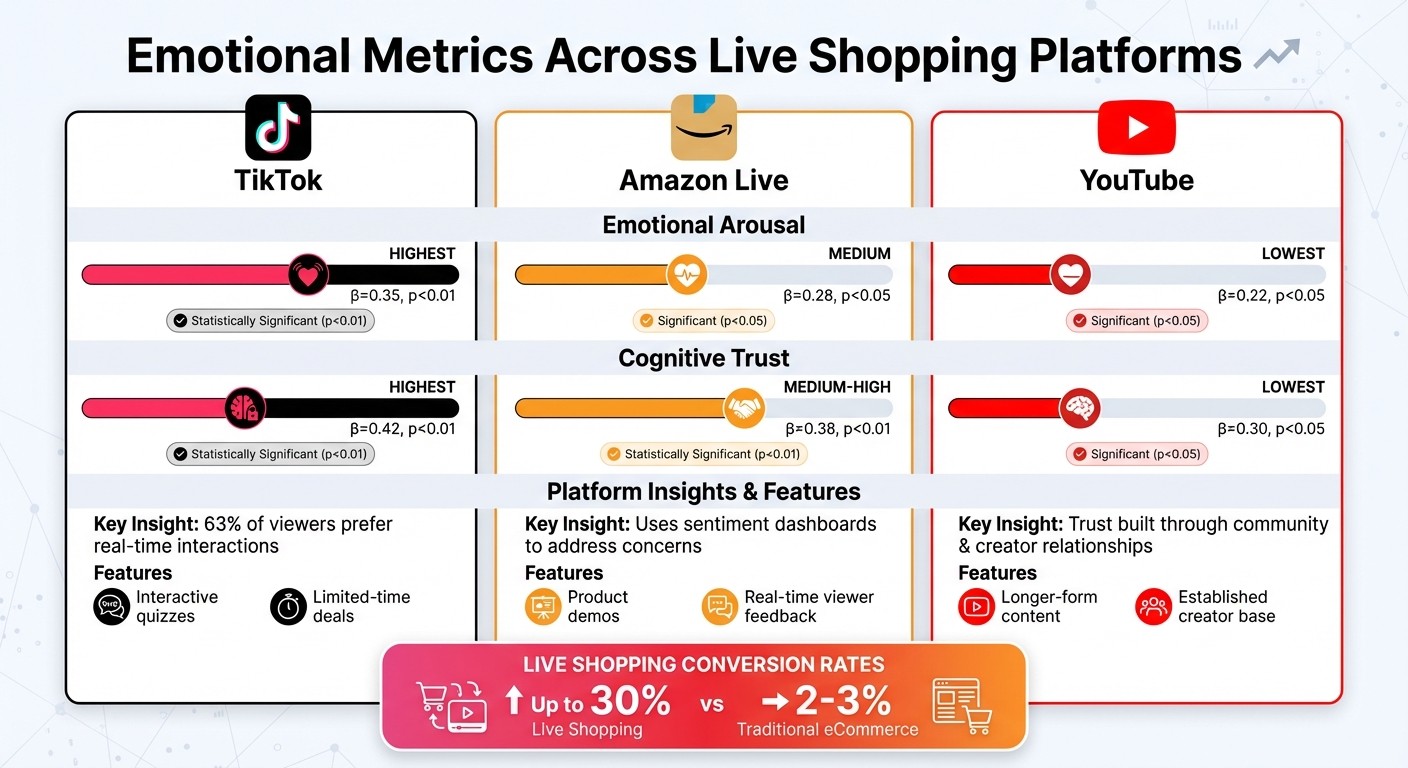
Platform Comparison: Emotional Metrics in Live Shopping (TikTok, Amazon Live, YouTube)
Study Design and Data Collection
To better understand emotional metrics in live shopping, researchers have turned to surveys and statistical tools. For instance, a 2025 study published in Frontiers in Communication gathered 503 valid survey responses from active livestream shoppers using online questionnaires. The study applied SEM (structural equation modeling) and bootstrapping techniques to analyze how emotions influence purchase behavior.
The study focused on several emotional metrics: cognitive trust (confidence in the host's recommendations), emotional arousal (the excitement and energy experienced during a stream), anticipated regret (fear of missing out, or FOMO), perceived enjoyment, and linguistic emotional valence (the positivity in the host's language). Platforms like Amazon Live and TikTok Shop also monitor behavioral indicators such as comment sentiment, dwell time, click-through rates, and engagement spikes during streams. To enhance insights, AI-powered sentiment analysis categorizes viewer comments in real time as positive, neutral, or negative, offering immediate feedback on emotional intensity.
These methods provide a foundation for comparing emotional metrics across platforms, shedding light on how different platforms influence user behavior.
Platform Comparison Results
Researchers used these emotional metrics to evaluate live shopping platforms, uncovering unique emotional drivers for each. The table below highlights how platforms like TikTok, Amazon Live, and YouTube leverage emotional arousal and cognitive trust to influence shopping behavior.
Emotional Metric | TikTok | Amazon Live | YouTube | Platform-Specific Insights |
|---|---|---|---|---|
Emotional Arousal | β=0.35, p<0.01 | β=0.28, p<0.05 | β=0.22, p<0.05 | TikTok creates urgency with interactive quizzes and limited-time deals; Amazon Live uses product demos to engage viewers; YouTube relies on community and creator trust. |
Cognitive Trust | β=0.42, p<0.01 | β=0.38, p<0.01 | β=0.30, p<0.05 | TikTok’s real-time interactions (preferred by 63% of viewers) build trust; Amazon Live uses sentiment dashboards to address viewer concerns; YouTube fosters trust with longer-form content. |
A separate study in SAGE Open focused on fashion livestreams, finding that positive linguistic emotional valence - warm and enthusiastic language from hosts - significantly boosts perceived value, enjoyment, and purchase intentions. This aligns with why live shopping events often achieve conversion rates of up to 30%, far surpassing the typical 2-3% seen in U.S. e-commerce.
These findings underline the growing importance of emotional engagement in shaping the success of live shopping platforms.
How AI Improves Emotional Engagement
AI Livestreams and Emotional Response
AI-powered livestreams tackle one of the biggest challenges in live shopping: the limited availability of human hosts. Unlike traditional livestreams, which are bound by time zones, schedules, and the physical limits of hosts, AI allows for round-the-clock availability across multiple platforms. This means shoppers across the U.S. can tune in and engage with live content whenever it suits them, no matter the time of day.
But the benefits go far beyond simply being "always on." AI systems bring an emotional edge by using real-time sentiment analysis. These systems can detect when viewers are excited, unsure, or losing interest. In response, they adjust the pacing, highlight different products, or tweak messaging to keep the audience engaged. This type of dynamic feedback loop is something human hosts often struggle to maintain, especially during lengthy or back-to-back sessions.
AI also excels at hyper-personalization. Instead of offering the same demos to everyone, AI can suggest tailored product recommendations, exclusive bundles, or time-sensitive deals based on each viewer’s browsing and shopping behavior. This makes the experience feel personal - like the platform understands the viewer's needs - rather than a generic sales pitch. It's this kind of adaptability that paves the way for platforms like TwinTone to innovate in the AI livestreaming space.
TwinTone's Approach to Emotional Engagement

TwinTone takes these AI advantages a step further by blending human authenticity with scalable AI capabilities. Their platform creates AI Twins of creators, preserving their unique style while expanding their reach. This combination of human-like interaction and AI-driven response helps build emotional trust, a crucial factor in connecting with audiences. AI Twins can greet viewers by name, recall past interactions, and demonstrate products in various contexts, making each livestream feel genuinely personal and engaging.
TwinTone supports over 1,000 brands and operates in more than 40 languages, giving U.S. companies a way to maintain consistent emotional connections with both domestic and international audiences. AI Twins can host shoppable livestreams on platforms like TikTok, Amazon Live, YouTube, and Shopify, seamlessly linking product demos to purchasing options. By aligning emotional highs with one-click buying opportunities, TwinTone bridges the gap between engaging content and immediate action, making the shopping experience both compelling and effortless.
Conclusion: Using Emotional Metrics to Win
Emotional metrics have the power to elevate live shopping conversion rates from a modest 2–3% to an impressive 30%. As we've explored, elements like trust, emotional arousal, and sentiment play a key role in influencing purchase decisions. These emotional drivers - combined with traditional metrics like conversion rates and average order value - help brands understand why some streams succeed while others fall short.
To put these insights into practice, start by auditing your live shopping performance and integrating emotional metrics into your analytics. For example, use post-event surveys to measure trust, analyze chat interactions and reactions to gauge sentiment and emotional intensity, and track metrics like watch time and return viewer rates to assess community engagement. Then, connect these emotional indicators to revenue metrics like conversion rates, average order value, and customer lifetime value to demonstrate their business impact.
Real-time AI sentiment analysis can take this a step further by allowing instant adjustments to pacing, offers, or content focus for better results. Tools like TwinTone push this even further by creating AI Twins of real creators, replicating effective emotional patterns - such as tone, pacing, language, and call-to-action timing - across continuous livestreams in over 40 languages. This eliminates scheduling constraints and coordination delays, enabling brands to deliver emotionally engaging product demos and shoppable content at scale. These capabilities open the door for rigorous testing and optimization.
To harness the full potential of emotional insights, experiment with live sessions designed specifically around these metrics. Incorporate trust-building elements, timed urgency, and interactive Q&A to see how they impact conversion and revenue. Use AI tools to analyze session recordings for facial expressions, tone shifts, and sentiment spikes, then apply those high-performing behaviors to future streams or AI-driven hosts. Over time, this cycle of measurement, learning, and iteration can become your secret weapon in the competitive world of live shopping.
FAQs
How do emotional engagement metrics impact live shopping success?
Emotional engagement is a key factor in making live shopping experiences more interactive and impactful. When content strikes an emotional chord, it strengthens the bond between viewers and the brand or creator, increasing the likelihood of purchases.
These engagement insights also allow brands to fine-tune their strategies, ensuring the content elicits positive feelings that drive action. By tapping into these emotional connections, live shopping can lead to higher sales, stronger customer loyalty, and better overall campaign results.
How does AI improve emotional engagement in live shopping experiences?
AI brings a new level of emotional connection to live shopping by enabling personalized interactions that truly resonate with audiences. With tools like AI Twins, brands can craft content that feels genuine and relatable, mimicking the warmth and engagement of human interaction.
On top of that, AI allows for real-time responses to viewer questions and feedback, creating a sense of immediacy and trust. This deeper emotional bond can translate into more engaged viewers, happier customers, and even higher sales.
Why is professionalism important for live shopping hosts?
Professionalism in live shopping hosts plays a crucial role in creating a trustworthy and engaging experience for viewers. When hosts come across as knowledgeable and reliable, it not only boosts confidence in the products being showcased but also strengthens the audience's connection to the brand.
A polished and professional approach fosters a welcoming environment, encouraging viewers to participate, ask questions, and feel involved in the shopping process. This level of interaction and trust often translates into increased sales and helps turn casual viewers into repeat customers.