Interactive VR for DTC Brands
How to build a futureproof relationship with AI
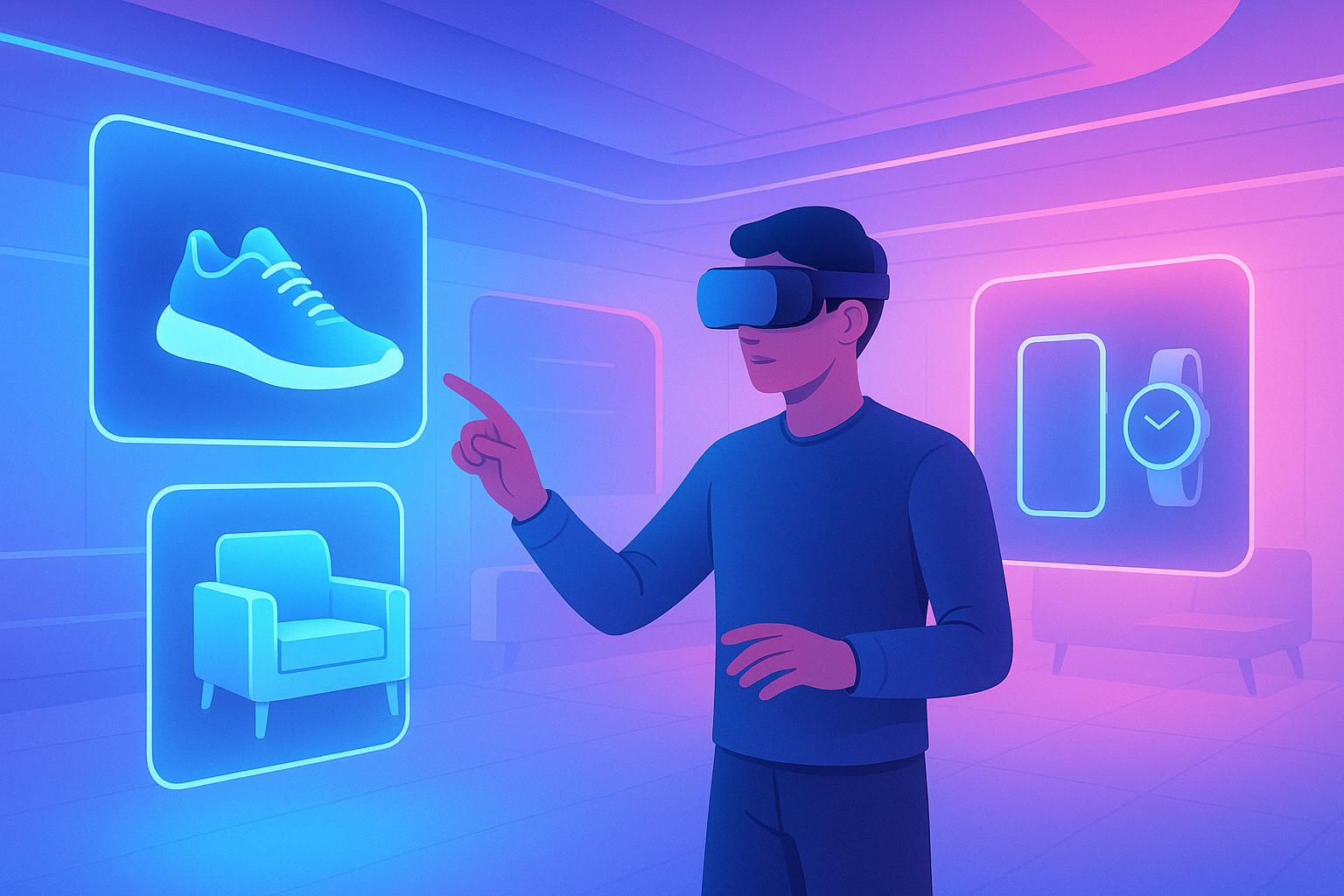
Interactive VR is transforming how direct-to-consumer (DTC) brands engage customers by creating immersive, 3D shopping experiences. It allows users to explore products in detail, visualize them in real-world settings, and even interact with brand stories. This approach addresses common online shopping challenges - like uncertainty about fit or quality - while boosting buyer confidence and driving higher sales.
Key Takeaways:
Customer Engagement: VR shopping experiences make customers active participants, creating stronger emotional connections and longer-lasting impressions.
Product Visualization: Features like 360° views and virtual try-ons reduce hesitation, improve satisfaction, and lower return rates.
Sales Impact: VR tools increase conversion rates by 15–25% and average order values by 30%.
AI Integration: Platforms like TwinTone leverage AI to create shoppable videos and 24/7 virtual guides, streamlining content production and enhancing user interaction.
Scalability: WebXR technology makes VR accessible on smartphones and desktops, removing the need for expensive headsets.
For DTC brands, starting small with virtual showrooms or product demos is a smart way to test VR’s potential. With tools like AI-powered content automation, brands can keep VR experiences dynamic and cost-effective while delivering measurable results.
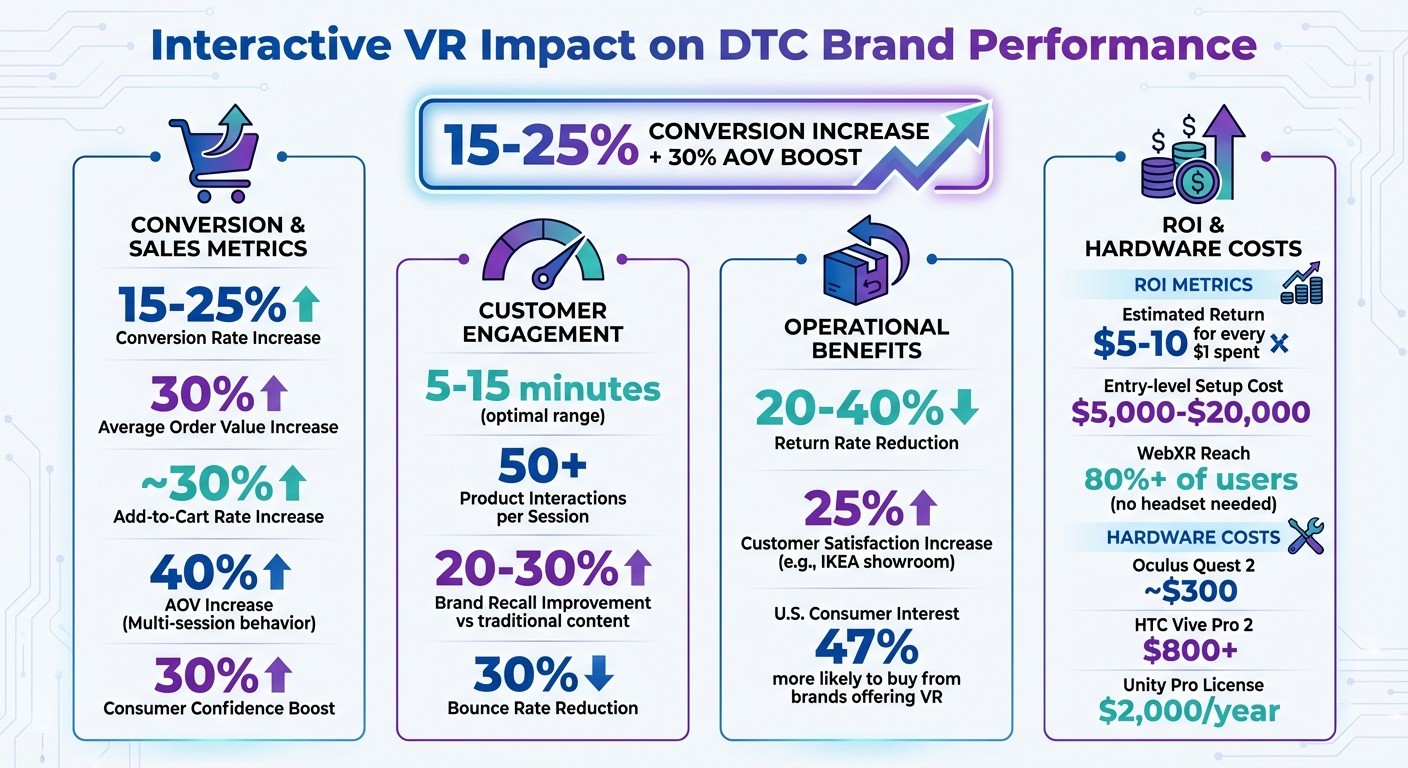
Interactive VR Impact on DTC Brand Performance: Key Metrics and ROI
Why Interactive VR Storytelling Works for DTC Brands
Stronger Brand Engagement and Emotional Connection
Virtual reality (VR) transforms the way customers interact with brands by making them active participants rather than passive observers. This sense of presence and agency creates deeply personal and memorable experiences, which lead to stronger brand recall compared to traditional 2D content. Instead of just watching a story, customers feel like they’re living it, fostering a deeper emotional connection.
A great example is Tom's Shoes' Virtual Giving Trip, where customers can virtually witness the charitable impact of their purchases. By immersing users in the brand’s mission, Tom’s not only strengthens emotional ties but also builds loyalty and drives sales. Metrics like session duration, interaction levels, and story completion rates highlight how impactful these experiences can be - interactive VR sticks with customers far longer than static ads ever could.
Now, let’s look at how VR enhances product visualization and builds buyer confidence.
Product Visualization and Try-Before-You-Buy
One of VR’s standout features is its ability to eliminate the uncertainty of online shopping. Through true-to-scale, 360° views, and detailed product inspections, customers can explore items as if they were physically present. This capability significantly reduces purchase hesitation and fosters confidence in buying decisions.
Take Warby Parker's VR try-on, for instance. By using realistic facial mapping, customers can see how glasses will fit and look, which not only reduces returns but also boosts satisfaction and conversion rates. Similarly, in the furniture space, VR allows shoppers to virtually place items in their rooms. IKEA's Virtual Showroom goes a step further, enabling customers to design entire spaces and see how furniture fits into their vision. This hands-on experience has been shown to increase customer satisfaction and conversions. In fact, these try-before-you-buy experiences can boost consumer confidence by as much as 30%.
Next, let’s explore how VR drives higher conversion rates and larger purchases.
Higher Conversion Rates and Average Order Value
By combining immersive engagement with detailed product visualization, VR doesn’t just enhance the shopping experience - it directly impacts sales. Shoppers feel more confident in their choices, which naturally leads to higher conversion rates. At the same time, VR showrooms and configurators encourage customers to explore add-ons, bundles, and premium upgrades, often resulting in larger purchases.
For example, when customers use IKEA’s VR tools to design complete rooms, they’re more likely to buy coordinated items and report greater satisfaction. This behavior not only increases conversion rates but also boosts average order values. Additionally, VR sessions provide brands with valuable behavioral data - such as time spent, products viewed, and navigation patterns - that can be used to fine-tune future experiences and optimize conversion flows.
For DTC brands diving into VR alongside social commerce, platforms like TwinTone take things further. By using AI to turn real creators into virtual twins, brands can produce shoppable videos and host AI-driven livestreams. This ensures consistent storytelling across platforms without the constant need for manual production, keeping the narrative fresh and engaging. These advancements pave the way for understanding the technology behind VR implementation.
How DTC Brands Use Interactive VR
Immersive Brand Stories
Virtual reality (VR) storytelling works because it actively involves customers in the narrative, turning them from passive viewers into participants. Instead of just reading about a brand's mission or watching a video, shoppers can virtually explore the places where products are made, meet the people behind them, or see the impact of their purchases firsthand. For example, brands with a focus on sustainability are creating virtual field trips to farms, recycling centers, or low-waste factories. These experiences often include interactive hotspots that showcase impact statistics or introduce local collaborators, making abstract ideas like carbon footprint or ethical sourcing feel more real and memorable. By focusing on a single, compelling story - whether it’s about the founder’s journey, environmental commitment, or craftsmanship - brands can create deeper engagement, boost recall, and inspire stronger purchase intent. Beyond storytelling, VR is also reshaping the shopping experience itself.
Virtual Flagship Stores and Product Showrooms
Imagine a VR showroom acting as a flagship store that anyone can visit from anywhere. Unlike standard e-commerce platforms with static product grids, VR showrooms let shoppers explore curated spaces, pick up items, rotate them in 3D, and see products in realistic settings. For instance, a couch might be displayed in a fully styled living room, or clothing could be showcased on lifelike mannequins. Alibaba's Buy+ takes this concept further by offering virtual malls where users can browse multiple brands and complete purchases entirely in VR. For direct-to-consumer (DTC) brands, these immersive spaces aren’t just visually engaging - they encourage product discovery and often lead to higher average order values. A beauty brand, for example, could create a "morning routine" station where shoppers interact with a cleanser, serum, and SPF as a bundled set. This type of environment encourages exploration of complementary products, ultimately increasing basket size. According to Accenture, 47% of U.S. consumers are more likely to buy from brands offering VR shopping experiences. Beyond browsing, VR also allows customers to interact with products in ways that build confidence in their purchases.
Interactive Product Demos and Tutorials
One of the biggest challenges in e-commerce is helping customers feel confident about their purchases without seeing the product in person. Interactive VR demos solve this by allowing users to "try" products virtually, eliminating the need for physical inventory. Shoppers can experience real-world scenarios, such as assembling furniture, testing makeup shades, configuring electronics, or experimenting with resistance settings on fitness equipment. These hands-on experiences are especially valuable for complex or high-stakes purchases. For instance, a DTC kitchen brand might offer a VR tool that lets users swap countertop materials, or a beauty company could provide a virtual mirror to preview cosmetics under different lighting conditions. Instead of relying on static feature lists, these immersive demos make decision-making faster and easier.
For brands looking to merge VR with social commerce, TwinTone offers an innovative approach. It transforms real creators into AI-powered "Twins" that deliver on-demand product demos and shoppable videos. These AI guides can appear in VR showrooms or alongside content on social platforms, offering consistent, creator-led storytelling around the clock - without the delays of traditional production timelines.
Technology Requirements for VR Implementation
Hardware and Software Needs
You don’t need every user to own a VR headset to dive into virtual reality. Devices like the Oculus Quest 2 (around $300) or HTC Vive Pro 2 (starting at $800) offer immersive experiences, but most direct-to-consumer (DTC) brands focus on WebXR compatibility. This approach works seamlessly on browsers like Chrome or Safari, making VR accessible on smartphones, tablets, and desktops - reaching over 80% of users without requiring specialized hardware. For brands experimenting with VR internally, entry-level setups range from $5,000 to $20,000. This includes a Unity Pro license (about $2,000 annually), a basic headset for testing (around $300), and hiring freelance 3D artists to create assets.
When it comes to VR development, Unity and Unreal Engine are the go-to platforms. Unity, which powers more than 70% of mobile games, offers a free tier for brands earning under $100,000 per year - making it perfect for quick prototyping. Unreal Engine, on the other hand, is free to use but charges a 5% royalty on revenue exceeding $1 million. It’s often chosen for its ability to create lifelike visuals, like photorealistic showrooms. Both platforms are compatible with ecommerce solutions such as Shopify and BigCommerce, thanks to plugins that enable direct purchases within VR environments.
Content Production Workflows
Creating VR content starts with tools like 360° capture or photogrammetry, which transform real-world spaces into captivating 3D models. IKEA, for instance, uses this approach to design virtual room layouts. Once captured, assets are refined using 3D modeling tools like Blender before being imported into Unity or Unreal Engine. A key focus during production is on narrative design - allowing users to explore at their own pace rather than following a rigid, linear path. To ensure a smooth experience, developers keep interactive objects to a minimum (fewer than 10) and maintain latency under 20 milliseconds to prevent motion sickness.
Using AI to Scale Content Production
AI is revolutionizing how VR content is created, drastically cutting production times. Tools like TwinTone bring VR experiences to life by generating AI-powered product demos and shoppable videos for virtual showrooms. These AI-driven assets act as virtual guides, delivering consistent, creator-led storytelling 24/7 without the need to coordinate with human influencers. For instance, a beauty brand can use TwinTone to instantly produce tutorials for new products, seamlessly updating VR content as the product lineup evolves. This automation integrates directly into Unity workflows, enabling personalized VR experiences that adapt to shopper preferences while reducing manual labor. By blending AI with VR, brands can create dynamic, interactive environments that keep pace with their audience’s expectations.
Connecting VR with Social Commerce and Shoppable Experiences
Shoppable VR Features
Virtual reality is reshaping shopping by enabling instant purchases through interactive features like hotspots, product cards, and direct checkout links. Imagine exploring a virtual showroom where you can tap on product hotspots to see prices (e.g., $49.99), read details, and add items to your cart - all without leaving the immersive experience. Fashion brands are already using VR fitting rooms, allowing customers to try on clothes virtually and buy them immediately through platforms like Shopify or WooCommerce. For example, Lowe's VR kitchen visualizer on Apple Vision Pro lets users customize cabinets via clickable hotspots and purchase them directly. This approach has significantly reduced return rates.
With WebXR compatibility, these shoppable features work seamlessly across devices, from smartphones and tablets to VR headsets. These tools also integrate with AI-powered livestreams, making content delivery more interactive and engaging.
AI-Powered Livestreams and Content Automation
AI is taking virtual shopping to the next level with tools like TwinTone, which powers continuous, automated livestreams in VR environments. Brands can embed AI Twins in their virtual showrooms to guide visitors through products, answer questions, and display shoppable overlays. These features are available in over 40 languages, making global scalability easy. Platforms like TikTok, Instagram, and YouTube integrate these AI-driven livestreams, allowing brands to expand their social commerce efforts without overspending.
Additionally, this technology generates on-demand user-generated content (UGC) and shoppable videos, keeping VR stores dynamic and engaging. Instead of static virtual spaces, shoppers experience an ever-evolving marketplace that feels fresh every time they visit.
Data and Analytics for Sales Optimization
The beauty of immersive VR shopping lies in the data it generates. Interaction metrics - such as hotspot clicks, dwell time, and demo-to-purchase conversions - flow directly into analytics platforms like Google Analytics or Shopify via API connections. Heatmaps reveal where shoppers focus their attention in virtual stores, helping brands optimize product placement to drive more sales.
Direct-to-consumer (DTC) brands can also compare VR shopping sessions with traditional 2D browsing. Benchmarks show that VR delivers 15-25% higher conversion rates and boosts average order values by 30% through upselling opportunities. Tools like TwinTone take this further by using AI to analyze performance data and personalize content in real time. This tailored approach consistently outperforms traditional advertising, helping brands achieve measurable returns on investment while providing shoppers with a highly customized experience.
Measuring ROI and Performance for Interactive VR
Key Performance Indicators (KPIs)
To evaluate the success of VR campaigns, focus on metrics that truly matter. For instance, longer session durations (ranging between 5–15 minutes) and more than 50 product interactions per session are linked to a 15–25% boost in conversion rates and an approximate 30% rise in add-to-cart rates.
Metrics like product interaction provide valuable insights into customer purchase intent even before items are added to the cart. Tools like interaction heatmaps can track user behaviors such as rotations, zooms, and customizations. They also capture data on configuration saves and sharing rates. For example, IKEA's VR showroom tests revealed that immersive room visualizations could increase customer satisfaction and drive conversions by around 25%.
Reducing product returns is another significant way VR impacts ROI. Detailed VR demos allow customers to better understand products, which can lead to a 20–40% reduction in returns. Additionally, VR storytelling has been shown to improve brand recall by 20–30% compared to traditional content.
To further validate VR's effectiveness, compare its performance against traditional methods through controlled A/B testing.
A/B Testing and Campaign Comparisons
A/B testing is a reliable way to showcase the value of VR. By splitting traffic equally between VR experiences and traditional web pages, you can analyze metrics like engagement time, conversion rates, and average order value (AOV). VR has been shown to increase AOV by 10–20% while reducing bounce rates by 30%.
Platforms like Google Optimize or built-in analytics from VR providers make it easy to set up these tests. Focus on high-intent pages and segment audiences by device type. Running these experiments for 2–4 weeks typically provides clear results. For example, Tom's Shoes saw a 30% improvement in loyalty metrics with their VR "Giving Trip" experience compared to standard video campaigns. Additionally, tracking cohorts pre- and post-campaign using UTM parameters in Google Analytics can help attribute revenue directly to VR exposure.
Using AI Analytics
AI-powered analytics take these insights a step further by transforming raw VR data into actionable strategies. Platforms like TwinTone track VR engagement, conversion funnels, and ROI in real time, often delivering an estimated $5–10 return for every $1 spent. These tools automatically identify which VR scenes, product demos, or narrative elements result in higher conversions and greater customer lifetime value.
Predictive engagement scoring helps detect potential drop-off points before they affect sales, while personalization insights highlight which product configurations resonate most with users. TwinTone's unified dashboards merge VR data with e-commerce metrics, offering a clear picture of VR's financial impact. For instance, multi-session behaviors - such as watching an AI Twin's user-generated content video before visiting a VR showroom - can lead to about 40% higher AOV. This data empowers direct-to-consumer (DTC) brands to refine immersive storytelling and optimize experiences across various channels.
Challenges and Best Practices for VR Implementation
Addressing Accessibility and Cost Barriers
One of the biggest hurdles in VR adoption is making it accessible while managing the high upfront costs of hardware and production. A smart approach is to start small and focus on experiences that work with devices people already own. For example, WebXR and mobile-based VR can run directly in a browser or on a smartphone, removing the need for app downloads or expensive gear. A good starting point might be creating a virtual demo for a flagship product or a compact showroom for a single collection, rather than diving straight into a full-scale virtual store.
For in-store events or activations, a few consumer-grade headsets can deliver immersive experiences without breaking the bank. By offering browser-based access alongside support for at least one mainstream VR headset, brands can strike a balance between accessibility and quality. This ensures that shoppers without dedicated VR devices can still engage with your brand, while more tech-savvy users enjoy a richer, more immersive experience. These cost-conscious solutions help lay the foundation for smoother customer journeys.
Designing User-Friendly VR Experiences
Even the most visually impressive VR experience can fall flat if it leaves users feeling lost or overwhelmed. To keep things engaging, it's best to design short sessions - around 5 to 10 minutes - with a clear structure: a beginning, middle, and a call-to-action like "add to cart" or "claim offer." Including a brief guided tutorial at the start can help ease users into the experience, teaching them basic interactions like where to look, which buttons to press, or how to navigate.
To prevent motion sickness and confusion, use teleportation or node-based navigation. Comfort settings are also essential - features like snap turning, adjustable movement speeds, a seated mode, and the option to disable motion blur can make the experience more comfortable for a wider range of users. Accessibility is another key consideration. Adding readable subtitles, spatial audio cues, and ensuring the UI meets color-contrast standards makes the experience more inclusive. A clean, intuitive design not only enhances user satisfaction but also simplifies future content updates.
Simplifying Content Updates with AI
Creating and maintaining VR content can be time-consuming and expensive. Each product update, seasonal campaign, or new SKU typically requires fresh shoots, editing, and localization. This is where AI-driven platforms like TwinTone come in. These tools can transform real creators into AI Twins, allowing brands to generate on-demand product demos, tutorials, and shoppable videos. Instead of reshooting content every time inventory or pricing changes, brands can update text prompts or product data and let the AI handle the rest - producing new scenes, voiceovers, and localized versions automatically.
TwinTone supports over 40 languages, making it easy to create region-specific content tailored to different U.S. audiences. Scripts, on-screen text, and even references can be adjusted to resonate with local preferences. Beyond VR, AI Twins can host 24/7 livestreams, walking shoppers through products, answering FAQs, and promoting current offers. By centralizing product data, brands can trigger regular AI updates, ensuring VR experiences stay fresh without the ongoing costs of manual content production. This approach speeds up the time-to-market for new products, reduces costs, and ensures consistent messaging across both immersive and traditional channels.
AR & WebXR Are Rewriting the Rules of eCommerce
Conclusion: Is Interactive VR Right for Your DTC Brand?
Interactive VR shifts the customer experience from passive scrolling to active participation, creating stronger emotional connections and making product benefits clearer. Surveys indicate that consumers are drawn to VR experiences, with features like immersive try-before-you-buy options boosting their confidence in making purchases.
For U.S.-based DTC brands, the advantages are clear: VR can increase conversions, reduce return rates, and build customer loyalty. However, whether VR is the right fit depends on a few key factors - how important visual storytelling is for your products, whether your audience is tech-savvy, and if your operations are ready to support such an initiative. VR shines when used for products that benefit from rich visuals, like furniture, apparel, beauty items, fitness equipment, or home goods. Brands targeting audiences already engaging with dynamic media are also well-positioned to succeed. Starting small with a pilot program - such as a virtual showroom for a flagship product or an immersive brand narrative tied to a major campaign - can help you test the waters, measure engagement, and assess conversion rates before committing to a larger rollout.
In the past, high production costs kept VR out of reach for many. But platforms like TwinTone are changing the game. These AI-driven tools make it easier to create on-demand demos, tutorials, and shoppable videos, all while keeping VR content up-to-date. With support for over 40 languages and 24/7 AI-powered livestreams, TwinTone ensures your immersive experiences stay aligned with inventory, pricing, and campaigns - cutting costs that might have been a barrier for smaller teams.
If your products thrive on visual storytelling, your audience values cutting-edge experiences, and you're prepared to test a focused VR use case, now is the time to explore. Track metrics like conversion rates, time spent in VR, add-to-cart actions, and return rates to gauge success. By combining immersive storytelling with shoppable features and leveraging AI tools to scale efficiently, your brand can gain a competitive edge. As VR becomes more mainstream, those who embrace it now will lead in customer experience, data-driven insights, and brand distinction. Interactive VR, powered by AI, offers a pathway to stand out and thrive in an evolving market.
FAQs
How can DTC brands use VR technology without spending a lot upfront?
DTC brands can now embrace VR technology without breaking the bank, thanks to AI-driven tools like TwinTone. These tools empower brands to craft immersive and interactive content, such as AI-based product demos and live streams, all without the need for expensive equipment, professional studios, or complicated production processes.
By simplifying the production process, this approach helps brands roll out captivating campaigns quickly and at a lower cost, making VR storytelling a practical option for businesses of any size.
How does AI improve VR shopping experiences for DTC brands?
AI is reshaping the way DTC brands approach VR shopping by delivering customized and interactive experiences that captivate customers and enhance sales. With AI-driven avatars and virtual hosts, brands can showcase products through immersive demos, host live interactive sessions, and provide content tailored to individual customer preferences.
This innovation also simplifies scaling user-generated content (UGC) campaigns, offering round-the-clock engagement without the need for manual effort or delays. The outcome? A smooth, engaging shopping journey that not only delights customers but also drives higher conversion rates.
How can interactive VR storytelling help DTC brands engage customers and build loyalty?
Interactive VR storytelling offers DTC brands a chance to connect with customers on a whole new level. By crafting engaging, immersive experiences, brands can present their products in a way that feels both realistic and emotionally impactful. This interactive approach allows customers to explore offerings in a personal and memorable setting.
The benefits go beyond just grabbing attention. VR storytelling often leads to longer engagement with the brand, improved brand recall, and more frequent customer interactions. Over time, this can translate into stronger loyalty and a deeper, more meaningful bond between the brand and its audience.