
The impact of UGC on brands
How to build a futureproof relationship with AI

User-generated content (UGC) is reshaping how brands connect with customers. It's content - like reviews, photos, and videos - created by real users, not marketing teams, and it drives trust, engagement, and sales. Here's why UGC matters:
Trust Factor: 92% of consumers trust user recommendations over branded ads.
Boosts Sales: Websites with UGC see a 29% increase in conversions.
Engagement Wins: UGC on social media can increase engagement rates by over 4,000%.
Influences Decisions: 85% of people find UGC more persuasive than professional content.
Brands like Nutrisense and Le Col have seen massive growth by leveraging UGC, proving its ability to build credibility and drive results. Whether it's a TikTok review or an Instagram post, UGC works across every stage of the buyer’s journey, from awareness to post-purchase loyalty. Want to scale this strategy? AI tools like TwinTone now make it easier to generate and manage UGC efficiently while maintaining its real-human appeal.
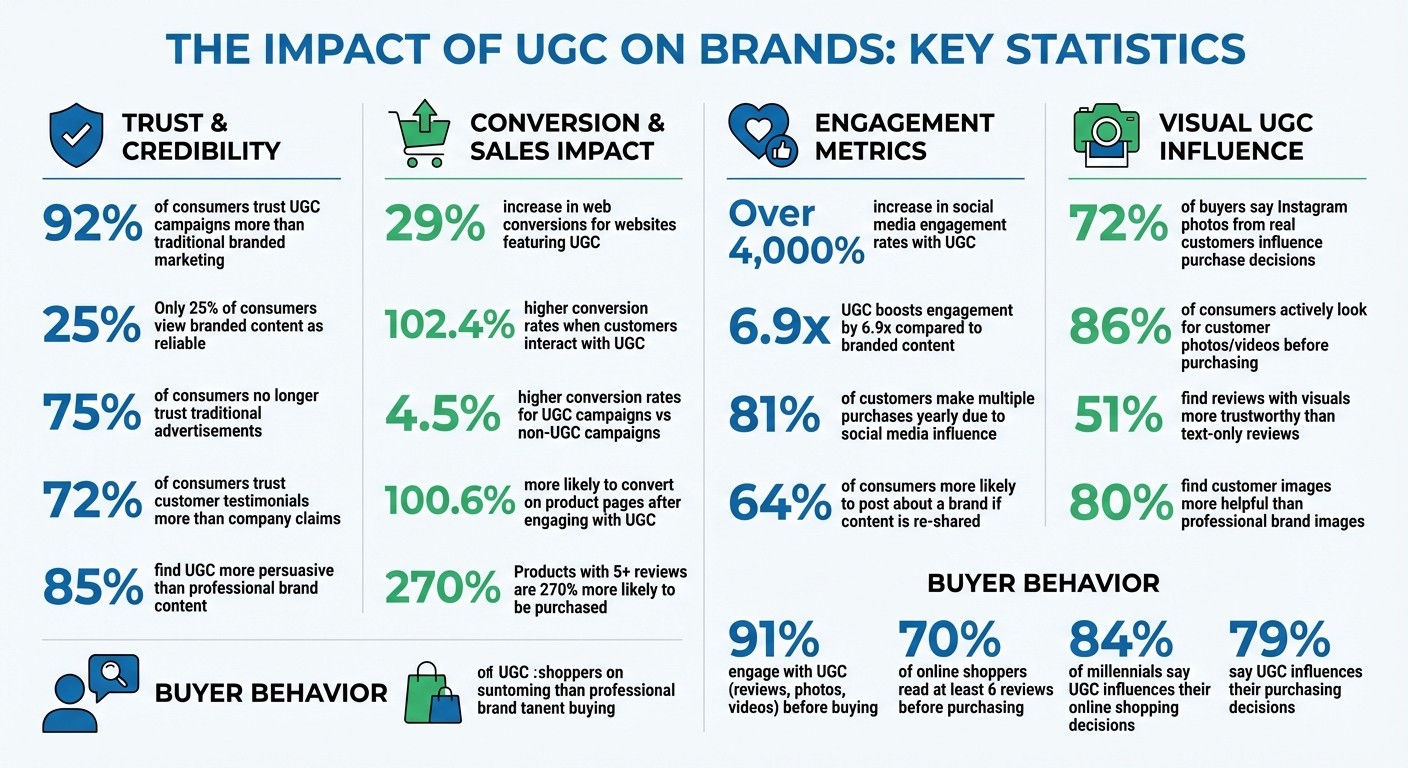
User-Generated Content Impact on Brand Trust and Conversions
UGC Marketing: Everything You Need To Know
What Is UGC and Why Brands Need It
User-generated content (UGC) is any branded material - like reviews, photos, videos, or social media posts - created by customers instead of the brand itself. While traditional marketing campaigns are carefully crafted and controlled by brands, UGC offers something different: a raw, unfiltered look at real customer experiences. This genuine perspective is what resonates most with audiences, boosting credibility and trust.
The key difference between branded content and UGC lies in how they’re perceived. Branded content often feels polished and goal-driven, while UGC delivers a more relatable, everyday perspective. Think of it as the difference between a company telling you how great their product is and a friend sharing their honest opinion. It’s no wonder that 72% of consumers trust customer testimonials more than a company’s own claims, and 85% say UGC is more persuasive than professional brand photos or videos when deciding what to buy.
And it’s not just about trust - UGC drives real results. Websites that feature UGC see a 29% boost in conversions compared to those that don’t. Plus, users who engage with UGC are 100.6% more likely to convert on product pages. Take Le Col, a cycling gear company, as an example. By integrating customer reviews and lifestyle images into its product galleries and retail partner sites, the brand achieved impressive results: a 13% increase in average order value, a 155% jump in revenue per visitor, and a 125% rise in conversion rates. As Andrew Longley, Le Col’s Head of Digital, put it:
"Reviews are as important to new customers as our own product claims".
How UGC Builds Trust Through Real Customer Experiences
UGC tackles one of the biggest challenges in advertising: skepticism. Traditional ads often feel biased, but content created by real customers feels more trustworthy because it comes from people without a financial stake in the brand. This peer-to-peer validation works as social proof, backing up your brand’s claims with authentic experiences.
What makes UGC even more effective is its unpolished, raw quality. Unlike sleek, brand-produced ads, UGC feels more relatable. For instance, a casual unboxing video filmed on a smartphone or an Instagram story showing your product in someone’s daily routine creates a sense of transparency and community. These real moments make your brand feel approachable and human.
In today’s world, where AI-generated content is becoming more common, people are placing higher value on verified, human-created material. Sharing real customer experiences isn’t just a marketing strategy - it’s a way to build meaningful relationships. When you reshare someone’s content and give them credit, it deepens their connection to your brand, fostering loyalty and engagement.
UGC's Role at Each Stage of the Buyer's Journey
UGC plays a crucial role in influencing customers throughout their buying journey.
Awareness Stage: UGC introduces your products organically. A TikTok review or Instagram post can grab attention and build trust without feeling like an ad.
Consideration Stage: This is where UGC shines. Seventy percent of online shoppers read at least six reviews before purchasing. Testimonials, Q&A posts, and side-by-side comparisons help address doubts and guide shoppers toward a decision.
Decision Stage: Seeing real people enjoying your product provides the final push. Photos, unboxing videos, and customer reviews on product pages reassure buyers and reduce hesitation.
Post-Purchase: UGC doesn’t stop working after the sale. When you reshare customer content and recognize their contributions, it strengthens their positive experience and encourages repeat purchases. In fact, 81% of customers say social media interactions influence them to shop multiple times a year.
Here’s a quick breakdown of UGC’s influence across the buyer’s journey:
Buyer's Journey Stage | How UGC Influences Decisions |
|---|---|
Awareness | Social posts and videos introduce products naturally, creating trust |
Consideration | Reviews, testimonials, and Q&A content address concerns and highlight product quality |
Decision | Customer photos and videos reduce hesitation by showing real-life use cases |
Post-Purchase | Sharing customer content fosters loyalty and encourages repeat purchases |
Data and Trends Showing UGC's Impact on Brands
The numbers don't lie - user-generated content (UGC) is reshaping the way brands connect with their audiences. While brands have long understood the value of customer voices, the data now solidifies UGC's role in driving trust, loyalty, and engagement. These trends reveal why consumers increasingly favor UGC over traditional advertising.
Why Consumers Trust UGC More Than Branded Content
There's a stark contrast in how consumers perceive branded content versus UGC. A whopping 92% of consumers trust UGC campaigns more than traditional branded marketing. On the flip side, only 25% of consumers view branded content as reliable, and 75% admit they no longer trust traditional advertisements.
This shift boils down to credibility. UGC resonates because it feels more authentic and relatable. The impact on brand perception is huge: 82% of shoppers say UGC improves how they view a brand, and 91% actively engage with UGC - like reviews, photos, and videos - before deciding to buy.
Visual UGC, in particular, holds significant sway. For instance, 72% of buyers say Instagram photos of products being used by real customers influence their purchasing decisions, and 51% find reviews with visuals more trustworthy than text-only reviews. Millennials especially value UGC, with 84% reporting that UGC on a brand's website influences their online shopping decisions.
How UGC Increases Engagement and Conversion Rates
UGC doesn’t just build trust - it delivers results. Websites featuring UGC experience a 29% boost in web conversions compared to those relying solely on branded content. When customers actively interact with UGC, the numbers are even more impressive: conversion rates jump by 102.4%, and UGC campaigns can achieve 4.5% higher conversion rates than non-UGC campaigns.
Different types of UGC engagement yield varying results. For example, engaging with Q&A sections can lead to a 194.2% boost in conversion rates, while even viewing one-star reviews can increase conversion rates by 85.7%. Social proof also drives repeat purchases, with 81% of customers making multiple purchases each year due to influence from social media.
UGC’s power goes beyond immediate conversions - it fosters deeper engagement and encourages repeat visits.
UGC's Effect on Website Time and Return Visits
Beyond driving sales, UGC helps brands build lasting connections with their audience. It not only attracts visitors but keeps them engaged for longer periods and encourages them to return, which is essential for nurturing long-term relationships and increasing customer lifetime value.
The community aspect of UGC plays a huge role in retention. 64% of consumers are more likely to post about a brand if that brand re-shares their content. However, brands need to stay responsive - 73% of social media users say they would switch to a competitor if a brand doesn’t respond to them on social platforms. Additionally, 66% of consumers rely on conversations with friends and family to stay informed about trends, emphasizing the importance of authentic customer voices in today’s digital landscape.
How to Add UGC to Your Marketing Strategy
User-generated content (UGC) is a powerful tool for building trust and boosting conversions. To successfully integrate UGC into your marketing efforts, focus on three key steps: collecting high-quality content, choosing UGC that aligns with your brand goals, and tracking its performance. While each step requires thoughtful planning, the rewards can significantly enhance your marketing approach.
Methods for Collecting Quality UGC
The first step is to inspire your audience to create content. Branded hashtag campaigns are a tried-and-true method. Take Apple’s #ShotOniPhone campaign, for example. It addressed customer concerns about low-light photography by showcasing stunning user-generated photos, helping rebuild confidence in its camera capabilities. Similarly, Starbucks’ #WhiteCupContest in 2014 and #RedCupArt in 2016 encouraged customers to share creative, product-focused content while keeping production costs low.
Contests and challenges can also drive participation. Offering prizes, discounts, or even the chance to be featured on your official channels motivates users to contribute. To guide submissions, provide clear prompts like “Show us how you style this product” or “Share your unboxing experience.”
Social listening tools are another valuable resource. They help uncover organic content that might not be directly tagged with your brand. If your customer base is small, consider hiring dedicated UGC creators to build an authentic content library.
Here’s an eye-opening stat: 47% of shoppers say user reviews on retailer websites are the most influential factor when researching products, and products with at least five reviews are 270% more likely to be purchased. Always get permission before sharing user content, and give credit to the original creators. This not only builds trust but also encourages others to participate.
Selecting UGC That Matches Your Brand Goals
Not all UGC will suit your marketing needs. The content you choose should align with your goals, whether that’s increasing awareness, driving conversions, or showcasing specific product features. Start by defining what success looks like and identifying the metrics you’ll use to measure it.
It’s also important to tailor UGC to the platform. Different platforms thrive on different styles of content. For instance, what works on TikTok might not resonate on LinkedIn, while Instagram tends to favor visually stunning photos. Given that 86% of consumers actively look for photos and videos from other customers before making a purchase - and 80% find these more helpful than professional brand images - it’s clear that visually engaging UGC can make a big impact.
A great example is Nutrisense, which has effectively leveraged UGC to build a thriving online community and boost engagement.
To make the most of UGC, consider creating a dedicated content library to organize and repurpose submissions across channels like email, social media, and product pages. If you’re working with paid UGC creators, review their portfolios to ensure their style aligns with your brand. Provide detailed briefs that outline your guidelines while leaving room for creative expression. And don’t forget to check for legal compliance, such as music copyrights, when sharing user-submitted videos.
Tracking UGC Performance and ROI
Measuring the impact of UGC goes beyond tracking likes and shares. Define key performance indicators (KPIs) that tie directly to your business goals, such as impressions, reach, mentions, click-through rates (CTR), cost-per-click (CPC), and conversions.
Real-world examples demonstrate the power of UGC. Toyota’s “Feeling the Street” campaign on Facebook, targeting 18- to 24-year-olds, achieved over 1.2 million engagements - a 440% improvement over the prior year’s traditional ads - without increasing its budget. Air France saw an 11% boost in CTR and a 21% drop in CPC by incorporating UGC into its Facebook ads. Similarly, Busabout replaced professional visuals on its website with user-generated photos, resulting in a 33% increase in online conversions and a 65% reduction in production costs.
To track performance effectively, tag content by product or campaign and compare UGC with branded content to evaluate its return on investment. Keep an eye on how UGC performs across various channels, such as social media, email campaigns (which can see a 13% increase in CTR and a 35% improvement in conversion rates), and product pages.
"The insights gained through Sprout Social have empowered us to innovate our brand engagement approaches."
Josh Martin, Director of Social Media and Brand Engagement, Papa Johns
Beyond numbers, analyzing sentiment through natural language processing can reveal whether UGC is positive, neutral, or negative. These insights can inform product improvements and shape long-term strategies. And here’s a compelling figure: consumers who engage with UGC are 100.6% more likely to convert. By tracking these patterns, you can identify which types of content deliver the most value. With a solid measurement system in place, you can even leverage AI tools to refine your UGC strategy further.
Using AI-Powered UGC Platforms Like TwinTone

Creating user-generated content (UGC) the traditional way often involves delays - shipping products, coordinating filming schedules, and managing revisions can slow things down. TwinTone changes the game by turning creators into AI-powered "Twins" that produce UGC instantly, cutting out these time-consuming steps.
UGC has been shown to boost engagement by up to 6.9 times compared to branded content. TwinTone leverages this power to simplify and accelerate the production of authentic content, helping brands scale without the usual headaches.
Creating UGC on Demand with AI Twins
At the heart of TwinTone is its ability to transform real creators into digital AI Twins. These AI-powered versions retain the creator’s unique style, tone, and personality, enabling brands to generate product demos and creator-driven content on demand. This eliminates the need for shipping products or waiting for lengthy production timelines.
TwinTone offers several subscription tiers to meet different needs:
Starter Plan: $110/month for 10 videos, multilingual support, and videos up to 60 seconds.
Pro Plan: $220/month for 20 videos, including advanced features.
Enterprise Plan: Custom pricing for 50+ videos, premium creator options, AI livestreams, and brand-specific training.
Authenticity matters - 90% of consumers say it’s a key factor when choosing brands. TwinTone’s AI Twins ensure content feels genuine, resonating with audiences while sidestepping the usual coordination delays. Beyond video creation, TwinTone also supports interactive livestreams and shoppable video content.
Running AI Livestreams and Creating Shoppable Videos
TwinTone takes UGC a step further by enabling brands to host AI-powered livestreams 24/7 on platforms like TikTok, Amazon, YouTube, Twitch, and Shopify. These streams keep brands visible around the clock without needing human hosts. Additionally, TwinTone creates shoppable videos where AI creators showcase products with in-hand visuals and direct purchase links.
This combination of social media and e-commerce aligns with modern consumer expectations. Brands using UGC report an average of 4.5% higher conversion rates, and campaigns featuring UGC see a 29% increase in web conversions. With multilingual support in over 40 languages, TwinTone also makes it easy for brands to maintain a consistent voice while scaling globally.
Automating UGC Production and Measuring Results
TwinTone doesn’t just simplify UGC creation - it automates the entire process. Through API integration, brands can seamlessly incorporate UGC generation into their marketing and CRM systems. This allows for programmatic content creation across entire product catalogs or campaign variations, eliminating the need for manual input.
Real-time analytics make it easy to track engagement, conversions, and ROI as campaigns unfold. With 79% of consumers saying UGC influences their purchasing decisions, TwinTone helps brands produce impactful content at scale. By syncing data with CRM systems, businesses can identify which AI-generated content drives the most value, ensuring efforts focus on what truly boosts revenue.
Conclusion: Building Long-Term Brand Success with UGC
User-generated content (UGC) has the power to forge lasting relationships between brands and their customers. By highlighting genuine customer experiences, brands can foster a sense of trust that transforms casual buyers into loyal advocates.
Research shows that UGC is seen as more trustworthy than traditional branded content. It consistently boosts conversion rates and inspires customers to share their own experiences. These insights highlight the impact of authentic connections, paving the way for strategies that make UGC scalable.
Examples from real-world campaigns show how authentic UGC drives engagement and builds vibrant communities. These brands didn’t stop at collecting content - they cultivated communities rooted in shared values and meaningful interactions.
That said, scaling traditional UGC campaigns can be challenging. Tasks like securing permissions, curating content, and ensuring consistency often demand significant resources. This is where AI-powered platforms like TwinTone come into play. By automating the creation of authentic content, these tools address the scaling hurdles, especially in a world where 90% of consumers place a high value on authenticity.
This guide has illustrated how UGC is reshaping the way brands connect with their audiences. By embracing AI-driven UGC solutions, brands can not only tackle scalability issues but also lay the groundwork for enduring success.
FAQs
How does user-generated content (UGC) build trust and credibility for brands?
User-generated content (UGC) builds trust and credibility because it comes straight from actual customers, not the brand itself. When people come across genuine reviews, photos, or videos from other shoppers, it serves as social proof - a clear signal that others have had positive experiences. This kind of peer validation feels more sincere than traditional ads, helping to ease doubts and skepticism.
What makes UGC even more powerful is its authenticity. It’s often unpaid and shared voluntarily, showing genuine enthusiasm. Whether it’s heartfelt testimonials, detailed reviews, or creative user posts, these contributions act as a form of digital word-of-mouth. By featuring UGC on platforms like social media, websites, or even email campaigns, brands can showcase real stories, promote transparency, and connect more deeply with their audience. This approach not only builds trust but also encourages loyalty and helps drive sales.
How does user-generated content (UGC) influence the buyer's journey?
User-generated content (UGC) has a knack for influencing shoppers at every step of their buying journey. In the awareness phase, real photos, videos, and posts from actual customers introduce a brand in a way that feels natural and relatable. Unlike polished ads, this kind of content builds trust and sparks interest more quickly. It’s no surprise - many people in the U.S. turn to friends and family for recommendations, so this peer-driven exposure feels authentic and impactful.
As shoppers move into the consideration phase, UGC like product reviews, unboxing videos, and testimonials becomes invaluable. These real-life experiences help address doubts and provide relatable insights, making it easier for potential buyers to feel confident about their choices. And when it comes to the purchase and loyalty stages, UGC continues to shine. Seeing others celebrate their connection with a brand reinforces trust and encourages repeat purchases. Over time, this cycle of sharing and engagement transforms customers into loyal advocates, strengthening the brand’s presence and appeal.
What’s the best way for brands to collect and use user-generated content (UGC)?
Brands can tap into the power of user-generated content (UGC) by streamlining how they collect and use it. Start by setting clear objectives - whether that’s boosting social media engagement, improving product page conversions, or enhancing email campaigns. Then, figure out which types of UGC best fit those goals: photos, videos, reviews, or even branded hashtags.
To gather UGC, keep an eye on hashtags and mentions on platforms like Instagram, TikTok, and X (formerly Twitter). You can also encourage content creation by hosting contests or adding submission forms to your website. Want more reviews? Ask directly on your product pages or work with platforms that collect customer feedback. The key is making it easy and fun for users to participate.
Once you’ve got the content, make sure to get the necessary permissions and curate only the best, most relevant pieces. Use UGC strategically across your marketing efforts - add customer photos to product pages to build trust, include short videos in social ads, or feature glowing reviews in email campaigns. Keep an eye on metrics like engagement, conversions, and revenue to see what’s working and fine-tune your strategy as needed. When done right, UGC can help brands feel more genuine, foster trust, and strengthen customer relationships.