How AI Twins Reduce UGC Production Costs
How to build a futureproof relationship with AI
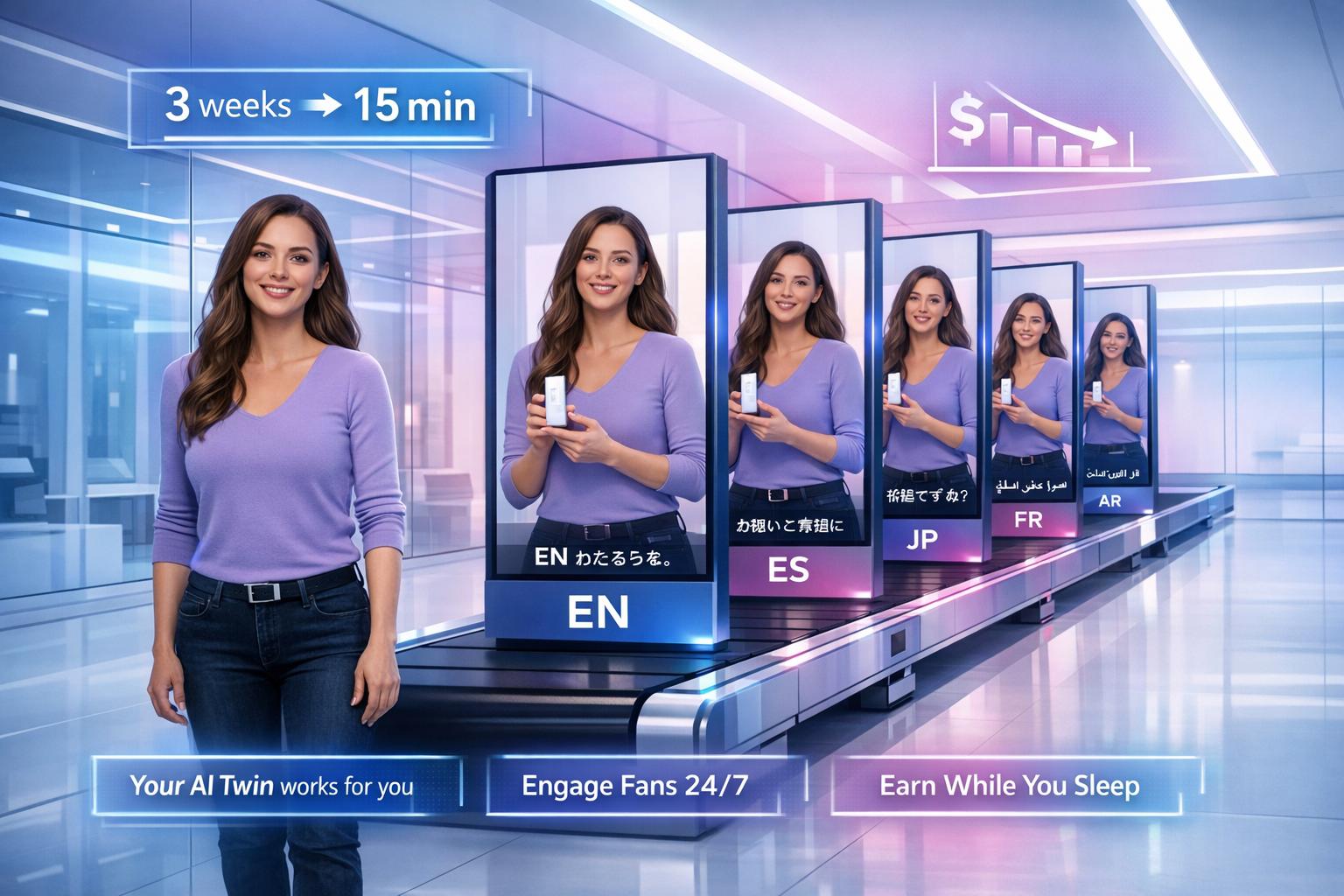
AI Twins are reshaping how brands create user-generated content (UGC) by cutting costs, speeding up production, and enabling global scalability. These AI-powered digital replicas mimic people or products to produce high-quality content without the need for photoshoots, shipping, or creator coordination.
Key Insights:
Cost Savings: Brands save up to 87% on content production costs. AI-generated UGC videos cost around $198 each compared to $350–$1,000 for conventional methods.
Faster Turnaround: Content creation timelines shrink from weeks to minutes, with some workflows taking just 16 minutes.
Scalability: AI Twins allow brands to produce thousands of content variations, localize for global markets, and test campaigns at a fraction of the cost.
Performance Boost: Ads featuring AI-generated UGC achieve 25–35% higher engagement rates, doubling click-through rates and tripling audience attention spans.
Why It Matters:
Ecommerce brands need large volumes of tailored content to stay competitive. AI Twins simplify this by automating repetitive tasks, localizing content instantly, and maintaining consistent branding across platforms. For example, Nestlé reduced scaling costs by 70% using 4,000 digital twins, while Unilever saved 55% on production costs.
AI Twins don’t replace humans - they complement them by handling high-volume tasks, freeing up teams to focus on strategy and large-scale campaigns.
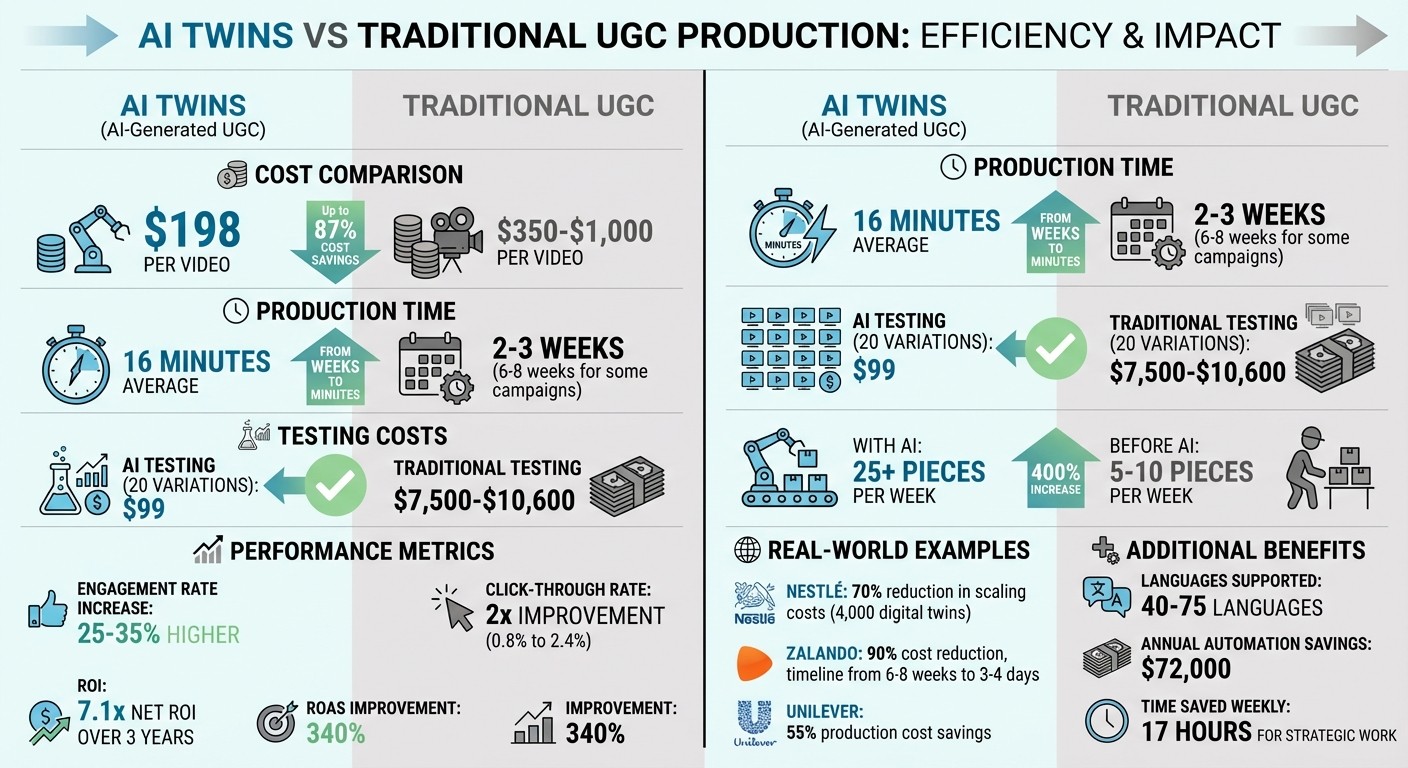
AI Twins vs Traditional UGC: Cost Savings and Performance Comparison
How AI Twins Automate UGC Production
Instant Content Generation
AI Twins have revolutionized the way user-generated content (UGC) videos are created, reducing production time to just 30 seconds on average. The process is simple: submit a product URL or upload photos, and the AI takes it from there. It pulls relevant descriptions, reviews, and visuals, drafts scripts with various hooks, using a UGC content idea generator to brainstorm concepts, selects B-roll footage, and produces polished videos featuring synthetic avatars that mimic human expressions at 24 frames per second.
With TwinTone's URL-to-video technology, brands can skip the lengthy creative brief process. Marketers can now generate multiple video variations in the time it used to take to coordinate with human creators. For instance, Poppi used this automation to achieve over 63 million impressions and reach 218 million creators, delivering content that outperformed traditional media campaigns.
Eliminating Manual Creator Coordination
Creating UGC the traditional way often involves time-consuming tasks like reaching out to creators, negotiating contracts, shipping products, and managing multiple revisions. Brands can use a UGC value estimator to compare these traditional costs against AI-driven savings. AI Twins replace this entire workflow with digital efficiency. Instead of juggling emails and scheduling conflicts, brands can tap into libraries of hyper-realistic digital twins.
The AI handles everything - scripting, casting, filming, editing, and even localization. It can translate and dub content into 40–75 languages instantly. This eliminates the need for regional reshoots or separate creator pools for different markets. A single digital twin can produce localized versions of content for global audiences while maintaining a consistent brand image.
Seamless Integration with Ecommerce Platforms
Beyond automating content creation, TwinTone simplifies content distribution by integrating directly with platforms like TikTok, Shopify, Amazon, YouTube, and Meta. This integration allows brands to publish videos across multiple channels with just one click, eliminating the need for manual uploads.
TwinTone also syncs with Product Information Management (PIM) and Digital Asset Management (DAM) systems to ensure that every video reflects the most current product information. Updates to packaging or pricing are instantly reflected in the content, maintaining accuracy and consistency.
Compliance is built into the system, ensuring videos meet retailer standards, including those from Amazon, Walmart, and GS1. This feature prevents issues during promotional cycles. In July 2025, Nestlé used this approach to convert 4,000 products into digital twins, cutting the time and cost of scaling content by 70% for brands like Purina and Nespresso.
Cost Savings with AI Twins: Breaking Down the Numbers
Lower Production Costs
Producing traditional user-generated content (UGC) often comes with hefty expenses. Think studio rentals, travel costs, lighting setups, and creator fees - all of which can push annual production budgets into the mid-five figures. With AI Twins, these costs are virtually eliminated. Once the digital twin is set up, creating additional videos costs just a fraction of what traditional methods require.
For example, AI-generated UGC videos average about $198 each, compared to the $350–$1,000 range for traditional UGC. A great case study here is Zalando, a European fashion retailer, which leveraged generative AI to produce imagery for its app and website. By doing so, they slashed production costs by 90% and cut timelines from 6–8 weeks to just 3–4 days. By late 2024, 70% of their editorial campaign images were AI-generated.
"Using generative AI cuts the time needed to produce imagery to around three to four days from six to eight weeks, and reduces costs by 90 percent."
– Matthias Haase, Vice President of Content Solutions, Zalando
This kind of efficiency allows brands to create more content without stretching their budgets.
More Content for the Same Budget
AI Twins don’t just save money - they let brands do more with what they already have. For instance, testing 20 variations of a video costs about $99 with AI platforms, compared to $7,500–$10,600 using traditional production.
This efficiency translates into a massive boost in content output. Brands using AI-generated UGC have reported increasing their weekly content production by 400% - jumping from 5 pieces to over 25 - without spending a penny more. On top of that, automated workflows save an estimated $72,000 annually by cutting down on manual tasks like coordination and content moderation by 40%. Nestlé provided a striking example in July 2025, when they converted 4,000 products into digital twins. This move reduced the time and cost of scaling content for brands like Purina and Nespresso by 70%.
This ability to produce more content at scale strengthens the overall return on investment, as we’ll explore next.
Higher ROI with 24/7 Content
AI Twins don’t take breaks, and this 24/7 availability delivers a measurable return on investment. They can react instantly to trends, seasonal changes, or market opportunities - tasks that would typically take weeks to plan and execute.
The results speak for themselves. AI-generated UGC often achieves a 25–35% higher engagement rate compared to traditional content. Over three years, organizations have reported a 7.1x net ROI, while also freeing up 17 hours a week for strategic initiatives.
TwinTone’s approach takes these benefits even further by integrating content creation with distribution. Brands can easily produce localized content for global markets without the need for regional reshoots. A single digital twin file can store all product variations, labels, and language formats, making it simple to refresh imagery for different markets or seasons - all without additional production costs.
How to Make Viral AI UGC Ads in 2026 (Full Workflow)
Maintaining Authenticity and Engagement with AI Twins
AI Twins are doing more than just saving money - they're helping brands and creators connect with their audiences in a way that feels personal and genuine.
Preserving Creator Style and Personality
Today's AI Twins are designed to capture the unique qualities that make creators stand out. These tools use advanced technology to create realistic digital replicas with just three photos, paying close attention to details like camera physics, natural lighting, and skin textures. This ensures the result avoids that overly polished "AI art" look. By uploading 2–5 minutes of video footage, creators can go a step further, building an AI Twin that mirrors their specific movements, gestures, and even emotional expressions. Essentially, these AI Twins don’t just look like the creator - they behave like them too.
What makes this possible is the precision in replicating subtle human behaviors. Creators can add emotional cues such as [laugh] or [excited] to scripts, triggering lifelike expressions. Advanced models even mimic natural eye movements, head tilts, and hand gestures - those little quirks that make interactions feel human. For example, ByteDance's OmniHuman technology can animate a static image to perform tasks like dancing or delivering a speech, all while staying true to the original person's facial expressions and body language.
Even the way scripts are written plays a role. AI tools analyze customer reviews and FAQs to craft scripts in a conversational tone, using phrases like “Honestly, I was skeptical…” instead of corporate jargon. This approach keeps the content relatable and authentic, which naturally leads to stronger engagement across platforms.
Engaging Audiences Across Platforms
Staying true to a creator's personal style doesn’t just build trust - it also boosts interaction across digital spaces. Data shows that AI-generated user-generated content (UGC) is a game-changer for performance. For instance, casual UGC-style ads have been shown to triple click-through rates (CTR) - jumping from 0.8% to 2.4% compared to more polished brand content. In some cases, AI-driven UGC-style videos have delivered a 200% boost in CTR over traditional video ads and generated 2.7x more leads than static image ads.
"Frankies Bikinis provides a concrete example of how UGC performs on ecommerce platforms. The swimwear brand used the Foursixty platform to integrate high-performing UGC into their ecommerce site. By placing top-performing creator content in key locations, Foursixty-driven content accounted for 19% of total orders and over 23% of their online revenue."
The secret lies in maintaining a mobile-friendly, casual aesthetic. AI Twins use conversational scripting with “lo-fi” language, mimicking real customer speech patterns and adding natural pauses to avoid the unsettling "uncanny valley" effect. Brands are also experimenting with short, attention-grabbing hooks (like “Stop doing X, try Y instead”) to improve thumb-stop rates on social platforms. Plus, the ability to format content for different aspect ratios - such as 9:16 for TikTok and Reels or 1:1 for Instagram - ensures the content feels like it belongs on each platform.
Multilingual and Global Reach
AI Twins are opening doors to global markets without the hassle of hiring creators in every region. These digital replicas use real human likenesses and voices, allowing brands to connect with local audiences in their preferred languages. The technology accurately mimics speech and expressions, ensuring that translated content still reflects the creator’s personality and style.
"Malaria No More demonstrated this capability with a breakthrough campaign featuring David Beckham speaking in 9 different languages. Using AI avatar technology, they generated authentic-looking video of Beckham delivering a consistent message to global audiences without requiring him to learn the languages."
For brands, this means they can take a successful ad in one language and instantly create versions in 75+ other languages with the same AI Twin. This is particularly valuable for ecommerce businesses aiming to expand internationally. Digital twins of products can store all variations - like labels, packaging, and language formats - in a single file, ensuring consistent branding across markets. And here’s the kicker: 76% of online shoppers prefer to buy products with information in their native language. AI Twins make it possible to meet that demand without skyrocketing production costs.
Implementing AI Twins in Your UGC Strategy
You can integrate AI Twins into your user-generated content (UGC) strategy without completely overhauling your current marketing operations. The key is to start with clear, measurable goals and then build your approach around them.
Choosing the Right AI Twin Platform
First, decide what you want to achieve. Are you looking to boost your return on ad spend (ROAS), create more content quickly, or expand into new markets? Your priorities will determine which platform features matter most.
For example, TwinTone is a popular choice for brands focused on creator-led video ads and live shopping integration. It’s designed to deliver performance-driven, relatable content at scale. With TwinTone, you can generate UGC videos on demand using AI Twins modeled after real creators. The platform supports over 40 languages and integrates directly with TikTok, Shopify, Amazon, and YouTube.
Pay attention to how platforms handle content preparation. TwinTone, for instance, allows you to upload product photos and scripts, then "dress" AI creators in specific branded apparel. This keeps your content aligned with your branding without needing to reshoot.
Pricing is another factor to consider. TwinTone’s Starter plan costs $110 per month for 10 AI-generated UGC videos, while the Pro plan offers 20 videos for $220 per month. Enterprise plans include 50+ videos, AI livestreaming, and custom support. Compare this to traditional UGC, where a single video can cost $100–$500 and take 2–4 weeks to produce.
Once you’ve chosen your platform, focus on integrating it smoothly into your existing workflows.
Adding AI Twins to Existing Workflows
AI Twins don’t replace human creators but work alongside them to enhance efficiency. Use human creators for high-level brand strategy and standout "hero" content, while AI Twins handle tasks like rapid content iteration, A/B testing, and localization.
Start by automating repetitive tasks. Many platforms allow you to generate videos directly from product URLs. Simply paste the URL, and the platform will pull information from your product page to create scripts and video variations. This eliminates the need for manual briefings.
Next, take advantage of batch production. Instead of creating one video at a time, use tools like "Batch Mode" to produce multiple variations in one go. You can experiment with different hooks, avatars, and aspect ratios - like 9:16 for TikTok, 1:1 for Instagram, and 16:9 for YouTube.
To make your AI-generated content resonate, input customer reviews and frequently asked questions into AI scriptwriters. This ensures the AI Twins address real customer pain points using language that feels relatable. Then, streamline your distribution process by using social media management tools to schedule and publish content directly to platforms like TikTok, Instagram, and YouTube. This approach can cut your production timeline from weeks to just minutes.
Don’t forget to include a human review step before publishing. This ensures that the content aligns with your brand guidelines and accurately represents your product.
Measuring Success and ROI
Once your AI Twins are up and running, it’s time to measure their impact. Focus on two key areas: production efficiency (time and cost savings) and campaign performance (engagement and conversions).
Start by evaluating content velocity. With AI Twins, brands can go from producing 5–10 pieces of content per week to over 25 pieces - a 400% increase. AI-powered UGC production takes about 16 minutes per video, compared to the 2–3 weeks traditional methods require. Plus, testing 20 video variations costs around $99 with AI, versus $7,500 to $10,600 for traditional production.
For campaign performance, focus on metrics like "thumb-stop rate" (the percentage of viewers who watch past the first three seconds) and overall watch time. These metrics help you evaluate the effectiveness of different AI avatars and scripts. On average, brands using AI Twin platforms report a 340% improvement in ROAS.
You can also run A/B tests to optimize your content. For example, test the same script with 10 different AI avatars or use the same avatar with 10 different hooks. Use performance data from the first 48 hours to identify underperforming content and quickly replace it with new variations. Compare the effectiveness of AI Twin content against your best-performing human-generated UGC to see how they stack up.
Finally, keep an eye on creative fatigue. Track how long an AI-generated ad performs well before the cost per acquisition starts to rise. When it’s time for a refresh, AI Twins make it easy to update your content in minutes rather than weeks.
Conclusion
AI Twins are reshaping how ecommerce brands approach user-generated content (UGC) production. The numbers speak for themselves: brands leveraging digital twin technology can cut content creation costs by up to 87%, reduce production timelines from 6–8 weeks to just a matter of days, and save 70% when scaling content across global markets. This is a game-changer for content strategies.
Beyond cost savings, AI-powered workflows ensure content remains authentic. Take Unilever as an example: they’ve shown that digital twins can uphold 100% brand consistency while delivering imagery twice as fast and at half the cost. With 79% of consumers saying UGC heavily influences their purchasing decisions, the ability to produce authentic, creator-inspired content at scale gives brands a clear edge in the competitive marketplace.
AI Twins also eliminate the challenges of traditional influencer coordination, provide around-the-clock content generation for social commerce, and allow for testing multiple creative variations - all at a fraction of the usual cost. As Esi Eggleston Bracey from Unilever explained:
"We've transformed what was once a complex, slow process into a marketing system that frees up our teams to focus on what they do best – think bigger, be creative, push boundaries and create magic for our brands."
Brands treating AI Twins as a strategic tool are seeing impressive results. By automating repetitive, high-volume tasks, human teams can focus on groundbreaking strategies and creative innovation. With TwinTone plans starting at $110 per month for 10 videos, even smaller businesses can access this technology without stretching their budgets.
In today’s fast-paced, scale-driven environment, relying solely on traditional UGC production could mean wasting valuable time and money. AI Twins aren’t here to replace human creativity - they’re here to enhance it, making high-quality, on-brand content scalable in ways that were once unimaginable.
FAQs
How do AI Twins create authentic user-generated content?
AI Twins craft user-generated content that mirrors real-life interactions by analyzing actual user data. They study how people behave, capturing their tone, style, and even visual elements to create content that feels natural and relatable - almost as if it came directly from a real person or brand.
What makes these AI models stand out is their ability to grow and adjust over time. They stay aligned with a brand’s identity, ensuring the content keeps its authentic voice while connecting with audiences. By doing this, AI Twins not only help maintain trust but also boost engagement, all while producing high-quality content efficiently and at scale.
How do AI Twins help ecommerce brands save money on UGC production?
AI Twins provide ecommerce brands with a smart way to create user-generated content (UGC) without breaking the bank. These digital replicas take over much of the content creation process, slashing production times - sometimes by as much as 50%. That means brands can get their content out faster while cutting costs significantly, saving up to half of what traditional methods would require.
On top of that, AI Twins simplify workflows by reducing the need for heavy human involvement. Yet, they still deliver the kind of relatable and engaging content that connects with audiences. The result? High-quality, professional content at a much lower cost, helping brands run more efficiently and maximize their return on investment.
How do AI Twins streamline marketing workflows and reduce costs?
AI Twins can become an integral part of your marketing workflows by serving as virtual stand-ins for your brand, products, or personas. Powered by real data, they can produce consistent, high-quality content quickly, cutting down on the manual effort required. Tasks like generating images, videos, or copy that usually consume valuable time can be handled efficiently, freeing up your team to concentrate on more strategic goals.
These AI-driven tools go beyond just automation. They personalize messaging for different audiences, ensuring your campaigns remain relevant and engaging. Plus, they make content revisions and campaign launches faster, enabling you to adapt quickly to market shifts. This efficient workflow not only saves time and lowers production costs but also preserves your brand’s voice and consistency throughout.