
How AI Powers Subscription Revenue Models
How to build a futureproof relationship with AI

Subscription models are evolving. AI is changing how businesses charge, retain, and serve customers. Here's what you need to know:
Traditional models: Fixed pricing tiers, predictable revenue, but limited flexibility. Light users overpay; heavy users feel constrained.
AI-driven models: Flexible pricing (e.g., usage-based), better personalization, and automated processes. These improve customer satisfaction and operational efficiency but come with higher costs.
Hybrid models: Combine flat fees with usage-based pricing, balancing predictability and flexibility.
AI helps businesses personalize services, predict churn, and automate tasks, boosting revenue and retention. However, managing AI's high costs and complexity is key to success. Companies like Notion and Anthropic are already integrating AI into their subscription strategies, signaling its growing importance.
Criteria | Traditional Models | AI-Driven Models |
|---|---|---|
Revenue Predictability | Stable | Variable, tied to usage |
User Fit | Limited flexibility | Tailored to usage and behavior |
Retention | Basic loyalty | Improved with personalization |
Operational Costs | Lower | Higher, due to AI infrastructure |
Scalability | Manual processes limit growth | Automated, scales easily |
AI is reshaping subscriptions by aligning costs with value and automating workflows, but businesses need to plan carefully to manage costs and complexity.
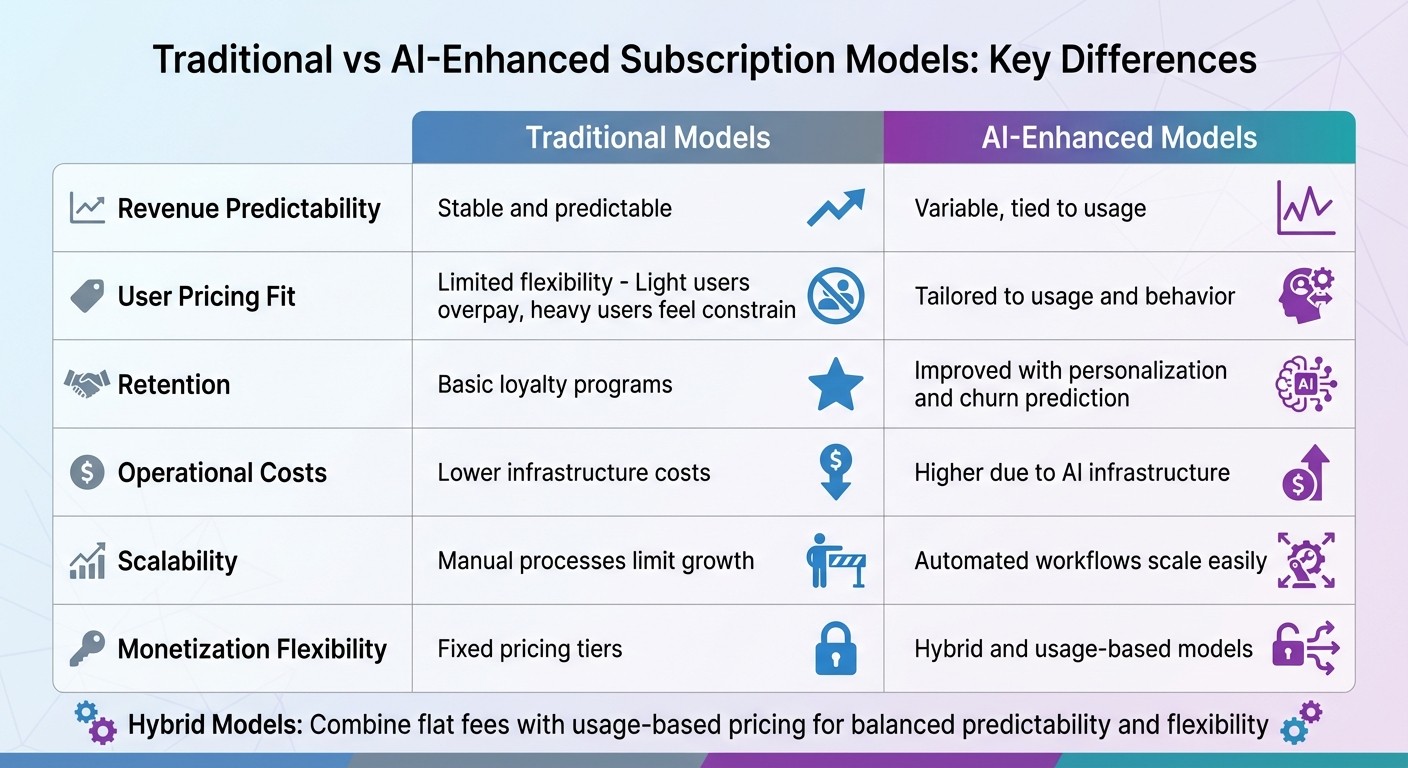
Traditional vs AI-Enhanced Subscription Models Comparison
How to Increase Revenue with AI
1. Traditional Subscription Models
Traditional subscription models rely on fixed pricing tiers, offering customers consistent monthly or annual fees regardless of how much they use the service. This approach is widely used by SaaS companies, collaboration tools, and apps designed for daily workflows, where steady access is more important than fluctuating usage patterns.
Revenue Impact
One of the biggest advantages of traditional subscriptions is the steady stream of recurring revenue they provide. This predictability makes it easier to manage cash flow compared to one-time purchases. However, growth often hinges on acquiring new customers and maintaining low churn rates. The flat pricing structure can be a double-edged sword - heavy users might feel limited, while light users may think they’re overpaying. For instance, Adobe reported $125 million in Q1 2025 from stand-alone AI products offered under subscription plans - a relatively small share of its overall revenue. These dynamics highlight the challenges in balancing revenue generation with customer satisfaction.
User Experience and Retention
While traditional subscriptions offer reliable revenue, the user experience plays a huge role in retention. Lower entry costs, typically ranging from $9.99 to $20 per month, make these models attractive by reducing the initial commitment for new users. This affordability encourages people to try the service, and regular interaction can build loyalty while providing basic data for personalization. However, retention can drop if customers feel the service isn’t delivering ongoing value. Heavy users might feel constrained by the lack of flexible usage options, while light users may wonder if the cost is worth it. For example, the median revenue per app install after 60 days is around $0.31, with AI apps performing slightly better at $0.63. To address these challenges, about 35% of apps now combine subscriptions with other revenue streams, like consumables or lifetime purchases, to improve stickiness.
Operational Efficiency
Traditional subscription models often use automated billing and onboarding processes, which help reduce administrative work. This allows teams to focus more on delivering content and services. These platforms also streamline workflows and provide analytics for basic optimization. However, managing large volumes of customers can still involve manual processes, and the rigid tiered pricing makes upselling or personalizing offerings more difficult. Without real-time insights, making adjustments requires additional coordination. AI-driven models, by contrast, can address these limitations with real-time personalization and automated optimizations.
Scalability
The fixed-fee structure of traditional subscription models can limit scalability, especially when usage patterns vary widely. As customer usage increases, flat fees can restrict revenue growth. For example, traditional SaaS models might frustrate heavy users, leading to churn or missed opportunities for higher monthly recurring revenue. Companies like Midjourney and Anthropic initially used seat-based or tiered subscription models but later transitioned to hybrid approaches to better accommodate variable workloads. AI-driven models offer a way around these scalability challenges by dynamically adjusting fees based on usage.
2. AI-Enhanced Subscription Models
Traditional subscription models often feel rigid, but AI is flipping the script by introducing more flexible options like usage-based billing and hybrid frameworks. Instead of flat rates, companies now offer tiered or usage-adjusted subscriptions that align costs with actual consumption. For instance, Anthropic Claude charges $3 per 1 million input tokens and $15 per 1 million output tokens, while also providing seat-based Pro and Max plans tailored to different customer needs.
Revenue Impact
AI-powered pricing models are reshaping how businesses generate revenue, particularly monthly recurring revenue (MRR). By aligning customer payments with the value they receive, these models create a win-win scenario. Machine learning tools analyze customer behavior, usage trends, and willingness to pay, helping companies offer timely upgrades that feel relevant and personalized. Premium AI subscriptions, typically priced between $9.99 and $20 per month, are proving effective in offsetting the high costs of AI inference. Hybrid models, which combine predictable base fees with usage-based charges, allow businesses to capture additional revenue as customers adopt more AI-driven features. This approach not only boosts revenue but also enhances user engagement and satisfaction.
User Experience and Retention
AI is transforming every stage of the subscription lifecycle, from onboarding to renewal. Automated and adaptive onboarding ensures new users get a personalized experience right away, reducing early churn and speeding up the time it takes for them to see value. Recommendation engines keep users engaged by offering relevant content or features, while churn-prediction models identify subscribers at risk of leaving. These insights let companies take proactive steps, like offering support or adjusting plans (e.g., downgrading from $29.99 to $14.99 per month) to retain customers. Beyond that, AI tools help manage tasks like content scheduling, community prompts, and personalized updates, all of which contribute to stronger retention rates.
Operational Efficiency
AI doesn’t just enhance customer-facing aspects - it also streamlines behind-the-scenes operations. Tasks like billing, revenue recognition, and customer support are automated, cutting costs and reducing errors. Machine learning algorithms can spot anomalies or billing errors before invoices go out, improving collections and minimizing disputes. AI agents handle routine tasks - like tier changes, payment issues, and FAQs - 24/7, passing only complex cases to human support. Platforms are also using automation for onboarding, marketing, and content delivery, freeing up teams to focus on growth. For example, tools like TwinTone create AI-powered “Twins” of real creators to generate on-demand videos and host live shopping events, eliminating the logistical challenges of coordinating with human creators. As these efficiencies grow, they pave the way for scalable operations and long-term growth.
Scalability
AI-driven subscription models make it possible to scale users and content without a proportional increase in labor. Automated workflows handle massive tasks - like onboarding thousands of users, sending lifecycle emails, or organizing content libraries - with minimal manual effort. For products that rely heavily on data and computation, combining a base subscription with metered usage ensures revenue grows alongside demand, helping cover infrastructure costs. For example, Clay offers enterprise-wide flat fees that aren’t tied to user counts, reflecting the value of automated workflows rather than individual logins. AI also improves forecasting and capacity planning, helping companies prepare for future compute, storage, and support needs. This ensures that costs align with revenue as businesses scale. It’s why platforms like Notion have moved from treating AI as an optional add-on to bundling it into higher subscription tiers, signaling its importance as a core feature.
Pros and Cons
When it comes to subscription models, both traditional and AI-driven approaches come with their own sets of advantages and drawbacks. Understanding these trade-offs is key for businesses deciding which model aligns best with their goals.
Traditional subscription models are known for their steady and predictable cash flow. Flat monthly fees make forecasting easier and simplify financial planning. However, these models often fall short in certain areas. For instance, light users may feel overcharged, while heavy users might feel restricted by usage caps, leading to dissatisfaction. Additionally, they lack the advanced personalization and automation capabilities that today’s customers increasingly expect, which can lead to higher churn rates. These limitations highlight why some businesses are exploring more dynamic options.
AI-enhanced models, on the other hand, flip the script by offering precise personalization and scalability. Through machine learning, these models analyze customer data to tailor offerings, predict churn, and automate processes like onboarding and content delivery. For example, AI-powered apps often double the median revenue per install over 60 days. With premium AI subscriptions priced around $9.99 per month, businesses can offset the high costs of running AI systems, while the global AI market is expected to grow from $294.16 billion in 2025 to $1.77 trillion by 2032, with an annual growth rate near 30%. However, these models come with challenges. Compute costs can run into the millions per month, posing risks to profitability if not carefully managed. Additionally, tiered or hybrid pricing structures can confuse users, and reliance on AI infrastructure raises questions about reliability.
Hybrid models, which combine a recurring base fee with metered usage, are emerging as a middle ground. These models offer a balance between predictability and flexibility. Many apps are now blending subscriptions with consumable purchases or lifetime access to increase customer engagement. By aligning costs with actual usage, hybrid models address AI's variable workloads while also generating additional revenue as customers scale up. This approach avoids some of the pitfalls of flat-fee pricing and demonstrates how AI is reshaping subscription strategies.
Here’s a comparison of how the two models stack up across key criteria:
Criteria | Traditional Subscriptions | AI-Enhanced Subscriptions |
|---|---|---|
Revenue Predictability | Simple and stable forecasting | More complex due to usage variability |
User Pricing Fit | Overcharges light users; caps heavy users | Better fit with tiers or usage-based pricing |
Retention | Standard loyalty | Improved through personalization and churn prediction |
Operational Costs | Lower | Higher due to compute needs; requires optimization |
Scalability | Limited by manual processes | Enhanced through automation |
Monetization Flexibility | Fixed tiers | Hybrid and outcome-based models |
AI-enhanced models clearly offer exciting opportunities for growth and customer retention but demand careful cost management. Research shows that organizations with formal AI strategies are twice as likely to succeed, emphasizing the importance of thoughtful planning and transparency.
For brands looking to harness these benefits, platforms like TwinTone showcase how AI can be effectively integrated into subscription models. With features like AI-powered user-generated content creation, automated livestreaming, and social commerce automation, TwinTone demonstrates the potential of combining AI with subscription strategies.
Conclusion
AI is reshaping subscription models by driving revenue growth, improving user experiences, and enabling businesses to scale effectively. Market trends point to a rapid rise in AI adoption, reinforcing the value of these investments and the opportunities they create for subscription-based businesses.
The focus now shifts to timing. The decision isn’t about whether to integrate AI but when. Subscription businesses should consider adopting AI once they have strong unit economics, quality customer data to enable personalization, and the infrastructure to manage costs efficiently. Research shows that consumers are willing to pay for premium AI features, often at price points around $9.99 per month, with AI-powered apps consistently outperforming industry revenue benchmarks.
AI should be viewed as a tool for growth, particularly for upselling and building customer loyalty, rather than as an added expense. Take Notion, for example: by May 2025, the company had woven AI into its Business and Enterprise plans, transitioning it from an optional add-on to a core feature. This approach highlights how integrating AI directly into subscription offerings can significantly boost profitability.
To maximize AI's potential, businesses can take practical steps such as implementing tiered conversion strategies, experimenting with hybrid pricing models, and closely tracking metrics like churn and customer lifetime value. Transparency is critical - customers need to clearly see the value they’re receiving compared to the costs involved. Platforms like TwinTone exemplify this approach, offering scalable AI-driven content creation and distribution through tiered plans ranging from $110 to custom enterprise pricing. These plans align AI capabilities with specific business needs, ensuring clarity and value at every level.
FAQs
How does AI improve customer retention in subscription-based models?
AI plays a key role in boosting customer retention for subscription-based businesses by creating personalized experiences tailored to individual preferences. This approach helps customers feel appreciated and keeps them engaged. On top of that, AI can automate communication, ensuring timely updates, reminders, and support are delivered. This consistency strengthens the relationship between brands and their subscribers.
Another advantage is AI's ability to optimize marketing efforts on a larger scale. It enables businesses to run targeted campaigns that keep customers interested and loyal over time. These features make AI an essential tool for maintaining and growing a thriving subscription-based business.
How does using AI impact the costs of subscription-based models?
Integrating AI into subscription-based models offers businesses a way to cut costs while boosting efficiency. By automating tasks like content creation and customer engagement, companies can avoid the hefty expenses tied to studio setups, lengthy production timelines, and high influencer fees. The result? Faster, more budget-friendly campaigns.
AI also plays a key role in scaling operations. It tailors user experiences and simplifies workflows, helping businesses achieve higher return on ad spend (ROAS) and make smarter use of their resources. With less manual work and fewer delays, companies can shift their focus toward growth and providing real value to their subscribers.
How does AI help brands scale more effectively than traditional methods?
AI empowers brands to streamline operations by automating essential tasks like content creation and live-streaming. This means brands can quickly produce personalized user-generated content (UGC), shoppable videos, and product demos - sidestepping the usual delays tied to creator outreach, negotiations, or manual editing.
By leveraging AI, brands can roll out high-quality, customized campaigns on a large scale, ensuring steady engagement and quicker delivery to market. The result? Saved time and an improved customer experience, thanks to tailored content and on-demand availability.