How AI Personalizes Fan Interactions
How to build a futureproof relationship with AI
AI is reshaping fan engagement by turning data into personalized experiences. From sports teams to creators, brands now use AI to analyze fan behavior - like app usage, ticket purchases, and social media activity - to create tailored interactions. For example, Orlando City SC increased app users from 7,000 to 22,000 and generated $1.5M in revenue after adopting AI in 2024. AI-powered tools like "AI Twins" and personalized videos allow brands to scale engagement while maintaining a human touch. Key takeaways:
AI analyzes fan behavior: Tracks clicks, purchases, and more to predict preferences.
AI Twins: Digital replicas of creators or brands that handle fan interactions 24/7.
Personalized content: Tools create videos, livestreams, and recommendations tailored to individual fans.
Proven results: Miami HEAT boosted ticket sales by 30% using fan data, while NBC Peacock delivered 7M unique Olympic highlight reels via AI.
This shift isn’t about replacing human connection - it’s about scaling it, ensuring fans feel valued while driving revenue growth.
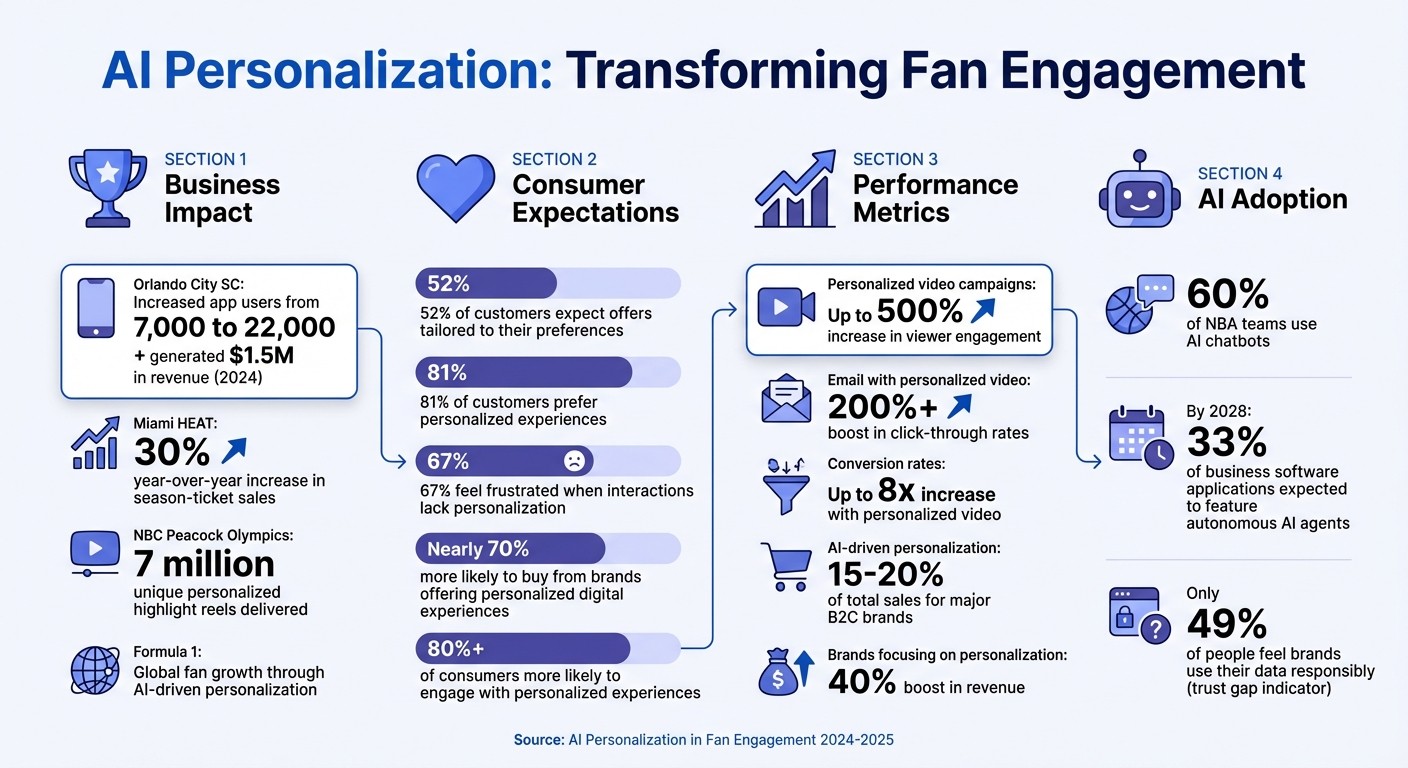
AI Personalization Impact: Key Statistics and Success Metrics for Fan Engagement
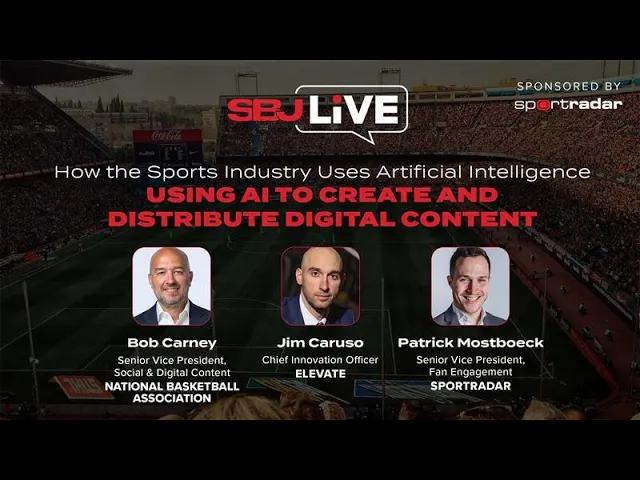
How the Sports Industry Uses Artificial Intelligence: Using AI to Create/Distribute Digital Content
Understanding Fan Behavioral Data
Personalization starts with understanding how fans interact digitally. Every click, view, purchase, and engagement paints a picture of fan behavior, revealing micro-segments like "merch-only superfans" or "lapsed locals" - fans who live within 25 miles of your venue but haven’t engaged in over 90 days.
Fan data generally falls into four main categories: digital engagement (like website activity, app usage, email opens, and social media interactions), transactional history (covering ticket purchases, merchandise, and concessions), in-venue signals (such as Wi-Fi analytics and beacon tracking), and contextual data (which includes device type, location, and time of interaction).
Why is this important? Because 52% of customers now expect offers tailored to their preferences. Behavioral data makes that level of personalization possible. For instance, the Miami HEAT leveraged Microsoft Dynamics 365 to build a data warehouse that focused on fan behavior rather than just demographics. The result? They saw a 30% year-over-year increase in season-ticket sales, all without changing their on-court product. Formula 1 adopted a similar strategy, using AWS and Salesforce Data Cloud to centralize fan data. By applying machine learning, they created "Battle Forecasts" that appealed to their "strategy-nerd" fan base, driving global fan growth.
The real power lies in linking specific fan behaviors to economic outcomes. For example, when someone hovers over a seat map or clicks on a size chart, those actions signal purchase intent. AI systems can then use these signals to deliver personalized, timely outreach. Up next, we’ll dive into how to efficiently gather this data.
Methods to Collect Fan Data
Collecting behavioral data requires a structured approach that taps into multiple fan touchpoints. Customer Data Platforms (CDPs) like Salesforce or Microsoft Dynamics 365 are invaluable here, consolidating data from various sources into unified profiles. This system treats fans like regulars, not anonymous visitors.
Interactive tools offer another rich source of data. AI chatbots, now used by 60% of NBA teams, along with predictor games, polls, and QR code scans, gather first-party data while keeping fans engaged. These gamified experiences resonate especially well with younger audiences or international fans who may not attend games in person. Social listening tools add another layer by monitoring fan sentiment across platforms, rounding out the fan profile.
In NFL stadiums, Wi-Fi analytics track fan movement to improve venue operations. This data informs everything from concession stand placement to sponsor activation zones. To keep marketing relevant, it’s crucial to process and act on this data quickly - ideally within 24 hours.
Ensuring Privacy and Compliance
Once you’ve defined your data collection strategy, protecting fan privacy becomes critical. Start with data minimization - only collect what’s necessary for specific purposes and ensure that all data is validated. Transparency is key: openly communicate how fan data is collected, used, and protected, rather than burying details in dense terms of service.
A consent-first approach is essential. Always get explicit permission before using sensitive data, and give fans control through preference centers. Allow them to choose between required cookies (essential for site functionality), functional cookies (for performance insights), and advertising cookies (for targeted marketing). Only required cookies should be active by default; the rest need user consent.
Strong security measures help guard against breaches, while ethical AI models prevent biases that could unfairly exclude certain fan groups. Regulatory compliance is also a must - whether it’s GDPR for Europe or CCPA for California, understanding the rules that apply to your audience is non-negotiable. Borussia Dortmund CEO Hans-Joachim Watzke sums it up well:
"If [a fan] gets the feeling that he's no longer regarded as a fan but instead as a customer, we'll have a problem".
Creating AI Twins to Scale Personalized Interactions
Once you've collected behavioral data, the next step is figuring out how to use it effectively - and at scale. Enter AI Twins: autonomous digital replicas designed to interact with fans 24/7 without overwhelming creators or their teams. By 2028, 33% of business software applications are expected to feature autonomous AI agents, signaling a major shift from manual engagement to smart automation. These AI-driven systems bridge the gap between detailed behavioral insights and scalable, personalized fan interactions.
What Are AI Twins?
AI Twins are digital systems trained to mirror a specific creator's tone, personality, and style. Unlike generic chatbots, these twins are crafted to feel personal. They learn from a creator’s writing samples, past social media interactions, and even personal journals to capture the subtle details that make each creator stand out.
In June 2025, creators Elizabeth Gasiba, Paige Piskin, and Marcella Cortland used the AI tool Soopra to create their own AI Twins. By uploading their writing and journals, they trained these replicas to sound and respond just like them. Piskin shared how the tool allowed her to produce more content and engage with fans without experiencing burnout, while Gasiba noted that her fans often commented on how closely the AI matched her voice. As Gasiba put it:
"Even though they know it's not me typing in real time, the responses still feel like me. The vibe, the tone, the little expressions - it all matches how I talk."
This approach ensures authenticity at scale. AI Twins can handle a large volume of messages and comments, eliminating bottlenecks while maintaining the creator’s unique voice. Piskin reflected on the transformation:
"Without these tools, I really was at a bottleneck a few years ago and struggled to keep up with content creation... Now I have so many tools and creative pipelines, I can produce more content... without getting burned out."
Platforms like TwinTone take this concept even further by enabling AI Twins to create on-demand UGC videos, host livestreams, and streamline social commerce. Brands can instantly access product demos and shoppable videos without the delays of traditional coordination.
Building Fan-Specific AI Profiles
AI Twins become even more impactful when they’re paired with detailed fan behavioral data. By combining these digital replicas with real-time fan insights, creators can deliver highly personalized experiences. The process starts by integrating data from ticketing systems, mobile apps, e-commerce platforms, and social media into unified fan profiles. This consolidated data allows AI Twins to craft responses that feel tailored to each individual.
AI algorithms analyze these profiles to uncover patterns - like preferred communication channels, purchasing habits, and engagement trends. Instead of relying on broad demographic categories, fans are grouped by specific lifecycle stages. This segmentation enables AI Twins to deliver hyper-personalized responses, adapting their messaging to align with each fan's unique history. And it matters: nearly 70% of consumers say they’re more likely to buy from brands that offer a personalized digital experience.
The system also improves over time through feedback loops. Creators retain control by toggling AI assistants on or off depending on traffic levels and ensuring transparency by clearly labeling AI interactions. For branded or sponsored content, many creators prefer to keep human oversight to maintain trust with advertisers.
Delivering Personalized Fan Experiences with AI
Once you've created AI Twins and incorporated fan behavioral data, the real challenge lies in delivering experiences that feel truly personal. With the help of integrated fan data, AI doesn't just tailor recorded content - it transforms live interactions. In fact, over 80% of consumers are more likely to engage with a company that provides personalized experiences.
The secret is moving past one-size-fits-all messaging. AI-powered tools analyze complex data - like viewing habits, purchase history, and engagement trends - to craft experiences tailored to individual fans. This shift from generic outreach to hyper-personalization is what separates brands that merely reach audiences from those that genuinely connect with them.
On-Demand UGC Videos
AI-driven video tools empower creators and brands to produce shoppable videos and product demos that adapt to fan preferences without the delays of traditional production. By analyzing behavioral data, AI can generate thousands of video variations, tweaking product recommendations, messaging, and visuals for each viewer.
The depth of personalization depends on the data available, and knowing where your content falls can help you make the biggest impact:
Personalization Level | Data Used | Example Use Case |
|---|---|---|
Basic | Name, Company, Job Title | Welcome video: "Hi Sarah, welcome to the team!" |
Behavioral | Product viewed, last login | E-commerce: Video featuring a product left in a cart. |
Contextual | City, Weather, Local events | Travel: "Tired of the rain in Seattle? See Cancun." |
Generative | Performance data, complex sets | Wealth Management: Personalized year-in-review video. |
Campaigns that use personalized video often see up to a 500% increase in viewer engagement compared to non-personalized content. When integrated into email campaigns, personalized videos can boost click-through rates by over 200% and increase conversion rates as much as eightfold.
A standout example is NBC Peacock’s use of generative personalization during the Olympics in July and August 2024. By analyzing 5,000 hours of coverage, they created "Your Daily Olympic Recap" using an AI clone of sportscaster Al Michaels. This system delivered 7 million unique variations of highlights tailored to individual users' viewing habits and preferences.
For brands aiming to replicate this success, platforms like TwinTone offer tools to generate on-demand UGC videos instantly. By transforming creators into AI Twins, brands can produce authentic product demos and shoppable videos in over 40 languages. With API access, brands can programmatically generate content for their entire product catalog, ensuring every product gets personalized attention.
To make on-demand UGC effective:
Map the Customer Journey: Identify key moments where personalized video can make the most impact, such as initial contact, post-demo follow-ups, or customer anniversaries.
Script for Variables: Design scripts with placeholders (e.g.,
{{first_name}}) and fallback options for missing data.Integrate CRM Data: Connect platforms like Salesforce or HubSpot to trigger video creation automatically when fans hit milestones.
A/B Test Elements: Experiment with thumbnails, calls-to-action, and script variations to optimize engagement.
Beyond pre-recorded content, real-time interactions take fan personalization to the next level.
AI-Powered Livestreams
Building on the personalized capabilities of AI Twins, AI-powered livestreams elevate engagement by adapting in real time to fan inputs and behaviors. These streams dynamically respond to live comments, votes, and actions, creating a more interactive experience.
The technology behind these streams relies on three main components: event ingestion, real-time data processing, and unified fan profile integration. For example, when a fan interacts during a livestream - whether by commenting, voting, or clicking - the AI can instantly adjust the content, provide tailored responses, or suggest relevant products.
This shift from passive viewing to active participation meets growing expectations. Studies show that 81% of customers prefer personalized experiences, while 67% feel frustrated when interactions lack personalization. AI-powered livestreams address this by making each viewer feel like the content is crafted just for them.
In November 2024, the Dallas Mavericks showcased this approach by using Magic Hour's video-to-video AI tool to create a pregame hype video for their matchup against the Orlando Magic. Displayed on the arena jumbotron, the video boosted fan engagement by tailoring content to the event. While this was a single-use case, the same technology can power continuous, always-on livestreams that adapt to individual fan behavior.
Platforms like TwinTone take this concept even further, enabling brands to run 24/7 AI-powered livestreams on platforms like TikTok, Amazon, YouTube, Twitch, and Shopify. AI Twins host these streams, presenting products with natural gestures and voice styles while responding to live fan interactions. With support for over 40 languages, brands can engage global audiences without the high costs of traditional production.
To deploy AI-powered livestreams effectively:
Start with Clear Goals: Define metrics like "time spent on page", "interaction depth", or "conversion rate" before setting up AI triggers.
Ensure Data Minimization: Collect only the data needed for personalization to maintain trust and comply with regulations.
Maintain Human Oversight: Use human-in-the-loop systems for critical decisions to ensure the content aligns with your brand's voice.
Test with A/B Variations: Experiment with interactive elements - such as voting prompts or AI overlays - on smaller audiences to measure effectiveness.
Here’s a comparison of traditional approaches versus AI-powered platforms:
Feature | Traditional Approach | AI-Powered Platforms |
|---|---|---|
Campaign Launch Time | Weeks | Minutes |
Content Delivery | Generic, scheduled | Personalized, on-demand |
Fan Interaction | Limited, manual | Real-time, 24/7 automated |
Multilingual Support | Costly/Limited | Automated across 40+ languages |
Availability | Human-dependent | 24/7 via AI Twins |
The balance between automation and authenticity is crucial. As Hans-Joachim Watzke, CEO of Borussia Dortmund, wisely noted:
"If [a fan] gets the feeling that he's no longer regarded as a fan but instead as a customer, we'll have a problem".
AI-powered personalization works best when it enhances the fan experience without making it feel overly transactional or impersonal.
Measuring and Optimizing AI-Driven Fan Interactions
Launching AI-powered personalization is just the first step. Without tracking clear metrics, it’s impossible to know whether AI is strengthening fan relationships or simply draining resources.
To make AI smarter over time, build a "self-learning flywheel." Every interaction - whether it’s a fan upgrading their seat or ignoring a push notification - feeds back into the system, refining predictions and improving results season after season. Below, we’ll dive into the key metrics you should monitor to fine-tune your AI personalization strategy.
Key Metrics to Monitor
Tracking the right metrics transforms raw data into actionable insights, creating a feedback loop that improves AI-driven personalization. Focus on four major categories: engagement, financial performance, loyalty, and operational efficiency.
Engagement metrics: Metrics like click-through rates, app login frequency, and social shares show how well your AI-driven content connects with fans. Low interaction rates signal that your personalization efforts may need adjustments.
Financial metrics: These measure the direct business impact of your strategy. Keep an eye on conversion rates, Average Order Value (AOV), Customer Lifetime Value (CLV), and overall revenue. For example, after using Salesforce's Commerce AI, one major B2C brand reported that AI-driven personalization accounted for 15% to 20% of its sales. Additionally, consolidating fan data from 200 websites boosted service agent satisfaction scores by 70%.
Loyalty metrics: Retention rates, repeat purchases, and engagement during off-peak times help gauge how well you’re turning casual fans into dedicated superfans.
Operational efficiency metrics: For brands using AI in customer service, metrics like agent satisfaction, resolution time, and chatbot accuracy are key indicators of improved support interactions. Considering that only 49% of people feel brands use their data responsibly, trust-related metrics are equally important.
Metric Category | Key Performance Indicators (KPIs) | Purpose |
|---|---|---|
Engagement | Click-through rates, app logins, social shares | Measures interest and content relevance |
Financial | Conversion rates, AOV, CLV, total revenue | Tracks business impact and ROI |
Loyalty | Retention rates, off-peak engagement, repeat buys | Assesses long-term fan relationships |
Service | Agent satisfaction, resolution time, chatbot accuracy | Evaluates efficiency of AI-assisted support |
Iterating Based on Insights
Once you’ve identified key performance indicators, use the insights to refine your AI engagement workflows. Algorithmic attribution can help link specific fan interactions to revenue outcomes, enabling you to adjust your approach for maximum impact. As Nick Paranomos from Active Digital explains:
"Attribution becomes a financial steering wheel, automatically recommending budget shifts toward what delivers and cutting what doesn't."
Regularly update AI models using real-time interaction data to avoid outdated recommendations. As fan preferences shift or new trends emerge, retraining these models ensures they stay accurate and aligned with current behaviors.
Testing is another critical step. Run micro-tests with small user groups to evaluate new recommendation logic or content types before rolling them out to everyone. Spotify exemplifies this strategy by constantly testing its recommendation algorithms, which has contributed to a 1,000% increase in both its user base and revenue over the last decade. By analyzing listening habits and even the time of day, Spotify creates highly personalized playlists that keep users engaged.
Platforms like TwinTone can apply similar strategies by analyzing which AI Twin interactions drive the most engagement and conversions. For instance, track which livestream formats generate the most viewer participation, which on-demand user-generated videos lead to purchases, and which personalization features resonate with specific audience segments. These insights help refine AI-driven personalization, enabling AI Twins to better adapt to individual fan preferences.
Lastly, maintain human oversight in the process. Regularly review AI-driven decisions to ensure they align with your brand values.
As Paranomos puts it:
"The engagement engine itself becomes the moat, compounding season after season into an advantage that can't be bought off the shelf."
Conclusion
AI-powered personalization is reshaping how brands turn fans into loyal communities. Research highlights that 81% of customers prefer companies offering personalized experiences, and brands that focus on personalization see a 40% boost in revenue. By moving away from static segmentation toward adaptive, self-learning systems, companies are seeing remarkable gains in fan engagement and revenue.
This shift - from gathering detailed fan insights to implementing AI-driven strategies - points to the future of fan interaction. Tools like TwinTone are enabling brands to take this to the next level. Instead of juggling manual tasks like content creation or livestream coordination, brands can now create on-demand UGC videos or host 24/7 AI-driven shopping experiences tailored to each viewer’s preferences. These solutions turn fragmented fan data into seamless, personalized experiences - without the typical operational hurdles.
Nick Paranomos from Active Digital puts it perfectly:
"AI scales precision, humans scale trust, and together they drive more conversions and higher yield per fan".
The most successful brands today are using AI to streamline repetitive tasks while focusing their human efforts on building genuine connections. By unifying fan data and maintaining transparent communication, companies can let AI handle the scalability of engagement while their teams focus on earning trust. The tools are already available - now it’s time to use them to turn casual fans into passionate advocates.
FAQs
How do AI Twins ensure a creator’s unique personality shines in fan interactions?
AI Twins are designed to mimic a creator's distinct voice by studying their existing content - whether that's videos, social media posts, or livestreams. By doing this, the system builds a tone model that reflects the creator's personality, including their favorite expressions, sense of humor, and emotional tone. The goal? To make interactions feel as genuine as possible.
When fans reach out, the AI uses this tone model to craft replies that sound like the creator while also customizing responses based on the fan's preferences. Even better, the system evolves over time, learning from each interaction to stay aligned with the creator's changing style - no manual updates needed. This means creators can stay connected with their audience around the clock, offering a personal touch that stays true to who they are.
How does AI ensure fan data stays private while personalizing experiences?
AI-powered personalization hinges on strong privacy measures to safeguard fan data while providing customized experiences. Here’s how it’s done:
First, platforms must secure clear, opt-in consent before collecting any behavioral data. Fans should have the ability to withdraw consent or request data deletion whenever they choose, ensuring they stay in control of their information.
Second, systems are built with privacy-by-design principles. This means data is anonymized or pseudonymized, retaining only the details necessary for accurate recommendations. Encryption is applied both when data is stored and when it’s being transmitted. Advanced methods like differential privacy and federated learning allow AI models to learn from aggregated data without exposing individual user records.
Lastly, strict adherence to U.S. regulations (CCPA/CPRA) and global standards like GDPR is ensured through regular audits and tight data access controls. Fans also benefit from transparent privacy policies, detailed settings to adjust personalization preferences, and tools to export or delete their data on demand. These measures allow creators and brands to craft personalized fan experiences while maintaining privacy and control.
How does AI enhance real-time fan engagement during livestreams?
AI is changing the game for livestreams by making them more personal and interactive in real time. It processes chat messages, reactions, and viewing patterns to offer tailored responses, recommend content, or even launch polls on the spot. This level of engagement makes every viewer feel seen and valued, strengthening their connection to the stream and boosting loyalty.
Platforms like TwinTone are pushing this concept further with AI-powered creator twins. These virtual hosts can handle live chats, present product demos, and even tweak visuals or music based on the audience's mood. The outcome? A lively, immersive experience that keeps fans entertained, inspires instant purchases, and deepens the relationship between creators and their communities.