
Emotion Data in UGC Campaigns
How to build a futureproof relationship with AI

Emotion-driven user-generated content (UGC) campaigns outperform traditional ads in key areas like engagement, conversions, and cost-efficiency. By analyzing emotions such as happiness, sadness, or surprise, brands can create relatable content that builds stronger connections with audiences. Here's why this matters:
Engagement: UGC videos generate 12x more engagement, with first-person content driving 35% higher interaction rates.
Conversions: Real customer content boosts conversions by 4.5x, with TikTok testimonials and Instagram shoppable posts leading the way.
Cost-Efficiency: AI-enhanced UGC costs $0.28 per engagement, cutting production costs by 90% compared to traditional ads.
Traditional ads, while controlled and polished, often fail to connect emotionally, leading to lower trust and effectiveness. Emotion-driven UGC, powered by AI, offers scalable, personalized, and relatable content that resonates better with modern consumers.
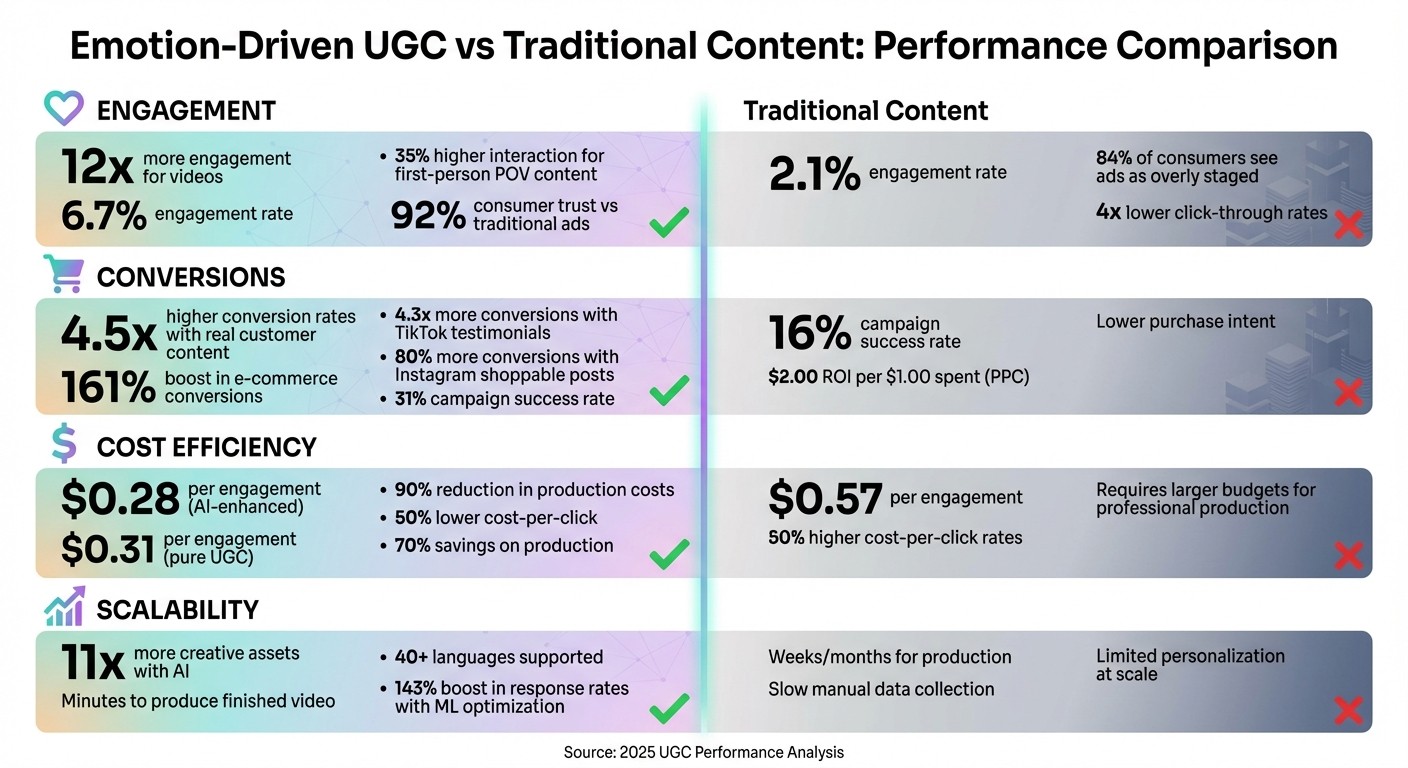
Emotion-Driven UGC vs Traditional Content: Performance Comparison
1. Emotion Data in UGC Campaigns
Emotional Engagement
Emotion data is reshaping how brands connect with their audiences. Unlike traditional sentiment analysis, which categorizes reactions as simply positive or negative, emotion data dives deeper, identifying specific emotions like happiness, surprise, fear, sadness, and anger in real time. This level of detail helps brands understand exactly which emotional triggers resonate with their audience.
When viewers see someone express genuine emotions in user-generated content (UGC), their brains mirror those feelings through a phenomenon known as the "Mirror Neuron Response". This neurological reaction explains why first-person point-of-view (POV) content outperforms third-person content, generating 35% higher engagement. It’s not just about watching; viewers emotionally connect with the creator, which strengthens brand recall when it’s time to make a purchase.
Studies reveal that about 12% of viewers show a measurable emotional response to creator content, with some campaigns reaching peaks of 50%. When creators display authentic emotions and hold viewers' attention, share rates can jump by 34%.
"This study proves that when creators grab and hold attention in social feeds, it generates an extended emotional reaction that fosters deep connections with the brand, driving brand memory and making it easier and faster for audiences to recall brands when making purchasing decisions".
Ben Jeffries, Co-Founder and CEO of Influencer
These emotional connections don't just boost engagement - they lay the groundwork for higher conversion rates.
Conversion Rates
The impact of emotion data extends beyond engagement to directly influence purchasing behavior. Emotional connections create stronger memory links in the brain, making brands easier to recall at critical moments.
For example, TikTok testimonials featuring real people deliver 4.3× more conversions compared to traditional branded content. Similarly, Instagram shoppable posts that include UGC see 80% more conversions than standard product posts. Consumers value authentic emotional expressions, perceiving them as more trustworthy and relatable - key drivers of purchase intent.
Scalability
The scalability of emotion-driven UGC is another major advantage. AI-powered emotion analysis can identify content that sparks emotional responses, allowing brands to scale their campaigns efficiently. AI tools also enable hyper-personalization by creating thousands of video variations that address customers by name or include localized details, making interactions feel more personal.
This scalability isn’t limited to one region. AI can break language barriers by generating campaign videos in multiple languages with accurate voice cloning and lip-syncing, ensuring the emotional impact remains intact across different markets. Production timelines are also significantly reduced - AI can transform a script into a finished video in just minutes, enabling brands to respond quickly to emotional trends. Additionally, Natural Language Processing can manage large volumes of customer reviews, grouping them by emotional themes to uncover actionable insights without human involvement.
Cost Efficiency
Emotion-driven UGC doesn’t just perform well - it’s cost-effective too. AI-enhanced UGC achieves a 6.7% engagement rate at just $0.28 per interaction, while slashing production costs by over 90%. Social ads featuring UGC also cut cost-per-click by 50%.
Content Type | Engagement Rate | Cost per Engagement |
|---|---|---|
Traditional Brand Content | 2.1% | $0.57 |
Pure UGC | 4.3% | $0.31 |
AI-Enhanced UGC | 6.7% | $0.28 |
Machine learning further optimizes campaign timing, boosting response rates by up to 143%. This combination of emotional resonance and cost efficiency allows brands to deliver impactful content while keeping budgets in check, all without compromising the authenticity that drives conversions.
2. Traditional Content Strategies
Emotional Engagement
Traditional content often leans heavily on brand-controlled messaging, focusing on product details, pricing, and functionality. This logical approach contrasts sharply with the emotional depth of user-generated content (UGC), which resonates more deeply with audiences by capturing authentic, nuanced feelings. Unfortunately, traditional campaigns, with their rational tone, tend to struggle when compared to the emotional pull of UGC-driven campaigns.
In today’s social media-driven world, the polished and curated nature of traditional advertising feels out of place. Around 84% of consumers perceive traditional ads as overly staged, favoring the authenticity of UGC recommendations instead. Adding to the challenge, traditional sentiment analysis tools often fall short, capturing only basic positive or negative reactions. They miss the subtle emotional cues that truly connect with audiences, which, in turn, hampers conversion rates.
Conversion Rates
When it comes to engagement, traditional ads lag far behind emotion-driven UGC. In fact, traditional ads generate click-through rates that are four times lower than those of UGC-based campaigns.
"For marketers still pouring budgets into polished brand spots, the message is clear: evolve or get left behind." - Aspire
The return on investment (ROI) further highlights this gap. While traditional pay-per-click (PPC) advertising typically delivers $2.00 for every $1.00 spent, creator-driven marketing averages a much higher return of $5.78. This stark difference reflects a shift in consumer trust - 92% of people trust word-of-mouth and user reviews over traditional brand ads.
Scalability
Traditional video production struggles to keep up with the fast pace of modern marketing. High-quality, personalized content for diverse audiences requires significant time and money, creating a bottleneck in the production process. From scripting to final edits, the timeline is often too long to respond to real-time trends effectively.
Additionally, traditional data collection methods, such as surveys and questionnaires, are slow and labor-intensive. These manual approaches lack the speed and flexibility of automated tools, making it difficult to scale campaigns or build personal connections with larger audiences. Historically, only the largest brands had the resources to overcome these challenges, but even they are now feeling the strain.
Cost Efficiency
Traditional content doesn’t just take more time - it’s also more expensive. At $0.57 per engagement, traditional brand content costs nearly twice as much as pure UGC ($0.31) or AI-enhanced UGC ($0.28). Traditional ads also incur 50% higher cost-per-click rates compared to UGC alternatives. With an average engagement rate of just 2.1% - less than half of UGC’s 4.3% - it becomes increasingly hard to justify the higher price tag.
The financial landscape is shifting. In 2025, creator-driven advertising revenue surpassed traditional formats like television, print, and radio for the first time. Traditional strategies can no longer compete with the affordability, efficiency, and emotional resonance of UGC campaigns, which deliver scalable and authentic connections with modern audiences.
UGC Strategy: Boosting Visibility and Sales With Customer Content
Pros and Cons
Here’s a breakdown of how emotion-driven user-generated content (UGC) stacks up against traditional content strategies:
Feature | Emotion-Driven UGC | Traditional Content Strategies |
|---|---|---|
Emotional Engagement | Delivers 12x higher engagement for videos, activates the "Mirror Neuron Response", and is trusted by 92% of consumers compared to traditional ads. | Often seen as "hollow" or lacking emotion, with a much lower engagement rate of 2.1%. |
Conversion Rates | Boosts e-commerce conversions by an average of 161%, with real customer content driving 4.5x higher conversion rates. Emotional campaigns see a 31% success rate. | Rational-only messaging achieves just a 16% success rate. |
Scalability | AI-enhanced UGC can generate 11x more creative assets, though results can be inconsistent without automation. | Offers predictable scheduling, but creating polished content can take weeks. |
Cost Efficiency | Costs as little as $0.28 per engagement with AI-enhanced UGC, saving brands up to 70% on production costs and cutting cost-per-click by 50%. | Costs are higher, averaging $0.57 per engagement, with larger budgets needed for professional visuals. |
The numbers speak for themselves: emotion-driven UGC thrives on authenticity, which builds trust. In fact, less polished UGC earns 28% more trust and is shared 34% more often. While traditional strategies may offer predictable workflows, they often lack the emotional connection that influences 79% of purchase decisions.
"Emotional marketing campaigns have a 31% success rate, nearly double the 16% success rate for campaigns that rely solely on rational messaging." - TrueFan AI
Emotion-driven UGC clearly outpaces traditional approaches in engagement, conversions, and cost-effectiveness. These metrics set the stage for the AI-powered solutions discussed in the next section.
TwinTone: AI-Powered Emotion-Driven UGC

TwinTone takes user-generated content (UGC) to the next level by combining emotion-driven strategies with cutting-edge AI. By focusing on emotional connections, the platform introduces AI Twins - digital versions of real creators that generate UGC videos on demand and host automated live shopping experiences. This technology uses neural mirroring to evoke genuine emotional responses, creating content that feels truly human, but at a scale that operates 24/7.
The magic of TwinTone lies in its ability to preserve the authentic traits of each creator. Studies reveal that 81% of users prefer natural movement over overly enhanced AI-generated facial expressions and gestures. By keeping these natural elements intact, TwinTone’s AI-driven content achieves 37% higher emotional responses compared to polished, traditional ads. It also boasts an impressive 6.7% engagement rate, far surpassing the 2.1% rate typically seen with traditional branded content.
When it comes to live shopping, TwinTone excels by creating real-time, emotionally engaging experiences. Its AI can craft hyper-personalized video variations, addressing customers by name or referencing their local context. This level of personalization taps into what researchers call the "brand-self connection" - the alignment between a brand’s message and a consumer’s personal values and aspirations.
"Emotion is the currency of modern commerce." - TrueFan AI
This emotional focus isn’t just effective - it’s efficient. Traditional content production often requires weeks or months of planning and execution, but TwinTone can deliver a polished video in just minutes. This speed allows brands to respond to trends and customer needs almost instantly, bypassing the delays associated with traditional production workflows.
TwinTone also supports 40+ languages and integrates seamlessly with APIs for programmatic content generation. This makes it easy for brands to produce shoppable videos, product demos, and other content in real time. And with over 70% of consumers citing authenticity as a key factor in purchasing decisions, TwinTone ensures that every piece of content resonates on a personal level.
Conclusion
Deciding between traditional content and emotion-driven user-generated content (UGC) ultimately comes down to balancing control with genuine connection. Traditional content gives you full command over messaging, timing, and visual identity - an advantage when rolling out complex products or ensuring brand consistency. However, this level of control can sometimes sacrifice the trust and relatability that modern consumers value.
On the other hand, emotion-driven UGC taps into unfiltered, real customer experiences, leveraging psychological triggers that influence up to 90% of purchasing decisions. Studies show that UGC often outperforms traditional content in key performance areas and does so at a lower cost. This highlights the growing importance of emotion data in shaping campaigns that not only connect with audiences but also deliver measurable results.
When deciding which approach to take, consider your goals. Traditional content works best when you need to maintain strict control over your message, educate users about complex features, or ensure consistent visuals during major product launches. Emotion-driven UGC, however, shines when the focus is on building trust, encouraging social sharing, or driving conversions through relatable customer stories. Many successful brands blend these strategies, using each where it’s most effective.
"There is no measurement tool more artfully refined or shrewdly developed than our own gut." - Tom Kelshaw, Innovations Director, Maxus
The future belongs to brands that can seamlessly merge data with intuition. While emotion analytics offer insights into what drives customer behavior, it’s human judgment that determines how to act on those insights. By balancing precision with authenticity, brands can create content that not only resonates emotionally but also delivers tangible results.
FAQs
How does using emotion data improve UGC campaigns?
Emotion data plays a key role in helping brands craft user-generated content (UGC) that truly connects with their audience. Studies reveal that emotions like joy and surprise can significantly increase engagement metrics - think more likes, comments, and views. By pinpointing these emotional triggers, brands can better predict which types of content will spark the strongest reactions and foster deeper audience connections.
When combined with AI-powered platforms, emotion data takes content creation to the next level. It allows for the automatic generation of content that feels genuine and relatable, driving longer watch times and more meaningful interactions. Considering that emotions influence over 70% of purchasing decisions, aligning UGC with the emotional preferences of your audience doesn’t just boost conversions - it also nurtures long-term loyalty and even viral success. TwinTone taps into these insights to deliver emotionally tailored, on-demand videos and livestreams, ensuring campaigns remain fresh, engaging, and perfectly tuned for the U.S. market.
How does AI enhance the cost-efficiency of emotion-driven UGC campaigns?
AI is revolutionizing how brands handle emotion-driven user-generated content (UGC), making the process faster and far more cost-effective. Tasks that once took hours of manual effort - like detecting and analyzing emotions in videos, audio, and text - are now completed in minutes. Advanced AI models can pick up on emotional cues and turn them into actionable insights, slashing labor costs and processing time by an impressive 95%. This speed allows brands to adjust their content strategies almost instantly.
Beyond analysis, AI is reshaping content creation itself. By using real creators to develop AI-powered "twins", brands can generate emotion-aligned UGC on demand. These AI personas can take on roles like producing shoppable videos, hosting live streams, and scaling content output - all without the need for constant outreach or new filming sessions. This automated approach not only lowers production costs but also maintains the emotional connection and authenticity that are key to engaging audiences and driving conversions.
With faster analytics, scalable content production, and more precise audience targeting, AI helps brands spend less while boosting engagement and return on investment (ROI).
Why do people trust emotion-driven UGC more than traditional advertisements?
People tend to trust user-generated content (UGC) because it feels genuine and easy to relate to. Unlike polished ads, UGC comes from everyday people, which creates a sense of connection and believability. Emotional content taps into our feelings, building trust and influencing choices.
Research highlights this trend: about 92% of consumers say they’re more likely to trust recommendations or content from peers than traditional ads. This trust is rooted in social proof and the emotional impact that UGC provides, making it an effective way for brands to connect with their audience.