Content Licensing for Social Commerce Brands
How to build a futureproof relationship with AI
Content licensing lets brands legally use creator-generated content like videos, images, or likenesses for specific purposes, avoiding copyright issues. This approach is crucial for social commerce, where user-generated content (UGC) significantly boosts conversions - up to 102.4% higher on product pages. Without proper licensing, brands risk fines up to tens of thousands of dollars per violation.
Social commerce is growing rapidly, with 48% of consumers expected to shop directly through social platforms by 2026, driven by Gen Z and live shopping trends. Licensing enables brands to repurpose influencer content into ads, emails, and product pages using a UGC content idea generator while staying compliant with FTC guidelines.
Key Licensing Models:
Organic Posting Rights: Use creator content on your channels for free but with limited reach.
Whitelisting/Dark Posting: Run paid ads via creators' handles for targeted campaigns, costing ~30% of the creator's fee.
Perpetual/Multi-Platform Rights: Secure indefinite, cross-channel use for evergreen campaigns at 100%-150% of the base fee.
Pricing Insights:
Paid ads: 20%-30% of the base rate per month.
Website use: 25% of the base rate monthly.
Perpetual rights: 3x-5x the total project fee.
Exclusivity clauses: Add 20%-100% to costs.
AI tools like TwinTone simplify licensing by automating workflows and generating 24/7 content with pre-secured rights, including multilingual options. This automation saves time, cuts costs, and helps brands scale globally in a market projected to reach $600 billion by 2027.
Content licensing is no longer optional - it's a must for brands aiming to thrive in the fast-paced world of social commerce.
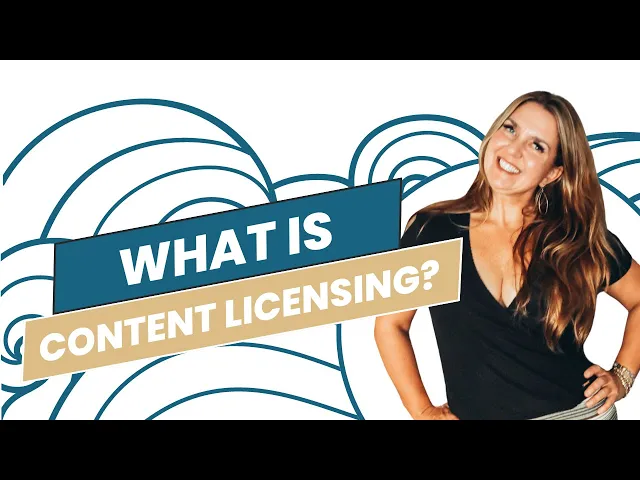
What is Content Licensing?
Main Content Licensing Models for Social Commerce
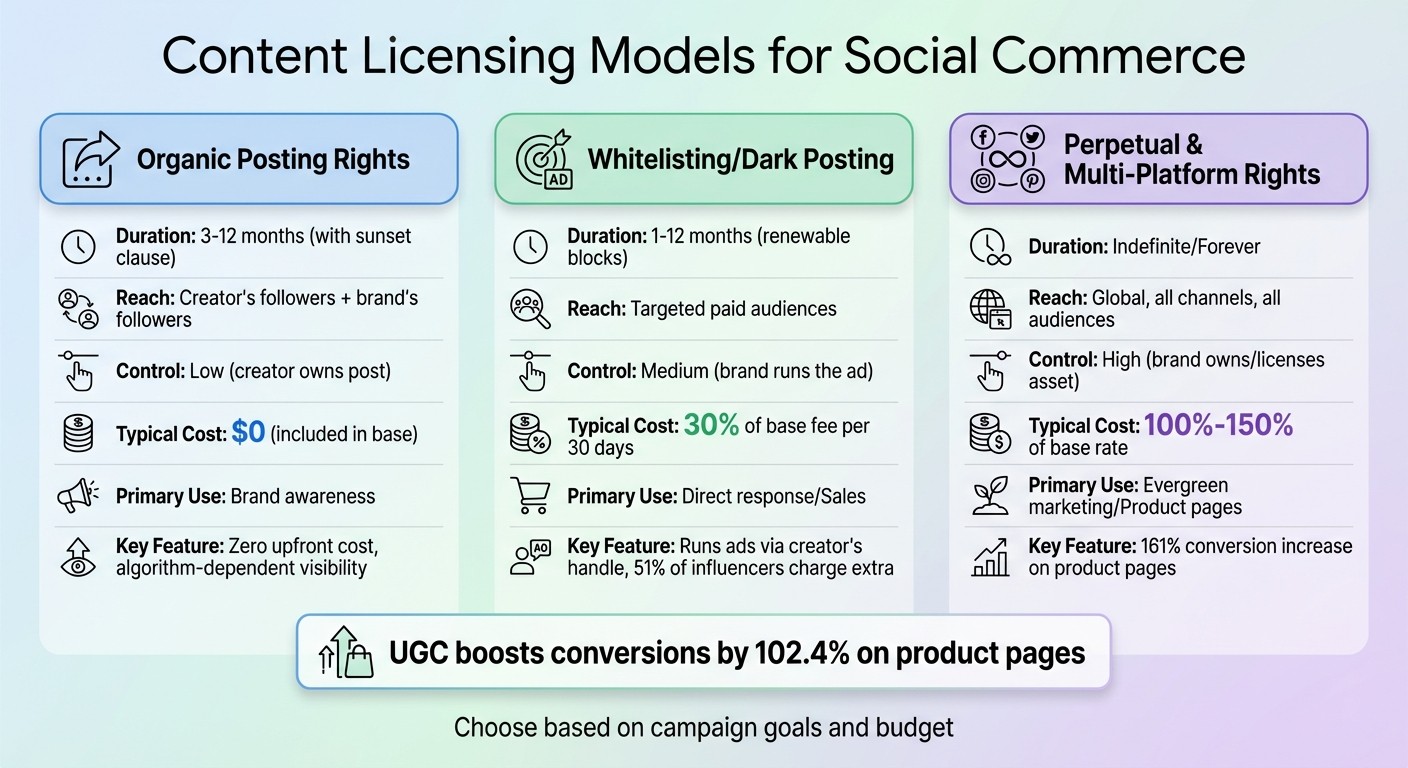
Content Licensing Models Comparison for Social Commerce Brands
When it comes to social commerce, brands typically rely on three primary licensing models. Each offers a unique balance of control, reach, and investment, making it essential to align the right model with your campaign goals and budget. Let’s break down these models and what they bring to the table.
Organic Posting Rights
With Organic Posting Rights, brands can share creator content on their own platforms - think Instagram, TikTok, newsletters, or websites - without spending on paid promotion. Here’s how it works: the creator first posts the content on their feed, and then the brand reposts it or embeds it elsewhere.
This model is perfect for campaigns focused on authenticity and social proof. However, visibility is entirely at the mercy of platform algorithms. The good news? You don’t spend a dime on amplification - organic usage comes at zero upfront cost. The downside is limited scalability and control over who sees the content.
To avoid potential pitfalls, always include sunset clauses in contracts. These clauses set clear timeframes (three, six, or 12 months) for how long the content can remain on your channels. Without them, you risk compliance issues, especially if the creator later works with a competitor or if your partnership ends on bad terms.
Whitelisting and Dark Posting
Whitelisting, now often called "creator licensing" to promote inclusive language, allows brands to run paid ads using the creator’s social media handle instead of their own. This strategy taps into the creator’s audience data and trust, making the ads feel more like genuine endorsements than typical brand promotions.
"Creator licensing combines two tried and true strategies into one marketing juggernaut." - Quinn Schwartz, Writer, GRIN
Dark posting is a variation where ads appear under the creator's handle but don’t show up on their public feed or your brand’s timeline. This approach is ideal for targeted campaigns, as it keeps the creator’s profile clean while allowing you to customize captions and calls-to-action.
Both whitelisting and dark posting come at an additional cost - typically 30% of the creator’s base fee for every 30-day period. Around 51% of influencers charge extra for these arrangements. On TikTok, Spark Ads are a great way to amplify existing organic posts while keeping engagement (views, comments, shares) on the creator’s original post.
Perpetual and Multi-Platform Rights
Perpetual and multi-platform rights give brands indefinite and cross-channel use of creator content. This type of licensing turns content into a permanent asset, making it ideal for evergreen campaigns like product page videos, email marketing, and long-term ad creatives.
Multi-platform rights expand this flexibility, allowing the content to be used everywhere - social media, paid ads, newsletters, and even e-commerce product pages. For instance, featuring user-generated content on product pages can increase conversions by 161%. These rights are a smart investment for high-performing assets.
However, this model comes with a higher price tag. Perpetual rights typically cost 100%–150% of the creator’s base rate, compared to standard usage rights that expire after six to 12 months. To get the most out of this investment, ensure you secure high-resolution source files so the content can be repurposed across formats.
Future-proofing your licenses is also crucial. Including "successor format clauses" in contracts ensures that your rights automatically extend to new platform features, such as TikTok Shop or Instagram Reels Remix, without renegotiation. Additionally, make sure your license covers background music. Brands can face copyright issues if a creator uses unlicensed audio in sponsored posts.
Here’s a quick comparison of the three models:
Feature | Organic Posting Rights | Whitelisting/Dark Posting | Perpetual & Multi-Platform Rights |
|---|---|---|---|
Duration | 3–12 months (with sunset clause) | 1–12 months (renewable blocks) | Indefinite/Forever |
Reach | Creator's followers + brand's followers | Targeted paid audiences | Global, all channels, all audiences |
Control | Low (creator owns post) | Medium (brand runs the ad) | High (brand owns/licenses asset) |
Typical Cost | $0 (included in base) | 30% of base fee per 30 days | 100%–150% of base rate |
Primary Use | Brand awareness | Direct response/Sales | Evergreen marketing/Product pages |
Pricing and Monetization Strategies
Turning licensed content into a revenue-generating asset starts with smart pricing and monetization strategies, building on the content licensing models already in place.
Pricing Based on Usage and Exclusivity
Once you've chosen a licensing model, setting a clear pricing strategy becomes essential to get the most value from your assets.
Most licensing deals follow a Base Rate + Usage Fee formula. The base rate accounts for content creation costs, such as production time, equipment, and the creator's expertise. Usage fees are added monthly as a percentage of the base rate, depending on where the content is used. For instance:
A $1,000 base rate might include:
20%–30% additional for paid social ads
25% for website or product page usage
15%–20% for email marketing
Exclusivity agreements - where creators are restricted from working with competitors - can significantly increase costs, adding anywhere from 20% to 100% to the base rate.
"The longer the brand wants to use your content, the more you can charge".
This insight from Natalie Van Dijk, Senior Manager of Media Services at impact.com, highlights how usage duration directly affects pricing. Premium rates, often 50% or more above standard pricing, are also common during high-demand periods like Black Friday or the December holidays.
For brands seeking perpetual usage rights (the ability to use content indefinitely), expect to pay a hefty premium - typically 3–5 times the total project fee.
"Never accept 'perpetual' usage unless getting paid a 3–5x multiple of what you earn from a single post".
This advice from Trevor A. Mengel of Cloutdesk underscores the value of long-term licensing arrangements.
Here’s a quick breakdown of pricing benchmarks:
Usage Type | Pricing Benchmark |
|---|---|
Paid Social Ads | 20%–30% of base rate per month |
Website/Product Pages | 25% of base rate per month |
Email Marketing | 15%–20% of base rate per month |
Exclusivity | 20%–100% of base rate |
Perpetual Rights | 3x–5x total project fee |
Print Media | 200%–400% of base rate |
Television | 1,000%–5,000% of base rate |
Hybrid Compensation Models
Hybrid compensation models blend a fixed fee with performance-based bonuses, aligning creator incentives with brand goals. For example, creators might earn an extra 10%–20% of the base fee if their content hits 100,000 views within 72 hours. Engagement-based bonuses can also be included, such as:
A 5% bonus for engagement rates between 3% and 5%
A 10% bonus for engagement rates between 5% and 8%
"This hybrid tier ensures production standards and caps downside while preserving performance upside".
Dan Atkins from Influencer Marketing Hub explains the value of this approach. However, these models require robust tracking systems to monitor metrics like views, engagement, and sales. Tools such as TikTok Shop's Order Attribution Dashboard can streamline this process, but brands should also be ready to audit creator dashboards and reconcile payouts manually. With 51% of influencers charging extra for licensing, integrating hybrid models into contracts upfront can save time and money.
These flexible structures open the door to multiple revenue streams.
Revenue from Licensed Content
Licensed content can generate revenue through transaction fees or affiliate commissions, especially with shoppable user-generated content (UGC). Platforms like TikTok Pulse and YouTube Shorts Partner also offer revenue-sharing programs, typically splitting earnings 50/50 for top-performing content (usually within the top 4% of platform performance).
Repurposing licensed content can amplify its revenue potential. Studies show that users who engage with UGC on product pages are 102.4% more likely to convert, while visual UGC can boost conversion rates by 103.9%. Brands calculate ROI using the formula:
(Incremental Revenue – Total Costs) ÷ Total Costs
For example, if a licensed video costing $1,500 generates $15,000 in additional sales, the ROI would be 900%.
To further enhance returns, brands should negotiate modification rights upfront. For instance, reformatting a 60-second video into shorter 15-second clips can expand its use across multiple platforms and ad formats. This added flexibility typically increases the base licensing fee by 20%–50%.
Key Licensing Contract Components
A well-constructed licensing contract lays the groundwork for effective social commerce by clearly defining rights, responsibilities, and remedies. These agreements help avoid misunderstandings by specifying content usage, display channels, and compensation terms.
Scope and Usage Rights
A strong contract should detail all deliverables and specify where they can be used - whether that’s paid social ads, organic posts, email campaigns, or even billboards.
"A license should define precise scope, duration, territory, and exclusivity, ensuring content remains an asset that can be repurposed or re‑licensed." - Kalin Anastasov, Content Manager at Influencer Marketing Hub
To prevent confusion, avoid vague language and list the exact platforms (e.g., TikTok Spark Ads, Instagram Reels) where content will appear. This ensures clarity and avoids unintended scope expansion.
The contract should also address how content can be modified, such as cropping, color adjustments, or translations. Additionally, creators should be required to deliver high-resolution raw files and unedited originals. These assets allow for future repurposing or adaptations.
Another important aspect is the use of pre-cleared music tracks from libraries like TikTok's or Meta's to avoid copyright issues.
Clearly define the license duration with specific start and end dates. Fixed-term licenses, typically lasting 6–12 months, should include clear renewal terms to give both parties flexibility.
With usage rights defined, the contract should also address exclusivity and compliance to solidify the partnership.
Exclusivity and Compliance Requirements
Exclusivity clauses should be kept narrow - for instance, restricting collaborations only with direct competitors - to ensure creators are not overly limited in their opportunities. Full exclusivity, if included, often comes with a 50% premium added to the base rate.
Ensuring compliance with FTC guidelines is crucial. Contracts must require creators to include clear disclosures, such as #ad or #sponsored, at the beginning of every post. Additionally, platform-specific branded content tools should be used to maintain transparency and avoid regulatory issues.
As AI tools for live shopping and content creation become more prevalent, contracts are beginning to include clauses that protect creators from having their likeness used to train generative AI models or create synthetic content without additional compensation. This type of protection is expected to become standard practice.
Audit rights are another essential component. These allow creators or their agencies to access ad account dashboards (like TikTok Business Manager) to verify that content is being used properly and that performance data is accurate.
Payment and Termination Terms
Clear payment and termination terms are critical for a complete agreement.
For payments, milestone structures work well - for example, 50% upon delivery, 25% at launch, and the final 25% upon meeting key performance indicators (KPIs).
It’s also important to separate usage fees from the base creative fee. As Sienna, a creator in the fashion and food space, points out:
"If you plan even minimal paid promotion, that usage must be carved out and budgeted separately in your statement of work."
Termination clauses should cover various scenarios. A "For Convenience" clause allows either party to end the agreement with a 30-day notice while ensuring pro-rata payment for completed work. A "For Cause" clause enables immediate termination in cases like conflicts of interest. Additionally, a "Performance-Based" clause allows brands to exit if engagement metrics, such as a 1% engagement rate, are not met.
To safeguard creators, include a kill-fee clause. This ensures that if a brand cancels without cause after content delivery, the creator receives an additional payment - typically 25%–50% of the remaining contract value. Finally, a 30-day "sunset period" post-contract ensures a smooth conclusion to campaigns, allowing for residual tasks like wrapping up ads before assets are pulled.
AI-Powered Licensing and Automation with TwinTone

Traditionally, licensing user-generated content (UGC) has been a tedious process for brands, involving manual outreach to creators and lengthy contract negotiations. TwinTone simplifies this process by using AI to automate workflows. With its tools, content is generated with pre-secured rights, eliminating the hassle of discovery, outreach, and licensing agreements. This shift paves the way for a more efficient and streamlined approach to UGC creation and distribution.
AI UGC Creation and Livestreams
TwinTone takes content creation to the next level by turning real creators into AI Twins capable of producing shoppable videos and hosting livestreams. These AI Twins generate videos with perpetual usage rights, which can increase conversion rates by over 30% and drive a 102.4% higher conversion rate for engaged viewers. This innovation is especially timely, as live social shopping is expected to grow by 36% by 2026, contributing to more than 5% of total U.S. e-commerce sales.
What’s more, AI Twins enable 24/7 content production, whether for product demos, Instagram Reels, or livestreams. This eliminates the scheduling conflicts and fluctuating costs that often come with traditional creator partnerships.
Automation and Multilingual Capabilities
TwinTone’s API integration ensures smooth, delay-free execution of global campaigns. Brands can generate content programmatically across entire product catalogs without juggling multiple creators or renegotiating licenses for each market.
The platform also supports multilingual output in over 40 languages, which is crucial for brands targeting diverse regions like MENA. Here, varying legal and advertising requirements can make licensing a challenging endeavor. Kalin Anastasov from Influencer Marketing Hub highlights the importance of adaptability in this fast-changing landscape:
"As short-form video, Reels, and Live Shopping evolve at breakneck speed, your ability to adapt - rather than renegotiate - becomes the strategic differentiator".
By automating these processes, TwinTone offers a scalable and cost-efficient solution for content creation.
Pricing and Accessibility
TwinTone’s pricing is designed to make AI-powered UGC accessible. The Starter tier, priced at $110/month, includes 10 AI UGC videos featuring creator avatars, multilingual support, and 60-second deliverables.
For $220/month, the Pro tier doubles the video output to 20 and adds enhanced features like expressive gestures and advanced voice options. For larger needs - such as 50+ videos, AI livestreaming, and premium creators - the Enterprise plan provides custom pricing and priority support. With the global social commerce market expected to hit $600 billion by 2027, TwinTone’s predictable pricing structure offers a cost-effective alternative to traditional creator partnerships for DTC brands.
Conclusion
Content licensing has become a key tool for brands looking to grow effortlessly in today’s fast-paced digital landscape. With 72% of consumers ready to make purchases directly on social platforms like Shorts, Reels, and Live Shopping, leading brands are leveraging licensing models that activate content across these formats with ease and precision. Modular licensing frameworks, as discussed earlier, simplify this process and drive higher conversion rates.
Gone are the days of outdated licensing workflows bogged down by legal risks and inefficiencies. AI-powered tools, such as TwinTone, now automate the process, securing rights in advance and eliminating the need for time-consuming manual outreach. This shift makes content licensing not just more efficient but also scalable.
Another game-changer is the move toward performance-based pricing and hybrid compensation models. Brands now pay for measurable results rather than simply for deliverables. Kalin Anastasov from Influencer Marketing Hub encapsulates this shift perfectly:
"As short-form video and live commerce surge to the forefront of digital marketing, forward-thinking brands face a critical question: are your licensing agreements engineered to harness the full potential of these emerging formats?"
This evolution in licensing strategies opens doors to vast global markets. For example, live shopping has already grown into a live shopping has already grown into a $100 billion industry in China00 billion industry in China. As automation continues to advance, brands that embrace AI-driven, scalable licensing models will be ready to claim their share of this booming market. Whether you’re a new DTC brand or a well-established retailer, the future of user-generated content and live shopping is automated, multilingual, and seamlessly integrated into broader digital marketing efforts.
FAQs
What are the advantages of using content licensing for social commerce brands?
Content licensing transforms fleeting creator content into long-term assets that can drive revenue for social commerce brands. By securing usage rights, brands can confidently reuse user-generated videos and photos across platforms like ads, product pages, and shoppable livestreams. This eliminates concerns about takedowns or compliance issues. Plus, it boosts brand visibility and increases conversion rates - shoppers who interact with on-site UGC are more likely to make a purchase.
Another advantage of licensing is its flexibility and cost-effectiveness. Brands can opt for tiered usage models, paying only for the specific channels - such as paid ads or live shopping - and timeframes they actually need. This avoids rigid contracts and helps keep budgets manageable. For brands aiming to scale quickly, TwinTone offers a solution with AI-generated creator content that comes with built-in licensing. This means on-demand videos, round-the-clock product demos, and smooth social commerce experiences without delays or the need for manual coordination.
What are the typical costs of different content licensing models?
The cost of content licensing can vary significantly based on its scope and terms. A simple, short-term license for use on a single platform might cost just a few hundred dollars per asset. On the other hand, more extensive licenses - covering multiple platforms, paid media, or extended usage periods - typically range from $1,000 to $5,000. If you're looking at perpetual licenses or agreements tied to performance metrics, costs can climb even higher, sometimes surpassing $10,000.
These pricing tiers are designed to reflect the value and flexibility provided, helping brands choose options that align with their specific business goals.
How does TwinTone simplify content licensing for social commerce brands?
TwinTone simplifies the content licensing process by automatically creating creator-style UGC videos that include usage-rights metadata. This means brands get perpetual, royalty-free rights to the content without the usual legal headaches or delays. By using TwinTone, brands can expand their social commerce campaigns more quickly and efficiently, all while staying compliant with licensing requirements.