How Brands Can Scale Live Shopping Without Creators
How to build a futureproof relationship with AI
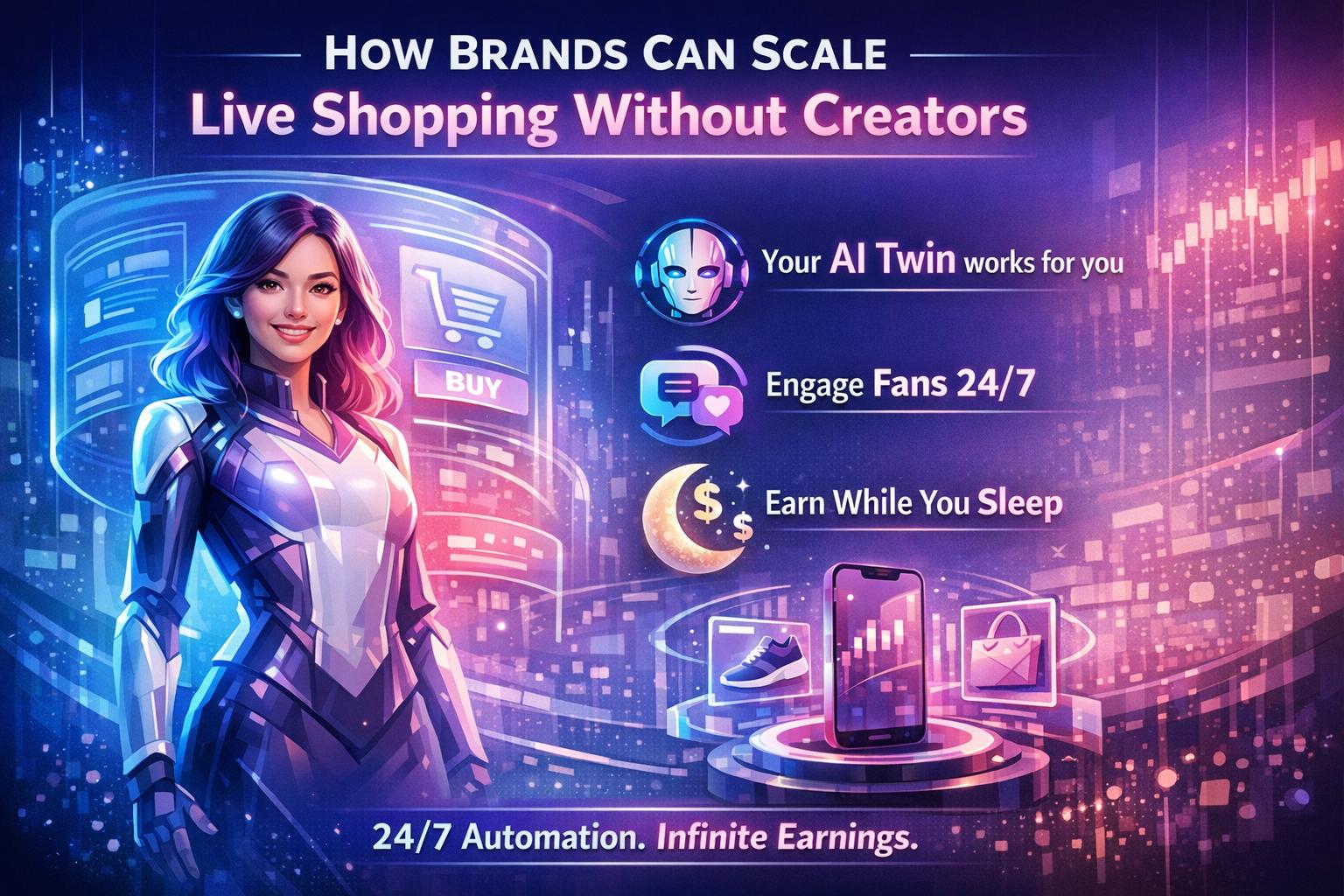
AI-powered live shopping is reshaping e-commerce by reducing reliance on human hosts. Here's how brands can run 24/7 live shopping events, cut costs, and reach global audiences without the challenges tied to creators:
AI Hosts: Operate nonstop, engage viewers in real-time, and handle multilingual AI livestreaming interactions, solving issues like time zone gaps and high labor expenses.
Cost Savings: AI reduces production costs by up to 70% and eliminates the need for constant human involvement.
Scalable Solutions: Automated platforms handle hosting, product displays, and analytics, allowing brands to target niche products and global markets efficiently.
AI-Generated Content: Tools like AI Twins create influencer-style videos at a fraction of the cost, with instant translation for international audiences.
Real-Time Analytics: AI tracks engagement, adjusts strategies mid-stream, and provides actionable insights to improve future events.
AI doesn’t replace creators entirely but complements them by handling repetitive tasks and enabling continuous live shopping. This hybrid approach ensures brands can maximize sales while minimizing costs.
Why Brands Rely on Creators for Live Shopping
How Creators Drive Live Shopping Engagement
Creators bring a personal touch to live shopping, transforming it into a dynamic and engaging experience. Their personalities and relatability make the process more enjoyable and interactive.
"The draw of the livestream is a live person or spokesperson that people relate to. Talking about the product is more fun than scrolling on your phone for information." - Jane Cheung, Global Research Leader for Consumer Industries, IBM Institute for Business Value
This human connection fosters trust and reduces hesitation among buyers. Take Nicki Minaj, for instance - her TikTok Shop Live event in late 2024 for her brand Pink Friday Nails captivated millions of viewers. Similarly, Dolly Parton’s live commerce event on Walmart Live showcased her kitchen and entertaining line, drawing significant attention. These examples demonstrate how creators build the confidence that encourages shoppers to make purchases. Notably, live commerce can boost conversion rates by up to 10 times compared to traditional e-commerce.
Problems with Creator-Dependent Live Shopping
While creators excel at engagement, relying on them for live shopping comes with challenges, particularly when it comes to scaling. Time zone differences make it nearly impossible to cater to a global audience without significant scheduling hurdles. Organizing sessions across multiple regions quickly becomes a logistical headache.
Another issue is the cost. Live selling requires hosts, real-time AI moderation, and customer support, all of which increase operational expenses. Each additional hour of live streaming raises costs due to talent fees, equipment, and staffing needs. On top of that, human hosts often face cognitive overload as they juggle live chats, inventory management, and maintaining performance. They’re also limited in their ability to customize offers for large audiences, resulting in a one-size-fits-all approach. This lack of personalization can be solved by AI grouping for live shopping, which segments viewers to deliver tailored offers. Language barriers further restrict their reach, as hosts are confined to the languages they speak. These limitations underscore the need for a more scalable solution to live shopping.
Everything You Need To Know About TikTok Live Shopping, AI UGC & More
AI-Powered Solutions for Live Shopping
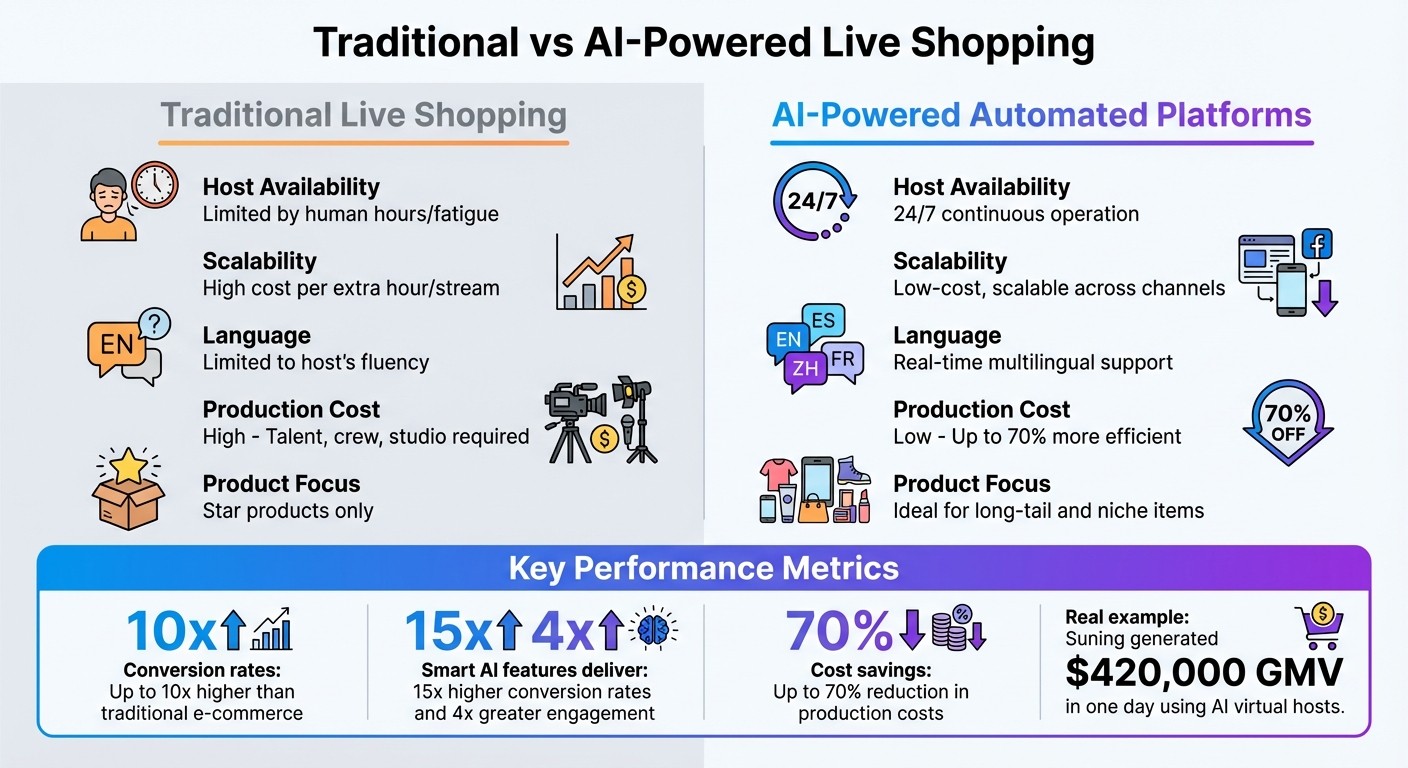
Traditional vs AI-Powered Live Shopping: Cost, Scalability, and Performance Comparison
AI is transforming the world of live shopping by removing the limitations tied to human hosts. Instead of being restricted by schedules or availability, brands can now offer round-the-clock live shopping experiences. These AI-driven tools handle everything - hosting, customer interaction, and more - so businesses can connect with global audiences without the logistical headaches or rising costs.
But this isn’t about replacing the human element entirely. It’s about scaling effective strategies. AI hosts take over repetitive tasks and resource-heavy parts of live shopping while keeping the level of engagement that drives sales. This means brands can promote niche or low-demand products that wouldn’t normally justify the cost of a human-hosted session. Plus, they can cater to customers in different time zones without hiring multiple shifts. It’s a game-changer for how live shopping operates.
AI Hosts for 24/7 Live Shopping
AI hosts bring 24/7 availability, allowing brands to engage shoppers whenever they’re ready to buy. This uninterrupted access is especially valuable for reaching audiences across different time zones, ensuring no opportunity is missed.
What makes modern AI hosts stand out is their ability to go beyond simple pre-recorded content. Using Agentic AI, these virtual hosts analyze various inputs - like chat activity, inventory levels, and viewer behavior - and adapt their approach in real time. For example, if engagement drops, the AI might launch a flash sale. If certain products spark more questions, it can shift focus to provide detailed explanations. This kind of decision-making mimics human intuition but operates without constant supervision.
"Traditional AI says, 'Here's a likely good product.' Agentic AI says, 'Here's what we should do next, and I'll do it unless you tell me otherwise.'" - beBit TECH
AI hosts also break language barriers with multilingual capabilities, instantly translating viewer comments and responding in their native language. Whether it’s English, Spanish, Mandarin, or dozens of other languages, these systems create seamless connections with shoppers worldwide. This makes cross-border commerce more accessible and cost-effective than ever.
Another major advantage is how AI hosts handle long-tail products - items with lower sales volumes that often don’t justify the expense of human-hosted sessions. AI can dedicate time to explaining these niche products and answering technical questions without the pressure of maximizing every minute of a human host’s time. This opens up new revenue opportunities for inventory that might otherwise go unsold.
Automated Live Shopping Platforms
AI hosts are just one piece of the puzzle. Automated live shopping platforms take things further by integrating these AI capabilities into a fully self-sustaining system. These platforms combine AI virtual hosts, real-time product displays, analytics, and automated sales tools, creating a streamlined live shopping experience that runs across multiple channels.
For instance, in November 2023, electronics retailer Suning used Baidu's "Huiboxing" virtual human livestreaming product to generate over 3 million yuan ($420,000) in gross merchandise value (GMV) in just one day. This highlights how automated platforms can deliver impressive results without relying on human creators.
Feature | Traditional Live Shopping | AI-Powered Automated Platforms |
|---|---|---|
Host Availability | Limited by human hours/fatigue | 24/7 continuous operation |
Scalability | High cost per extra hour/stream | Low-cost, scalable across channels |
Language | Limited to host's fluency | Real-time multilingual support |
Production Cost | High (Talent, crew, studio) | Low (Up to 70% more efficient) |
Product Focus | Star products | Ideal for long-tail and niche items |
These platforms also enable multi-platform streaming, allowing a single AI avatar to broadcast on TikTok, Shopify, Amazon Live, and more simultaneously. This approach maximizes reach without adding complexity or cost.
Interactivity remains a top priority. AI systems monitor chat activity to answer common questions, provide up-to-date pricing and stock info, and even trigger purchase actions - all in real time. The result is an experience that feels personal and responsive, even without a human host. Studies show that incorporating smart AI features into live shopping can lead to 15x higher conversion rates and 4x greater engagement.
Scaling UGC with AI for Shoppable Content
Live shopping is just one piece of the puzzle. To keep shoppers engaged between sessions, brands need a steady flow of user-generated content (UGC). UGC has always been a powerful tool - its relatable, unscripted nature strongly influences buying decisions. But working with human creators can be slow, costly, and unpredictable. That’s where AI steps in, allowing brands to generate creator-style content at scale without the usual headaches.
Here’s the reality: 92% of brands say human creators often miss the mark on project scope, 58% struggle with creator management, and 32% deal with multiple rounds of revisions. AI-generated UGC sidesteps these issues while keeping the authentic vibe that makes UGC so effective. Instead of waiting weeks for filming, editing, and approvals, brands can whip up product demos or unboxing videos in just minutes. This speed and efficiency make on-demand AI-generated UGC a game changer for showcasing products.
On-Demand AI-Generated UGC
AI Twins are shaking up how brands create video content. These digital replicas of real influencers let brands use their appearance, voice, and style - legally licensed, of course. The process is simple: upload product images, add a script, pick an AI Twin, and within five minutes, you’ve got a video that looks like the influencer is personally demonstrating your product. Compare that to the 7–14 days it typically takes for traditional creator collaborations.
This tech turns static product photos into dynamic videos. Think virtual unboxings, 360-degree views, and feature highlights. Fashion brands, for example, can use tools like "Dress Your Creator" to instantly change outfits on AI avatars to match seasonal trends - no reshoots needed.
The cost savings are huge. Hiring a traditional creator can cost $150 to $500+ per video. With AI, you’re looking at less than $1 per video. That means you can afford to create content for every single product in your catalog, even those niche items that wouldn’t justify a human creator’s fee.
AI also makes global scaling a breeze. With instant translation into over 40 languages, brands can adapt a single video for audiences across the US, Europe, Latin America, and Asia - all without hiring local creators. It’s a cost-effective way to reach diverse markets.
Integration with E-Commerce Platforms
Creating great content is only half the battle. To drive sales, shoppable UGC needs to integrate seamlessly with platforms like Shopify, BigCommerce, or Amazon Live. This ensures viewers can buy products directly from the content without any extra steps.
Take fashion boutique CSB, for example. In 2025, they added AI-powered shoppable videos and saw a 6% boost in conversion rates. Hampden, another fashion brand, used similar tools and reported a 232% jump in Average Order Value. These numbers show the potential when AI content is directly tied to e-commerce systems.
AI also personalizes the shopping experience. For instance, it can display different models for clothing, showcase a variety of skin tones for beauty products, or offer size-specific demos - all tailored to what the customer is browsing. Achieving this level of customization manually would be nearly impossible at scale.
Distribution is fully automated, too. AI-generated UGC can be pushed to TikTok, Instagram, and YouTube simultaneously, keeping your marketing efforts running smoothly without manual uploads. Some brands are even transforming text-based customer reviews into video testimonials using AI avatars and voiceovers, adding a new layer of engagement to social proof.
The stats speak for themselves: 79% of consumers say UGC heavily influences their purchasing decisions, and UGC videos get 12x more engagement than traditional brand-produced content. Beauty shoppers, in particular, who engage with UGC on a site are 213% more likely to convert than those who don’t. AI-powered UGC is rewriting the playbook for content marketing - and it’s doing it at a fraction of the cost.
Optimizing Live Shopping Operations with AI Tools
Live shopping events are all about driving sales, and AI-powered analytics give brands a serious edge. These tools provide real-time insights into what's working and what’s not, allowing businesses to adjust their strategies on the fly instead of relying on guesswork.
Real-Time Analytics and Audience Insights
AI keeps a close eye on every aspect of a live stream: how many people are watching, what they're saying in the chat, how often they click, inventory levels, and even emoji usage. By analyzing all these signals, brands get a clear picture of how their audience is responding. For example, AI can link chat comments to behaviors like hovering over a product or how long someone watches, helping to identify emotions like excitement, curiosity, or hesitation.
"AI systems interpret live comments, questions and emojis to gauge customer sentiment - identifying excitement, curiosity or hesitation - and correlate these insights with behavioral cues like clicks, hover actions and viewing duration to uncover individual preferences." – Shantha Farris, Sales and Commerce Offering Strategy Leader, IBM Consulting
AI also pinpoints the exact moments when viewers are most engaged - or when they start tuning out. If there’s a noticeable drop-off during a product demo, it’s a clear sign that part of the segment might need to be reworked. On the flip side, peak engagement moments can be turned into shoppable highlights for social media.
When engagement dips, AI can step in with instant solutions. It might prompt the host to switch topics, answer trending questions, or even launch a flash sale. These real-time adjustments not only keep the audience engaged but also help brands measure and improve the performance of their live shopping events.
Measuring ROI and Continuous Improvement
Tracking the right metrics is key to understanding the return on investment (ROI) for live shopping. Metrics like Gross Merchandise Value (GMV), conversion rates, and cost-per-acquisition (CPA) provide a clear picture of success. Live commerce events have been known to deliver conversion rates as high as 30%.
Take the example of Three Ships Beauty. In September 2025, they held a one-hour pre-launch event for their "Dream Night Cream", hosted by CEO Sarah Moret. The event brought in 1,200 unique viewers, generated 356 orders, and achieved a 26% conversion rate, resulting in $25,000 in revenue. Numbers like these show why live shopping is such an appealing strategy.
AI doesn’t just track overall performance; it also evaluates individual hosts. By analyzing which hosts - or even AI-powered digital hosts - generate the most GMV and engagement, brands can fine-tune their approach. Jeff Johnson, Dermalogica's Head of Commerce, captured this idea perfectly:
"We're just trying to mix up as many variables as possible to guide us to what works for us and what gets us the most traffic, the best conversion and the most value." – Jeff Johnson, Head of Commerce, Dermalogica
After the stream ends, the analysis continues. AI tools monitor metrics like repeat viewership, refund rates, and Net Promoter Score (NPS) to gauge customer satisfaction over time. They also identify where viewers dropped off, helping brands refine future events by cutting out confusing or unengaging segments. This constant cycle of feedback and improvement turns live shopping into a scalable, reliable revenue stream.
Metric Category | AI Metrics | Objective |
|---|---|---|
Engagement | Peak interest moments, drop-off points, sentiment analysis, keyword trends | Spot high-performing content and fix weak spots |
Conversion | GMV, average order value (AOV), host-specific conversion rates, add-to-cart rate | Measure sales impact and host effectiveness |
ROI/Efficiency | CPA, production cost savings, revenue vs. staffing costs | Assess financial performance and scalability |
Retention | Returning viewer rate, refund rate, NPS/customer satisfaction score (CSAT) | Track loyalty and satisfaction over time |
Conclusion
Brands have the potential to scale live shopping effectively without relying solely on human creators by leveraging AI-powered hosts. These AI hosts can operate non-stop, broadcasting across multiple platforms and languages, connecting with global audiences in ways that a single human creator simply cannot. By adopting this approach, brands can see up to 70% cost savings compared to traditional creator-led streams, while also achieving conversion rates that are up to 10 times higher than standard e-commerce methods.
The key to these impressive results lies in the behavior-driven responses of AI. It's not just about looking realistic; it's about acting realistic. AI hosts that engage viewers by answering questions in real time, checking inventory, and tailoring promotions based on viewer behavior create a more interactive and engaging shopping experience. For example, improving real-time Q&A capabilities alone can drive sales up by 25%, proving that interactivity is just as important as a polished digital appearance.
"AI is better considered a partner in a hybrid strategy." – AnyMind Group
A practical way to start is by using AI for repetitive tasks, like product demos or overnight streams, while reserving human creators for high-stakes campaigns. Real-time analytics can guide this balance, ensuring AI handles the day-to-day engagement efficiently while human creators focus on delivering emotional resonance.
FAQs
How do AI hosts keep live shopping engaging without human creators?
AI hosts elevate live shopping experiences by integrating personalized responses, emotion recognition, and real-time adjustments. These tools allow them to analyze viewer behavior and preferences, creating interactions that feel tailored and engaging. By responding in ways that align with audience expectations, AI hosts can make the experience feel more natural and relatable.
What’s more, AI hosts can tweak content on the fly during live streams. For instance, they might shift topics or adjust promotions based on how the audience reacts in real time. By mimicking human-like interactions and maintaining a conversational tone, these AI systems keep the shopping experience interactive and engaging - all while lessening the need for human creators to manage every detail.
What are the cost advantages of using AI for live shopping?
Using AI in live shopping offers brands a smart way to cut costs. Instead of relying on human hosts, AI-powered virtual hosts take center stage. This means brands can skip expenses like salaries, benefits, and the hassle of managing schedules. Plus, these virtual hosts are ready to go 24/7, ensuring operations never miss a beat - all without extra labor costs.
AI doesn’t stop there. It takes over tasks like crafting content, suggesting products, and handling customer interactions. By automating these processes, brands can run leaner teams and keep operations smooth. This not only slashes expenses but makes it easier to scale live shopping efforts, reaching bigger audiences without having to grow the workforce.
On top of that, AI tools boost engagement and drive conversions by leveraging real-time analytics and tailoring experiences to individual shoppers. The result? Improved sales and a better return on investment, making AI a savvy choice for brands looking to expand their live shopping strategies without breaking the bank.
How does AI support multilingual communication in live shopping?
AI is transforming multilingual communication in live shopping by leveraging advanced language processing to facilitate real-time, personalized interactions across different languages. These systems can quickly adapt to individual preferences, delivering instant, natural responses that help create a meaningful connection - no matter what language the shopper speaks.
With tools like emotion analysis, multilingual capabilities, and audience analytics, AI makes it easier for brands to connect with customers worldwide. This technology not only removes language barriers but also enables businesses to expand globally while offering genuine shopping experiences to a diverse audience.