
The Best UGC Strategy for DTC Brands in 2026
How to build a futureproof relationship with AI

User-generated content (UGC) is now the go-to marketing strategy for direct-to-consumer (DTC) brands in 2026. Why? It’s more relatable, cheaper to produce, and delivers better results than traditional ads. Here’s the breakdown:
UGC drives engagement: UGC videos generate 12x more engagement than brand-made content.
Consumers trust UGC: 84% of people trust campaigns with UGC, and 55% avoid products without reviews or photos.
Cost-effective: AI tools can create UGC for less than $1 per video in minutes, compared to $150–$500 for human creators.
Higher returns: TikTok UGC ads cut customer acquisition costs by 75% and deliver 26% higher ROAS.
AI has transformed UGC with tools that produce hundreds of variations in minutes, predict performance, and even localize content for global audiences. The focus is now on creating short, authentic-looking videos that resonate with modern consumers. Brands using AI-driven UGC strategies are seeing faster production, better testing, and stronger results. Waiting to adopt this approach? It could cost you.
This New AI Tool Creates UGC Ads For You (Step-by-step Tutorial)
Why Old UGC Methods Don't Work Anymore
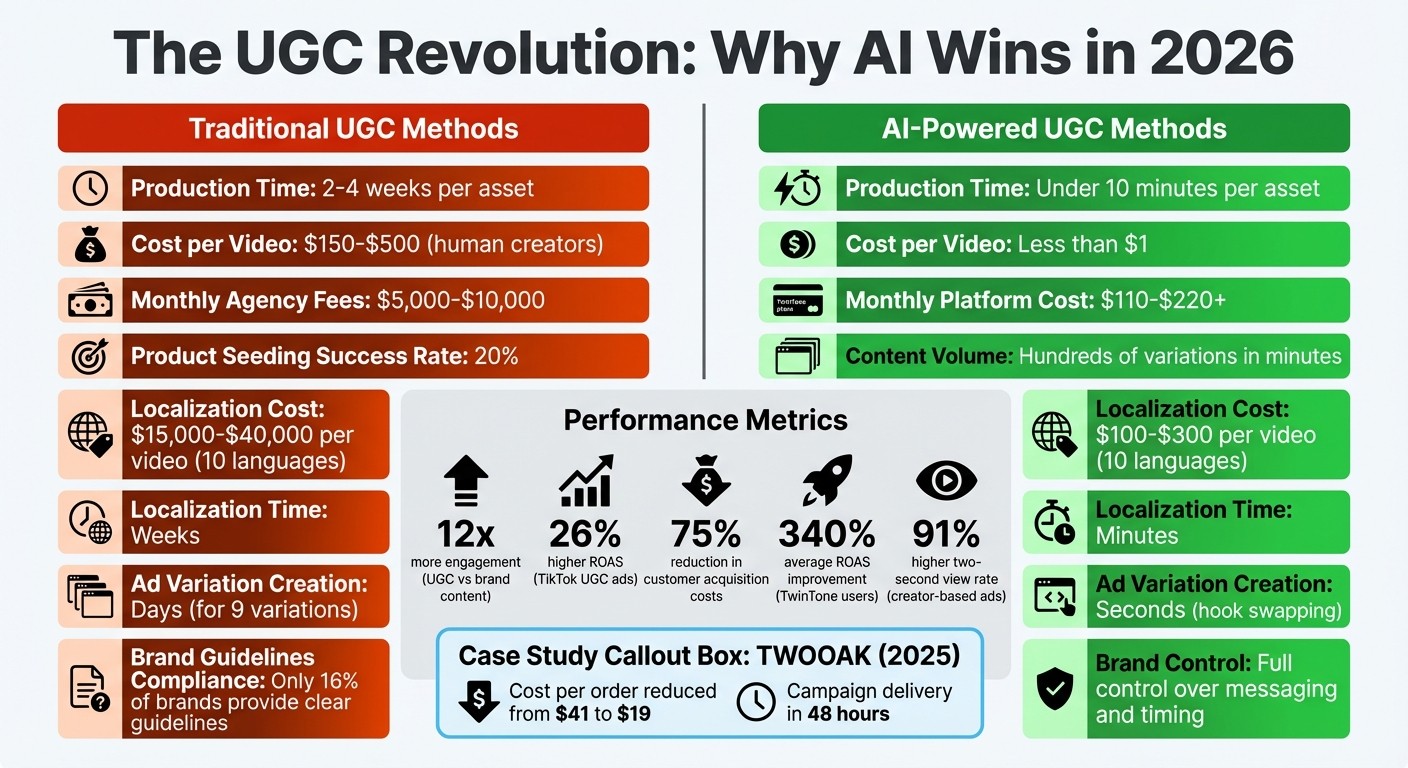
AI vs Traditional UGC Methods: Cost, Speed & Performance Comparison 2026
The old way of handling User-Generated Content (UGC) - relying on manual outreach to creators, enduring long waits for deliverables, and paying hefty agency fees - just doesn't cut it in 2026. Brands sticking to these outdated methods often find themselves trapped in a cycle of spending $5,000 to $10,000 per month on agencies that take weeks to deliver campaigns. This approach not only drains budgets but also falls short in meeting the fast-paced demands of modern marketing.
While manual UGC production can take 2–4 weeks per asset, AI tools can generate content in under 10 minutes. With Customer Acquisition Costs (CAC) rising by 25–40%, brands simply can't afford to invest time and money into slow, expensive processes that may not even yield results. These inefficiencies highlight the urgent need for a new way of producing UGC.
Problems with Manual Creator Outreach
Looking closer, manual creator outreach is riddled with inefficiencies. Managing multiple freelancers and navigating manual workflows to secure rights often leads to confusion and delays. Even product seeding - sending free products to creators in hopes they’ll post - has a success rate of just 20%.
Scalability is another major hurdle. Platforms like TikTok and Instagram thrive on testing multiple hooks and content variations, but creating nine ad variations manually can take days. On the other hand, AI can swap out hooks in just seconds. Adding to the chaos, only 16% of brands provide clear guidelines to creators, which results in off-brand submissions that require time-consuming manual moderation - an impossible task when dealing with high volumes.
Where Old UGC Falls Short in Social Commerce
As social commerce evolves, traditional UGC methods can’t keep up with the demands of platforms like TikTok and Meta. These platforms require a high volume of ad variations to perform well, and 85.7% of DTC advertisers now rely on AI for creative research to meet this need. The shift toward distributed commerce - where shopping happens directly on platforms like TikTok Shop and Meta instead of brand websites - further exposes the limitations of old workflows.
Localization is another area where traditional methods fall behind. Translating and localizing content into 10 languages can cost $15,000–$40,000 per video when done manually, due to the involvement of multiple translators and re-editing steps. AI, however, can handle localization for just $100–$300 per video and complete the process in minutes instead of weeks.
Take the DTC brand TWOOAK as an example. In 2025, they used AI marketing systems to eliminate traditional bottlenecks, cutting their cost-per-order from $41 to $19 and delivering entire campaigns in just 48 hours.
"The average agency charges $5,000 to $10,000 per month. They take weeks to deliver a finished campaign... This is a massive resource drain for a growing brand."
What Makes an Effective AI-Driven UGC Strategy
An effective AI-driven user-generated content (UGC) strategy in 2026 relies on three key elements: speed, scale, and personalization. The goal is to generate multiple content variations quickly while maintaining the raw, authentic feel that resonates with audiences. AI plays a vital role in enabling rapid testing, scaling successful campaigns, and personalizing content for diverse audiences.
The best strategies tackle three major challenges: producing enough variations to discover what works, maintaining a steady stream of content across platforms, and reaching global audiences without the usual high costs. Brands that excel in these areas often see better performance and profitability. Take Petco's "Spotted" sampling program as an example - it achieved a 90% response rate by sending products to a curated group of pet owners, leading to a 405% jump in review volume and an 80% increase in organic search clicks for featured products.
What sets successful strategies apart is their ability to turn one piece of content into dozens of variations tailored to specific audiences and moments in the customer journey - all without requiring additional manual production. This approach doesn’t replace human creators but complements them by using AI for rapid iteration and localization, while human-led content remains at the heart of the strategy.
Creating UGC at Scale with AI Twins
To meet the demand for fast content production, AI Twins provide a game-changing solution. These photorealistic digital avatars, modeled on real people who have given explicit consent and are fairly compensated, allow brands to create authentic, on-brand UGC without the delays of coordinating with traditional content creators. The result? Content that feels real while giving brands full control over messaging, timing, and variations.
The true advantage lies in testing. Using the 3x3 Scaling Method, brands can mix and match three different hooks with three unique content formats - like demos, reviews, or unboxings - to create nine variations in just minutes. This speed enables brands to test ideas immediately, identify what works, and scale successful campaigns without unnecessary delays.
AI Livestreams and Shoppable Videos
AI-driven livestreams are another powerful tool for creating personalized, scalable content. These always-on shopping experiences showcase products, answer questions, and drive conversions - all without requiring human hosts. This aligns with the modern consumer's behavior, where discovery and purchase often happen simultaneously on platforms like TikTok Shop.
The numbers back this up. TikTok ads featuring creator content deliver a 26% higher return on ad spend (ROAS), and creator-based ads achieve a 91% higher two-second view rate compared to traditional polished ads. The key is maintaining an authentic, unpolished aesthetic - think handheld, lo-fi visuals that feel natural in social media feeds.
Shoppable videos add another layer by embedding purchase options directly into the content. These videos are highly effective: when shoppers interact with reviews and UGC, they convert at a rate 161% higher than those who don’t. For instance, Frankies Bikinis leveraged top-performing UGC on their website, which drove 19% of total orders and over 23% of online revenue.
Reaching Global Audiences with Multilingual UGC
AI-powered multilingual tools are breaking down barriers to global reach. Instead of relying on time-intensive and costly manual translations, AI can localize content into over 175 languages in minutes while preserving the original tone. This allows brands to enter new markets, test demand quickly, and scale successful campaigns efficiently.
This localized approach is crucial because 51% of social media users say they’re more likely to buy a product if they see posts featuring "people like them". A great example is Rhode Skin’s 2024 launch of their Lip Phone Case. By gifting the product to a network of micro-influencers without scripted requirements, they generated $8.3 million in earned media value (EMV) and achieved a 31.9% average engagement rate on Instagram.
How to Use TwinTone for Your UGC Strategy
TwinTone simplifies the process of creating user-generated content (UGC) by combining AI technology with a network of over 20,000 verified creators. Here’s how it works: pick a creator or one of 100+ AI avatars, upload your product images and copy, and generate a 30-second video. The platform even handles creator compensation for likeness rights, ensuring you get authentic content while keeping full control over messaging, timing, and variations.
One standout feature is TwinTone's "Product in Hand" technology, which transforms your existing product photos into UGC-style video ads featuring AI avatars. No need to ship products or schedule time-consuming photoshoots. For fashion brands, the "Dress Your Creator" tool updates AI avatars with new outfits, letting you refresh content effortlessly.
For brands looking to scale, TwinTone’s AI Live Shopping feature offers 24/7 livestreaming in over 40 languages, using AI versions of real creators. The platform automates distribution across TikTok, Instagram, and YouTube, making it easier to reach global audiences. With over 1.2 million videos already created and an average return on ad spend (ROAS) improvement of 340%, TwinTone delivers results that speak volumes.
These features make TwinTone a go-to solution for brands aiming to create scalable, efficient UGC. Flexible pricing plans ensure there’s an option for every stage of your growth.
Starting with the TwinTone Starter Plan
If you’re just dipping your toes into AI-powered UGC, the Starter Plan is a great place to begin. For $110/month, you’ll receive 10 AI-generated videos featuring real creator avatars, complete with multilingual support and a maximum length of 60 seconds. The plan is designed to help emerging direct-to-consumer (DTC) brands test creative ideas quickly, identify what works, and refine their strategy. Once you’ve nailed down a winning formula, you can scale up to higher-volume plans.
Growing with Pro and Enterprise Plans
The Pro Plan, priced at $220/month, doubles your output to 20 videos per month. It also unlocks advanced features like expressive creator gestures, enhanced voice styles, and more sophisticated multilingual options. This plan is ideal for brands that have validated their UGC approach and need consistent, high-quality content for multiple campaigns.
For larger brands, Enterprise plans provide custom solutions starting at 50+ videos per month. These plans include access to premium creators, AI grouping for live shopping, priority support, and brand-specific AI training. For example, Poppi used TwinTone’s Enterprise features to generate over 63 million impressions and reach 218 million creators. Co-founder Allison Ellsworth shared:
"We generated over 63 million impressions and 218 million creator reach! proving that UGC + experiential content can outperform traditional media".
Similarly, Gymshark improved its ROAS by 10.2% by using TwinTone to create a "flywheel" of UGC-driven momentum. Enterprise plans also offer a "Done For You" service, which handles daily content creation and automated distribution across platforms - perfect for brands managing global campaigns or extensive product lines.
TwinTone Pricing and Plan Comparison
Feature | Starter ($110/mo) | Pro ($220/mo) | Enterprise (Custom) |
|---|---|---|---|
Monthly Videos | 10 AI UGC videos | 20 AI UGC videos | 50+ AI UGC videos |
Creator Access | Real creator avatars | Real avatars with gestures | Premium creators with training |
Video Length | Up to 60 seconds | Up to 60 seconds | Custom lengths available |
Voice & Style | Standard | Advanced voice styles | Fully customized |
Multilingual Support | Yes (40+ languages) | Enhanced variations | Full global localization |
AI Livestreaming | Not included | Not included | 24/7 live shopping |
Distribution | Manual | Manual/Standard | Automated multi-platform (DFY) |
Support Level | Standard | Enhanced | Priority with dedicated management |
Best For | Testing & validation | Multi-campaign consistency | Enterprise scale & automation |
Choosing the right plan depends on your goals. The Starter Plan is perfect for testing creative ideas and validating your strategy. The Pro Plan works well for brands needing consistent, high-volume content. When you’re ready for global reach and full automation, the Enterprise Plan has you covered. Each option aligns with modern marketing demands, offering a tailored path to success.
Tracking ROI from AI-Powered UGC
AI-generated user-generated content (UGC) must ultimately lead to revenue. Metrics like likes and shares might give you a sense of engagement, but they don’t show how your efforts impact the bottom line. In 2026, direct-to-consumer (DTC) brands need to track the entire customer journey - from the first impression to the final purchase - to truly measure success.
The rise of AI-powered UGC has reshaped how performance is evaluated. This approach not only speeds up the creation of UGC but also connects that content directly to revenue outcomes. Quick turnaround times now allow brands to test multiple versions of content, identify top performers, and focus their ad spend on what works best.
Which Metrics to Track
Start by focusing on metrics that directly tie to sales. Key indicators like return on ad spend (ROAS), cost per acquisition (CPA), conversion rate, and average order value (AOV) provide a clear picture of whether your AI-generated content is driving purchases. For example, brands using AI-powered UGC have reported an average 340% boost in ROAS.
Engagement metrics are also essential, as they show whether your content is grabbing attention. Metrics like click-through rates (CTR), two-second view rates, watch time, and total engagements help determine if your creative hook is effective. TikTok ads driven by creators, for instance, are known for capturing immediate viewer interest.
Efficiency and retention metrics round out the picture. Track cost per acquisition, earned media value (EMV), bounce rate, and time on site to evaluate both the cost-effectiveness of your content and how well it retains customer interest. Additionally, analyzing video production costs and asset longevity can reveal the long-term value of AI-generated UGC. You can even estimate the monetary value of your content to better understand its impact. Unlike seasonal branded campaigns, this type of content often delivers consistent results over time. Using UTM parameters can further pinpoint which UGC posts are driving the most qualified traffic.
Metric Category | Key KPIs to Track | Why It Matters for AI UGC |
|---|---|---|
Conversion | ROAS, CPA, Conversion Rate, Revenue, AOV | Links AI-generated content directly to sales performance |
Engagement | CTR, Two-Second View Rate, Watch Time, Engagements | Indicates if your content grabs and holds attention |
Efficiency | Cost per Acquisition, EMV | Evaluates the cost-effectiveness of AI-generated UGC |
Retention | Bounce Rate, Time on Site, Brand Sentiment | Confirms whether your content builds trust and keeps interest |
To refine your campaigns, try the 3x3 testing method: create three different hooks and three unique body segments (like demos, reviews, or unboxings) to generate nine variations. AI tools make it easy to swap out hooks without needing to re-film. Tracking "swipe decay" - the point where viewers lose interest - can help you optimize your content. A strong campaign typically retains 40–50% of viewers through to the final call-to-action.
Using TwinTone's Analytics Tools
TwinTone’s Analytics Tools bring all these metrics together, providing real-time insights across platforms. Just as AI twins speed up content creation, TwinTone’s analytics enable brands to optimize campaigns based on revenue-focused data. With results from over 1.2 million generated videos analyzed, the platform helps brands move beyond inconsistent "one-hit wonders" to consistently high-performing content.
TwinTone identifies the AI Twins and scripts that resonate most with your audience, making it easier to scale the avatars and messaging that deliver results. Automated distribution across TikTok, Instagram, and YouTube centralizes data and allows you to monitor campaign performance in real time. The platform also uses AI-driven creative testing to personalize content for different audience segments, automatically deploying the best-performing variations. Supporting over 40 languages, TwinTone lets you track ROI globally.
Conclusion
AI-powered UGC has become more than a tool - it's now a necessity for DTC brands aiming to stay competitive. Traditional methods of sourcing UGC are slow, expensive, and often inefficient. In contrast, AI can produce high-quality, engaging UGC in just minutes for less than $1 per video. The message is clear: adapt to this new standard or risk falling behind.
With solutions like TwinTone, brands no longer need to rely on creator availability or lengthy negotiations. AI allows for instant generation of multiple content variations, enabling brands to test, refine, and deploy the most effective assets across platforms like TikTok, Instagram, YouTube, and Amazon. Plus, the built-in analytics provide real-time insights, connecting each piece of content directly to revenue and offering support in over 40 languages.
Looking ahead to 2026, success will hinge on rapid testing and creativity rooted in data. Winning won’t depend on who has the largest budget but on who can test faster, scale smarter, and make decisions based on analytics rather than intuition. AI-driven UGC transforms content creation into a dynamic, daily process, ensuring brands stay ahead of the curve.
Get started with the Starter Plan at $110/month for 10 AI-generated UGC videos. Need more? The Pro Plan at $220/month offers higher output and advanced features, while the Enterprise Plan delivers full automation, AI livestreaming, and premium creator access. In today’s landscape, waiting costs more than acting - especially when your competitors are already leveraging AI to scale their content while you’re stuck with manual processes.
FAQs
How does AI make UGC creation faster and more effective for DTC brands?
AI is shaking up how direct-to-consumer (DTC) brands approach user-generated content (UGC), making the entire process faster and more cost-effective. With advanced AI tools, brands can now produce high-quality, natural-looking videos instantly - no need for traditional production setups like cameras or editing teams. This means more content in less time, which translates to better efficiency and lower expenses.
But it doesn’t stop there. AI takes personalization to the next level by tailoring content to match a brand’s unique style, products, and audience preferences. It can even analyze performance data to fine-tune strategies, ensuring the content drives engagement and boosts conversions. By automating repetitive tasks and delivering actionable insights, AI helps DTC brands scale their UGC efforts while keeping the quality and relevance of their content intact in a competitive landscape.
How does AI-generated UGC save costs compared to traditional methods?
AI-generated user-generated content (UGC) offers a game-changing way for DTC brands to save money and speed up their content creation process. By slashing production time by as much as 99% and cutting creation costs by around 30%, it minimizes the need for manual tasks like moderation and management.
With automation handling resource-heavy tasks, brands can shift their focus to strategy and audience engagement while staying within budget. It’s a smart, efficient approach to meet today’s marketing demands.
How can AI-powered UGC strategies help DTC brands expand globally?
AI-driven user-generated content (UGC) strategies are transforming how direct-to-consumer (DTC) brands expand into international markets. By automating content creation, enabling tailored messaging, and refining distribution, these tools make it easier for brands to connect with diverse audiences worldwide.
One key advantage is the ability to produce authentic, high-quality UGC at scale. AI tools can generate content quickly, eliminating the time-consuming steps of traditional methods. This means brands can meet the growing demand for localized content without delays.
AI also plays a major role in personalizing content. By analyzing customer behavior and preferences, it helps brands adapt their messaging to fit specific cultural and regional nuances. This kind of customization boosts engagement and strengthens relationships with global consumers.
On top of that, AI-powered platforms enhance content distribution. They can strategically place UGC across social media channels, ensuring it reaches the right audience at the right time. This targeted approach maximizes visibility and impact, helping brands grow their international footprint while building meaningful connections with audiences around the world.