AI Twins in Visual Storytelling
How to build a futureproof relationship with AI
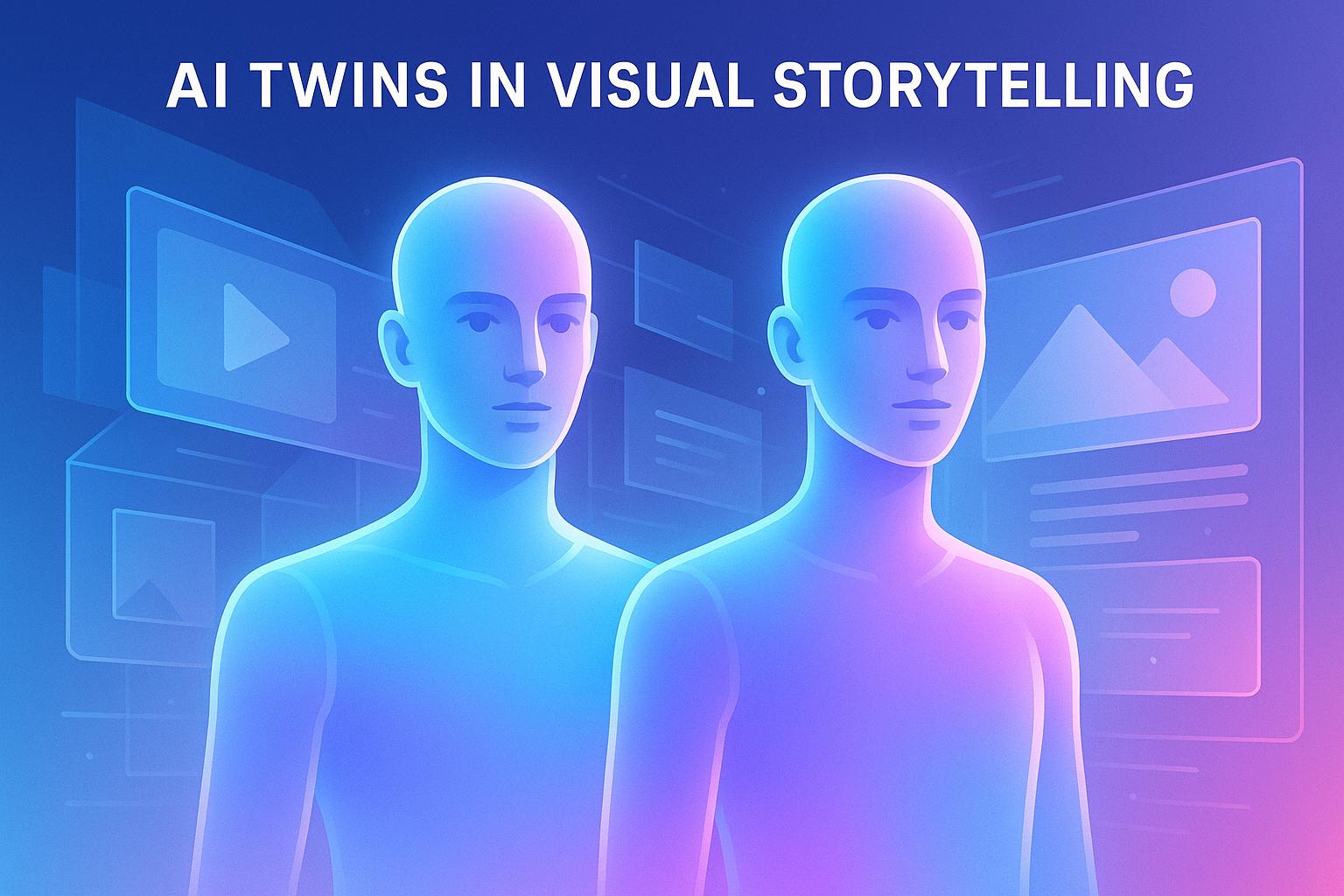
AI Twins are changing how brands and creators produce content. These digital replicas, modeled after real individuals, can create videos, host live streams, and interact with audiences in real-time. They save time and reduce costs by eliminating the need for repeated shoots, while offering highly tailored content for different viewers. Platforms like TwinTone are leading this shift, allowing creators to license their likeness for automated, scalable content production.
Key points:
What are AI Twins? Digital replicas mimicking real people’s appearance, voice, and behavior.
Why use them? Lower production costs, faster content creation, and personalized storytelling.
How are they used? From product showcases to live streams, AI Twins handle repetitive tasks while creators focus on larger projects.
Challenges? Transparency, ethical concerns, and avoiding biases in representation.
Future potential: AI Twins could power 24/7 interactive content, bridging creators and brands with their audiences.
This technology is reshaping content creation, offering efficiency and scale, but requires thoughtful use to maintain trust and inclusivity.
Reid Hoffman meets his AI twin - Full
How AI Twins Enable Personalization
AI Twins are transforming how stories are told, offering a way to craft deeply personalized narratives. Instead of producing a single video and hoping it clicks with everyone, these AI-powered tools adjust the same core story to suit individual viewers. This goes far beyond just swapping out a name or image - it’s about reshaping the entire experience, including tone, pacing, scenes, and calls-to-action, all tailored to the person watching.
Customizing Visual Narratives
AI Twins rely on a mix of data to deliver stories that feel personal. They analyze behaviors like watch history, time spent on specific scenes, whether viewers pause or skip, and how they interact with elements like clickable features. They also consider demographics such as age, location within the U.S., language preferences, and device type. Context matters too - factors like the time of day, how the viewer found the video (social media, email, search), and the campaign they came from all influence the story's presentation.
With this data, AI Twins adjust the narrative in meaningful ways. For instance, if a viewer segment tends to lose interest early, the AI can trim lengthy explanations and get straight to the point. On the other hand, audiences who enjoy in-depth content might see more detailed, slower-paced segments. Even the setting can shift - urban scenes for city viewers or outdoor environments for suburban audiences. Tone is also tailored: younger viewers might encounter casual language and playful visuals, while older or professional audiences get a more straightforward, polished approach. Through all these variations, the brand’s identity - logos, colors, fonts, and messaging - stays consistent.
TwinTone takes this personalization even further by letting creators turn their likeness into AI Twins. These AI Twins can generate branded videos and host live streams automatically. Brands can integrate product feeds, pricing in USD, and audience data from CRM or ad platforms directly into TwinTone. The AI Twin then produces multiple video versions, tweaking hooks, featured products, and calls-to-action for each specific segment - all while maintaining the creator’s recognizable presence. For live product showcases, the AI Twin can operate around the clock, rotating featured items, answering FAQs, and highlighting limited-time U.S. promotions, all without the creator needing to be on camera. TwinTone also supports translations in over 40 languages, making it easier to adapt content for different audiences across the U.S. and beyond.
This level of personalization naturally leads to a new frontier: interactive storytelling.
Interactive and Branching Story Paths
AI Twins don’t just adapt linear stories - they can also create branching narratives where viewers actively shape their experience. By combining pre-set story points with decision-making logic, these tools allow viewers to choose their path. For example, they might click options like “learn basics,” “see advanced features,” or “watch real-life use cases.” Even subtle behaviors, like hovering over certain elements or scrolling patterns, can guide the AI in tailoring the experience.
A branching narrative often starts with a shared introduction and then splits based on the viewer's interests. Each branch can dive deeper - someone selecting “see advanced features” might then explore industry-specific examples, budget-friendly options in USD, or different content lengths. Throughout all these paths, the AI Twin maintains a consistent persona, whether it’s acting as a shopping guide or fitness coach. It also references prior choices to create continuity, such as saying, “Since you’re interested in budget options under $100, let’s compare these two models.” Visual consistency - like matching lighting, settings, and typography - helps reinforce the sense that all paths belong to the same story. Clear interface cues, like progress indicators or options to restart, give viewers control and build trust. This approach resonates particularly well with U.S. audiences, enhancing engagement through dynamic, personalized interactions.
Measuring Viewer Engagement Impact
Personalization only matters if it drives results, and brands carefully track key metrics to measure the impact of AI Twin-driven content. Metrics like watch time and completion rates are analyzed for each segment and story path. Interaction rates, such as clicks on branching options, replays of key scenes, or skips, provide deeper insights into viewer behavior.
Performance metrics like click-through rates (CTR) to landing pages, add-to-cart rates, and conversion rates (e.g., purchases, sign-ups, or demo bookings) are also critical. Using UTM parameters and attribution models common in U.S. marketing, brands can measure how personalized videos influence these outcomes. Over time, they compare figures like revenue per viewer, average order value in USD, and customer lifetime value between audiences exposed to AI Twin content and those who watched non-personalized videos. Personalized storytelling programs often target increases such as 20–40% in watch time and 10–30% in CTR.
Microsoft highlights that AI-powered digital twins enable brands to create “thousands of variants on a single product image” from one core model. This dramatically expands personalized content libraries without requiring additional photoshoots.
By shortening production timelines and automating repetitive tasks, AI Twins allow for more testing and refining of narratives based on real-time analytics. These analytics - tracking watch time, engagement, and conversions - feed back into the system, enabling continuous improvement. The AI learns which tones, visuals, and story paths perform best for each audience, enhancing efficiency and effectiveness.
TwinTone’s AI Twins have generated over 1 billion views, demonstrating how AI-driven personalization can deliver tailored content at scale. By identifying high-performing story paths and phasing out less effective ones, brands can maximize engagement and revenue. Closed-loop learning, where interaction data and performance metrics refine the AI’s configurations, ensures every viewer gets a story uniquely tailored to their preferences and habits.
Scalability and Efficiency in Content Production
Producing content the traditional way often feels like an uphill battle - managing studios, coordinating crews, hiring talent, and juggling post-production schedules. It’s a process riddled with inefficiencies. Enter AI Twins: a game-changer that transforms a creator’s likeness into a reusable, digital asset. Once the AI Twin is trained, brands can generate new visuals, videos, or interactive experiences on demand - no need to call back the production team or plan costly reshoots. This approach unlocks a new era of scalable and efficient content creation.
Cutting Production Costs and Time
AI Twins streamline the production process by cutting out the repetitive and expensive steps. Instead of organizing studios, hiring teams, or dealing with travel logistics for every campaign, brands invest upfront in creating and training their AI Twin. After that, generating content becomes quick and cost-effective. Campaigns that previously cost tens of thousands of dollars can now be executed for a fraction of that - sometimes even in the high three figures. And what used to take weeks to produce can now be delivered in mere days or hours.
A great example is Nestlé’s use of digital product twins, which has slashed production costs and time by 70%. Similarly, Microsoft highlights how consumer packaged goods companies benefit from 3D digital product twins. Traditionally, creating localized product images required constant reshoots, tweaks, and adjustments to packaging and language. Now, brands can make all these changes digitally within a single file, generating thousands of asset variations without the need for new photography.
But the value of AI Twins goes beyond saving time and money - they’re also revolutionizing dynamic brand campaigns.
AI Twins in Brand Campaigns and Commerce
AI Twins are becoming the backbone of always-on brand campaigns. Acting as modular virtual hosts, they seamlessly deliver content across formats, from quick ads and tutorials to FAQ videos and retargeting creatives. Once an AI Twin is set up, marketers can simply update scripts with new messages, seasonal deals, or product details to create fresh assets almost instantly. This capability enables brands to maintain ongoing, personalized engagement with their audiences.
In commerce, AI Twins are particularly powerful for creating large volumes of user-generated content (UGC)-style visuals that feel authentic but are produced programmatically. They ensure consistency across all channels while compensating creators for the continued use of their digital likeness. AI Twins also integrate with product feeds to automatically generate new content - such as virtual try-ons, product comparisons, or themed lookbooks - keeping visuals perfectly aligned with real-time updates to product catalogs.
TwinTone: AI-Driven Content at Scale

TwinTone takes the concept of AI Twins to the next level, allowing creators to turn their likeness into digital assets that can produce branded content or even host livestreams autonomously. With TwinTone, brands can create on-demand UGC, 24/7 shoppable content, and interactive showcases. The platform offers over 100 AI Avatars with diverse personalities, giving brands plenty of options to match their messaging style.
Marketers can upload product images and scripts to instantly generate UGC-style video ads or product showcases. TwinTone’s support for more than 40 languages ensures global reach, while built-in performance analytics help brands track key metrics like production costs, turnaround times, engagement rates, and conversions. This data allows U.S. companies to measure the ROI of AI Twin-generated content and compare its performance to traditional methods, making it easier to refine strategies and maximize impact.
Ethical, Cultural, and Viewer Perception Considerations
As AI Twins reshape the world of visual storytelling, it’s essential to address ethical and cultural challenges to maintain authenticity and trust. While the technology is undeniably powerful, it can also raise concerns about transparency, representation, and viewer skepticism. Without clear safeguards, there’s a risk of eroding trust and reinforcing harmful biases. Let’s explore how these issues can be tackled thoughtfully.
Transparency and Trust in AI Content
One of the biggest risks with AI Twins is misrepresentation. If audiences can’t distinguish between a real person and an AI-generated version, trust can erode quickly. Surveys reveal that many Americans remain skeptical about the growing presence of AI in everyday life. This highlights the importance of brands being upfront about their use of AI Twins.
Transparency starts with clear communication. For instance, videos and product pages should include labels like "AI-generated performance of [Creator Name]" to let viewers know when they’re interacting with an AI Twin. Beyond labeling, creators can build trust by offering FAQs that explain how the AI Twin was trained and the boundaries of its use. By framing the Twin as an extension of the creator - not a replacement - they can preserve authenticity. Co-creating scripts, setting clear guidelines, and ensuring the Twin reflects the creator’s tone and values are key steps in this process.
Regulatory developments are also pushing for greater transparency. For example, the SAG-AFTRA 2023–2024 agreement mandates “clear and conspicuous consent” for the reuse of an actor’s digital likeness, along with fair compensation. Similarly, the EU AI Act (2023) requires labeling of deepfakes and AI-generated media, while the U.S. Federal Trade Commission (FTC) warns that undisclosed AI deepfakes in political ads could be considered deceptive practices. These regulations underscore that transparency isn’t just a best practice - it’s becoming a legal necessity.
Representation Across Cultures and Demographics
AI Twins offer an opportunity to broaden representation in visual storytelling, but if not carefully designed, they can unintentionally reinforce existing biases. Problems often arise from imbalanced training data, stylistic defaults, or persona settings that favor certain skin tones, accents, or body types while marginalizing others.
A 2023 study by MIT and Boston University revealed significant gender bias in generative AI image models. Prompts for “CEO” predominantly produced male images, while “nurse” yielded mostly female representations - despite the diversity of these roles in real life.
Bias can also appear in the form of overrepresented lighter skin tones and underrepresented darker or non-Western features in high-status roles. To counter this, teams should regularly audit the data used to train AI Twins, ensuring it reflects a wide range of races, ethnicities, genders, ages, and body types. Brands and creators should also provide configurable options for hair textures, facial features, and culturally relevant clothing, avoiding a one-size-fits-all Western aesthetic.
For campaigns targeting multiple markets, involving local consultants or creators from those communities can help identify and avoid stereotypes, misused symbols, or language errors. Testing AI outputs with diverse user panels and conducting bias checks - such as evaluating how well the AI Twin understands cultural terminology or regional slang - are practical steps toward inclusivity.
AI Twins also have the potential to amplify underrepresented voices. By partnering with creators from diverse backgrounds and developing AI Twins that adapt to various languages and regions, brands can make their content more inclusive. Tools like TwinTone allow for localization across different languages, helping brands connect with diverse U.S. subcultures without sacrificing cultural relevance. Creating AI Twin ensembles that reflect real-world diversity can shift AI from a tool that perpetuates bias to one that democratizes visibility and storytelling.
Addressing Viewer Concerns and Ethical Risks
Viewers have valid concerns about AI Twins, including fears of misrepresentation, job displacement, misuse of likeness, and unease with deepfake-style content. Surveys show that many Americans perceive deepfakes as a threat, making proactive disclosure and ethical safeguards essential.
To address these concerns, brands should use clear labeling, consistent disclosures, and educational content to explain how AI Twins work and what boundaries are in place. For instance, emphasize that AI Twins handle repetitive tasks, freeing creators to focus on more creative, human-driven work.
Ethical use of AI Twins requires explicit consent and well-defined contracts. These agreements should outline what media can be used for training, the approved use cases (e.g., product demos, live shopping streams), and restricted categories like political endorsements. Time-limited licenses with renewal options allow creators to renegotiate or revoke permissions, avoiding perpetual usage rights.
Approval workflows are another safeguard. Creators or their agents should review and approve AI-generated content before it’s released, especially for paid ads or commercial campaigns. Tools like audit logs and usage dashboards can track where and how an AI Twin is used, providing transparency and accountability. Contracts should also include takedown rights and retraining options to ensure the AI Twin stays aligned with the creator’s image and values.
Data privacy is a critical piece of the puzzle. Teams must treat all data - whether biometric (e.g., images, voice recordings), behavioral (e.g., engagement metrics), or interaction-related - as highly sensitive. Privacy-by-design principles, secure storage, and strict access controls are essential to protect creators’ likenesses and maintain audience trust. These ethical measures are just as important as the efficiencies and personalization benefits that AI Twins bring to the table.
AI Twins vs. Traditional Content Production
When brands are deciding how to create visual content, they often face a key decision: stick with traditional production methods or explore the possibilities of AI Twins. Each option comes with its own set of pros and cons related to cost, speed, creative control, and how audiences perceive the final product. By understanding these differences, brands can make more informed choices about where to allocate resources and which approach aligns best with their content goals. Building on earlier discussions about personalization and cost efficiency, this section provides a direct comparison between AI Twins and traditional production methods.
Comparison: AI Twins vs. Traditional Methods
AI Twins and traditional production differ across several important factors, from budget considerations to how audiences engage with the content.
Dimension | AI Twins | Traditional Production |
|---|---|---|
Cost per Asset | Lower and predictable; eliminates ongoing costs for talent, crews, and locations. For example, H&M transformed a single shoot into multiple digital versions. | Higher per asset; requires hiring models (typically $500–$5,000+ per day), photographers, stylists, production crews, and covering location fees for each campaign. |
Production Speed | Minutes to hours; AI workflows can deliver campaign-quality visuals quickly, enabling real-time responsiveness. | Weeks to months; involves scheduling shoots, coordinating talent, managing logistics, and editing - each iteration requiring a similar level of effort. |
Scalability | Easily scalable to produce countless variations across platforms, languages, and audience segments. Nestlé, for instance, has created over 4,000 3D digital product twins and plans to convert 10,000 for faster production. | Limited scalability; entering new markets or creating variations typically demands separate production efforts, with costs increasing as volume grows. |
Personalization | Supports hyper-personalized, data-driven content that adapts to individual preferences - ideal for "N=1 marketing." | Typically limited to broader demographic segmentation; creating personalized versions is costly and time-intensive, relying on historical data rather than real-time inputs. |
Measurement & Optimization | Integrates real-time data and analytics, allowing brands to test and refine campaigns before launch and continuously improve performance. | Relies on slower post-campaign analysis; traditional A/B testing and data collection can take weeks and are less dynamic. |
Initial Investment | High upfront costs (ranging from $50,000–$500,000+ depending on customization) for AI infrastructure, training data, and skilled personnel. However, per-asset costs drop significantly with scale. | Lower initial costs for single shoots, but ongoing expenses remain high and do not decrease with increased production. |
Creative Flexibility | Enables rapid experimentation with styles, scripts, and edits without additional shooting costs. However, it may lack the subtle emotional depth of human improvisation. | Allows for genuine human creativity and improvisation, but significant changes often require new shoots, adding to costs. |
Authenticity Perception | Can feel authentic if brands are transparent about AI use. For example, H&M showcased AI-generated and human-created versions side by side, including model quotes to build trust. | Generally seen as more authentic since audiences know they are viewing real humans, benefiting from traditional media's established credibility. |
For brands producing over 100 pieces of content each month, AI Twins often provide a lower total cost of ownership within six to twelve months. Nestlé’s investment in digital product twins, for instance, led to a 70% reduction in both time and cost for scaling content. On the other hand, brands with smaller content needs (under 20 pieces per month) may find traditional production more cost-effective.
Benefits and Limitations of AI Twins
AI Twins bring unique opportunities and challenges that go beyond operational metrics, offering new possibilities in storytelling and ethical considerations.
Consideration | Benefits of AI Twins | Limitations of AI Twins |
|---|---|---|
Technical Infrastructure | Automates multi-platform content generation after setup, offering 24/7 availability for live streams or product showcases. | Requires significant upfront investment in advanced AI tools, infrastructure, and skilled personnel, along with ongoing updates to ensure quality and consistency. |
Content Volume & Variety | Generates endless variants from a single 3D model, including changes in language, packaging, or backgrounds, without additional physical shoots. | Quality depends on diverse training data; insufficient diversity can lead to biased outputs. |
Narrative Depth | Excels at producing frequent, lower-stakes content like product explainers, how-to videos, localized promotions, and social media snippets. | Struggles with capturing the emotional depth or nuanced performances that human actors bring, making it less effective for flagship campaigns. |
Global Reach | Enables rapid localization in over 40 languages, helping brands connect with international audiences. | Achieving deep cultural relevance requires careful programming and data curation, which human teams often handle more effectively. |
Ethical & Legal Framework | Allows for clear consent frameworks and audit logs. For example, H&M ensured models retained image rights and received fair compensation for their digital likenesses. | Raises ethical concerns around likeness usage, consent, and potential misuse such as deepfakes, requiring strict legal safeguards and transparency. |
Representation & Bias | Can amplify underrepresented voices by working with diverse creators and tailoring content for various contexts. | Effectiveness depends on the diversity of training data; without it, there’s a risk of perpetuating biases, requiring ongoing attention. |
Audience Trust | Transparency about AI usage can resonate with younger, tech-savvy audiences who value innovative approaches. | Lack of disclosure risks eroding trust, as audiences may feel misled about the authenticity of the content or the human effort behind it. |
Use Case Fit | Well-suited for scalable, personalized campaigns, seasonal variations, and continuous optimization using real-time analytics. | Less effective for high-profile campaigns or announcements requiring emotional nuance, cultural sensitivity, and genuine human interaction. |
Many brands are finding success with a hybrid model - leveraging AI Twins for scalable, data-driven content while relying on traditional methods for flagship campaigns that demand emotional depth and authenticity. The right approach depends on factors like production volume, desired personalization, budget limitations, and audience expectations. For high-volume, data-heavy campaigns, AI Twins offer unmatched efficiency and speed, while traditional methods remain the go-to for meaningful storytelling and cultural resonance.
Conclusion: The Future of AI Twins in Visual Storytelling
AI Twins are transforming the way we approach visual storytelling by blending efficiency with personalization. As this technology evolves and becomes easier to use, the next few years could see AI Twins move from experimental tools to a core part of social commerce and collaborations between creators and brands. Research already highlights their role in improving content creation processes and cutting costs.
Looking ahead, we might see AI Twins powering 24/7 video storefronts, handling tasks like product discovery, answering questions, and offering personalized recommendations. Platforms like Instagram, TikTok, and live shopping events could seamlessly integrate these AI-driven experiences. For creators, AI Twins could take over repetitive tasks like FAQ videos, tutorials, and evergreen recommendations, freeing up time to focus on storytelling and building communities. Brands, on the other hand, could use insights from AI Twins to fine-tune their messaging and visuals, creating stronger connections between their stories, audience engagement, and sales.
Key Takeaways
Scalability is one of the standout advantages of AI Twins in visual storytelling. Once an AI Twin is trained to replicate a creator’s or spokesperson’s likeness, it can produce endless on-brand content - videos, images, or live streams - for various campaigns, audiences, and platforms. This eliminates the need for repeated shoots. For example, an apparel brand could use an AI Twin to dynamically display different styles and sizes in a video based on a shopper’s browsing history. Similarly, a U.S.-based creator’s AI Twin could answer product questions in real time, maintaining a consistent tone and presence 24/7.
Cost savings are another major benefit. By removing the need for frequent reshoots, brands can refresh content for new markets or seasons without additional production costs. Microsoft notes that digital twins allow brands to "test creative concepts instantly without adding costs". For brands producing high volumes of content - over 100 pieces per month - AI Twins can lead to significant savings within six to twelve months, all while delivering high-quality visuals for social media, product pages, and advertisements.
Personalized engagement reaches a new level with AI Twins. By using behavioral data and intent signals, they can adapt scripts, visuals, and calls-to-action to suit specific audience segments - or even individual viewers. This hyper-targeted approach ensures that every viewer experiences content uniquely tailored to their preferences and past interactions. Platforms like TwinTone demonstrate how creators can turn into AI Twins, enabling them to auto-generate branded content and host live showcases. This approach aligns with what U.S. audiences value: content that feels genuine, immediate, and interactive.
However, the success of AI Twins hinges on ethical practices. Brands must secure clear, written consent for likeness use, ensure transparency by labeling AI-generated interactions, and prioritize diverse representation across race, gender, age, body type, and language. By handling these aspects responsibly, brands can build trust with their audiences and gain a competitive edge in markets that value openness and inclusivity.
Next Steps for Brands and Creators
To fully embrace AI Twins, brands need to balance efficiency with ethical considerations while maintaining a sense of authenticity.
For U.S.-based brands ready to explore this technology, here’s a practical approach:
Define Use Cases: Start with one or two specific scenarios, such as always-on product explainers or seasonal campaign variations. Set clear KPIs to measure success.
Select Talent: Choose creators or spokespeople who align with your brand’s voice, and secure explicit permission for likeness use through clearly defined contracts.
Partner with a Platform: Use a platform like TwinTone to train your AI Twin, generate branded content, and support live or interactive events without requiring in-house expertise.
Test and Optimize: Run A/B tests comparing AI Twin content to traditional formats, measure results, and refine your approach based on data and audience feedback.
For individual creators and influencers, start by identifying the traits that define your personal brand. Work with platforms that offer clear control over how your likeness is used and set boundaries on which brands or categories your AI Twin can represent. Services like TwinTone allow creators to license their AI Twin for branded content or live showcases, creating opportunities to earn income - whether through flat fees, revenue sharing, or performance-based bonuses.
Transparency is key. Always label content hosted by your AI Twin, and reserve personal or sensitive topics for your human presence. Track metrics like cost per asset, production speed, and engagement rates to measure the impact of AI Twins on your workflow and audience connection. For live AI Twin experiences, monitor viewer engagement and satisfaction, and use A/B testing to measure the impact on sales and retention over time. This data-driven approach will help you refine your strategy and maximize the potential of AI Twins in your content creation efforts.
FAQs
How do AI Twins deliver personalized storytelling while staying true to a brand's identity?
AI Twins, such as those developed with TwinTone, give brands the ability to replicate the voice, style, and personality of real creators. These digital counterparts can generate customized content on demand and even host live streams that feel genuine and interactive, ensuring the message connects with the intended audience.
By streamlining content creation and live engagement, AI Twins enable brands to expand their reach without losing the personal element that fosters trust and creates deeper connections.
What ethical factors should brands consider when using AI Twins to create content?
When leveraging AI Twins for content creation, brands must emphasize transparency by openly informing their audience whenever AI-generated content is involved. This openness is key to building trust and maintaining ethical communication practices.
Equally important is respecting privacy and consent. Creators should retain full control over how their likeness is used, and explicit approval must be secured before any content is produced with their AI Twin.
Finally, brands should steer clear of using AI Twins in ways that could spread misinformation or damage audience trust. Every piece of content should reflect the brand's values and remain genuine in its intent.
How can brands evaluate the impact of content created by AI Twins versus traditional methods?
To gauge how well AI Twin-generated content is performing, brands can monitor key metrics like engagement rates, click-through rates, and conversions. These numbers provide valuable insights, helping brands spot patterns and fine-tune their AI Twin’s output to better connect with their audience.
By leaning on this data, brands can make smarter decisions, ensuring their AI Twin consistently produces scalable, tailored content that delivers impactful results.