AI Twins in Personalized Marketing
How to build a futureproof relationship with AI
AI Twins are reshaping marketing by simulating customer behavior to deliver hyper-targeted campaigns. These digital replicas use data from multiple sources - like purchase history and social media interactions - to predict how customers will respond to campaigns before they launch. This approach saves time, reduces costs, and improves campaign accuracy.
Here’s what you need to know:
What They Are: AI Twins are digital models of customer segments or individuals that mimic behaviors and preferences.
How They Work: They combine first-party data (e.g., purchase history), zero-party data (e.g., customer-provided preferences), and third-party data (e.g., social platforms) to create dynamic, evolving profiles.
Why They Matter: AI Twins allow brands to test campaigns virtually, refine strategies, and deploy only the most effective content.
Key Benefits: Brands using AI Twins have reported improved customer engagement, higher revenue, and better loyalty metrics. For example, Coca-Cola and other companies have seen measurable success using this technology.
AI Twins also enable scalable content creation, especially for social commerce. Platforms like TwinTone transform real creators into AI-driven content engines, producing videos, livestreams, and shoppable content in over 40 languages. This capability supports global campaigns while maintaining local relevance.
Privacy and ethical considerations are critical. Brands must comply with regulations like GDPR and CCPA, ensure data security, and maintain transparency to build trust with consumers.
AI Twins are no longer experimental tools - they’re becoming essential for brands aiming to excel in today’s competitive marketing landscape.
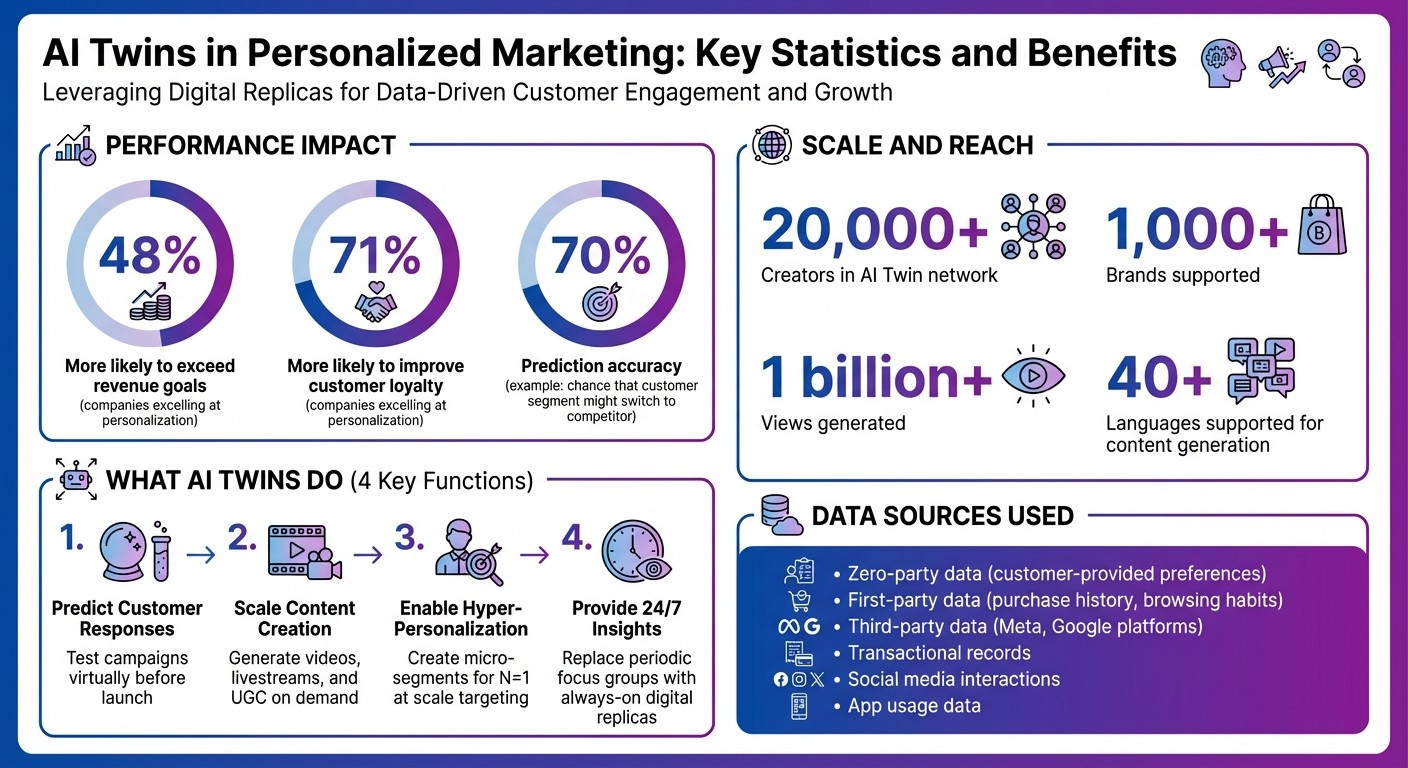
AI Twins Marketing Performance: Key Statistics and Benefits
Research and Data on AI Twins
What Research Shows About AI Twin Performance
Independent research has shown that AI Twins can significantly enhance marketing campaign outcomes. These findings align with earlier results from major retailers and well-known brands, highlighting how AI Twins improve campaigns through pre-launch simulations.
To understand these performance improvements, it's essential to examine the advanced data integration and machine learning technologies that drive AI Twins.
Data and Technology Behind AI Twins
AI Twins rely on a mix of diverse data sources to create highly accurate behavioral models. They merge zero-party and first-party data - like purchase history and browsing habits - with third-party segment-level data from platforms such as Meta and Google. On top of that, they incorporate transactional records, content engagement metrics, social media interactions, and app usage data to build a comprehensive picture of customer behavior.
These models are powered by Generative AI (GenAI), which uses continuous feedback loops to evolve and adapt in real time. Machine learning algorithms dig deep into behavioral patterns to predict preferences, while Agentic AI autonomously creates tailored content and offers. This combination allows brands to simulate interactions with virtual customer segments, test marketing strategies, and fine-tune campaigns before they go live.
With this blend of cutting-edge technology and data, AI Twins deliver measurable improvements that validate their effectiveness.
Measurable Results from AI Twins
Brands leveraging AI Twins consistently outperform traditional marketing approaches, achieving higher revenue and stronger customer loyalty. For instance, these tools can predict specific outcomes - like a 70% chance that a customer segment might switch to a lower-priced competitor. Insights like these enable brands to develop precise discount strategies to retain customers.
AI Twins also enhance conversion rates by tailoring campaigns to reflect genuine customer preferences. They provide insights faster than conventional methods, freeing up marketing teams to focus on broader strategies while the technology manages real-time adjustments across multiple audience segments.
Take TwinTone, for example - a platform that allows creators to function as AI Twins. It enables them to produce on-demand user-generated content (UGC) videos and livestreams in over 40 languages, consistently delivering high-performing content that resonates with diverse audiences.
How Brands Use AI Twins in Marketing
Predicting Customer Responses to Marketing
Brands are now using AI Twins, built from first- and third-party data, to predict how different customer groups might respond to marketing campaigns before they even launch. Instead of sticking to traditional A/B testing, marketers can interact with these AI Twins or run automated simulations to test various creative elements - like ad copy, imagery, discount offers, and timing.
Take an e-commerce brand, for example. They might use an AI Twin to determine the best offer to win back customers who have stopped buying, then implement that strategy across the segment. The process typically starts with a campaign brief outlining goals, budget (in USD), target audiences, and channels. Marketers then use AI Twins to identify the most effective creative angles and timing. Once the campaign is live, performance data is fed back into the AI models, improving predictions for future campaigns. This simulation-based approach also makes scaling content creation for social commerce much more efficient.
Scaling Social Commerce with AI-Generated Content
AI Twins are transforming how brands approach social commerce by enabling the creation of massive amounts of content - like product demos, reviews, and live-style videos - tailored for platforms such as Instagram and TikTok. Tools like TwinTone turn real creators into AI Twins capable of generating user-generated content (UGC) on demand, hosting AI-driven livestreams, and embedding shopping actions directly into videos. This means U.S. brands can instantly access shoppable videos and product demos without the usual delays of coordinating with creators. So far, this network of over 20,000 creators has supported more than 1,000 brands, generating over 1 billion views.
Here’s how it typically works: brands identify their top-performing creators and use their video content and style to create AI Twins. These AI Twins can then produce tutorials or host live sessions. By linking a product catalog, brands can ensure these AI-generated videos include shoppable overlays and deep links with pricing in USD. For instance, marketers might brief an AI Twin with a scenario like "Back-to-school essentials under $50", and the Twin will generate multiple short-form videos. These videos are virtually tested to predict metrics like watch time and conversions, with the best-performing versions shared on social platforms. Real-time data from these campaigns further refines both the content and customer behavior models.
Personalization for Specific Audience Segments
AI Twins take personalization to a new level by creating highly detailed micro-segments based on behavioral, transactional, and contextual data. These segments go beyond basic demographics, grouping customers into categories like "mobile-first discount seekers", "eco-conscious repeat buyers", or "high-intent window shoppers." Each micro-segment is modeled to predict how it will respond to various incentives, product types, messaging tones, and channels, allowing marketers to fine-tune not just the offer but also how and when it’s delivered.
For example, an AI Twin representing eco-conscious skincare buyers might highlight ingredient transparency and sustainability over price. Meanwhile, a Twin targeting lapsed sports gear buyers could suggest trade-in deals delivered via messaging apps. This approach enables brands to execute highly personalized campaigns at scale, achieving what’s often called an "N=1 at scale" effect across thousands of micro-segments.
Brands that use digital twin simulations for marketing often see measurable improvements in campaign performance. Studies show that companies excelling at personalization are 48% more likely to exceed revenue goals and 71% more likely to improve customer loyalty. Plus, by testing ideas virtually, brands can cut down on media waste and experimentation costs, helping them hit revenue and ROAS targets more efficiently.
Challenges and Ethics of AI Twins
Data Privacy and Personalization Trade-offs
AI Twins rely on a mix of brand-owned data and behavioral insights from platforms like Meta and Google. While this enables highly specific customer simulations - like targeting loyal buyers or those who’ve stopped purchasing - it also introduces privacy risks. The more personalized the insights, the higher the chance that anonymized data could be reverse-engineered to reveal individual identities if not carefully safeguarded.
To address these concerns, U.S. regulations like the CCPA require brands to obtain explicit consent from users. Practical strategies for compliance include minimizing data use by focusing on aggregated customer segments rather than individual profiles, pseudonymizing personal identifiers, and conducting regular audits to ensure privacy standards are met. Transparent privacy policies are equally important. They should clearly explain how customer data is used in AI Twins, striking a balance between leveraging richer data for better predictions and minimizing surveillance risks. Adhering to these practices not only ensures compliance with regulations like GDPR and CCPA but also builds consumer trust in AI-driven marketing.
Building Consumer Trust with AI Marketing
Trust is the cornerstone of AI-driven marketing, especially when customers are unaware of AI’s role in their experiences. Brands can foster transparency by clearly labeling AI-generated content and offering simple opt-out options for data usage. For example, labels like "This product demo uses an AI Twin of a creator" or "These recommendations are based on simulated customer preferences" provide clarity. Allowing customers to easily opt out of AI-based personalization demonstrates respect for their autonomy and preferences.
Platforms like TwinTone take this a step further by using licensable AI Twins from verified creators, ensuring that real people are compensated for the use of their digital likenesses. This approach grounds AI marketing in human authenticity rather than relying solely on synthetic personas. Combining AI’s efficiency with human oversight is key. Validating simulations with real customer feedback before launching campaigns can prevent the unsettling "uncanny valley" effect, where overly precise personalization feels more invasive than helpful.
Technical Problems in Using AI Twins
Integrating AI Twins with existing CRM and martech systems can be a complex task. These systems often need to pull behavioral data from various sources - like web analytics, point-of-sale systems, social media platforms, and loyalty programs. This process can lead to issues such as data latency and quality inconsistencies, which undermine the effectiveness of AI simulations.
Accuracy is another critical factor. AI Twins trained on biased or outdated data can produce flawed predictions that don’t align with actual customer behavior. A phased rollout can help mitigate these risks. For instance, brands can begin with pilot tests on smaller customer segments, validate predictions through A/B testing, and gradually scale up while monitoring for model drift caused by seasonal changes or economic shifts. Addressing these technical hurdles is essential to fully unlocking the potential of AI Twins in marketing campaigns.
What's Next for AI Twins in Marketing
AI Twins as 24/7 Marketing Tools
AI Twins are stepping in as a game-changer, replacing traditional focus groups with dynamic, always-on digital replicas of customer segments. These Twins update continuously using first-party behavioral data and channel interactions, offering marketers a real-time alternative to periodic focus groups that only capture fleeting snapshots of consumer sentiment. With AI Twins, teams can "interview" these digital personas anytime to test messages, offers, and creative ideas - saving time and money compared to traditional methods.
By integrating AI Twins with platforms like CDPs, CRMs, and analytics tools, marketers can quickly simulate customer responses, identify preferred channels, and predict conversion rates in just minutes. Creative teams can experiment with different headlines, visuals, and value propositions, using the Twins' feedback - like sentiment analysis and uplift predictions - to fine-tune their campaigns before launch. And it doesn’t stop there: as real campaign data flows back, these Twins evolve, becoming even more accurate tools for ongoing research and strategy.
AI Twins on Social Commerce Platforms
AI Twins are also making waves in social commerce, where they go beyond research to create content directly. These digital replicas of creators can produce platform-ready content, like shoppable videos and real-time livestreams, tailored to U.S. pricing and audience preferences. This means brands can instantly deploy custom content across social platforms like TikTok, Instagram, Amazon, and Shopify.
Take TwinTone, for example. This platform turns real creators into AI Twins capable of generating short-form videos, product demos, and livestreams that align with each brand’s voice and compliance needs. Instead of juggling influencer schedules, brands can rely on these creator Twins to deliver campaign-specific content on demand. They also personalize product recommendations and analyze engagement data to refine scripts, hooks, and offers over time. With support for over 40 languages, TwinTone allows U.S. brands to run multilingual AI-powered livestreams, promoting products globally without the usual logistical headaches or inflated costs.
The Future of AI in Content and Marketing
AI Twins are set to become even more powerful as advancements in generative AI make them smarter, more versatile, and better at understanding context. Imagine Twins that can process text, images, video, voice, and even AR/VR interactions to provide a complete picture of how U.S. consumers engage with brands across channels. These Twins won’t just produce copy or visuals - they’ll create interactive videos, personalized landing pages, and dynamic experiences that adapt in real time to user behavior.
For U.S. brands looking to expand globally, multilingual AI Twins will be a game-changer. They’ll help brands replicate successful strategies in new markets while respecting local languages, customs, and regulations. For example, a Twin representing "value-conscious parents" could be customized for different regions, taking into account local holidays, pricing preferences, and payment methods. Generative AI will handle translations and cultural adjustments, while simulations test audience reactions before campaigns go live - helping brands avoid missteps and tone-deaf messaging.
To stay ahead, U.S. companies should focus on building clean, consented first-party data and unified identity systems. Piloting small-scale Twin-driven campaigns can help validate their impact on engagement and revenue. It’s also crucial to set up safeguards for brand safety and privacy while exploring specialized platforms like TwinTone to fill gaps in simulation, generative media, and social commerce. These steps will ensure AI Twins continue to drive personalization and efficiency, solidifying their role as indispensable tools in modern marketing.
Conclusion
Main Benefits of AI Twins
AI Twins are transforming personalized marketing by offering hyper-personalization at scale. What used to take weeks of focus group testing can now be achieved in moments, thanks to data-driven insights. Brands can simulate countless campaign variations, test messaging on virtual personas, and roll out only the top-performing content - all without increasing staff or ballooning budgets. Research shows that companies excelling in personalization are 48% more likely to exceed revenue goals and 71% more likely to improve customer loyalty. These results directly translate to stronger ROI, higher conversion rates, and more efficient ad spending.
AI Twins also drive faster innovation and deeper engagement. Instead of waiting months for traditional research, marketers gain instant feedback on creative ideas, pricing strategies, and promotions. Campaigns can then be adjusted in real time across email, SMS, social media, and websites. The outcome? Better open rates, click-through rates, and repeat purchases - because every message resonates with what each audience segment genuinely values. For U.S. companies expanding into international markets, AI Twins' multilingual capabilities offer a strategic advantage, making it easier to connect with global audiences.
These benefits highlight the potential for brands to take actionable steps that can elevate their marketing efforts to the next level.
Next Steps for Brands
With these advantages in mind, it’s time for brands to act. U.S. marketers should start by auditing their first-party data and creating unified customer profiles across CRM systems, websites, and apps. Focus on one or two high-impact use cases - such as reactivating lapsed customers or upselling existing ones - and launch a controlled pilot with clear success metrics and privacy measures in place. Once the results show value, expand into more advanced strategies like AI-generated user-generated content (UGC), shoppable videos, and livestream shopping.
Platforms like TwinTone make these steps more achievable. By turning real creators into AI Twins, brands can produce on-demand product demonstrations, shoppable videos, and 24/7 livestreams. This eliminates scheduling conflicts and reduces costs while staying aligned with AI Twin insights. TwinTone supports over 40 languages and automates content distribution across TikTok, Instagram, Amazon, and Shopify, enabling U.S. brands to scale their social commerce efforts while keeping content fresh, consistent, and optimized.
The message is clear: AI Twins are no longer an experiment - they’re becoming an essential tool for modern marketing. Brands that invest in clean data, pilot programs, and the right platforms today will not only see immediate gains in efficiency and engagement but also lay the groundwork for even more advanced AI-driven marketing in the future.
From In-House Builds to Digital Twins: How AI Is Transforming Retail Operations and CX
FAQs
How do AI Twins enhance personalized marketing campaigns?
AI Twins are changing the game in personalized marketing by giving brands the ability to produce dynamic, on-demand content such as UGC-style videos and AI-driven livestreams. This approach cuts out the hassle of lengthy outreach and coordination, making it easier to scale campaigns quickly and effectively.
Available around the clock and capable of resonating with a wide range of audiences, AI Twins enhance customer interaction, elevate campaign results, and increase returns on ad spend (ROAS). Their flexibility empowers brands to deliver customized, impactful content whenever it's needed.
What are the privacy risks of using AI Twins in marketing?
When incorporating AI Twins into marketing strategies, privacy risks can arise, such as the misuse of personal information, impersonation without consent, and a lack of transparency regarding data collection and usage. These risks could open the door to privacy violations or even identity theft.
To mitigate these challenges, it’s crucial to partner with platforms that emphasize data protection, provide clear and transparent usage policies, and uphold ethical standards in the creation and application of AI technologies.
How can brands improve the accuracy of AI Twin predictions?
To improve the precision of AI Twin predictions, brands should focus on regularly tracking performance metrics and adjusting their AI Twins based on actionable insights. By consistently comparing predictions with actual data and collecting customer feedback, businesses can ensure these systems remain dependable and in tune with audience expectations.
Over time, fine-tuning AI Twins allows them to keep pace with evolving trends, shifting preferences, and changing behaviors. This ongoing process ensures marketing efforts remain highly tailored and impactful.