AI Twins for Live Commerce: Use Cases and Examples
How to build a futureproof relationship with AI
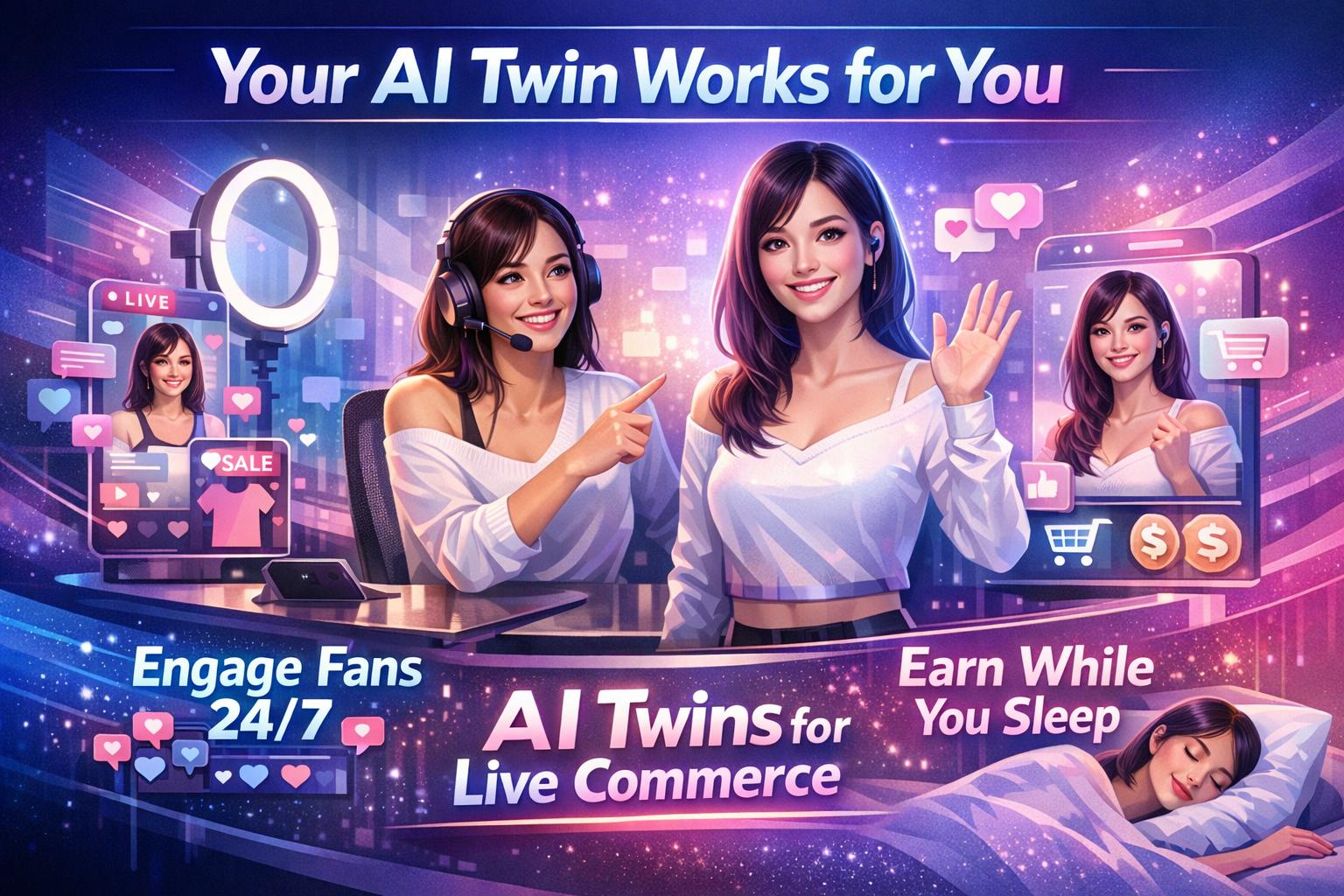
AI Twins are transforming live commerce by acting as interactive, data-driven digital assistants in real-time shopping. These virtual counterparts enhance shopping experiences through personalized recommendations, dynamic pricing, and 24/7 engagement. By integrating advanced AI with live shopping platforms, brands are seeing higher conversion rates, reduced return rates, and increased customer satisfaction. Key highlights include:
Personalized Shopping: Virtual try-ons and tailored suggestions improve purchase confidence.
Interactive Engagement: AI responds instantly to customer questions and actions, boosting participation.
24/7 Virtual Hosts: AI-powered avatars run live shopping events non-stop, cutting costs and driving sales.
Dynamic Pricing: Real-time data optimizes pricing to maximize revenue during live events.
Cross-Platform Reach: AI Twins operate seamlessly across platforms like TikTok, Instagram, and YouTube.
Performance Insights: Real-time analytics help brands fine-tune strategies for better results.
Live commerce is growing fast, with projections of $220 billion by 2028. AI Twins are at the forefront, providing smarter, more engaging shopping experiences. Brands using this technology are not just keeping up - they're setting new standards in e-commerce.
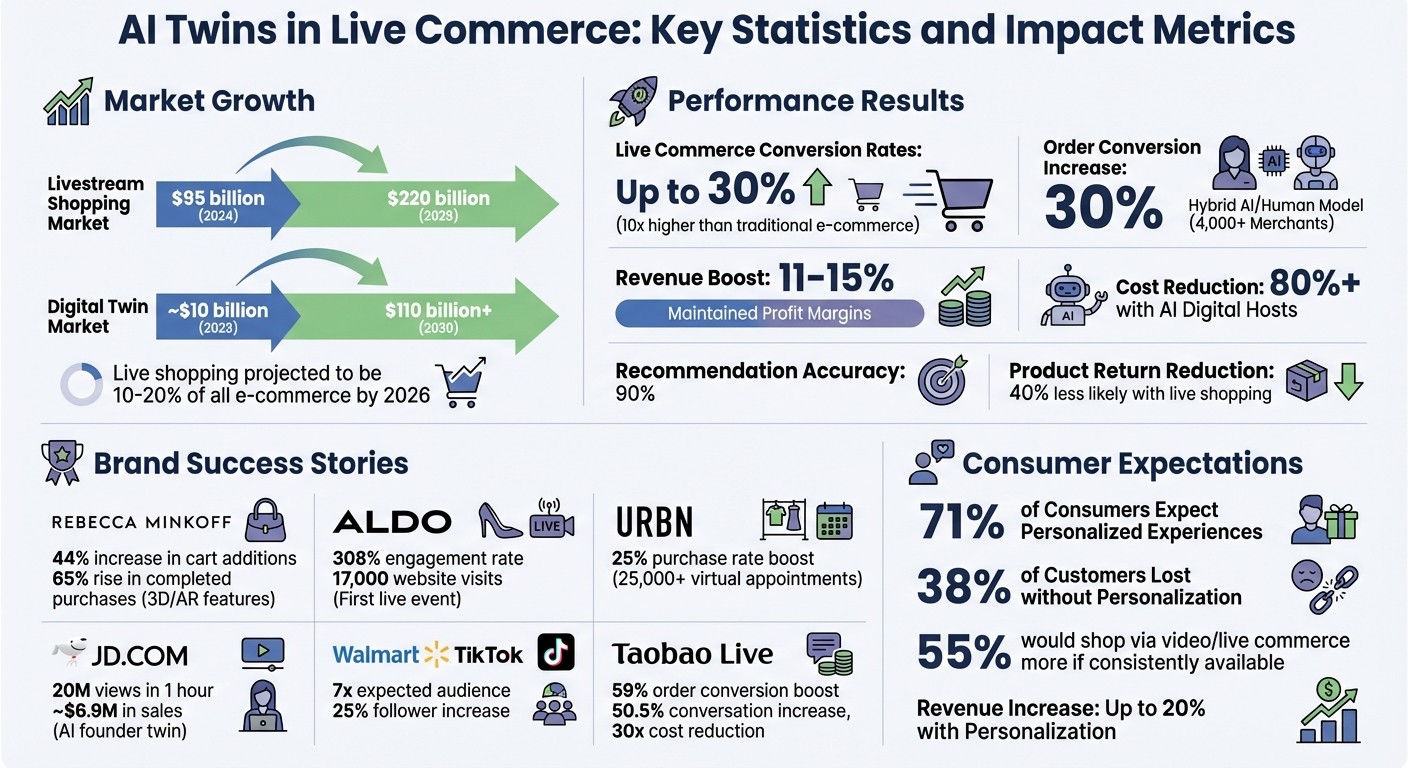
AI Twins in Live Commerce: Key Statistics and Impact Metrics
LiveCart: Online Live Selling with AI Avatars
AI Twins in Live Commerce: Transforming Real-Time Shopping
AI Twins are virtual counterparts that sync with real-world data at regular intervals, automatically updating to reflect changes like inventory shifts or customer sentiment. This real-time adaptability opens up exciting possibilities in live commerce.
In this space, AI Twins typically appear in two key roles: Customer AI Twins and Creator AI Twins. Customer AI Twins focus on enhancing the shopping experience with features like virtual try-ons and tailored product suggestions. On the other hand, Creator AI Twins are AI-powered avatars that host livestreams, interact with viewers, express emotions, and keep audiences engaged around the clock [4, 8, 11].
What powers these twins? Generative AI. By processing real-time data - like chat activity, clickstreams, inventory levels, and social sentiment - these systems can anticipate customer needs, simulate buying scenarios, and provide context-aware responses.
This technology is fueling significant market growth. For example, livestream shopping is expected to surge from $95 billion in 2024 to $220 billion by 2028. Retailers are increasingly turning to 24/7 virtual hosts to maintain a constant online presence. As Glance AI describes it:
"AI Twins are transforming fashion personalisation by creating digital replicas of shoppers... It's the future of shopping, where every customer feels seen and every purchase feels right".
The real game-changer here is the shift from static digital models to dynamic entities that evolve with every interaction. Unlike traditional chatbots that follow rigid scripts, AI Twins adapt in real time, learning from feedback to fine-tune promotions, refine product recommendations, and adjust their conversational style. This makes the shopping experience not only more responsive but also far more personalized.
1. Personalized Recommendations
Real-Time Styling That Adapts to Each Shopper
AI Twins use live engagement signals to adjust product displays during shopping events, ensuring that each shopper sees items aligned with their preferences rather than a one-size-fits-all selection. This instant analysis and adjustment create a dynamic shopping experience that feels uniquely tailored to each individual.
Interactive tools like 3D and AR visualizations are proving to be game-changers for online shopping. Take Rebecca Minkoff, for example. By incorporating 3D and AR features, the brand saw a 44% increase in cart additions and a 65% rise in completed purchases. Uri Minkoff, the brand's Cofounder and CEO, shared:
"3D media makes for a much more interactive shopping experience. Customers can examine our products from every angle, including the option to view products in augmented reality, which helps them get a better sense of quality and size."
Another standout example is URBN, the parent company of Anthropologie and BHLDN. They introduced virtual appointments for fittings and consultations, engaging over 25,000 customers. These personalized sessions led to a 25% boost in purchase rates. By offering tailored advice and building shopper confidence, these experiences not only increased sales but also deepened customer trust.
The numbers speak for themselves: personalized shopping can boost revenue by up to 20% and aligns with the 71% of consumers who expect tailored experiences. On the flip side, failing to deliver personalization risks losing up to 38% of potential customers. Plus, with shoppers being 40% less likely to return products bought through live shopping experiences, the value of AI-driven personalization becomes even more compelling.
2. Interactive Engagement
Two-Way Conversations That Drive Sales
AI Twins are changing the game of live shopping by turning it into a truly interactive experience. Instead of just watching, viewers can actively participate, thanks to real-time monitoring of chats, emojis, viewing times, and click patterns. Imagine this: a viewer sends a cheerful emoji or asks about product sizing, and the AI Twin immediately responds with tailored product details, reviews, or even personalized recommendations. This smart interaction helps distinguish casual browsers from serious buyers, creating a seamless shopping journey.
And the results speak for themselves. In 2021, the footwear brand ALDO hosted its first live shopping event and saw a staggering 308% engagement rate, along with 17,000 website visits during the session.
What makes this even more effective is the way AI Twins handle repetitive questions, letting human hosts focus on storytelling and building a connection with the audience. Jane Cheung, Global Research Leader for Consumer Industries at IBM, summed it up perfectly:
"Talking about the product is more fun than scrolling on your phone for information".
Walmart has taken this interactivity to another level. In 2023, they introduced the "Shop with Friends" feature, where shoppers can use augmented reality to try different outfits on virtual models that match their body shape. Friends can join in, "heart" their favorite looks, and leave comments in real time. This collaborative approach not only makes shopping more engaging but also helps customers feel more confident about their purchases.
3. Virtual Brand Representatives
AI Twins as Your 24/7 Sales Force
AI Twins are digital replicas designed to represent your brand around the clock. These virtual representatives seamlessly handle product demonstrations, answer customer inquiries, and maintain an engaging presence during live shopping events. Their tireless availability creates opportunities for impressive outcomes, as illustrated below.
Take JD.com as an example. In April 2024, they introduced an AI digital version of their founder, Richard Liu, during a livestream event for JD Home Appliances and JD Supermarket. This AI twin replicated Liu’s accent and gestures, delivering a lifelike and engaging experience. The result? Over 20 million views in just one hour and approximately RMB 50 million (around $6.9 million) in sales.
A hybrid approach, where a human host takes charge during high-engagement periods (3–4 hours) and the AI Twin steps in during quieter times, has proven highly effective. For over 4,000 merchants, this model increased order conversion rates by 30%.
AI-driven digital hosts also significantly cut costs - by more than 80% - while achieving 90% accuracy in personalized recommendations. This nonstop, personalized interaction ensures your brand stays consistent and dynamic. By incorporating AI Twins, you can expand your live commerce efforts while maintaining a cohesive and engaging brand presence at all times.
4. Dynamic Pricing
Real-Time Price Optimization That Drives Revenue
AI Twins go beyond simply showcasing products - they analyze real-time data to fine-tune pricing on the fly. During live shopping events, these systems keep an eye on chat sentiment, click patterns, inventory levels, and engagement trends to pinpoint the perfect moment for a flash sale or discount. Instead of resorting to broad price cuts that could hurt margins, they calculate price elasticity - how demand shifts with a 1% price change - to apply highly targeted discounts. This precision not only boosts revenue but also ensures profitability during live events.
The results speak for themselves. A major Chinese online retailer saw an 11% revenue increase while maintaining a 10% gross margin by analyzing real-time demand and competitor stockouts. Similarly, a leading U.S. home furnishings retailer achieved a 15% revenue boost and a 10% profit increase in a month-long pilot across 10,000 products.
"Traditional AI says, 'Here's a likely good product.' Agentic AI says, 'Here's what we should do next, and I'll do it unless you tell me otherwise.'" – beBit TECH
At the heart of this strategy is inventory-aware pricing. AI Twins connect directly to inventory APIs, ensuring they don’t promote items that are running low on stock. They also craft personalized bundles, pairing main products with complementary accessories, which appeal to price-conscious shoppers ready to make a purchase. This thoughtful approach not only drives conversions but also builds trust with customers by offering value exactly when they’re most engaged.
5. Cross-Platform Scalability
Reaching Customers Wherever They Shop
AI Twins make it possible for brands to connect with their audience across platforms like TikTok, Instagram, YouTube, Amazon, and Shopify - all through a single deployment. A notable example comes from July 2025, when Taobao Live, part of Alibaba Group, used knowledge distillation to compress a massive 670B model into something manageable for standard hardware. This upgrade allowed them to swap their 14B dense production model for a 30B Mixture-of-Experts (MoE) model. By activating just 3B parameters during live streams, they saw a 59% boost in order conversions, a 50.5% increase in multi-turn conversation volume, and slashed computational costs by an impressive 30x. This approach seamlessly integrates with live commerce strategies, ensuring brands can maintain high engagement across platforms.
One of the biggest challenges with traditional models is the delay in responses during live events, which can disrupt the experience. By leveraging reinforcement learning, AI Twins shorten reasoning paths and minimize response delays. The result? Instant, accurate answers that keep viewers engaged and ready to make purchases.
"A retail twin can be the foundation for getting our customers the products and help they need, when and where they need them." – Cheryl Friedman, Vice President, Lowe's Innovation Labs
This level of efficiency is driving massive growth in the digital twin market, projected to jump from around $10 billion in 2023 to over $110 billion by 2030. For brands, the stakes are high: failing to deliver personalized, cross-platform experiences could cost them up to 38% of their customers. Meanwhile, 55% of consumers say they’d shop through video and live commerce more often if it were consistently available. Clearly, scalable AI Twins are becoming a must-have for modern retailers.
TwinTone is a standout example, offering more than 20,000 creator AI Twins that host branded live streams around the clock in over 40 languages. The platform automates content distribution across TikTok, Instagram, and YouTube, allowing brands to scale user-generated content campaigns instantly.
6. Performance Analytics
Real-Time Insights That Lead to Smarter Decisions
AI Twins take live commerce to the next level by not only hosting events but also capturing key metrics as they happen. These virtual counterparts pull data from chats, videos, clickstreams, and sensors, creating a "closed-loop" analytics system. This system identifies the exact moments that spark purchases, reveal drops in engagement, and showcase the best-performing products. With this information, brands can make real-time adjustments to their campaigns.
Live commerce has the potential to deliver conversion rates of up to 30% - a figure that’s as much as ten times higher than traditional e-commerce. For example, during a December 2020 Walmart TikTok livestream, analytics tools recorded seven times the expected audience and a 25% increase in followers.
AI Twins go beyond just tracking numbers; they link specific moments, like product unboxings, to immediate spikes in add-to-cart actions. This approach focuses on uncovering why sales happen, not just observing the results. Brands can then adapt on the fly - whether it’s shifting the conversation, emphasizing different product features, or even tweaking prices based on live audience engagement.
"Use analytics-derived insights and machine learning to develop automated real-time prompts for optimizing livestreams as they go out." – McKinsey Digital
TwinTone's performance analytics build on this concept by monitoring engagement and user satisfaction metrics, conversions, and ROI in real time. This transforms every livestream into an opportunity to learn and improve, making each session more effective than the last.
Conclusion
AI Twins are revolutionizing live commerce by creating seamless, data-driven experiences that run around the clock. These digital counterparts handle tasks like personalized virtual try-ons and real-time promotion adjustments, freeing up human teams to concentrate on strategy and storytelling.
The numbers back it up: AI Twins are driving both efficiency and sales growth. Real-world applications show clear returns on investment, improving customer engagement and streamlining operations. With live shopping expected to make up 10–20% of all e-commerce sales by 2026, the potential here is enormous.
Agentic AI takes this a step further, analyzing chat sentiment, monitoring inventory, and instantly delivering personalized product bundles. This technology enables brands to seamlessly weave AI Twins into their multi-channel strategies. The examples discussed earlier illustrate how these tools enhance personalized recommendations and ensure scalability across platforms.
To get started, focus on high-impact categories like fashion, beauty, or home goods - areas where features like virtual try-ons and 3D visualization can make an immediate difference. Begin by deploying AI co-hosts in "advisor mode" for simpler tasks, such as answering FAQs, and gradually scale up to more autonomous roles as confidence in the system grows. Success hinges on integrating your data streams so that AI Twins can access real-time inventory, CRM, and POS data across all channels.
TwinTone’s platform ties all these elements together, offering a comprehensive solution for brands. From generating authentic user-generated content videos to hosting AI-powered live streams and tracking performance analytics, it’s all managed within one system. Brands that act now will set the standard for the future of live commerce, turning every live stream into a chance to learn and every customer interaction into a conversion opportunity.
FAQs
How do AI Twins make live shopping more personalized?
AI Twins add a whole new dimension to live shopping by introducing lifelike digital avatars that mirror a shopper’s appearance, style preferences, and body proportions. These avatars let customers virtually try on items like clothing or accessories, giving them a realistic preview of how the products would look on them. This not only eliminates much of the guesswork but also builds confidence in their purchase choices.
By delivering tailored recommendations and creating interactive, personalized experiences, AI Twins make shopping more engaging and help shoppers feel a stronger connection to the brand. It’s a shopping journey that feels intuitive and enjoyable.
How do AI Twins help with dynamic pricing during live shopping events?
AI Twins bring a new level of sophistication to dynamic pricing during live shopping events. By analyzing real-time data - like customer behavior, demand patterns, and inventory status - they empower businesses to tweak prices on the spot. The result? Companies stay competitive while boosting revenue potential.
These tools also simulate various pricing scenarios, helping brands find that sweet spot between making a profit and keeping customers happy. This ability to adjust quickly is especially crucial during high-traffic live events, where split-second decisions can make or break sales performance.
How can brands use AI Twins across different platforms?
Brands can use AI Twins to deliver a unified and tailored shopping experience across different platforms. These AI-powered tools can be embedded into live streaming platforms, e-commerce sites, and social media channels, enabling features like real-time product suggestions, virtual try-ons, and interactive customer interactions.
To make this integration smooth, brands can rely on AI-driven tools to sync customer data across all platforms. This ensures AI Twins can adjust to each platform’s unique features while providing a consistent and personalized experience. For instance, they can analyze customer behavior during live streams or on social media to offer customized recommendations and dynamic marketing strategies.
By combining real-time data syncing with adaptable AI Twin systems, brands can boost customer engagement, create more personalized experiences, and increase conversions across their digital channels.