AI Twins for Interactive Storytelling
How to build a futureproof relationship with AI
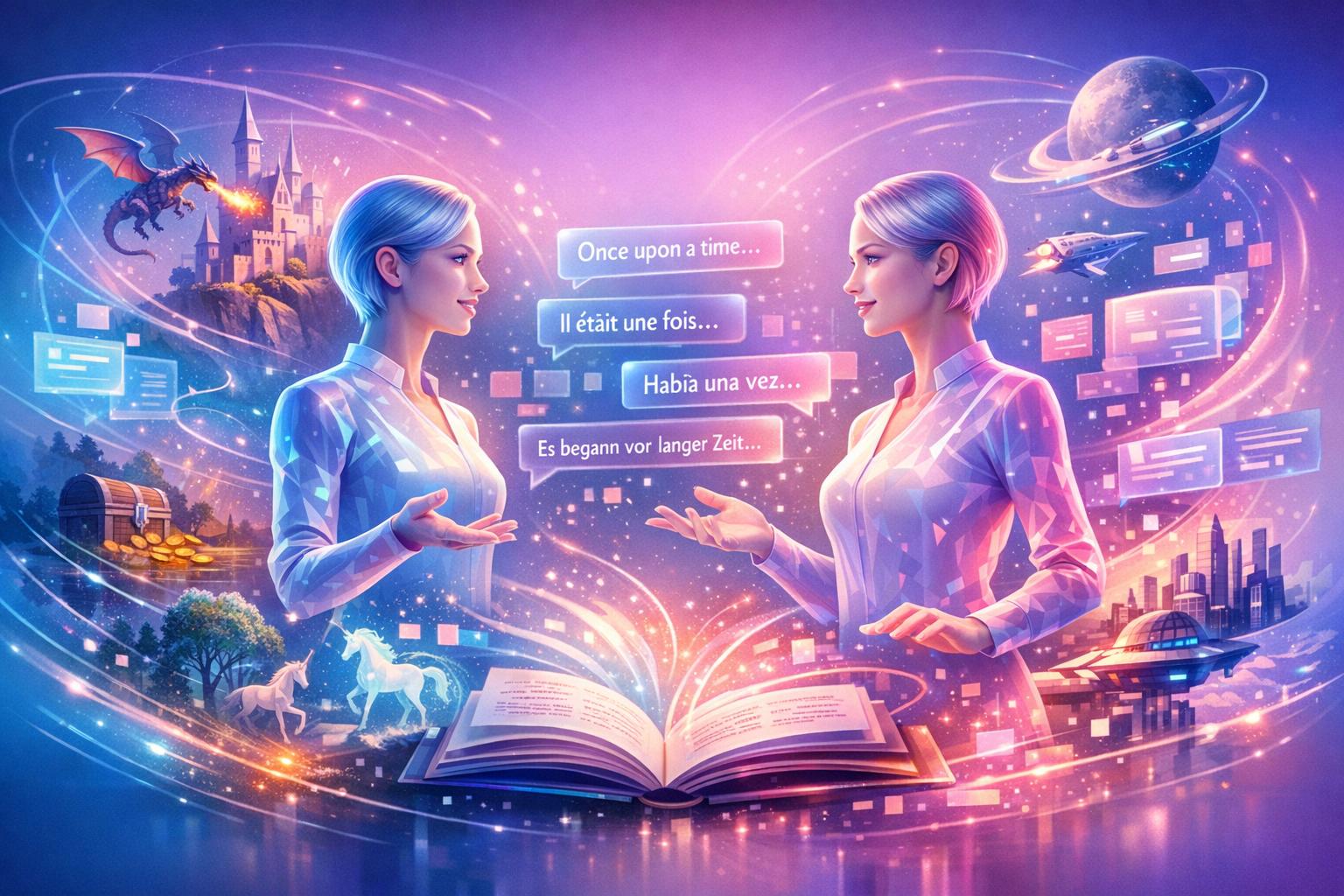
AI Twins are changing how we experience stories. Unlike older methods that relied on pre-recorded, fixed paths, AI Twins create real-time, personalized interactions. These AI-powered avatars respond instantly to user inputs, generating speech, gestures, and visuals on demand. This shift makes storytelling more engaging and dynamic, moving beyond passive viewing to active participation.
Key highlights:
Real-time interaction: AI Twins predict and generate video frames in milliseconds, creating seamless, responsive experiences.
Scalability: Content can be created faster and in over 40 languages, cutting production time by up to 90%.
Applications: From live shopping streams to interactive product demos, AI Twins are useful for brands and creators.
User engagement: AI-driven content boosts viewer engagement by 47% and increases purchase intent by up to 9x.
Platforms like TwinTone and systems like Odyssey-1 and Storycaster are leading this evolution, offering tools for faster, more dynamic storytelling. While challenges like generation delays and trust concerns exist, the potential for creating more immersive and interactive content is undeniable.
How I Built A Conversational AI Avatar with HeyGen
How AI Twins Change Interactive Storytelling
AI Twins are reshaping how we experience storytelling by making it interactive and responsive in real time. Unlike traditional videos that play the same way with every viewing, these AI-powered systems use advanced world models to predict and generate video frames based on user input. Whether it’s a click, a voice command, or a controller action, every interaction directly influences what happens next on screen. This technology is driving new experiments that redefine how audiences engage with stories.
One standout example of this innovation came in May 2025 when the AI lab Odyssey, led by Oliver Cameron, introduced Odyssey-1. This cutting-edge interactive video model could generate realistic video frames every 40 milliseconds, allowing users to guide the unfolding story in real time using a keyboard or controller. With the help of advanced GPU clusters, the system maintained a smooth 30 frames per second. As Cameron described:
"Video you can both watch and interact with, imagined entirely by AI in real-time... Consider it an early version of the Holodeck."
This seamless feedback loop creates a dynamic, immersive experience, replacing passive viewing with genuine interaction.
The technology isn’t just for entertainment. TwinTone applies this real-time capability to practical uses like instant product demos and shoppable videos in over 40 languages. By transforming creators into AI Twins, the platform enables on-demand user-generated content and continuous livestream hosting. For brands, this means engaging with audiences in real time without the delays of traditional video production. It’s a perfect example of the "record once, repurpose infinitely" philosophy in action.
The possibilities extend even further with room-scale systems. In June 2025, researchers from UCLA and Microsoft Research unveiled Storycaster, a generative AI system that transforms physical spaces into interactive storytelling environments. Using six projectors and four Azure Kinect cameras, the system responded to voice commands to create three-act narratives with real-time audio-visual feedback. In a study involving 13 participants, the system projected AI-generated visuals onto real-world objects, blending physical and digital elements. Participants found the AI narrator and audio effects particularly immersive, demonstrating the potential of this technology to merge storytelling with the physical world.
The benefits of AI Twins are also backed by data. A December 2025 study involving 92 participants revealed that multimodal AI Twins - integrating voice and photorealistic avatars - significantly increased engagement and motivation compared to interactions using only text or voice. Led by Constanze Albrecht and Pat Pataranutaporn from MIT and UCLA, the research highlighted key interaction metrics:
"interaction quality metrics, particularly persuasiveness, realism, and user engagement, emerged as robust predictors of psychological and affective outcomes."
These findings emphasize how AI Twin technology is revolutionizing interactive storytelling, delivering deeper engagement and more meaningful audience connections.
1. Traditional Interactive Storytelling Methods
Before the rise of AI-driven interactivity, traditional storytelling methods laid the groundwork for audience engagement through pre-planned, structured approaches.
Traditional interactive storytelling relied heavily on pre-scripted branching narratives. These narratives allowed users to make choices at key moments - think of "choose-your-own-adventure" books or interactive museum displays. However, this approach had a major limitation: every possible outcome had to be written in advance, restricting the depth and dynamism of the interaction.
Real-Time Feedback
One of the biggest challenges with traditional systems is their lack of real-time responsiveness. Take, for example, MIT's KidsRoom project, which transformed a physical space into a narrative inspired by Where the Wild Things Are. While innovative, the experience was driven by a fixed script. Users could only trigger pre-programmed sequences - they had no ability to influence or change the story's direction.
This issue extends to data-driven environments, where traditional systems operate on batch processing. Users often face delays of minutes or even hours before seeing the results of their actions. Nate Stewart, CEO of Materialize, explains this limitation with a vivid analogy:
"Giving agents access to a digital twin using a data warehouse is like sharing a picture of a starry night: the stars haven't looked that way in a long, long time".
Essentially, these systems show a snapshot of the past, not the present. The inability to provide real-time feedback remains a key shortcoming of traditional methods.
Audio-Visual Engagement
Traditional storytelling methods often use multimedia tools like audio tours, videos, and interactive kiosks. For instance, the Holocaust Museum & Cohen Education Center employs STQRY Kiosks for immersive audio tours featuring local testimonies, while the American Battlefield Trust integrates videos and interactive maps into its traveling exhibits. These tools enhance engagement by making static content more dynamic and accessible, even in multiple languages.
However, these experiences depend entirely on preloaded content libraries. Every video, audio file, and visual element must be created and uploaded in advance. This reliance on traditional production methods is not only time-consuming but also expensive. For example, producing high-end formats like 360-degree videos or VR walkthroughs can be prohibitively costly, limiting accessibility for smaller organizations. The best AI tools for interactive storytelling, by contrast, can cut production costs by nearly 30%, while offering the flexibility to generate content on demand.
Scalability and User Experience
The rigid nature of traditional systems also creates challenges in scalability. Expanding content - whether by adding new storylines, translating into multiple languages, or updating existing material - requires significant manual effort. Maintaining narrative consistency across branching paths becomes a resource-intensive task, making it difficult to keep up with changing user expectations.
User experience often takes a hit as well. For example, 57% of people dislike advertisements that interrupt their viewing experience. Passive formats also tend to lead to lower information retention compared to active participation. Even traditional VR storytelling presents risks - when virtual environments fail to align with physical spaces, users may accidentally collide with real-world objects, creating safety concerns.
While these methods were groundbreaking in their time, they struggle to adapt quickly or scale efficiently without requiring substantial investments in pre-production. This is where AI-driven approaches begin to offer a compelling alternative.
2. AI Twins for Interactive Storytelling (TwinTone)

TwinTone's AI Twins are pushing the boundaries of interactive storytelling by moving beyond static, pre-scripted narratives. Instead of relying on pre-recorded content, this platform uses advanced technology to create responses and visuals in real time, delivering experiences that instantly adapt to user input.
Real-Time Feedback
The secret behind TwinTone's responsiveness lies in its world model architecture. Unlike traditional video models that generate entire clips in advance, AI Twins predict the next frame based on the current state and user actions. This allows the system to stream new, realistic video frames every 40 milliseconds, making interactions feel seamless and immediate. Oliver Cameron, an AI researcher, puts it this way:
"A world model... predicts the next state given the current state and an action... allowing the user to guide video generation in real-time with their actions."
Using autoregressive modeling, the system feeds each generated output back into the model's context. This ensures stable, coherent video streams that can run for up to five minutes or more without interruption. This dynamic approach transforms storytelling, replacing static narratives with engaging, real-time experiences.
Audio-Visual Engagement
TwinTone's AI Twins bring stories to life through full-body avatars that include animated facial expressions, adding a layer of emotional depth to interactions. The platform can transform real creators into digital avatars that retain their unique tone, style, and personality. These avatars can communicate in over 40 languages, generate on-demand user-generated content (UGC) videos, and even host AI-powered livestreams that feel true to the original creator. The system's robust infrastructure supports streaming at up to 30 frames per second, powered by GPU clusters.
Scalability
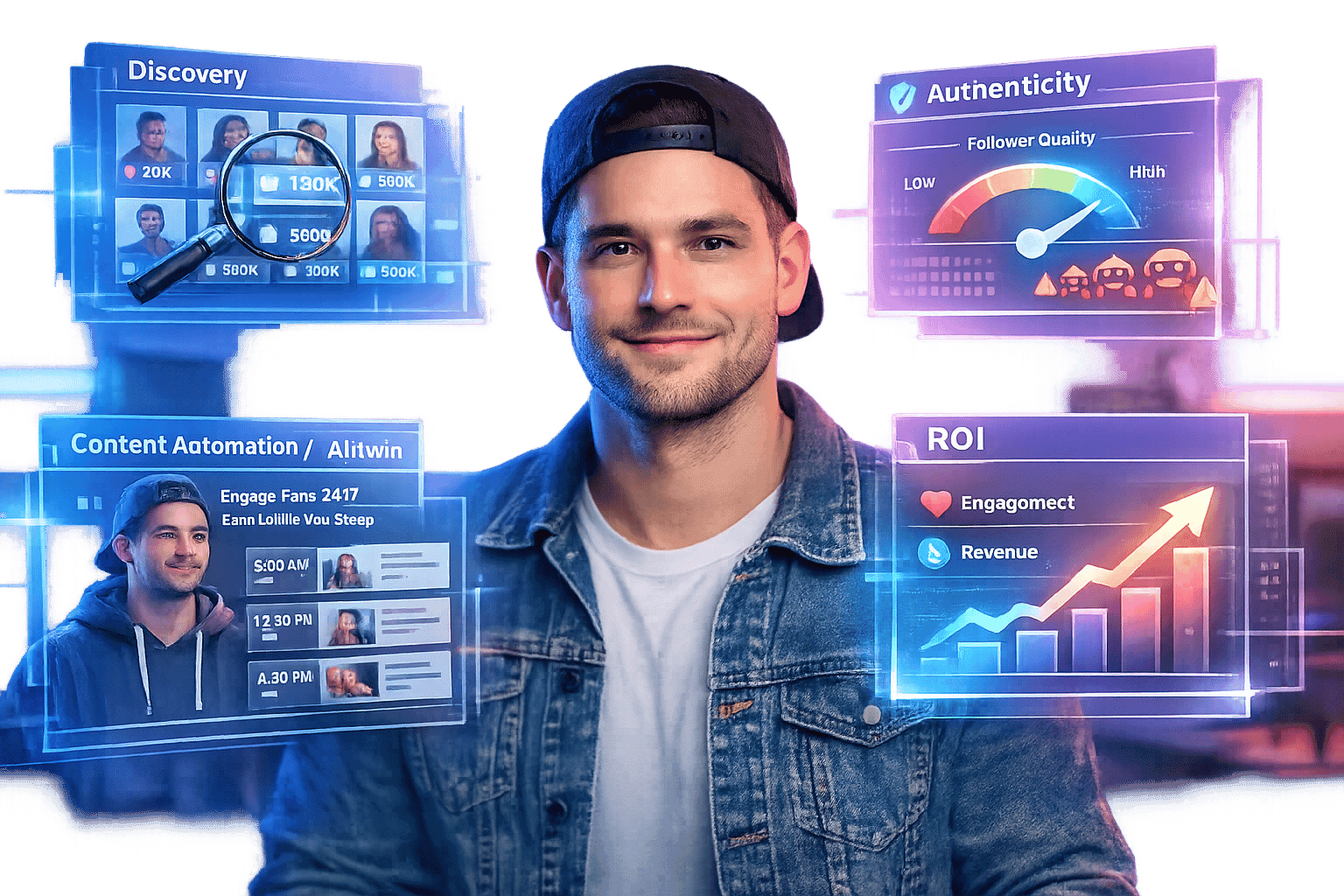
Traditional storytelling often requires painstaking manual scriptwriting for every possible narrative branch. TwinTone eliminates this bottleneck by using structured data and large language models to generate rich, detailed content on demand. This automation can cut production times by up to 90%, enabling rapid content creation. For brands, this means they can use TwinTone's API to generate marketing content programmatically, whether for specific products or entire campaigns. The platform also offers performance analytics, providing real-time insights into engagement, conversions, and ROI, so brands can quickly identify what resonates with their audience.
User Experience
This technology doesn’t just streamline production - it transforms how users engage with content. AI Twins turn passive viewers into active participants, giving them the ability to shape the story. With 24/7 availability, the system can handle thousands of interactions simultaneously, something that would otherwise require enormous resources. For brands, the benefits are clear: companies using AI for personalization are 48% more likely to surpass revenue goals and 71% more likely to report stronger customer loyalty.
Pros and Cons
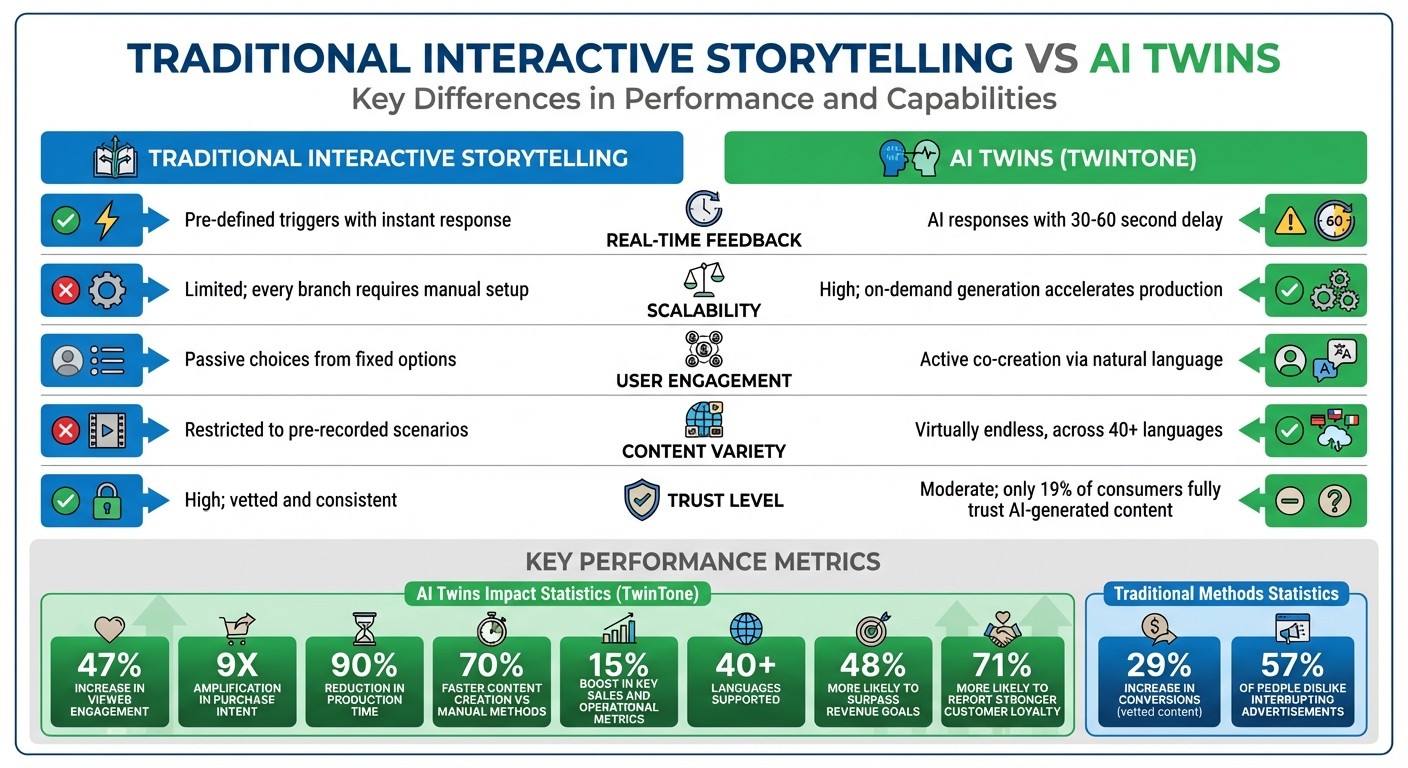
Traditional Interactive Storytelling vs AI Twins: Key Differences and Performance Metrics
This section dives into the strengths and challenges of traditional methods versus AI Twins, highlighting how each approach shapes brand strategies.
Traditional methods rely on pre-recorded, pre-loaded content. This ensures consistent, predictable experiences with instant response times. However, scalability is a major hurdle - every narrative branch must be manually written and filmed. As Naisha Agarwal from UCLA puts it:
"By leveraging generative AI, Storycaster enables content to be created on demand, allowing environments, characters, and narratives to evolve in direct response to the audience".
AI Twins, on the other hand, excel at scalability. They can generate thousands of responses in seconds, enabling personalized, real-time interactions. But there’s a catch: scene generation often involves a 30- to 60-second delay, and human oversight is still needed to catch errors or inappropriate content.
Trust also plays a significant role in this comparison. While only 19% of consumers fully trust AI-generated content, traditional, vetted content can increase conversions by up to 29%. On the flip side, AI dramatically speeds up content creation - up to 70% faster than manual methods. Companies using digital twins have also reported a 15% boost in key sales and operational metrics.
Here’s a side-by-side look at how these two approaches stack up:
Feature | Traditional Interactive Storytelling | AI Twins |
|---|---|---|
Real-time Feedback | Pre-defined triggers with instant response | AI responses with a 30–60 second delay |
Scalability | Limited; every branch requires manual setup | High; on-demand generation accelerates production |
User Engagement | Passive choices from fixed options | Active co-creation via natural language |
Content Variety | Restricted to pre-recorded scenarios | Virtually endless, across 40+ languages |
Trust Level | High; vetted and consistent | Moderate; only 19% of consumers fully trust AI-generated content |
These differences provide a clear framework for deciding which method aligns best with a brand’s goals and audience expectations.
Conclusion
AI Twins are transforming how brands tackle interactive storytelling. Unlike traditional methods that rely on manual scripting and filming for every narrative twist, AI Twins bring scalability to the forefront. They can generate thousands of personalized responses without the need for constant human intervention - a game-changer for content creation.
The numbers back it up: AI-powered interactive content boosts viewer engagement by 47%, and shoppable interactive features can amplify purchase intent by 9x. A prime example is the NFL Draft, where AI assistants highlighted relevant merchandise in real time as players were chosen, making the most of heightened fan excitement.
This platform thrives in scenarios demanding scalable, authentic content. E-commerce brands, for instance, can instantly create product demos or run continuous AI-driven livestreams on platforms like TikTok, Amazon, and YouTube. Meanwhile, global brands can connect with audiences in 40+ languages without the need to hire multilingual teams. The shift from passive content consumption to active engagement is reshaping the creator landscape. As Abubakar Khan puts it:
"The rise of faceless creators isn't about replacing humans. It's about redefining what it means to be a creator".
AI Twins shine in high-volume, fast-paced contexts like product launches, seasonal campaigns, live shopping events, and ongoing social media strategies. For brands bogged down by slow creator outreach and limited content production, they provide a quicker and more consistent way to engage audiences. While challenges like generation delays and trust concerns remain, for businesses focused on speed, scale, and personalization, the benefits are undeniable.
FAQs
How do AI Twins make interactive storytelling more engaging?
AI Twins bring a new dimension to interactive storytelling by turning characters into lifelike, responsive companions that adjust to user input in real time. These AI-powered characters can hold natural conversations, recall past interactions, and adapt their responses based on the user’s choices. The result? A storytelling experience that feels immersive and deeply personal.
Platforms such as TwinTone push this idea even further by enabling creators to step into the role of AI Twins themselves. These AI-driven avatars can produce videos on demand, host interactive livestreams, and deliver instant, customized content. With features like photorealistic visuals, memory-based dialogue, and real-time audiovisual feedback, AI Twins transform static stories into dynamic, collaborative experiences that captivate audiences and keep them coming back for more.
What challenges do creators face when using AI Twins for content creation?
AI Twins open up new avenues for content creation, but they also bring a set of distinct challenges. To start, building a realistic AI Twin requires gathering a substantial amount of personal data - things like speech patterns, gestures, and visual characteristics. This naturally raises privacy and security concerns, making it crucial for creators to handle this data responsibly to maintain user trust.
Another hurdle lies in achieving a truly lifelike quality. If an AI Twin feels even a little off, it can trigger the uncanny valley effect - that unsettling feeling people get when something seems almost human but not quite right. This can hurt audience engagement and even damage a brand’s credibility. On top of that, interactive storytelling demands that AI Twins respond instantly while keeping the narrative consistent. This is a highly technical challenge, and any misstep can lead to a disjointed or confusing experience.
Lastly, creators must keep a firm grip on editorial control over their AI Twin’s output. This ensures that the content stays true to the brand’s voice, meets legal standards, and respects cultural nuances. Strong oversight systems are key to delivering content that feels genuine and aligns with the creator's vision.
What makes AI Twins different from traditional interactive storytelling methods?
AI Twins are transforming the world of interactive storytelling by bringing real-time, dynamic digital avatars of creators to life. Unlike traditional storytelling, which depends on pre-written scripts or pre-recorded videos, AI Twins respond instantly to audience inputs. They generate live audio-visual reactions - complete with speech, facial expressions, and gestures - cutting out the lengthy production steps like filming and editing.
These AI-powered avatars learn and replicate a creator's unique voice, style, and mannerisms, offering a personalized and engaging experience for every viewer. Platforms like TwinTone push this innovation even further by equipping creators with tools to produce on-demand videos, host AI-driven livestreams, and provide interactive content around the clock. This approach redefines storytelling, moving far beyond static, pre-produced formats to deliver immersive, scalable, and efficient content creation.