AI Twins in Event Ticketing
How to build a futureproof relationship with AI
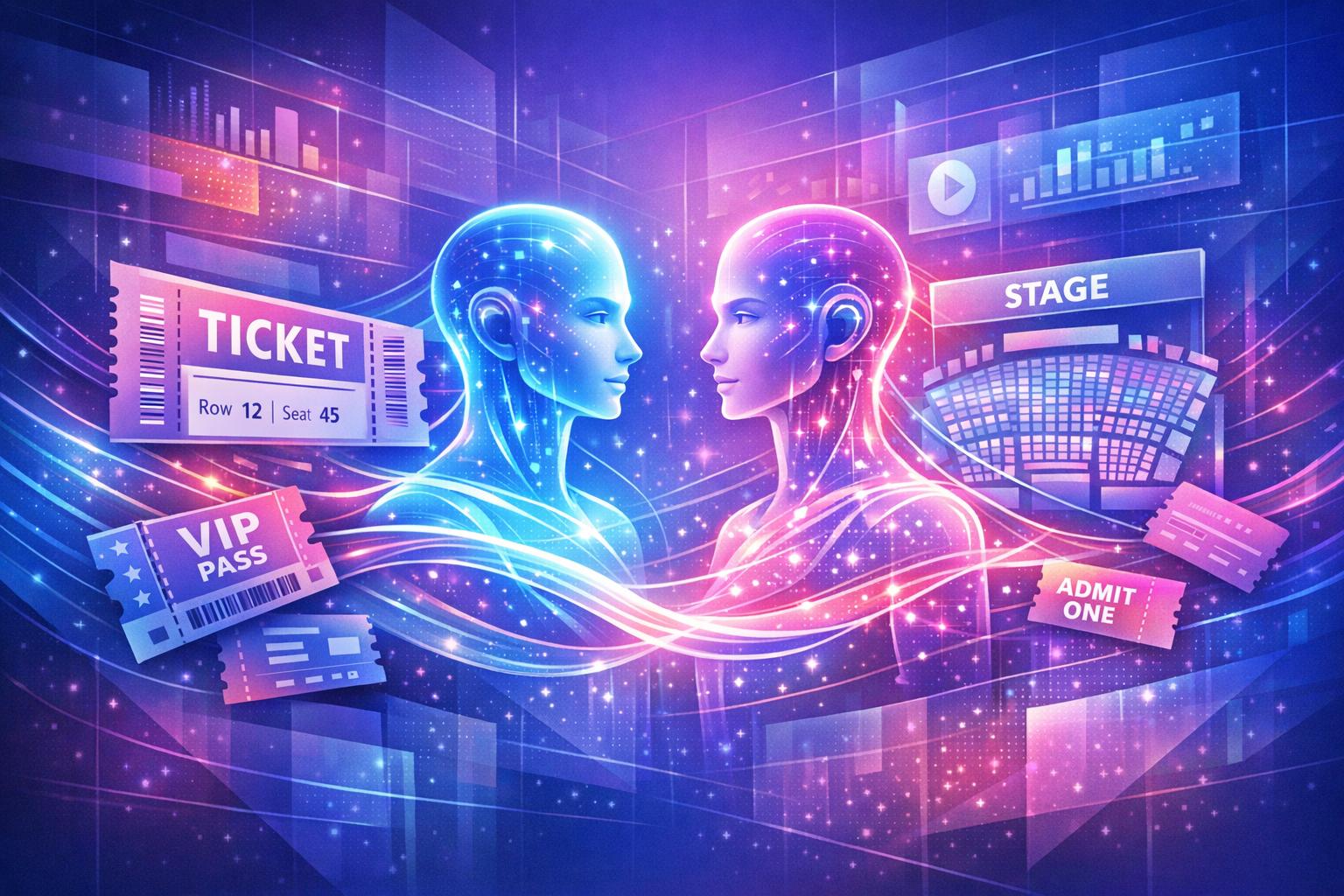
AI Twins are reshaping how fans buy event tickets, making the process faster and more personalized. Unlike older systems, which rely on manual navigation and static profiles, AI Twins act as interactive digital assistants, handling everything from seat selection to checkout. These AI-driven personas analyze preferences, predict behavior, and even make purchases for users, creating a smoother ticketing experience.
Key Highlights:
Faster Ticketing: AI Twins reduce friction by automating the buying process.
Personalized Recommendations: They analyze user preferences (budget, seating history, etc.) and use AI grouping to suggest the best options.
24/7 Support: AI-powered assistants offer real-time help in over 40 languages.
Revenue Growth: Features like dynamic pricing and targeted upselling have shown to increase revenue by 10%–30%.
Compared to older systems and digital venue replicas, AI Twins stand out for their ability to engage fans directly and simplify complex processes. They’re already driving changes in the industry, with companies like Ticketmaster and Eventbrite reporting improved efficiency and sales.
Quick Comparison
Feature | Older Systems | Digital Venue Twins | AI Twins |
|---|---|---|---|
Customer Support | Limited, reactive | Indirect (venue-focused) | 24/7 conversational AI |
Fan Engagement | Generic email campaigns | Virtual tours, wayfinding | Personalized, real-time |
Efficiency | Manual, slow processes | Venue layout optimization | Automated workflows, predictions |
Revenue Potential | Minimal upselling | Moderate improvements | Dynamic pricing, targeted offers |
AI Twins are already transforming event ticketing, offering fans a more intuitive, hassle-free experience while helping organizers increase sales and efficiency.
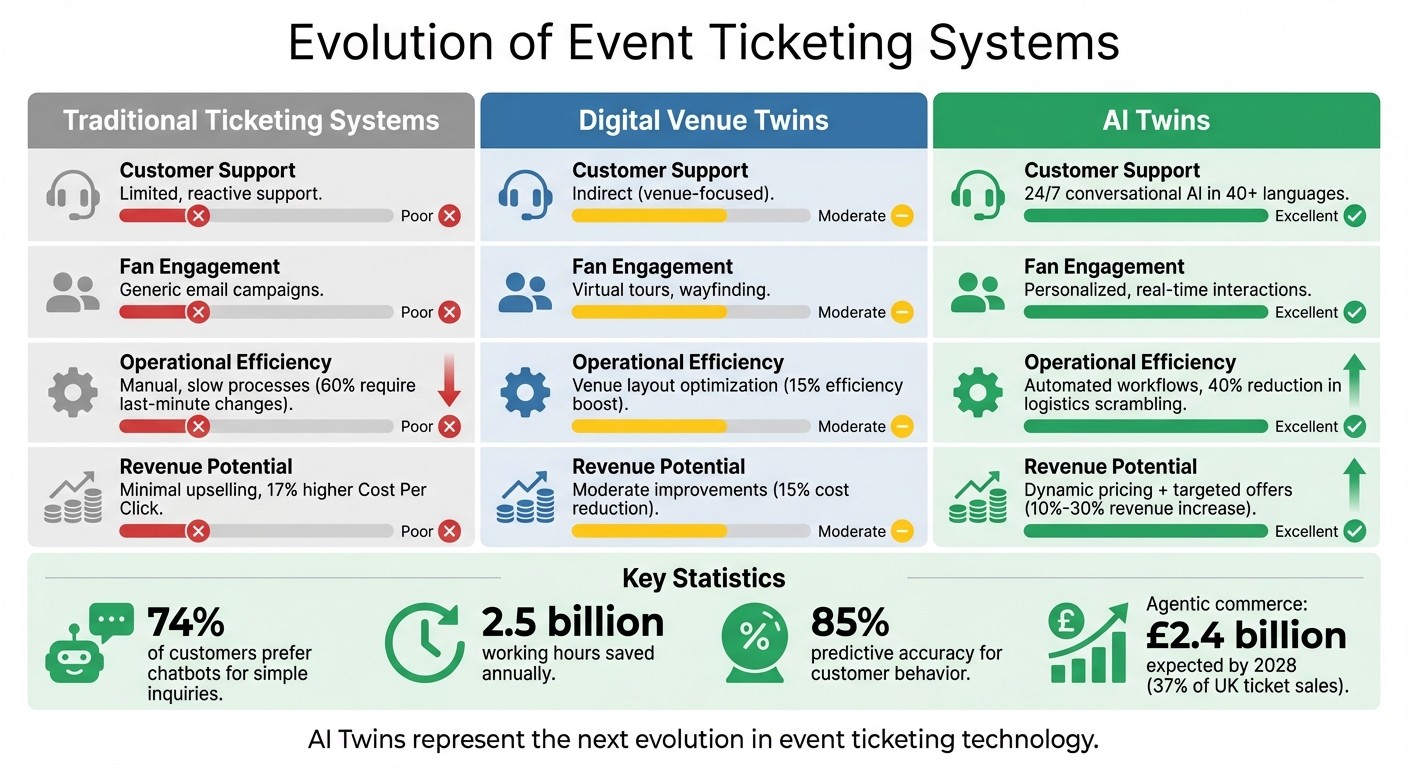
AI Twins vs Traditional Ticketing Systems Comparison
1. Traditional Ticketing Systems
Customer Interaction
Traditional ticketing systems rely heavily on reactive support, leaving fans stuck waiting for human assistance or sifting through static FAQs that often fail to provide timely answers. There's no real-time help or instant responses, which makes the process feel like a chore. As Peter Yagecic from Situation Interactive aptly describes:
the entire process is often viewed as a "tolerated impediment" to the actual event.
Fans just want to secure their tickets and move on, but outdated systems make this unnecessarily difficult. The lack of immediate support also weakens opportunities for meaningful fan engagement.
Fan Engagement
When it comes to connecting with fans, traditional systems fall short by relying on generic email campaigns and promotions that don’t align with individual preferences. This cookie-cutter approach feels impersonal, especially when consumers now expect tailored experiences. Instead of evolving with fans' changing interests, these systems rely on static profiles based solely on past purchases. In fact, only 14% of organizations manage to achieve a comprehensive, 360-degree view of their customers.
Operational Efficiency
Operationally, traditional ticketing systems are bogged down by outdated manual processes and rigid, static plans that fail to account for real-time crowd dynamics. A staggering 60% of event organizers report needing to make last-minute layout adjustments onsite because their planning data is inaccurate or outdated. Drew Rose, a Solution Engineer at Simio, highlights the issue:
traditional approaches to security and staffing are "not only time-consuming but inherently limited in their ability to predict outcomes".
Even creating events can be a slow process. Organizers often struggle with "writer's block" when manually entering event descriptions and categories. On top of that, tasks like data reconciliation and report generation consume valuable hours that could be better spent on strategic planning. These inefficiencies not only slow everything down but also limit opportunities to maximize revenue.
Revenue Potential
Traditional ticketing systems treat sales as simple transactions, leaving little room for personalized upselling, dynamic pricing, or smarter inventory management. Marketing campaigns that don’t leverage AI-optimized content underperform, with a 17% higher Cost Per Click compared to AI-driven efforts. On top of that, logistical issues like gate congestion or long concession lines discourage fans from spending on food, drinks, and merchandise. The end result? Missed revenue opportunities and disappointed fans who expected a smoother experience.
2. Digital Twins for Venues
Operational Efficiency
Static planning methods often fall short when it comes to managing complex venues, but digital twins are changing the game. By creating a live, interactive 3D replica of a venue, powered by real-time IoT sensor data, digital twins allow planners to move beyond outdated floor plans. This technology enables organizers to simulate layouts and predict crowd flows before the actual setup, solving a common issue - 60% of event organizers report making last-minute layout changes due to outdated planning data.
Digital twins also provide real-time monitoring of crowd density and equipment status, helping teams address potential problems before they escalate. Here's a striking example: Between 2024 and 2025, Ikea used an AI-driven digital twin platform to model 37 of its locations, covering 42 million square feet. This initiative cut energy consumption by 30%, saving the company millions of dollars. On average, venues using digital twin technology report a 15% boost in operational efficiency and up to a 15% reduction in preparation and operational costs. These insights not only streamline operations but also lay the groundwork for smarter revenue strategies.
Revenue Potential
When it comes to generating revenue, digital twins open doors that traditional systems simply can't. By simulating customer behavior through Customer Digital Twins (CDTs), venues can pinpoint the best moments to offer premium add-ons like lounge access or upgraded concessions, increasing the average transaction value. This technology also supports predictive yield management, allowing organizers to forecast demand and fine-tune pricing accordingly.
A great example of this potential comes from the 2024 Australian Open. Organizers implemented a first-party data solution that provided deeper insights into fan behavior, leading to more targeted marketing campaigns and smoother event execution. Looking ahead, agentic commerce - where AI agents make purchases on behalf of fans - could revolutionize ticket sales. By 2028, this approach is expected to account for 37% of total ticket sales in the UK, generating around £2.4 billion. Jorn Lambert, Chief Product Officer at Mastercard, captures this shift perfectly:
Mastercard is transforming the way the world pays for the better by anticipating consumer needs on the horizon. The launch of Mastercard Agent Pay marks our initial steps in redefining commerce in the AI era.
These innovations also naturally enhance how fans interact with events.
Fan Engagement
Digital twins are redefining fan experiences, making them more immersive and personalized. One standout feature is "place-shifting", which lets remote fans virtually attend events from anywhere. For instance, in 2024 and 2025, Wimbledon teamed up with IBM Consulting to use generative AI and digital insights for delivering prematch summaries and postmatch analyses. This system transformed raw data into engaging, natural language stories that kept fans connected throughout the tournament.
Venues are also leveraging digital twins to provide tailored experiences. From personalized wayfinding to real-time player stats and AI-powered digital avatars, these tools enhance how spectators navigate and enjoy events. The result? A richer, more interactive experience that keeps fans coming back for more.
3. AI Twins for Event Ticketing
Customer Interaction
AI Twins are reshaping ticketing support through the use of Digital Twins of a Customer (DToC). These digital profiles go beyond traditional static customer data by leveraging real-time and historical insights to predict fan behavior and preferences. This allows ticketing systems to proactively address customer needs, often before they even voice them.
In September 2025, Ticketmaster unveiled a revamped Support Community powered by AI and machine learning. Tailored for the live event industry, this platform helps both clients and fans access the right resources for event setup and troubleshooting. Its AI-driven search engine continuously learns from user queries, enabling most questions to be resolved with a single search. Plus, it offers round-the-clock automated assistance, streamlining problem-solving for fans and organizers alike. By improving with every interaction, this system demonstrates how AI can enhance accuracy and efficiency in customer support.
With 74% of customers favoring chatbots for straightforward inquiries, this level of automation is estimated to save businesses around 2.5 billion working hours annually. Such seamless support not only improves the customer experience but also lays the groundwork for operational improvements and revenue growth.
Operational Efficiency
AI Twins aren't just transforming customer interactions - they're also revolutionizing behind-the-scenes operations. Generative AI-powered Customer Digital Twins (CDTs) use real-time data to predict behaviors like purchase likelihood and churn risk. This allows ticketing platforms to automate time-consuming tasks such as generating reports, organizing data, and reconciling finances.
Predictive capacity planning is another major advantage. By analyzing social media trends and historical data, AI tools can forecast attendance for specific sessions or areas. This helps event organizers allocate resources more effectively. Jessica Stewart, Ticketing Manager at The Event Planner Expo, shared the impact of these predictions:
We've cut our day-of logistics scrambling by at least 40 percent just from better predictions.
Dynamic pricing optimization adds another layer of efficiency. AI systems monitor market trends in real-time, adjusting ticket prices based on demand, presales activity, and search patterns. This ensures ticket prices align with market conditions, maximizing profitability.
Revenue Potential
Building on operational improvements, AI Twins also open up new avenues for revenue growth by personalizing the fan experience. Through hyper-targeted upselling, generative AI-powered CDTs analyze browsing habits and past purchases to offer personalized extras - like travel insurance or VIP lounge access - at just the right moment. This approach has been shown to boost revenue by 10% to 30% through more effective cross-selling and upselling.
Agentic commerce is another game-changer in ticket sales. In November 2025, Ticketmaster introduced agentic features in Google Search's "AI Mode." This innovation lets U.S. fans use conversational queries to find and purchase verified tickets directly through a secure checkout link provided by the AI. This "ask, decide, and buy" model simplifies the entire process, reducing friction from discovery to purchase. By 2028, agentic commerce is expected to account for £2.4 billion in ticket sales in the UK alone, representing 37% of the market.
The Golden State Warriors offer a powerful example of how AI Twins can drive revenue. Between 2025 and 2026, in partnership with Google Cloud, the team utilized over 30 fan-facing data sources and 100 million data points through their mobile app. Using Vertex AI, they delivered personalized food recommendations and enabled natural language search for venue policies, making the fan experience smoother. Aaron Parris, EVP and Co-Lead of Partner Success at FEVO, highlighted the transformation:
The shift in how customers find tickets via conversational AI like ChatGPT and Gemini is real... forcing us to rethink how offerings are marketed and ensure transactions are frictionless.
How to get your systems ready for your AI Agent
Advantages and Disadvantages
Every ticketing system comes with its own set of pros and cons. By weighing these trade-offs, event organizers can better determine which approach aligns with their specific goals and challenges.
Criteria | Traditional Ticketing Systems | Digital Twins for Venues | AI Twins for Event Ticketing |
|---|---|---|---|
Customer Interaction | Static, manual navigation with limited support | Indirect interaction through 3D venue visualizations | 24/7 conversational AI agents enabling autonomous purchasing |
Fan Engagement | Transaction-focused, limited to the point of sale | Moderate engagement via virtual tours and wayfinding | High engagement with personalized content, AR experiences, and co-creation |
Operational Efficiency | Manual processes prone to delays and bottlenecks | Venue-centric optimization for crowd flow and safety | Automated workflows reducing logistical chaos by 40% |
Revenue Potential | Fixed or tiered pricing with few upsell opportunities | Moderate increases through optimized seating and capacity planning | Significant gains via dynamic pricing and AI-driven upsells (10%–30% increase) |
While the table highlights key trade-offs, there are additional nuances to consider. For instance, AI Twins have shown impressive results in recent implementations, significantly boosting engagement and revenue potential. However, they face a unique challenge: anti-bot measures like CAPTCHA often block the very autonomous agents that power AI-driven ticketing systems.
Another standout feature is the predictive accuracy of customer digital twins, which can forecast behavior with up to 85% precision. This capability enables highly targeted upselling and dynamic pricing strategies. For venues and organizers, the choice ultimately comes down to finding the right balance between enhancing fan experience, streamlining operations, and maximizing revenue.
Conclusion
The comparison between traditional ticketing systems, digital twins for venues, and AI Twins highlights a clear evolution in how event organizers can enhance fan experiences and boost revenue. While traditional methods rely heavily on manual processes and reactive customer support, AI Twins bring a new level of efficiency with 24/7 conversational assistance, tailored recommendations, and dynamic pricing that adjusts to real-time demand.
AI Twins don’t just improve operations - they transform the entire fan journey. Instead of dealing with clunky websites or long customer service wait times, fans can now ask natural language questions like, "Can you find me two tickets for this weekend’s concert?" and complete their purchase instantly. This streamlined "ask, decide, buy" model removes barriers and meets the growing expectations for fast, personalized interactions.
"The shift in how customers find tickets via conversational AI like ChatGPT and Gemini is real, and that's the first place AI moves the needle, forcing us to rethink how offerings are marketed and ensure transactions are frictionless." – Aaron Parris, EVP and Co-Lead of Partner Success, FEVO
For event organizers, AI Twins are not some far-off concept - they're a practical tool for solving today’s challenges. Predictive analytics can help optimize venue capacity, reducing the need for last-minute changes. AI-driven upsell features can be seamlessly integrated into the checkout process, capturing impulse purchases. And AI-powered support communities offer instant answers, all without requiring a larger customer service team. These solutions don’t demand huge budgets; they just require a willingness to embrace tools that cut out manual tasks and eliminate fan frustrations. With AI Twins, organizers can create sustainable operations while delivering the streamlined, personalized experiences fans now expect. The technology to make this happen is already here.
FAQs
How do AI Twins enhance the ticket-buying experience?
AI Twins reshape the ticket-buying experience by making it more personalized and stress-free. They use real-time data - like your past event attendance, favorite artists, location, and browsing habits - to deliver customized recommendations, adjust pricing dynamically, and offer conversational support that feels natural and easy. The result? You can focus on the thrill of the event itself, without getting bogged down by the process of purchasing tickets.
TwinTone takes this concept even further with its AI-driven Twins, delivering on-demand video content that enhances the buying journey. These videos might showcase seat views, highlight venue features, or even offer a peek behind the scenes. The Twins can also host live, interactive sessions to answer fan questions, suggest the best seats, and provide personalized discounts - all around the clock. By merging real-time support with engaging, shoppable content, AI Twins not only simplify the ticket-purchasing process but also make it more exciting and interactive for fans.
How do AI Twins improve live event ticketing compared to traditional systems?
AI Twins transform live event ticketing by combining automation with a tailored customer experience. These advanced systems operate around the clock, managing customer inquiries, resolving issues, and even suggesting upgrades or add-ons - all without requiring human intervention. This means shorter wait times, reduced costs, and a hassle-free experience for fans, no matter the time of day.
On top of that, AI Twins dive into fan preferences and behaviors in real time. This allows them to adjust pricing dynamically, roll out targeted promotions, and offer personalized recommendations that resonate with each individual. They also bolster security by spotting fraudulent activities and automating verification processes. The outcome? A ticketing experience that's not only smoother but also drives higher engagement and loyalty from fans while helping event organizers run things more efficiently.
How can AI Twins help event organizers increase revenue?
AI Twins give event organizers a powerful way to turn fan interactions into revenue. These lifelike, on-demand AI avatars offer personalized experiences like shoppable videos, instant product demonstrations, and 24/7 livestreams. The result? Fans stay engaged before, during, and after events, driving ticket sales, boosting merchandise purchases, and opening up new revenue streams - all without the need for additional staff.
What’s more, AI Twins deliver real-time insights into fan preferences and buying habits. This data allows organizers to fine-tune ticket prices, design custom bundles, and sharpen their promotional strategies. By creating these tailored, data-driven experiences, organizers can not only sell more tickets but also increase upselling opportunities and maximize what each fan spends - directly fueling revenue growth.