AI Tools for Geo-Specific Influencer Outreach
How to build a futureproof relationship with AI
AI tools are transforming how brands connect with local audiences through influencers. These tools identify influencers whose followers are concentrated in specific areas, like cities or neighborhoods, ensuring campaigns reach the right people. They also handle outreach, verify follower authenticity, and track performance, saving time and improving efficiency.
Key takeaways:
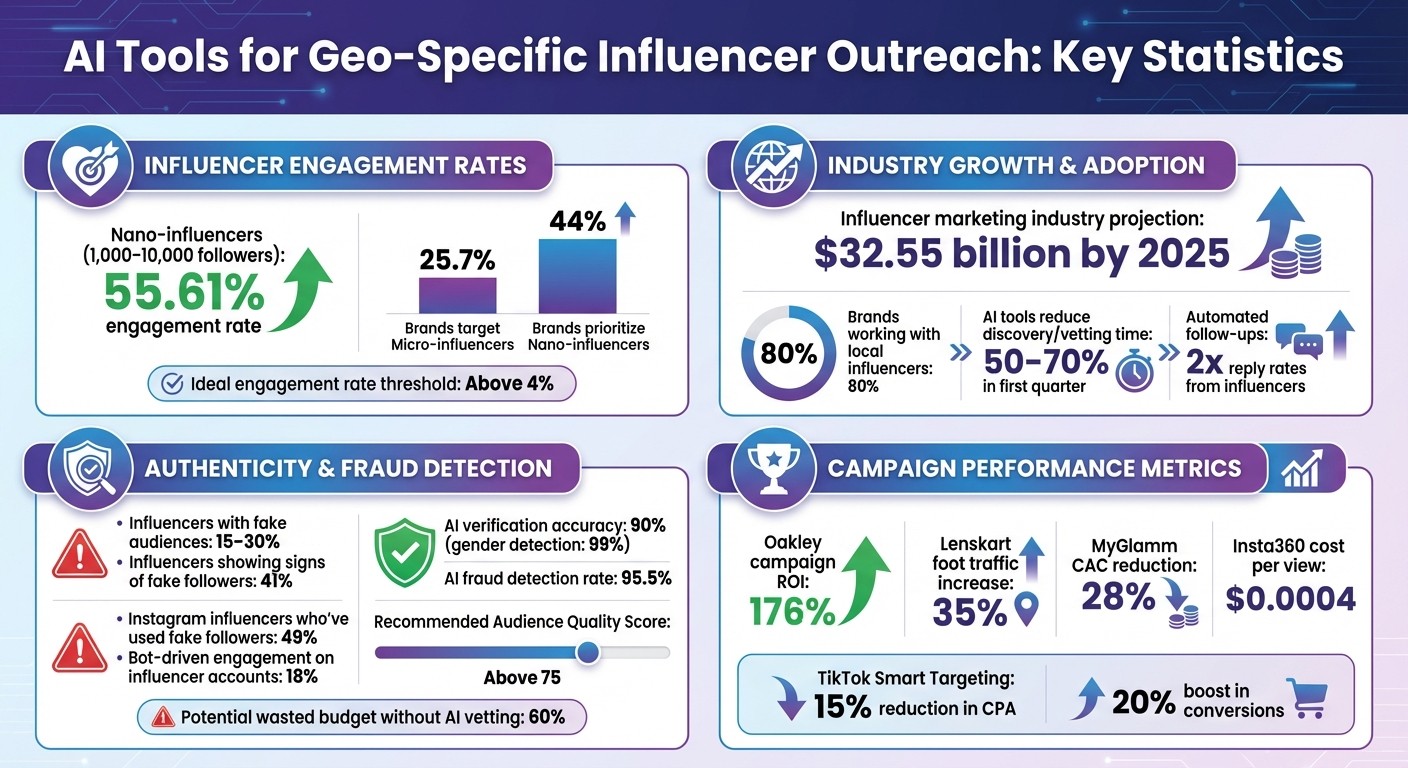
Nano-influencers (1,000–10,000 followers) have engagement rates of 55.61%.
80% of brands now work with local influencers to improve regional visibility.
AI tools analyze audience locations, automate outreach, and verify authenticity.
Platforms like TwinTone create AI Twins of influencers for scalable, localized content.
Real-time analytics help brands adjust campaigns and maximize ROI.
AI simplifies influencer marketing by automating tedious tasks and focusing on results, making it easier for brands to target local audiences effectively.
AI-Powered Influencer Marketing Statistics and Key Metrics
Best AI Tools for Social Media Influencer Marketing Campaigns | ClickUp
Choosing AI Tools for Location-Based Influencer Discovery
The right AI tools help pinpoint influencers with loyal, local audiences in your target area - whether that's a city or a specific ZIP code. The real value lies in finding platforms that dig deeper than surface-level filters, uncovering where an influencer’s followers actually live, not just where the influencer is based. This level of detail eliminates the hassle of outdated manual searches.
Manually searching hashtags like #ChicagoVegans or #NYCFood is not only time-consuming but often misses influencers who don’t use obvious location tags. AI tools simplify this process by using automated databases to filter creators by city, state, or even a specific radius. Essentially, these tools act as digital matchmakers, pairing brands with creators who align with their values and audience demographics.
This precision is especially crucial as brands increasingly focus on nano and micro-influencers. With 44% of brands prioritizing nano-influencers and 25.7% targeting micro-influencers, finding creators with tightly knit local followings - rather than scattered, global audiences - can significantly boost engagement and drive foot traffic for regional campaigns.
Features to Prioritize in Location-Targeting AI Tools
For effective location-based campaigns, prioritize tools with granular location filters. Choose platforms that allow you to refine searches by country, city, region, and even ZIP code. This level of specificity ensures you’re connecting with creators who have a strong local presence instead of a diluted, widespread audience.
Another crucial feature is audience location data. Advanced tools distinguish between where an influencer lives and where their followers are based. For instance, an influencer in Los Angeles might have 60% of their audience in Austin, Texas. This dual-location filtering ensures your campaigns reach the right people in the right places.
AI-powered matching systems are also essential. These tools analyze audience demographics, engagement metrics, and alignment with your brand’s niche. By focusing on creators with high credibility and authentic engagement, you can avoid falling into the trap of “fake” influence - especially since nearly 49% of Instagram influencers have used fake followers at some point.
Finally, prioritize engagement over reach. Tools that highlight influencers with engagement rates above 4% are ideal. Nano-influencers, in particular, often achieve high engagement, making them perfect for location-specific campaigns.
How TwinTone Powers Location-Based Campaigns

TwinTone offers a fresh approach to location-based influencer marketing by streamlining the entire outreach process. Instead of juggling dozens of local creators across different time zones, brands can use TwinTone to create AI Twins - virtual versions of real creators that produce on-demand UGC (user-generated content) videos tailored to specific regions.
This platform allows brands to scale localized content effortlessly. For instance, product demos can be customized for multiple cities without the need for manual coordination. AI Twins maintain the original creator’s tone, style, and personality while adapting the messaging for regional audiences. This makes it possible to run continuous, location-specific campaigns across multiple markets simultaneously, saving both time and budget compared to traditional influencer partnerships.
TwinTone also adds geo-targeting capabilities through shoppable videos and AI-powered livestreams. Brands can host 24/7 shopping streams on platforms like TikTok, Amazon, YouTube, and Shopify, with AI creators presenting products in ways that resonate with local audiences. With support for over 40 languages, the platform can produce content for diverse communities across the U.S., from Spanish-speaking audiences in Miami to Korean-speaking viewers in Los Angeles.
For brands managing multiple SKUs or seasonal campaigns, TwinTone’s API access enables programmatic content generation across different product lines and regions. Built-in analytics track engagement, conversions, and ROI in real time, giving brands immediate insights into campaign performance. Starting at $110 per month for 10 AI UGC videos, TwinTone makes localized creator content accessible for businesses of all sizes.
Filtering and Verifying Influencers for Location-Based Campaigns
Finding the right local influencers is just the beginning - ensuring they’re legitimate and resonate with the intended audience is just as important. This step is critical for getting the most out of your localized campaigns. Thankfully, AI tools have made this process faster and more reliable by analyzing hundreds of data points that would otherwise take weeks to review manually.
Here’s why verification matters: Between 15%–30% of influencers have fake audiences, and 41% show signs of fake followers. Without proper checks, brands risk wasting money on inflated metrics that fail to deliver real local engagement. AI-powered platforms, however, can verify metrics with at least 90% accuracy, and gender detection can even hit 99% accuracy. Let’s break down how AI confirms influencer authenticity and ensures their audience aligns with your campaign’s regional focus.
Checking Audience Location and Authenticity
AI tools use data triangulation to verify an influencer’s location. This involves cross-referencing location tags, bios, and images for local landmarks. For example, it can differentiate between someone who lives in Chicago and someone who just posted a single photo from O’Hare Airport.
The most reliable tools prioritize sustained local signals, like six months of consistent local tags, instead of one-off posts. They also separate where the influencer is based from where their audience lives. For instance, by reviewing historical posts, AI can ensure the influencer’s local tags align with your target geographic area.
To verify an audience’s authenticity, AI flags suspicious accounts by analyzing follower-to-following ratios, repetitive comment patterns, and profiles with no pictures or questionable links. It also identifies "ghost" followers - accounts that have been inactive for over six months.
For location-specific campaigns, brands should filter influencers by audience location thresholds. For example, you might require that at least 50% of an influencer’s followers are in the target city. For more precise insights, especially in competitive markets like New York City or Miami, consider requesting access to private audience data. AI tools can process this data to deliver 100% accurate demographic insights, eliminating any guesswork.
Measuring Regional Relevance and Engagement
Once location authenticity is confirmed, the next step is evaluating the influencer’s actual impact in the region. Raw follower counts mean little without genuine local engagement. AI tools measure regional relevance by analyzing comment sentiment, audience reactions, and even ensuring brand safety while spotting bot-driven activity.
Engagement patterns also tell a story. Authentic engagement usually peaks within 24 hours of posting, whereas bot-driven interactions often show unnatural spikes. Considering that 18% of engagement on influencer accounts typically comes from bots or fake accounts, this verification is a must.
AI also helps assess niche alignment by analyzing audience interests, content themes, and cultural cues specific to your target region. For example, a food influencer in Portland, Oregon, might post about farm-to-table dining and local breweries - content that resonates with Portland’s food scene but wouldn’t make sense for a campaign in Las Vegas.
"Discovery without matching wastes budget; matching without discovery limits your options and drives costs up." - InfluenceFlow
It’s also worth manually reviewing comment quality. Generic, repetitive phrases like "fabulous" or "love this" often signal engagement pods or bot activity. Focus on creators with audience credibility and authenticity scores above 75. And don’t overlook nano-influencers, who currently achieve an impressive 55.61% engagement rate. Their strong community ties make them especially effective for location-specific campaigns where trust and connection matter more than reach. These steps lay the groundwork for the automated, data-driven outreach strategies covered in the next section.
Automating Location-Based Influencer Outreach
Once you've verified your local influencers, the next hurdle is scaling your outreach effectively. When you're targeting multiple cities or regions, manual outreach quickly becomes unmanageable. This is where AI-powered automation steps in to handle the workload while still keeping messages personal and relevant to each area's culture. Automation ensures your outreach feels tailored to every region while maintaining the authenticity that’s so crucial for local campaigns.
The influencer marketing industry is projected to reach $32.55 billion by 2025. AI tools are already playing a key role in this growth, cutting discovery and vetting times by 50–70% in the first quarter alone. But the benefits go beyond saving time - automation can significantly improve results. For instance, brands using automated follow-up sequences have reported double the reply rates from influencers. These tools optimize messaging and streamline processes, balancing efficiency with the personal touch needed to build trust in local markets.
Using AI to Customize Outreach Messages
Generic mass emails just don’t work in location-based campaigns. Influencers can easily spot a template email, and it’s a big turn-off. AI tools now offer a smarter alternative by analyzing an influencer’s recent social media activity to craft highly personalized introductions that reference their content, location, or collaborations.
For example, an AI-generated message might say: "I loved your recent post about the new coffee shop on Melrose Ave! Our brand is launching a limited-edition product in LA next month, and I think your audience would love it." This level of personalization makes the outreach feel genuine, even though it’s automated.
Platforms like Influencer Hero and IMAI use natural language processing (NLP) to connect brands with creators based on regional trends, local preferences, and geographic filters such as "NYC female influencers" or "Miami fitness creators". These platforms also create AI-generated briefs and automated email sequences, making outreach much easier. One marketer using Influencer Hero can manage the workload of five full-time team members working manually.
"Our AI will create a personalized sentence based on the last posts on social media to guarantee hyper personalized communication." - Influencer Hero
AI-driven drip campaigns also keep the conversation going by sending follow-ups automatically, often on days 3 and 7. This steady communication keeps your brand on the influencer’s radar without coming across as pushy. For example, in mid-2024, Oakley teamed up with Creator.co to engage local athletes and fitness influencers for in-store try-on events. Using AI for discovery and automated recruitment, the campaign delivered a 176% ROI.
When crafting outreach messages, include details like local product launches, events, or even neighborhood-specific hashtags (e.g., #NYCFood or #PortlandBreweries). These touches make your outreach feel relevant and timely. To manage these efforts effectively, integrate your outreach tools into a centralized CRM system.
Connecting Outreach Automation with CRM Systems
Automation works best when paired with a CRM system that tracks every interaction - who’s responded, who hasn’t, and who’s ready to move forward. By connecting AI tools to platforms like HubSpot, Pipedrive, or Salesforce, you can automatically log every message, response, and contract detail in one place.
Modern influencer CRMs like Influencer Hero, SEVA, and Brandwatch come with features like "Deal Pages" or "Relationship Boards" that visually track each influencer’s progress - from "Identified" to "Contacted" to "Contract Signed". This makes it easier to manage regional campaigns and ensures no leads slip through the cracks, even when juggling multiple time zones.
For location-specific campaigns, segment your CRM by audience location thresholds, such as influencers with at least 50% of their followers in your target city. Set up alerts to notify your team when a high-priority influencer opens an email or clicks a link. This real-time tracking helps you focus on the most engaged influencers, while CRM dashboards provide insights into location-specific metrics like engagement rates, conversions, and cost per acquisition. These data points are invaluable for refining future campaigns.
In 2025, Insta360 used Brandwatch Influence to manage over 4,000 partners and 60 campaigns annually. By automating their outreach and reporting processes, they slashed manual work from 15 hours per launch to just 10 minutes, achieving a cost per view of $0.0004.
As Téa Liarokapi from Moosend explains:
"Influencer outreach isn't just about sending direct messages or cold emails - it's about creating personalised, scalable conversations that open the door to meaningful partnerships." - Téa Liarokapi, Moosend
Before launching a large-scale outreach campaign, take the time to manually review the top 10% of influencers in your CRM to ensure they align with your brand. Even the best AI tools can miss subtle nuances, so a quick human review can make all the difference in ensuring your messages resonate.
Running and Improving Location-Based Campaigns with AI
Launching and refining campaigns based on location-specific data is essential for success. AI tools make this process easier by combining platform geotargeting features with real-time analytics that reveal how campaigns perform in different regions. This approach ensures campaigns are fine-tuned to maximize their impact in targeted areas.
Using AI Tools with Platform Geotargeting Features
The best location-based campaigns blend AI-powered discovery tools with the geotargeting features offered by platforms like TikTok, Facebook, and Instagram. For example, TikTok's Symphony uses AI to match brands with trending influencers who align with their style. Once these influencers are identified, brands can amplify their reach through TikTok's paid geotargeting, narrowing the audience to specific cities or zip codes.
TikTok also offers Smart Targeting, which allows AI to expand interest categories while keeping the location fixed. For instance, if a campaign targeting "fitness enthusiasts in Chicago" isn't performing well, the AI might include wellness or nutrition audiences - but still only within Chicago. This strategy has delivered impressive results, including a 15% reduction in cost per acquisition and a 20% boost in conversion rates for brands using broad targeting to reach over 80% of potential users in a country.
Another tactic is repurposing top influencer content as geotargeted Facebook or Instagram ads aimed at the same local audience. In 2024, Lenskart, an eyewear brand, collaborated with lifestyle influencers on YouTube and Instagram to drive both online and in-store engagement. Their efforts led to a 35% increase in foot traffic at their physical stores.
When setting up campaigns, use hyper-local filters within AI tools to find creators with a strong audience presence in specific areas, such as a city or even a zip code. Tools that analyze IP and GPS data can verify whether an influencer’s followers are concentrated in your target location, helping you avoid spending on influencers with scattered or irrelevant audiences. By combining automated outreach with precise geotargeting, you can significantly enhance local visibility and conversions.
Measuring Location-Based Performance and ROI
Once your localized campaign is live, the next step is to track its performance. AI delivers real-time data through dashboards that monitor engagement daily. This enables quick adjustments to captions, post timing, or budget allocation based on regional performance. For example, if a campaign in San Antonio outshines one in Austin, you can shift more resources to San Antonio influencers while the campaign is still running.
Key metrics to focus on for local ROI include audience location verification, local engagement spikes, cost per acquisition (CPA), and conversion lift. AI tools analyze these metrics to pinpoint which influencers are driving the most engagement in specific neighborhoods. A great example is MyGlamm, a beauty brand that used micro-influencers and referral codes to track direct sales. By monitoring performance in real time, they reduced their customer acquisition cost (CAC) by 28% compared to traditional advertising methods.
You can also integrate AI platforms with eCommerce systems like Shopify, WooCommerce, or Amazon Attribution to track sales linked to specific creators in targeted regions. This full-funnel attribution reveals which influencers are driving actual purchases, not just likes or comments. In mid-2024, Oakley partnered with Creator.co to activate athletes and fitness creators for in-store try-ons. By using AI to track store visits and conversions, they achieved a 176% ROI.
"AI helps brands measure ROI across different stages: awareness, engagement, and conversions." - Ayu Kusumaning Dewi, SEO Content Writer, HypeAuditor
AI also safeguards your budget by identifying fake audiences. Without AI vetting, studies suggest that 60% of influencer marketing budgets could be wasted on fraudulent or low-quality audiences. Tools that verify Audience Quality Scores (AQS) and detect fraudulent activity can identify up to 95.5% of known fraud. This ensures your investment goes toward authentic, local influence that delivers measurable results.
Lastly, keep an eye on your Share of Voice (SoV) by geography to see how your brand stacks up against competitors in specific regions. AI tools can track brand mentions and sentiment by location, helping you determine which markets are thriving and which need more focus. This ongoing analysis allows you to adapt your strategy and maximize ROI across all your target locations.
Conclusion: Growing Location-Based Outreach with AI Tools
AI has reshaped how brands approach geo-specific influencer outreach, turning it into a streamlined, data-driven process. Tasks that once consumed hours can now be completed in just 1–2 hours, allowing teams to shift their focus from tedious spreadsheet work to strategic planning and creative collaborations. With tools that filter creators by city, verify audience authenticity, and track performance at the zip-code level, brands can confidently partner with influencers who make a real impact in their local markets.
The rise of nano and micro-influencers has been a game-changer for location-based campaigns. For instance, an influencer with 5,000 engaged followers concentrated in your target city often delivers better results than someone with 100,000 followers spread across the country. When combined with AI-driven brief creation, automated outreach, and real-time analytics, brands can effectively manage dozens of local influencers without increasing their team size or budget. This level of efficiency has opened the door for advanced tools like TwinTone.
TwinTone takes scalability to the next level by creating AI Twins of real influencers. These AI Twins can produce on-demand UGC videos, host AI-powered livestreams 24/7, and provide localized product demos and shoppable content instantly. With multilingual support in over 40 languages, TwinTone also makes it easier for brands to enter new markets while keeping the unique voice and style of each creator intact.
The future of location-based influencer marketing lies in building systems that are not only scalable but also consistently effective across all markets. By leveraging AI for tasks like discovery, vetting, outreach, and performance tracking, brands can dedicate their energy to what truly matters: fostering genuine connections with local audiences and driving measurable results in every region they serve.
FAQs
How can AI tools verify influencer authenticity and ensure their audience is in the right location?
AI tools play a key role in verifying the authenticity of influencers by examining a variety of factors. These include follower growth patterns, engagement rates, content consistency, and any signs of bot activity. The data collected is then used to calculate an authenticity score, which helps brands distinguish genuine creators from accounts with fake or purchased followers. To ensure location accuracy, these tools analyze details like geotagged posts, IP ranges, language usage, and mentions of local venues. This provides brands with a clear understanding of where an influencer's audience is actually located.
TwinTone takes this concept even further by introducing AI Twins - digital versions of real creators. These AI Twins maintain the creator’s verified profile and signature style, enabling brands to generate authentic, shoppable UGC (user-generated content) videos tailored to specific regions. With built-in location intelligence, TwinTone ensures that campaigns reach the right audience efficiently, eliminating delays and manual coordination. This makes geo-targeted outreach not only seamless but also highly effective.
Why are nano-influencers so effective for local campaigns?
Nano-influencers are a game-changer for local campaigns because they blend a personal touch with a strong connection to specific communities. With follower counts ranging from 1,000 to 10,000, these influencers often boast engagement rates between 8–12%, easily surpassing the performance of their larger counterparts. Their audiences are typically close-knit, often within the same neighborhood or community, which makes their recommendations feel more like advice from a trusted friend.
What sets nano-influencers apart is their ability to tap into local culture, language, and preferences. They create content that feels relatable and authentic, striking a chord with their followers. This connection not only improves brand recall but also leads to higher conversion rates. On top of that, their lower costs allow brands to collaborate with several nano-influencers across different regions, expanding their reach without breaking the budget.
How does TwinTone simplify geo-specific influencer marketing?
TwinTone takes geo-specific influencer marketing to a whole new level by removing the hassle of manual outreach and coordination. Thanks to advanced AI, TwinTone creates AI Twins of real creators, enabling them to produce on-demand UGC videos, host AI-driven livestreams, and scale campaigns seamlessly.
For brands, this means instant access to localized, shoppable content that’s perfectly tailored to specific regions - no waiting, no logistical headaches. TwinTone makes it possible to run targeted campaigns quickly and efficiently, saving both time and resources while delivering maximum results.