AI Stress Detection for Livestream Shopping
How to build a futureproof relationship with AI
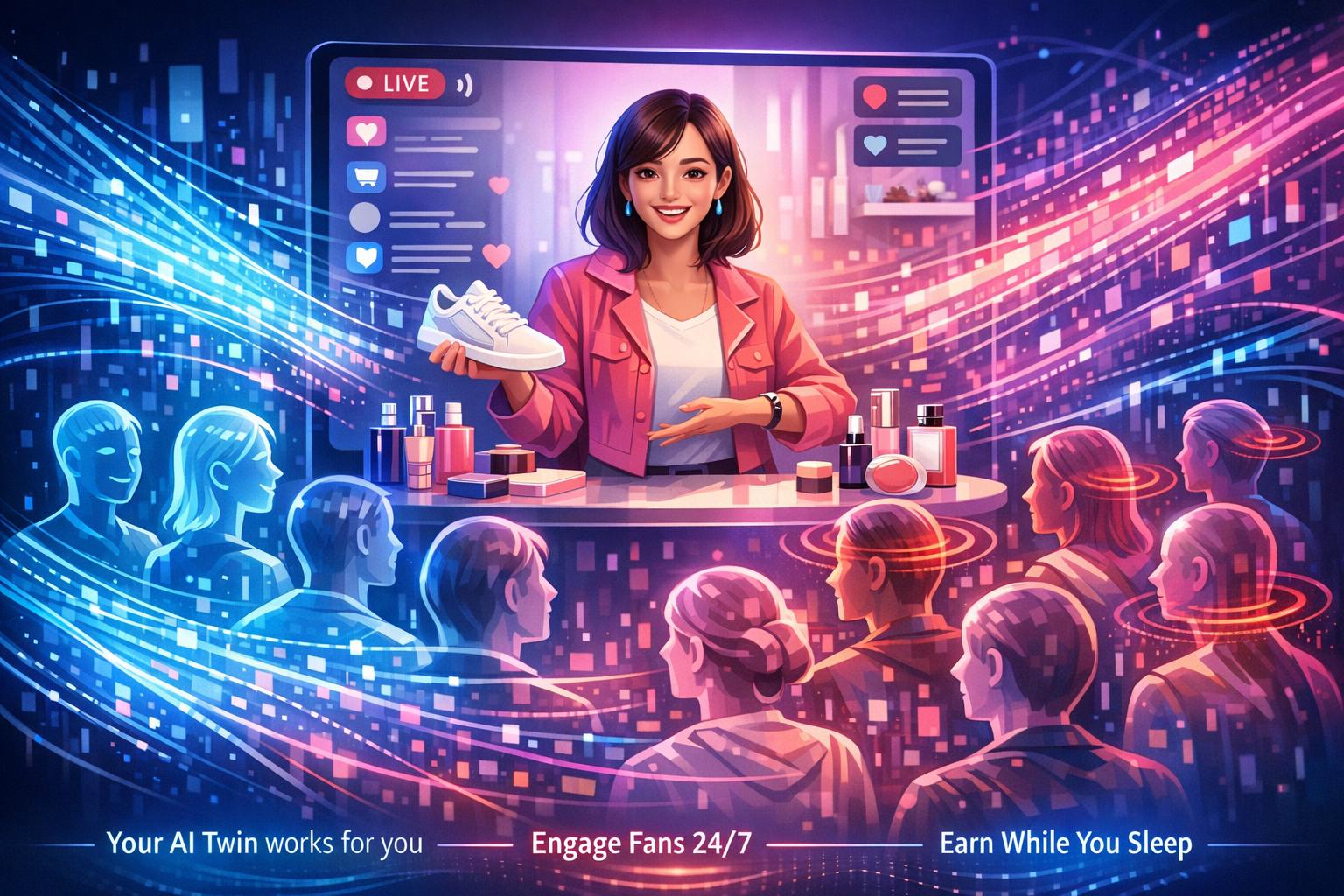
Livestream shopping in the U.S. is growing fast, with sales jumping from $31.7 billion in 2023 to an expected $67.8 billion by 2026. But stress during live events is causing problems - viewers feel overwhelmed by fast-paced presentations, countdown timers, and decision fatigue, leading to cart abandonment and disengagement. AI-powered stress detection is changing this by identifying viewer emotions in real time through facial expressions, voice analysis, and chat sentiment. Brands can then adjust pacing, add Q&A sessions, or offer support to create a smoother shopping experience. Early results show a 42.1% sales boost and a 24.6% engagement increase when stress is reduced, making this technology a game-changer for the future of online shopping.
Stress in Livestream Shopping
What Causes Stress During Livestream Shopping
Livestream shopping can be an overwhelming experience for viewers, as it often combines multiple stressors. At the top of the list is information overload - imagine trying to absorb product details, follow a fast-moving chat, and listen to the host's commentary, all at the same time. It’s a lot to process, and when you throw in technical issues like buffering or glitches, the result can be mentally exhausting.
Then there’s the pressure of time. Features like countdown timers and flash sales create a sense of urgency, forcing shoppers to make snap decisions. This is often paired with FOMO (fear of missing out), especially when exclusive or limited-edition items are only available during the livestream. Seeing real-time updates of others adding items to their carts can further fuel a sense of competition and stress.
Another major factor is perceived uncertainty. Unlike traditional shopping, livestream viewers can’t physically touch or inspect items before purchasing. This is particularly challenging for products like beauty and fashion, where quality and fit are key concerns. The lack of hands-on experience intensifies doubts about product reliability and service, increasing mental strain.
Stressor Type | Common Triggers | Behavioral Effect |
|---|---|---|
Cognitive | Information overload, Product uncertainty | Cart abandonment, decision deferral |
Temporal | Countdown timers, Flash sales | Impulse buying, post-purchase regret |
Social | FOMO, Peer competition | High arousal, increased "urge to buy" |
Technical | System overload, Complex UI | Live-streaming fatigue, channel avoidance |
These stressors not only make decision-making harder but also influence how viewers interact with the shopping experience. This interaction is often optimized through AI grouping for live shopping to better manage viewer segments.
How Stress Affects Customer Engagement
The stress caused by these triggers has a noticeable impact on how viewers engage with livestream shopping. For starters, live-streaming fatigue - a sense of exhaustion from constant stimuli - can drive shoppers back to traditional e-commerce platforms, where they can browse at their own pace. Over time, this overload depletes their ability to make decisions effectively.
While a little excitement might encourage impulse purchases, too much stress can lead to emotional exhaustion. This happens when shoppers feel mentally drained, often due to service failures or the inability to inspect products physically. Emotional exhaustion not only reduces engagement but also leads to behaviors like cart abandonment or leaving the stream altogether. Many shoppers simply choose to avoid the risk of buying something they can’t see or touch, leading to decision paralysis.
In some cases, the consequences of stress extend beyond lost sales. For example, in China, lawsuits involving AI-driven livestream shopping platforms rose by 44% in 2023, highlighting how stress-related service issues are becoming legal challenges as well.
How AI Detects Stress in Real-Time
AI Tools for Emotion Recognition
AI systems are now capable of analyzing multiple data streams to identify stress in viewers during livestreams. One key method involves studying facial expressions - tracking subtle changes in the eyes, mouth, and cheeks that hint at tension, frustration, or hesitation. Using the I3D algorithm, which examines successive video frames, these systems can even capture fleeting micro-expressions.
Voice analysis is another critical component. AI converts speech into Mel spectrograms to uncover shifts in pitch, speed, and tone. When someone is under stress, their voice often becomes higher-pitched and faster, while certain features like pitch jitter tend to decrease. By combining facial expressions, voice data, and even heart rate information, a deep learning framework has achieved an impressive 85.1% accuracy in identifying acute stress states.
Additionally, Natural Language Processing (NLP) plays a significant role in stress detection. Large Language Models (LLMs) scan live chat comments and questions to pick up on signs of confusion, frustration, or overwhelm. For example, in November 2025, Amazon upgraded its AI assistant Rufus with advanced NLP features, integrating technologies like Anthropic's Claude Sonnet and Amazon Nova. These upgrades allow Rufus to better interpret conversational context and recognize when users need extra assistance.
Interestingly, AI can also differentiate between genuine and forced emotions - what researchers call "deep acting" versus "surface acting." This is particularly important in livestream shopping, as viewers who sense insincerity in a host's enthusiasm are far less likely to make a purchase or return for future events.
Real-Time Applications in Livestreams
The ability to respond instantly to stress signals is where this technology truly shines. AI systems process data in real-time, enabling livestream platforms to adjust their content dynamically. For example, if facial analysis shows viewers appearing confused or if chat sentiment turns negative, the system can automatically activate features like enhanced Q&A sessions or slow down the pace of product presentations.
Studies show that using behavioral realism strategies, such as improving real-time Q&A, can boost sales by 25% for digital streamers. The focus here isn’t just on making the AI look more human but on enhancing the quality of interactions. Research indicates that an AI’s ability to answer questions effectively has a greater impact on sales than its visual presentation.
The numbers back up the effectiveness of these tools. Shoppers using AI assistants during their buying journey are over 60% more likely to make a purchase, and the number of monthly users of AI shopping assistants has grown by 149% in the past year. By reducing stress through personalized support and timely interventions, AI not only creates a smoother shopping experience but also drives better results for both consumers and brands.
Using TwinTone for Stress-Aware Livestreams

Adapting Content with AI Twins
TwinTone takes livestream commerce to the next level by adapting in real-time to viewer emotions. At its core, TwinTone's AI Twins blend stress detection with immediate content adjustments. For instance, if the system picks up on subtle cues like facial micro-expressions or negative sentiment in live chat, it slows down product demonstrations and initiates targeted Q&A sessions to address viewer concerns. It can even shift the format from product-centric presentations to more conversational interactions.
The system relies on multi-modal data from cameras, microphones, and natural language processing (NLP) tools to gauge emotional intensity and sentiment. Advanced machine learning models analyze both valence (whether emotions are positive or negative) and arousal (the strength of those emotions) to identify states such as frustration or hesitation. When stress is detected, the AI Twin can tweak background visuals, modify messaging, or even introduce flash deals to reengage viewers.
"AI emotion recognition is at the forefront of this transformation, turning the abstract art of reading human emotions into a precise, data-driven science." - Saptarshi Das, Content Editor, Rapidops Inc.
With support for over 40 languages, TwinTone's stress-aware adjustments work seamlessly across global markets, allowing brands to deliver personalized experiences without delays. This dynamic adaptability not only enhances the viewer experience but also delivers measurable results for businesses.
How Brands Benefit
TwinTone's ability to adapt content in real-time offers clear business advantages. For example, its instant Q&A feature, triggered by detected confusion, has been shown to boost sales by 25%. Similarly, activating real-time lottery features during dips in engagement can increase sales by 17%. By turning stress insights into actionable responses, AI Twins can improve customer retention rates by 15–20%.
The potential for growth in this space is massive. In 2024/2025, 35% of shoppers made purchases during livestream events - a significant jump from just 13% the year before. Additionally, consumers now spend an average of 143 minutes per day on social media. TwinTone's AI-powered livestreams, which operate 24/7, keep audiences engaged without the fatigue that human streamers often experience. By maintaining emotional engagement and reducing barriers like cart abandonment, stress-aware content helps brands create a seamless shopping experience that drives results.
Measuring the Impact of AI Stress Detection
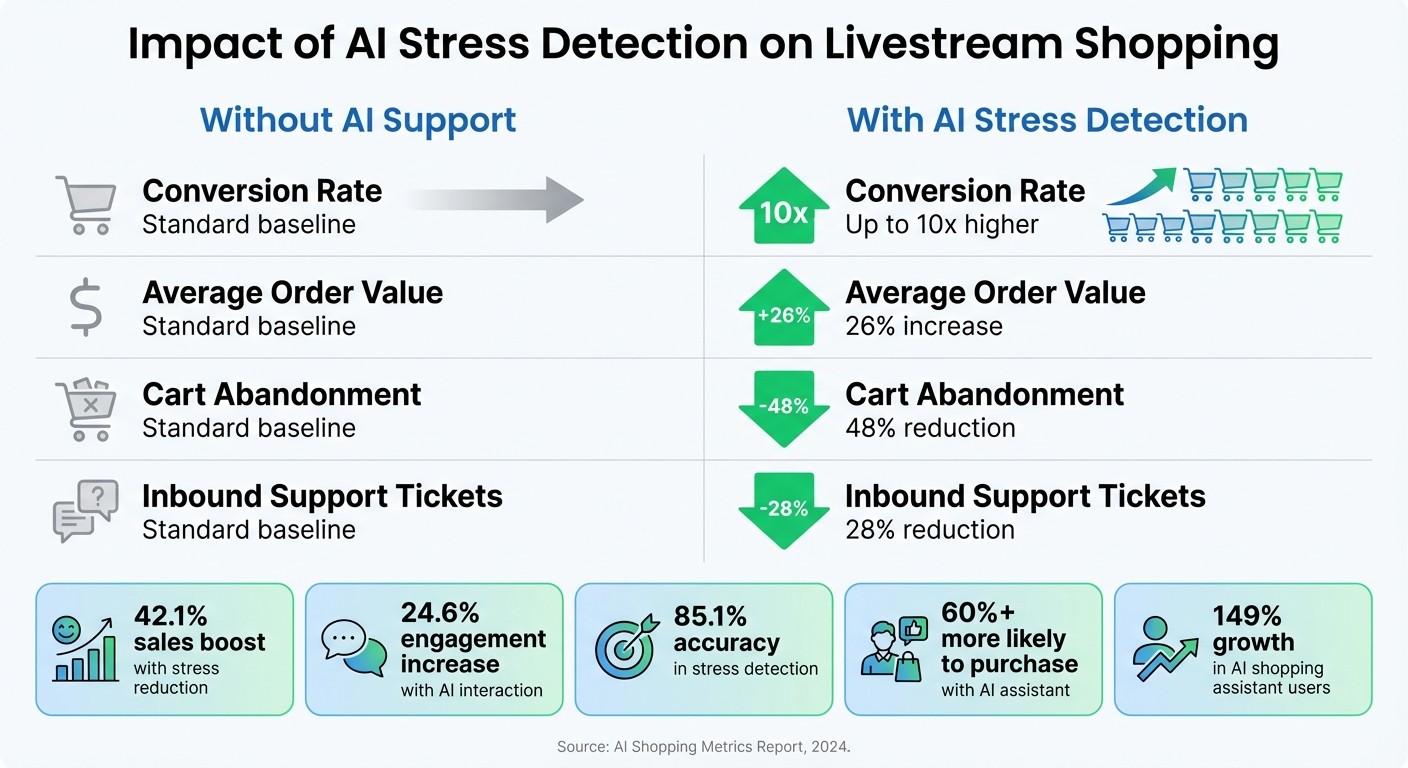
AI Stress Detection Impact on Livestream Shopping Performance Metrics
Viewer Outcomes With and Without AI Stress Detection
Data shows that AI stress detection significantly enhances livestream performance. To fully understand its impact, brands should analyze live sentiment cues - like comments, emojis, and questions - alongside behavioral data such as clicks, mouse hovers, and viewing duration. This combination helps identify friction points during the livestream experience.
The results? A stark contrast between traditional livestreams and those powered by stress-aware AI. For example, live commerce supported by AI achieves conversion rates up to 10 times higher than standard e-commerce. AI-powered recommendation engines also increase the average order value by 26%, while automated processes reduce cart abandonment by 48%.
Metric | Without AI Support | With AI Stress Detection |
|---|---|---|
Conversion Rate | Standard | Up to 10x higher |
Average Order Value | Standard | 26% increase |
Cart Abandonment | Standard | 48% reduction |
Inbound Support Tickets | Standard | 28% reduction |
Another key metric to monitor is the referral-to-human agents rate, which can indicate unresolved customer stress. For meaningful insights, wait four to six weeks after deploying AI tools before analyzing metrics. This timeframe allows early novelty effects to stabilize, providing a clearer picture of long-term performance.
These findings highlight the measurable benefits of AI stress detection, which extend across different markets worldwide.
Global Scalability with Multilingual Support
TwinTone’s real-time translation capabilities ensure that stress and emotion detection remain accurate across multiple languages, enabling consistent performance metrics on a global scale. Whether viewers in Tokyo, São Paulo, or Berlin join the same livestream, the AI processes sentiment in their native languages, ensuring no loss in precision.
"If you can define what's most important to your core customer, then a livestream can speak to them in an easy, targeted and entertaining manner." – Jane Cheung, Global Research Leader for Consumer Industries at IBM Institute for Business Value.
Supporting over 40 languages, TwinTone ensures that stress detection works just as effectively in Mandarin as it does in English. This multilingual capability allows brands to replicate their stress-aware strategies across regions without needing to rebuild systems. As a result, regional livestream experiments can seamlessly evolve into global commerce strategies, with reliable metrics tracking in every market.
The Future of Stress-Aware Livestream Commerce
Livestream shopping is evolving beyond impulse-driven sales, shifting toward emotionally aware experiences that build deeper connections. With the APAC market expected to hit $77 billion by 2030, brands are turning to real-time stress detection to craft more supportive shopping environments. This transformation taps into the stress detection techniques mentioned earlier.
Using emotional AI, brands analyze facial expressions, vocal tones, and language patterns to understand how shoppers feel. By tailoring pacing and content based on detected stress levels, AI helps create a more seamless and calming shopping journey. And it’s working - 29% of U.S. consumers report that AI makes online shopping less stressful, with similar sentiments in the UK (27%) and Canada (28%).
"Comparing options faster and sticking to a budget are just some of the ways AI tools can turn a chaotic, emotional process into a more structured one. It might not remove the stress, but you still end up feeling more in control." – Marty Bauer, Ecommerce Expert, Omnisend
Looking ahead, livestream commerce will blend human and AI-driven engagement for optimal results. These hybrid models pair human hosts for emotionally charged moments with AI avatars that provide continuous, stress-aware support around the clock. A great example comes from August 2025, when AnyMind Group and Evian in Thailand hosted over 800 livestream hours on Shopee. Human hosts covered 45 hours, while AI avatars handled the rest, reducing hourly costs by 90% and driving a 200% increase in sales. Similarly, TwinTone’s AI Twins enable brands to maintain consistent, stress-aware interactions across time zones, while human hosts focus on building meaningful connections during key moments.
As 81% of shoppers turn to AI for stress-sensitive tasks during busy periods, brands that prioritize empathy and support over aggressive sales tactics are more likely to earn lasting loyalty. The goal is to create shopping experiences where customers feel understood, supported, and empowered.
Conclusion
The analysis above highlights how AI is reshaping livestream shopping into a more empathetic and customer-focused experience. By detecting stress in real time - through facial expressions, voice tones, and text - AI allows brands to adjust their approach on the fly. This means they can fine-tune pacing, messaging, and content to ease decision-making and reduce the mental strain that often pushes shoppers away.
The results speak for themselves. Brands leveraging AI for emotional insights report a 24.6% increase in engagement, a 42.1% jump in sales, and conversion rates climbing from 3% to 18% within just an hour. Additionally, with 70% of U.S. consumers acknowledging that AI-driven recommendations influence how they feel, the emotional impact of these tools is hard to ignore.
TwinTone's AI Twins take this concept even further, offering personalized, stress-responsive livestream shopping in over 40 languages. This ensures a seamless, round-the-clock shopping experience that prioritizes customer comfort while eliminating fatigue.
"By simplifying decisions, boosting confidence, fostering emotional connections, and anticipating needs, AI elevates the art of shopping to a science rooted in human psychology." – Ian Anderson, VP of AI, Glance
As the U.S. livestream shopping market is projected to hit $67.8 billion by 2026, investing in AI-powered stress detection isn’t just about improving metrics - it’s about building trust. When shoppers feel understood rather than overwhelmed, they’re far more likely to return, turning casual viewers into loyal customers. The future of shopping belongs to those who make that connection.
FAQs
How does AI identify customer stress during livestream shopping?
AI has the ability to process real-time data like facial expressions, voice tones, and engagement patterns to pick up on signs of customer stress during livestream shopping events. By analyzing these subtle signals, brands can pinpoint moments when shoppers might feel confused, overwhelmed, or hesitant.
With this information, brands can pivot their approach on the spot - whether that means clarifying product details, answering pressing questions, or addressing specific concerns. This kind of real-time adjustment not only makes the shopping experience smoother but also keeps customers more engaged and satisfied throughout the interaction.
How does reducing stress improve livestream shopping experiences?
Lowering stress during livestream shopping creates a better experience for everyone involved - both viewers and hosts. When shoppers feel at ease, they’re more likely to trust the host, stay engaged throughout the session, and make well-thought-out purchasing decisions. This not only encourages loyalty but also reduces spur-of-the-moment buys that shoppers might regret later.
For hosts, a calm audience makes a big difference. It allows them to communicate more effectively and showcase products without interruptions or tension. TwinTone’s AI-powered platform takes this a step further by identifying stress in real time and adjusting elements like pacing, tone, and visuals to keep things smooth and engaging. The result? Happier viewers, higher conversion rates, and creator-driven shopping events that feel effortless - any time, day or night.
How does AI improve customer engagement and boost sales during livestream shopping?
AI is transforming livestream shopping by delivering highly tailored and interactive experiences that connect with viewers on a personal level. With AI-powered hosts, such as virtual avatars, the shopping experience becomes more engaging. These avatars can capture and hold attention by aligning with audience preferences and presenting relatable personas. This approach not only minimizes barriers in the shopping process but also encourages impulse buying and boosts customer satisfaction.
Beyond emotional connection, AI streamers leverage tools like real-time sentiment analysis, personalized product recommendations, and automated responses to engage with viewers effectively. These capabilities help turn interest into immediate purchases, driving up conversion rates and fostering repeat customers. TwinTone pushes this innovation further by creating AI Twins of real creators, enabling on-demand, stress-aware livestreams, shoppable video demonstrations, and 24/7 content. This offers U.S. shoppers the instant and seamless experiences they’ve come to expect.