AI Storytelling for Social Commerce
How to build a futureproof relationship with AI
Static content is failing brands on social media. Users scroll past product images and videos, leading to low engagement and poor conversions. AI storytelling solves this by creating real-time, personalized narratives that adapt to each stage of the buyer's journey.
Here’s what you need to know:
AI storytelling drives results: Sephora increased sales by 20%, Crocs boosted sales by 40%, and Adidas saw a 25% lift using AI-powered tools like AR try-ons.
Static content falls short: Generic posts lack interactivity, fail to answer customer questions, and get buried by algorithms.
AI creates dynamic experiences: Tailored story arcs, interactive videos, and real-time analytics improve engagement and conversions.
Platforms like TwinTone scale AI content: AI Twins generate on-demand UGC videos and 24/7 livestreams, eliminating delays from traditional creator partnerships.
AI storytelling transforms social commerce by replacing static ads with engaging, shoppable experiences that deliver measurable sales growth.
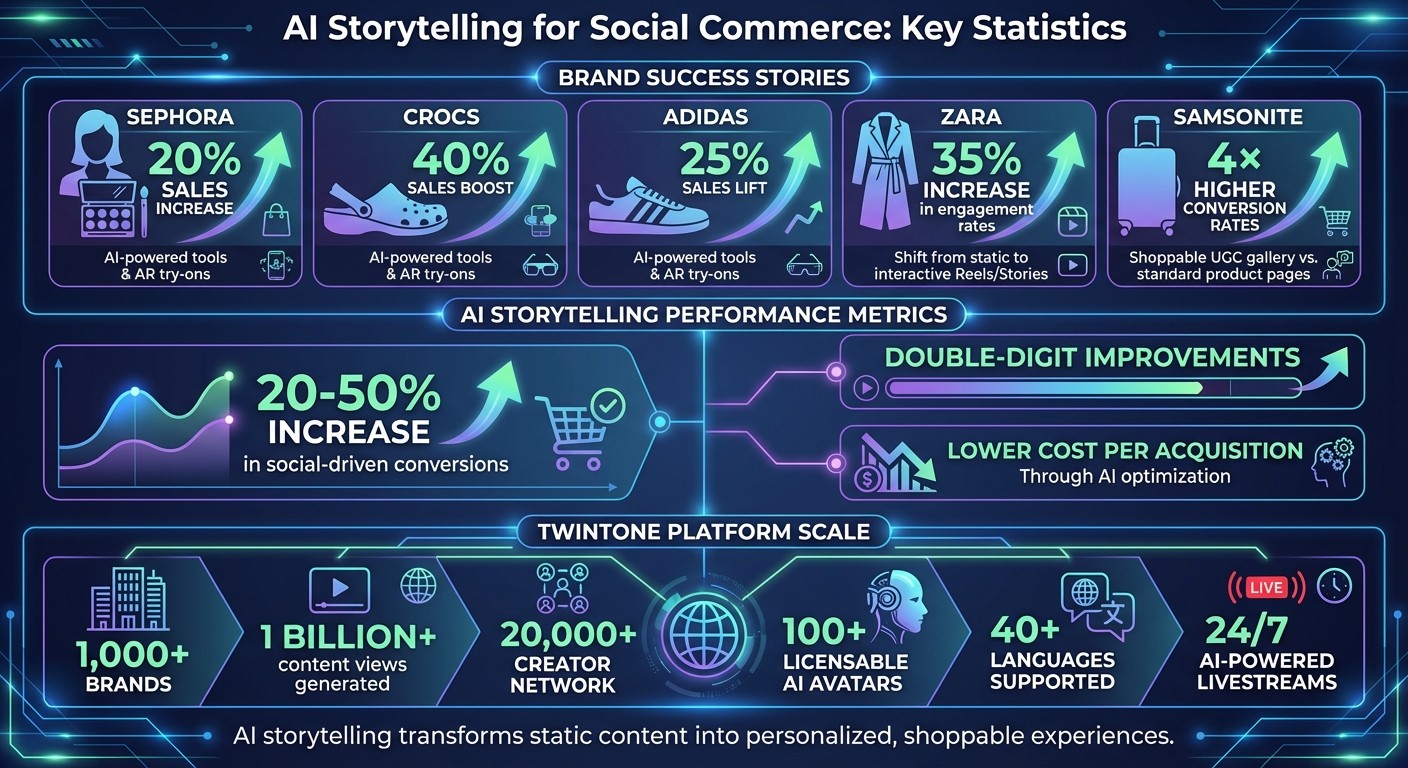
AI Storytelling ROI: Brand Performance Statistics and Conversion Metrics
Social Commerce Engagement Problems for Brands
What Social Commerce Looks Like Today
In the U.S., brands are primarily leaning on platforms like Instagram, Facebook, TikTok, Pinterest, Snapchat, and Amazon Live for social commerce. The process usually starts on a mobile device: a user scrolls through TikTok or Instagram Reels, taps on a product tag from a shoppable post or Story, checks out the price in U.S. dollars, reads product details and reviews, and then makes a purchase. Brands like Sephora on Instagram, H&M on Facebook Shops, and Sony on Amazon Live have created seamless in-app shopping experiences that turn browsing into instant buying. Live shopping takes it a step further by offering real-time product demos with one-click purchasing directly integrated into the stream. This creates a highly engaging environment but requires brands to have the resources to staff these live sessions. Despite these streamlined shopping journeys, many brands face challenges when their content fails to grab and hold user attention.
Why Static Content Doesn't Work
Static images and generic posts often get lost in the endless scroll of social media feeds. Content that lacks interactivity is more likely to be buried by platform algorithms, which means reduced visibility and fewer conversions. Static visuals also fail to answer critical shopper questions like, "Will this fit someone who’s 5'10"?", "Is it easy to clean?", or "What does it look like in real life?" Without engaging stories or clear use cases, static posts come across as just another ad. Zara addressed this issue by shifting from static images to Instagram Reels and Stories featuring interactive, time-sensitive videos. This change led to a 35% increase in engagement rates and helped boost their online sales.
How Engagement Problems Reduce Conversions
Engagement gaps can disrupt the customer journey at every stage of the funnel. Weak content often results in drop-offs, starting with the discovery phase. Generic visuals fail to grab attention, meaning fewer users interact with product tags or calls to action. During the consideration phase, a lack of context - such as how to use the product, who it’s for, or what makes it different - reduces clicks to product pages. Once users reach product detail pages or in-app views, the absence of features like demos, social proof, or real-time Q&A can create uncertainty, particularly for expensive items. This uncertainty often leads to users leaving before adding items to their cart. For instance, unanswered questions about fit, return policies, or shipping details can cause cart abandonment, especially on mobile devices where users are less tolerant of lengthy checkout processes.
Samsonite tackled this challenge by incorporating TikTok user-generated and influencer content into a shoppable gallery on their website. The result? A fourfold increase in conversion rates. However, not every brand can maintain an always-on, interactive presence due to limitations like creator availability, long production timelines, or coordination issues. These constraints can cause brands to miss peak discovery moments or off-hours traffic, ultimately costing them sales. To truly convert attention into purchases, brands need to embrace dynamic storytelling that keeps users engaged throughout their journey.
AI Just Destroyed E-Commerce. And Gave Every Creator a Store of One
How AI Storytelling Fixes Social Commerce Problems
Static content often falls short in engaging users and driving conversions, but AI storytelling steps in to bridge this gap. By creating dynamic, real-time narratives tailored to each shopper's journey, AI storytelling transforms how brands interact with their audience. Instead of offering the same generic post to everyone, AI tools craft personalized experiences using behavioral data like the shopper's first interaction platform, browsing history, cart contents, and engagement patterns. For instance, a first-time visitor might see a quick, emotionally engaging hook that highlights the problem your product solves. On the other hand, a returning shopper might encounter in-depth explainers, comparison videos, or social proof clips tailored to their demographic or specific use case. At the final conversion stage, AI generates customized stories - such as before-and-after scenarios, urgency-driven offers, or FAQ-style content - designed to address lingering doubts. These messages are fine-tuned by AI models that analyze which combinations of format, message, and length work best for different audience segments. Let’s explore how personalized story arcs, interactive experiences, and measurable outcomes contribute to success.
Personalized Story Arcs for Each Buyer Stage
AI storytelling thrives on adapting content to where a shopper is in their journey. At the awareness stage, AI analyzes data like the user's first interaction platform, the type of content they’ve viewed, and inferred interests - such as whether they engage more with content about sustainability or discounts. Based on this, it crafts short, compelling hooks and problem-framing narratives that resonate with the specific audience. During the consideration phase, AI uses browsing patterns and engagement data to deliver detailed explainers, comparisons, and social proof that align with the shopper’s preferences. When it comes to conversion, AI adapts to cart data and pricing sensitivity, offering urgency-driven stories or videos that address final concerns. The system constantly evolves by analyzing which combinations of content and delivery methods drive the highest conversions for each audience segment.
Interactive and Real-Time Story Experiences
AI doesn’t just tell stories - it makes them interactive and engaging. Imagine a chat-style video where a virtual host asks what you’re shopping for - “comfort or performance?” or “under $50 or premium?” - and then tailors the storyline based on your choices. Similar to AR try-ons or virtual shopping assistants, these experiences adapt in real time to user input. Some systems even reorder episodes - like unboxing videos, product demos, or testimonials - based on what a viewer has already watched or clicked, making the next piece of content feel like a natural progression rather than a random ad. In live shopping events, AI-powered hosts can respond to FAQs, highlight products trending in the chat, and trigger limited-time offers when engagement spikes, mimicking the dynamic energy of successful live commerce sessions. These interactive elements boost dwell time, encourage repeat engagement, and generate intent signals like poll responses or in-video clicks, which, in turn, improve content placement and organic reach on social platforms.
Measurable Results for Your Business
The impact of AI storytelling isn’t just theoretical - it delivers tangible results. Personalized, story-driven content performs better across key metrics. For example, user-generated content (UGC) and shoppable galleries built around stories significantly outperform static product grids. Samsonite’s social video gallery, for instance, achieved up to 4× higher conversion rates compared to standard product pages. Story sequencing and interactive features also enhance engagement by presenting content in a logical flow and offering users meaningful actions that shape their experience. When paired with conversion tracking, AI can test countless variations of hooks, calls to action, and narrative styles, identifying the combinations that maximize results. Brands like Sephora, Crocs, Adidas, and Kylie Cosmetics have seen 20–40%+ increases in sales through campaigns featuring optimized shoppable posts, AR try-ons, and live demos. For most businesses, adopting AI storytelling can lead to double-digit improvements in video completion rates, 20–50% increases in social-driven conversions, and lower cost per acquisition as the system fine-tunes its approach to maximize revenue per view.
Scaling AI Storytelling With TwinTone

AI storytelling has proven effective, but many brands face challenges when it comes to scaling their efforts. Traditional partnerships with creators often require constant outreach, scheduling, and coordination - slowing down the production of personalized content. TwinTone changes the game by transforming real creators into AI Twins, enabling on-demand user-generated content (UGC) videos and 24/7 AI-powered livestreams. With over 1,000 brands already onboard and content reaching more than 1 billion views through a network of 20,000+ creators, TwinTone offers a seamless way to scale personalized, real-time AI storytelling.
Creator AI Twins for Continuous Content
TwinTone uses advanced analysis to replicate a creator’s voice, mannerisms, and style, crafting AI Twins that stay true to the creator’s personality while producing content on demand. Brands can choose from a library of over 100 licensable AI Avatars, upload product photos and scripts, and instantly generate UGC videos. Features like Product In Hand allow AI Twins to appear as if they’re holding the product, creating high-converting, shoppable content without the need for a production shoot. Meanwhile, the Dress Your Creator tool lets brands change an AI Twin’s outfit instantly to reflect seasonal trends or match specific clothing lines, keeping content fresh and relevant without reshooting. This approach ensures brands can maintain dynamic, personalized engagement at scale.
On-Demand UGC and Livestream Shopping
TwinTone’s 24/7 AI Live Shopping feature hosts continuous branded livestreams across platforms like TikTok, Instagram, YouTube, and Shopify. These AI Twins interact with viewers in real time, answering questions, showcasing trending products, and activating limited-time offers during peak engagement - all without needing a human host. With support for over 40 languages, brands can run simultaneous livestreams tailored to different markets and time zones. For shoppable videos, TwinTone automatically tags products with purchase links and distributes the content across social channels. The process is entirely automated: brands upload their assets, the AI generates the content, and the platform handles distribution. This eliminates the need for manual coordination, while TwinTone’s analytics ensure each piece of content delivers measurable results.
Automating Social Commerce and Analytics
By connecting directly to product catalogs via API, TwinTone automates the creation of scripts, UGC videos, and live-demo variants for new products as they’re added. This allows brands to scale their storytelling efforts across thousands of products without increasing staff or production costs. The platform tracks key metrics like conversion rates, engagement, watch time, and revenue attribution, breaking down performance by twin, product, and channel. With multilingual support for over 40 languages, TwinTone helps brands localize their content with tailored details - like cultural nuances, U.S. English spelling, and USD pricing for American shoppers. The Done For You option takes care of daily content creation, creator coordination, and multi-platform distribution, turning what once took weeks of effort into an automated, continuous workflow. Combined with real-time analytics, TwinTone offers a comprehensive solution for scaling social commerce with efficiency and impact.
Conclusion
For a long time, brands have struggled to make an impact with static posts and images that fail to grab attention or drive meaningful sales. But AI storytelling changes the game by turning passive product displays into engaging, interactive narratives that guide shoppers from discovery to purchase. Campaigns using this approach have shown impressive results, with significant increases in views, engagement, and conversion rates.
Platforms like TwinTone take this concept to the next level. By simplifying collaborations with creators, TwinTone eliminates the delays that often come with traditional partnerships. Already trusted by over 1,000 brands, the platform has generated more than 1 billion views through a network of 20,000 creators. TwinTone's standout feature is its ability to transform real creators into AI Twins, who can produce on-demand user-generated content (UGC) videos and host AI-powered livestreams around the clock. Tools like "Product In Hand" and "Dress Your Creator" ensure content remains fresh and focused on driving conversions. And with support for over 40 languages, brands can deliver tailored storytelling to audiences worldwide. No more waiting weeks for content or coordinating schedules - AI Twins provide instant product demos, shoppable videos, and real-time interactions, anytime.
AI storytelling is redefining how brands engage with their audiences by offering real-time, adaptive, and human-like content. With automated distribution across platforms like TikTok, Instagram, YouTube, and Shopify, along with detailed analytics tracking engagement, conversions, and revenue, platforms like TwinTone ensure consistent growth. Brands moving away from static content to embrace personalized, always-on storytelling will meet the growing demand for engaging and shoppable experiences.
FAQs
How does AI storytelling help brands engage customers and boost sales in social commerce?
AI storytelling allows brands to connect with their customers by offering tailored, captivating content on a large scale. With the help of AI-driven tools, brands can produce videos and live streams that come across as genuine and relatable, showcasing products in ways that truly click with their audience.
This method not only builds trust but also sparks interaction and boosts sales. Plus, AI storytelling brings features like instant product demonstrations, shoppable videos, and round-the-clock live shopping - all without the usual delays or hefty expenses tied to traditional content production. It's a fresh approach that makes social commerce more interactive and impactful.
What are the main challenges brands face with static social media content?
Brands frequently face challenges with static content on social media because it often misses the mark when it comes to engaging and resonating with audiences. Static images and videos can come across as detached, blending into the fast-paced scroll of social feeds, which makes grabbing attention or driving meaningful actions much harder.
Another drawback is that static content doesn’t allow brands to adapt messaging for individual preferences at scale. Today’s consumers crave interactive, dynamic, and relatable experiences. Sticking to static posts alone can hold back a brand’s potential to drive conversions and thrive in the competitive world of social commerce.
How does TwinTone use AI storytelling to create personalized and scalable content?
TwinTone uses AI storytelling to turn real creators into AI Twins, making it possible to instantly produce personalized UGC-style videos and live streams. These AI Twins give brands the ability to create on-demand product demos, shoppable videos, and round-the-clock creator content - all without waiting on outreach or dealing with production delays.
With this method, brands can maintain constant engagement through flexible, scalable, and multilingual content, creating a more personal connection with customers while boosting conversions with ease.