Why AI-Powered Live Shopping Outperforms Influencers
How to build a futureproof relationship with AI
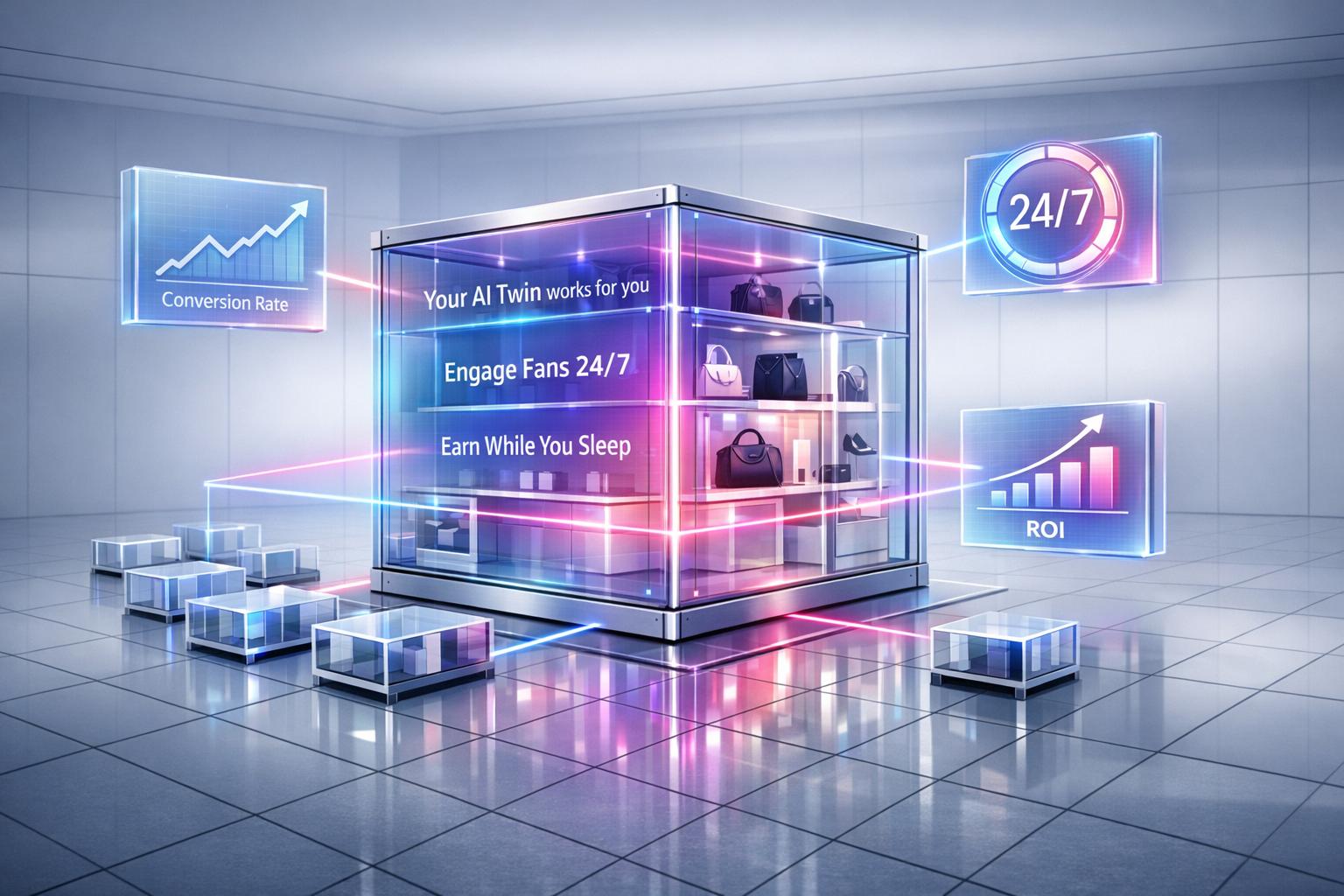
AI-powered live shopping is reshaping ecommerce by delivering results that influencers can't match. Platforms like TwinTone offer:
Higher conversions: Up to 40% conversion rates, compared to 10–30% for influencers.
24/7 availability: AI operates round the clock, across time zones and languages.
Cost savings: Plans start at $110/month, far cheaper than influencer fees.
Scalability: AI groups viewers and handles questions without fatigue.
Lower risks: No reputation issues tied to influencers.
While influencers excel at emotional connections and trust, AI wins on efficiency, scalability, and ROI. With the U.S. live shopping market projected to reach $67.8 billion by 2026, AI-driven platforms are the future of ecommerce.
1. TwinTone AI-Powered Live Shopping
Engagement & Personalization
TwinTone's AI avatars bring real-time, personalized interactions to life, adapting instantly to each viewer's behavior. The platform fine-tunes product displays on the fly, tailoring them to individual preferences. During live streams, the AI handles common chat questions instantly, creating a seamless and human-like feedback loop.
What makes this possible? NeverCookie technology, which identifies visitors with a staggering 99.9% accuracy while staying fully compliant with GDPR and CCPA guidelines. This enables TwinTone to track preferences and deliver recommendations without overstepping privacy boundaries. On top of that, Large Language Models adjust scripts in real time, using data from past performance to keep the interaction relevant and engaging. This level of personalization ensures TwinTone is ready to scale effortlessly.
Scalability & Availability
Unlike human influencers who need rest and work limited hours, TwinTone runs 24/7, across all time zones. This constant availability not only boosts store visibility in platform algorithms but also ensures your storefront is always open for business. Plus, the AI can stream in multiple languages simultaneously, removing any geographical or linguistic barriers.
Take JD.com's experience as an example. In April 2024, they used the "Cai Xiao Dongge" AI digital human for live-streaming, which led to an astonishing 7.6x increase in order volume compared to their standard sessions. Even after live streams end, TwinTone's AI chatbots keep the conversation going, answering product questions in the same style as the original host.
Conversion Rates & ROI
TwinTone redefines the traditional marketing funnel, shrinking the time it takes to move from awareness to purchase to just minutes. Its AI doesn’t just follow orders - it sets revenue goals, tracks multiple signals like chat activity and inventory levels, and makes real-time decisions to trigger promotions or tweak scripts. This approach has driven conversion rates as high as 30%, a significant leap compared to traditional methods.
Even better, customers who shop through TwinTone's live experiences are 40% less likely to return products than those using standard ecommerce platforms. And the benefits don’t stop there. The AI automatically creates shoppable highlight reels from recorded streams, turning one-time events into ongoing sales opportunities. As Jane Cheung, Global Research Leader for Consumer Industries at IBM Institute for Business Value, puts it:
The livestream can answer any questions they have immediately and tailor promotions to their exact preferences.
Cost Efficiency & Integration
TwinTone doesn’t just deliver results - it makes the process simple and affordable. It integrates seamlessly with platforms like TikTok, Shopify, Amazon, YouTube, and Meta through APIs, enabling instant updates and one-tap checkouts. And with plans starting at just $110/month, it’s a budget-friendly alternative to traditional influencer fees, which can reach thousands per post.
Despite its potential, AI streamers currently hold a market penetration rate of less than 1%, signaling huge opportunities for early adopters. TwinTone’s pricing starts at $110/month for 10 AI UGC videos and scales up to enterprise-level plans with 50+ videos and full live-streaming capabilities. It's a cost-effective way to tap into a growing market without the hefty price tag of influencer campaigns.
2. Influencer Marketing
Engagement & Personalization
Unlike AI, which thrives on delivering instant, data-driven responses, influencer marketing leans heavily on the power of human connection and storytelling. Influencers build trust by sharing personal experiences and reviews that resonate with their audience, creating what’s known as parasocial relationships. In fact, 68% of Indian consumers trust influencer recommendations more than brand-generated content. By weaving product endorsements into their usual content style, influencers make their suggestions feel natural and relatable.
Take Maybelline China's 2023 live product launch with Angelababy, for example. It pulled in an audience of 6 million viewers and resulted in the sale of 10,600 lipsticks. Similarly, in the UK, Katherine Ryan’s live event with Snug led to a 160% spike in virtual consultations and a 450% increase in sales.
However, this human-centric approach has its drawbacks. During high-traffic live sessions, influencers may struggle to address every viewer's question, leaving some potential buyers frustrated. As Jie Li from Hangzhou Dianzi University points out:
AI streamers, with their standardized and concise sensory presentation, better meet the need for quick decision-making, thus outperforming human streamers in functional differences.
While the human touch is undeniably powerful, it comes with limitations, particularly in scalability.
Scalability & Availability
Human influencers, unlike AI, are bound by physical constraints. They can’t work around the clock, and live commerce sessions - especially in China - often stretch to six hours, with new products showcased every five minutes. This pace is demanding and simply unsustainable for most individuals. Moreover, inconvenient streaming schedules have been a significant hurdle for live commerce adoption, with 29% of Europeans, 32% of Americans, and 44% of Latin Americans citing this as a barrier.
To counter these challenges, some brands have adapted. For example, Stormi Steele, founder of Canvas Beauty, achieved an impressive $1 million in sales during a single six-hour TikTok Live session in June 2024. To avoid over-reliance on her availability, the brand transitioned to a team-based model. Similarly, the beauty brand Made by Mitchell collaborated with multiple creators throughout 2024, a strategy that generated 10.5 million impressions and quadrupled their follower base.
Conversion Rates & ROI
Influencer-led marketing can deliver remarkable results, with live events achieving conversion rates of 10-30%, far above the typical e-commerce rate of around 2%. But this success isn’t without challenges. High-profile influencers often come with steep price tags, which can eat into ROI. Additionally, influencers may lack the technical knowledge needed for credibility in specialized categories like skincare or electronics. There’s also the potential for reputational risk - personal controversies involving influencers can harm a brand’s image. As Jane Cheung, Global Research Leader for Consumer Industries at the IBM Institute for Business Value, explains:
The draw of the livestream is a live person or spokesperson that people relate to. Talking about the product is more fun than scrolling on your phone for information.
Cost Efficiency & Integration
The economics of influencer marketing are complex. While nano-influencers on Instagram boast engagement rates 10 times higher than mega-influencers, managing a large network of them can be logistically overwhelming for larger brands. Celebrity hosts, while capable of driving massive one-time traffic, are expensive and less practical for day-to-day content creation. Negotiating commission splits and securing top-tier talent further complicates the process, often impacting ROI.
Integration poses another challenge. When Facebook and Instagram discontinued their native live-shopping features, brands had to pivot, hosting content on their own platforms to retain control over customer data and scheduling. Walmart’s December 2020 TikTok livestream fashion event, for instance, attracted seven times more viewers than expected and boosted its follower base by 25%. This success led the company to establish its own live shopping channel for regular events, moving away from sporadic influencer-led campaigns.
These limitations highlight the hurdles influencer marketing faces when compared to the seamless, always-on capabilities of AI-driven live shopping.
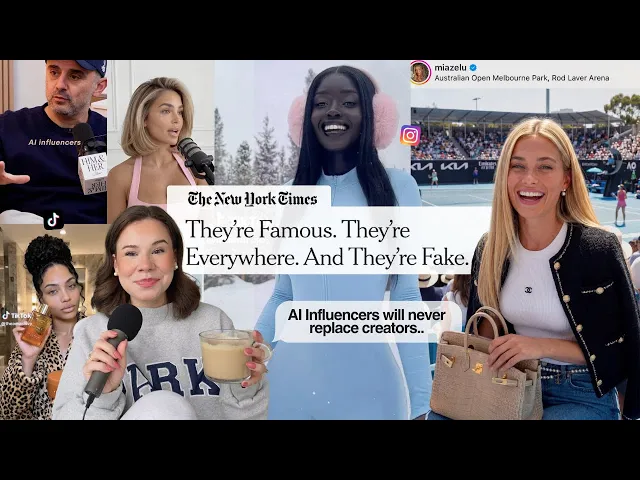
AI influencers are making millions in 2026..but they won't replace influencers & here's why..
Pros and Cons
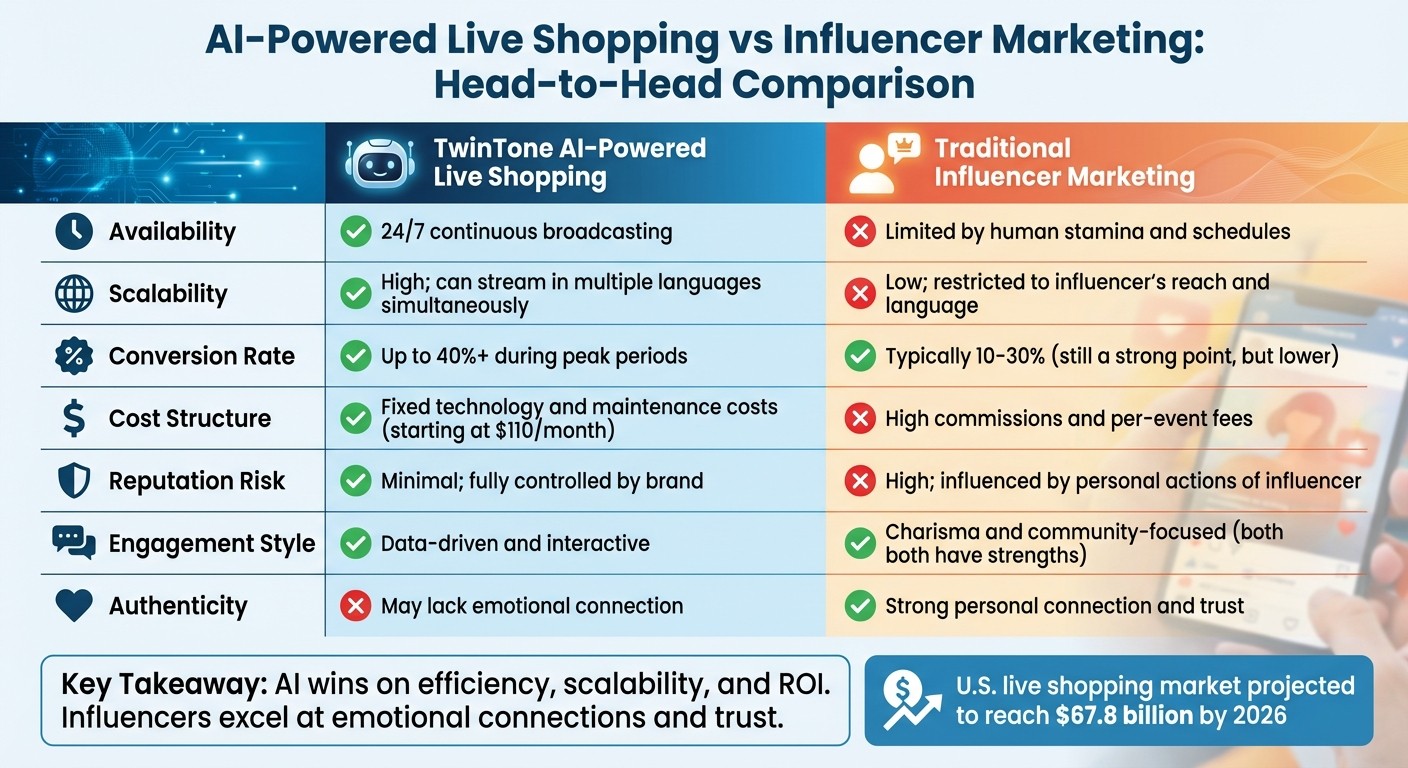
AI-Powered Live Shopping vs Influencer Marketing: Performance Comparison
Both TwinTone AI-powered live shopping and influencer marketing bring their own strengths and challenges to the table. Understanding these differences can help brands decide which approach aligns best with their goals in social commerce. Let’s break down the trade-offs, starting with TwinTone's AI-driven strategy.
TwinTone AI-powered live shopping shines when it comes to scalability and consistency. Operating 24/7, it can engage global audiences across different time zones without any breaks or fatigue. The platform reliably increases order volumes while minimizing risks to a brand's reputation. Another advantage is its predictable cost structure - expenses are fixed and tied to technology and maintenance, unlike the often-variable fees associated with influencer campaigns.
That said, AI-driven live shopping does have its drawbacks. One major hurdle is the lack of authenticity. AI personas, no matter how advanced, cannot genuinely connect with audiences on a human level. They lack personal experiences, emotional depth, and the ability to demonstrate products in a relatable way - like describing how something feels, smells, or functions in real life. This disconnect can lead to skepticism from viewers, and some may even criticize the displacement of human creators in favor of AI.
On the other hand, influencer marketing offers a different set of advantages. It thrives on building trust through authentic interactions. Influencers often achieve conversion rates between 10–30%, thanks to their ability to engage with their audiences on a personal level. However, this approach is not without its challenges. High fees and the limited availability of influencers due to stamina or scheduling constraints can eat into ROI. Additionally, brands must navigate the risks tied to an influencer's personal controversies, which can damage their reputation - something AI systems avoid.
Here’s a side-by-side comparison of the two approaches:
Feature | TwinTone AI-Powered Live Shopping | Traditional Influencer Marketing |
|---|---|---|
Availability | 24/7 continuous broadcasting | Limited by human stamina and schedules |
Scalability | High; can stream in multiple languages simultaneously | Low; restricted to the influencer's reach and language |
Conversion Rate | Up to 40%+ during peak periods | Typically 10–30% |
Cost Structure | Fixed technology and maintenance costs | High commissions and per-event fees |
Reputation Risk | Minimal; fully controlled by the brand | High; influenced by the personal actions of the influencer |
Engagement Style | Data-driven and interactive | Charisma and community-focused |
Authenticity | May lack emotional connection | Strong personal connection and trust |
Each method has its place in a brand's social commerce strategy, depending on priorities like scalability, trust, or cost management.
Conclusion
In today’s world, where efficiency and scalability are the keys to success, brands looking for consistency and long-term ROI have a clear choice. TwinTone's AI-powered approach removes the hurdles of human limitations, unpredictable expenses, and potential reputation risks.
The numbers speak for themselves: TwinTone achieves conversion rates of over 40% during peak periods, far surpassing the typical 10–30% seen in traditional influencer campaigns. Operating around the clock on a global scale with fixed technology and maintenance costs, TwinTone is paving the way for a future where AI consistently outshines older methods.
"Live commerce makes it so much easier for a customer to fully understand a product so there are no surprises after the purchase... the friction that is often part of the buying experience is eliminated with generative AI-augmented live commerce."
Shantha Farris, Sales and Commerce Offering Strategy Leader, IBM Consulting
TwinTone doesn’t stop when the live event ends. It keeps shoppers engaged by answering product questions and assisting with payments, all while maintaining the host's unique style. This extended engagement boosts ROI even further. Plus, the platform gives brands full control over their messaging, reducing the risk of reputation mishaps. With the U.S. live ecommerce market expected to hit $67.8 billion by 2026, there’s never been a better time to embrace technology that grows alongside your goals.
Kick things off with high-margin product categories, connect TwinTone to your customer data platforms to create personalized rewards, and amplify your reach by using AI-generated clips on TikTok, Reels, and YouTube Shorts. TwinTone's real-time personalization and data-driven insights ensure your brand stays ahead of the curve.
FAQs
Why does AI-powered live shopping drive better conversion rates than influencer marketing?
AI-powered live shopping transforms the way customers shop by creating personalized, real-time interactions that align with individual preferences. Instead of relying on traditional influencer-driven approaches, AI dives into user behavior during live streams to suggest products and promotions that feel tailor-made for each viewer. This kind of customization not only makes the shopping experience more engaging but also boosts the likelihood of a purchase.
On top of that, AI virtual hosts keep the momentum going with consistent engagement, adapting their sales tactics on the fly using real-time data. Unlike human influencers, these virtual hosts can scale effortlessly, delivering high-quality interactions without skipping a beat. The result? A smooth, captivating shopping experience that drives more frequent sales.
What privacy concerns should businesses consider when using AI for live shopping?
The use of AI in live shopping brings up critical privacy concerns. These systems often gather personal data to provide tailored recommendations and interactions. However, if this data is mishandled or accessed without permission, it can lead to privacy breaches and potentially damage customer trust.
To mitigate these risks, businesses need to be upfront about how they collect and use data. Gaining explicit consent from customers is a must, as is adhering to privacy regulations. Retailers should also prioritize strong data security measures and adopt ethical AI practices. Striking this balance ensures personalized experiences while safeguarding consumer privacy.
How do AI-powered platforms keep audiences engaged without a human touch?
AI-powered platforms keep engagement levels high by introducing advanced virtual characters, like AI avatars, that closely imitate human behavior. These digital hosts are available around the clock, ensuring consistent interactions without the constraints of human schedules. Using advanced technology, they can mimic gestures, respond instantly, and even sprinkle in humor, creating a lively and relatable experience for audiences.
What sets these platforms apart is their ability to deliver personalized experiences. By analyzing real-time data, they offer tailored recommendations and responses that help build a genuine connection with users. This approach not only strengthens trust but also enhances the overall shopping experience. Together, these features make AI-driven solutions a powerful option for delivering engaging, scalable, and cost-efficient live shopping experiences that align with the fast-paced world of modern ecommerce.