
AI-Generated UGC for Paid Ads: Does It Work?
How to build a futureproof relationship with AI

Yes, AI-generated UGC works - but it depends on your goals.
AI-generated user-generated content (UGC) is transforming paid ads by offering faster production and lower costs compared to human-made content. Tools like TwinTone let brands create videos for as little as $2 each in just 16 minutes, compared to the $150–$212 per video and 2–3 weeks required for creator-made UGC. AI content also delivers 18.5% engagement rates, significantly outperforming the 5.3% seen with human-made ads.
However, human-created UGC still leads in trust, with 81% of people finding it believable, compared to 63% for AI-generated content. It also drives 23% higher user retention and is essential for building long-term connections with audiences.
For brands, the best strategy is a mix: use AI-generated UGC for rapid testing and scaling, and creator-made UGC for building deeper relationships. Here's a quick breakdown:
AI-Generated UGC: Fast, affordable, ideal for testing and scaling. Use a UGC content idea generator to keep your creative pipeline full.
Creator-Made UGC: More engaging, better for trust and retention. You can even use a UGC value estimator to measure the ROI of these assets.
Brand-Produced Ads: High-quality but expensive and slower to produce.
Key takeaway: Combine AI and human content to balance speed, cost, and audience connection.
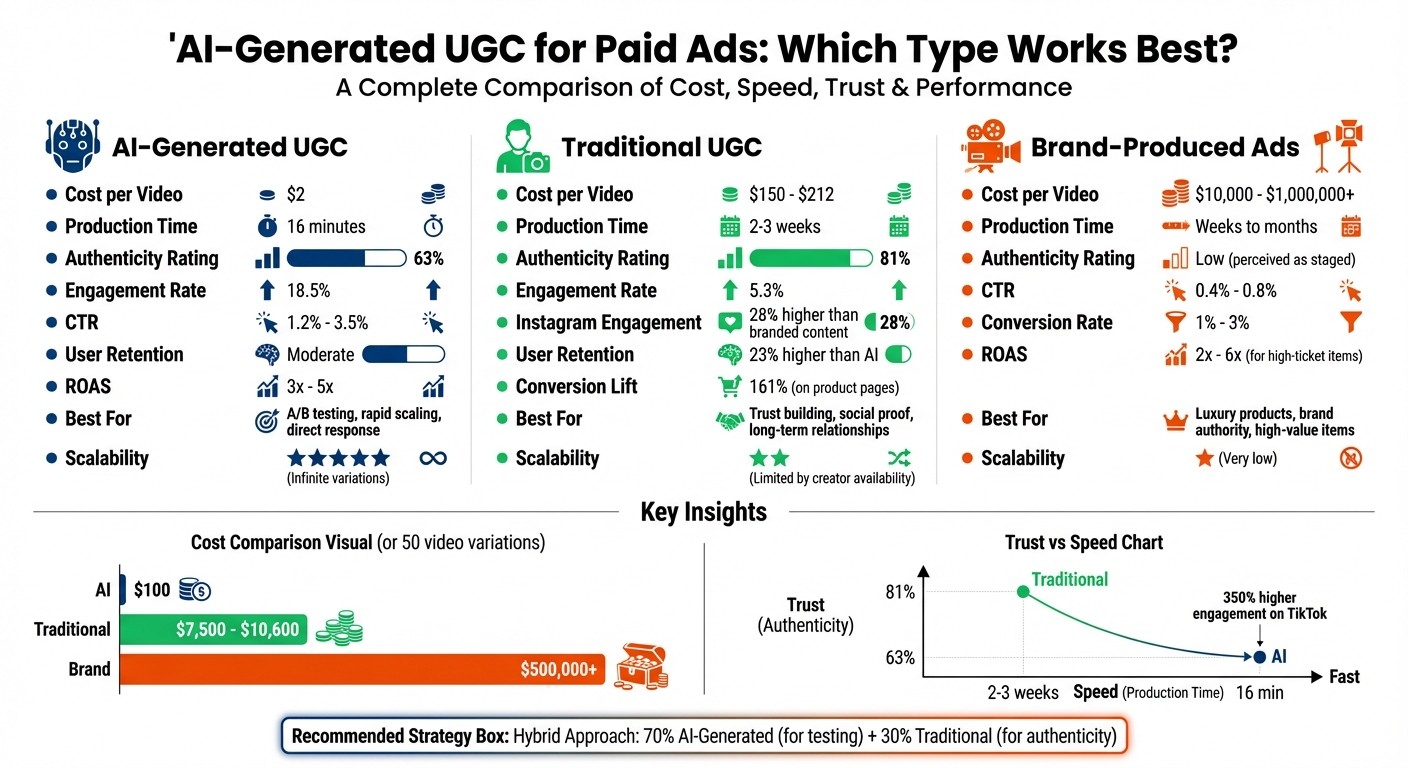
AI-Generated vs Traditional vs Brand-Produced UGC: Cost, Speed, and Performance Comparison
1. TwinTone AI UGC

Cost Structure
TwinTone operates on a subscription-based pricing model that significantly reduces the cost of video production. Instead of paying $150 to $212 per video when working with creators, TwinTone offers an effective cost of just $2 per video. Plans include the Starter package at $110 per month for 10 videos, the Pro plan at $220 per month for 20 videos, and an Enterprise option for 50+ videos with custom pricing.
Beyond cost savings, TwinTone eliminates the hassle of managing emails, shipping products, and dealing with revision fees. These efficiencies can reduce your Cost Per Acquisition by 20% to 50% and deliver a 28% lower Cost Per Result and 31% lower Cost Per Click compared to traditional user-generated content (UGC). For mid-range direct-to-consumer (DTC) products, this translates into a 3x to 5x Return on Ad Spend (ROAS). Next, let’s dive into how TwinTone’s speed outshines traditional production methods.
Production Timeline
Speed is where TwinTone truly shines. The platform can take your project from script to finished video in just 16 minutes. Compare that to the 5 to 10 days it typically takes with traditional human creators. All you need to do is write a script, choose an AI avatar, and generate your video - no back-and-forth scheduling, waiting for filming slots, or dealing with multiple approval stages.
This rapid process allows you to create dozens of ad variations daily. It also gives you the flexibility to quickly respond to trending topics or adapt based on performance data. For example, in early 2024, the EdTech startup Headway used AI-generated avatars for their video ads. The result? A 40% increase in ROI, 3.3 billion impressions, and a dramatic reduction in production time. Such speed and scale are nearly impossible to achieve with traditional methods, making TwinTone a game-changer for scalable campaigns.
Scalability
TwinTone’s approach enables 50x faster iteration cycles compared to traditional production methods. The combination of subscription pricing and rapid production speeds allows you to test multiple hooks, calls-to-action, and messaging angles all at once - without blowing through your budget. Plus, with API integrations and support for over 40 languages, scaling campaigns globally becomes seamless, eliminating the need to hire additional creators.
This flexibility lets you experiment with various ad variations at minimal cost. As highlighted by an industry expert:
"The power to create endless creative variations on the fly makes rapid A/B testing a reality, uncovering performance insights that used to be too expensive or time-consuming to find." - ShortGenius Blog
Performance Data
TwinTone’s AI-generated content delivers impressive results, with click-through rates (CTR) ranging from 1.2% to 3.5%, far outpacing the 0.4% to 0.8% typically seen with traditional studio ads. In blind tests, 78% of consumers were unable to tell the difference between real UGC and AI-generated content.
That said, there’s still a gap in trust. While AI UGC has a 63% trust rating, traditional UGC scores higher at 81%. Additionally, users acquired through authentic creator content tend to have 23% higher retention rates. This suggests that while AI UGC excels at driving top-of-funnel awareness and rapid testing, human creators remain essential for fostering long-term customer relationships - a topic we’ll explore further in the next sections.
AI Ads vs Human Creators: Which Performs Better? (UGC Expert & AI Engineer Reveal Data)
2. Traditional UGC
Unlike the quick and budget-friendly nature of AI-generated UGC, traditional user-generated content (UGC) depends on organic collaborations with real creators.
Cost Structure
Traditional UGC involves partnering with actual people to create content that blends seamlessly into social media feeds. On average, creators charge between $150 and $212 per video. If you’re looking to produce 50 video variations for testing, you’re looking at a price tag of $7,500 to $10,600.
But that’s not all. There are hidden expenses to consider - shipping products to creators, managing contracts, and dealing with multiple revisions can add up quickly. Adapting content for different platforms? That’s another $50 to $100 per format. And if deadlines are missed or the content doesn’t align with your brand, the costs and risks skyrocket.
Production Timeline
Creating traditional UGC isn’t exactly a quick process. From brainstorming to final delivery, it typically takes 2 to 3 weeks. Compare that to AI-generated content, which can be churned out in as little as 16 minutes.
This slower pace can be a challenge, especially for fast-moving campaigns. On platforms like TikTok, where trends can vanish almost as quickly as they appear, timing is everything. As Amber Macho from Creative Adbundance puts it:
"Human UGC takes time. Coordinating creators, shooting revisions, and managing approvals can slow campaigns down."
Scalability
Scaling traditional UGC is no small task. It requires additional coordination, shipping logistics, and approval processes. Expanding to new regions? That means finding creators who fit each market and speak the language.
The slower production cycle also makes it harder to test different hooks, angles, or calls-to-action in real time. While AI can generate numerous variations in just a day, traditional UGC demands meticulous planning upfront. Daniel Rozin, CMO and Co-founder of AdGPT, explains:
"Slow testing cycles waste opportunity. UGC ads thrive on speed. When iteration lags, competitors capture attention first."
Performance Data
Despite the higher costs and longer timelines, traditional UGC delivers when it comes to building trust and driving results. It scores 81% in perceived authenticity and achieves 23% higher user retention compared to AI-generated content. On product pages, it can increase conversions by 161%, and on Instagram, it drives 28% higher engagement than branded content.
A great example? Iconic London. By leveraging a traditional UGC strategy, the brand saw a 126% lift in conversion rates and an 11% increase in average order value over 12 months. These numbers highlight the power of traditional UGC in fostering trust and driving conversions, even if it comes with higher costs and longer production times. It’s a strategy that prioritizes long-term brand trust over quick wins.
3. Brand-Produced Ads
When it comes to advertising, brand-produced ads stand out as the polished, high-budget option. Unlike AI-generated or traditional user-generated content (UGC), these ads rely on professional production teams, scripted messaging, and studio-level quality. However, this comes at a steep cost.
Cost Structure
Producing a brand ad is no small investment. Budgets can range from thousands to millions of dollars, often consuming an entire quarter's advertising funds. Costs pile up quickly with elements like creative briefs, casting, location scouting, state-of-the-art equipment, and post-production editing. The downside? This hefty price tag limits the ability to experiment with multiple low-risk campaigns, something AI-generated and UGC content excel at.
Production Timeline
The timeline for brand-produced ads is another hurdle. From brainstorming concepts to delivering the final product, the process can drag on for weeks or even months. This delay makes it tough to react quickly to trends or competitor strategies, leaving brands less agile in fast-paced markets.
Scalability
Scaling these ads is a challenge. Want to tweak the messaging, test a new call-to-action, or adapt the content for a different market? Each adjustment requires starting over - re-planning, re-shooting, and re-editing. This lack of flexibility makes high-volume testing nearly impossible, putting brand-produced ads at a disadvantage compared to more nimble UGC-style campaigns.
Performance Data
The numbers tell an interesting story. Brand-produced ads typically see click-through rates (CTR) between 0.4% and 0.8% and conversion rates hovering around 1% to 3%. These figures often fall short compared to UGC content, especially with younger audiences like Gen Z, who tend to scroll past overly polished ads that feel out of place in their social feeds.
That said, brand-produced ads do shine in specific scenarios. For high-ticket items priced at $2,000 or more, their professional quality can inspire the trust needed to close a sale, delivering a return on ad spend (ROAS) of 2x to 6x or more. On the other hand, for everyday products, the relatable and authentic vibe of UGC often outperforms these polished campaigns.
Advantages and Disadvantages
When weighing the pros and cons, each advertising method brings its own strengths and weaknesses. Understanding these trade-offs helps brands decide how to balance speed, cost, and audience connection.
AI-generated UGC is all about speed and affordability. With subscription models, videos can cost as little as $2 each and take just 16 minutes to produce. This allows brands to create up to 50 ad variations for the price of a single traditional video. While AI can simulate authenticity fairly well - earning a 63% perceived authenticity score - it still falls short of capturing the subtleties of human expression.
Traditional UGC strikes a middle ground. Although it comes with higher costs, it offers something AI can't fully replicate: trust. With an 81% authenticity rating and a 23% boost in user retention compared to AI-generated UGC, it delivers a strong connection with audiences. The downside? It's harder to scale. Coordinating with real creators can take 2–3 weeks, making it less flexible for quick trend responses or creative testing.
Brand-produced ads are the premium option, often costing anywhere from thousands to millions of dollars per campaign. They shine when a polished, authoritative image is needed, such as for luxury or high-value products. These ads can deliver impressive returns, with ROAS (Return on Ad Spend) ranging from 2x to 6x or more. However, the trade-offs include long production timelines - weeks or even months - and a perception of being overly polished, which can make them feel less relatable.
Interestingly, AI-generated UGC has achieved engagement rates up to 350% higher on TikTok and reduced costs per result by 28% in paid campaigns. On the flip side, traditional UGC has proven its value by increasing conversions by 161% when used on product pages.
"AI UGC wins on volume metrics (views, shares, immediate engagement) while traditional UGC dominates quality metrics (trust, authenticity, purchase influence)." - Superscale
Here's a side-by-side look at how these methods compare:
Attribute | AI-Generated UGC | Traditional UGC | Brand-Produced Ads |
|---|---|---|---|
Cost per Video | $2–$198 | $150–$1,000 | $10,000–$1,000,000+ |
Production Time | 16–45 minutes | 2–3 weeks | Weeks to months |
Authenticity Rating | 63% | 81% | Low (perceived as staged) |
Best Use Case | A/B testing, direct response | Trust building, social proof | Luxury products, brand authority |
Scalability | Infinite variations | Limited by creator availability | Very low |
User Retention | Moderate | 23% higher than AI | Low to moderate |
This breakdown highlights how each approach aligns with different campaign objectives, helping brands choose the right tool for the right job.
Conclusion
The success of AI-generated user-generated content (UGC) depends largely on what you're aiming to achieve with your campaign. As we've seen in the comparisons earlier, each approach has its strengths and trade-offs.
AI-generated UGC stands out for its speed and affordability, with costs averaging around $2 per video. It's perfect for quickly testing different creative ideas and scaling campaigns with localized content in no time. However, while its quick turnaround and cost efficiency are undeniable, its 63% authenticity rating falls short of the trust levels achieved by human creators, who score 81%.
On the other hand, traditional UGC excels at building trust and driving conversions. It’s particularly effective for industries like health, finance, and luxury, where consumer confidence is critical. For example, Iconic London saw a 126% boost in conversion rates and an 11% rise in average order value within a year of incorporating traditional UGC. With a 23% higher user retention rate, this approach is a no-brainer for high-consideration purchases.
Brand-produced ads, while polished and authoritative, often struggle with "ad-blindness" on social media. Plus, their production costs can range from thousands to millions of dollars - making them less practical for brands with tight budgets, even though they shine in luxury positioning.
Ultimately, the right content mix depends on your goals. A hybrid strategy - using 70% AI-generated content for rapid testing and 30% traditional content for authenticity - offers a balanced approach. This method allows brands to test messages quickly with AI, then amplify the most effective ones using real creators. By combining speed, cost efficiency, and human connection, brands can stay agile while building genuine relationships with their audience. Striking this balance is the key to long-term success.
FAQs
Can AI-generated UGC build trust and feel as authentic as traditional UGC?
AI-generated user-generated content (UGC) has a different impact on trust and relatability when compared to traditional UGC. Content created by actual customers or creators typically feels more personal and genuine, which naturally helps establish trust with audiences. On the other hand, AI-generated UGC can sometimes miss the emotional connection that makes content resonate, leaving it feeling less "real" to some viewers.
That being said, AI-generated UGC has proven to be highly effective in areas like engagement and scalability. Many brands have reported noticeable improvements in ad performance when leveraging AI for content creation. Still, as consumers increasingly value content that feels relatable and authentic, brands face the challenge of balancing AI-driven efficiency with the human touch that builds trust. The key to success lies in aligning AI-generated content with both audience expectations and the brand’s core values.
What are the cost advantages of using AI-generated UGC in paid advertising?
AI-generated user-generated content (UGC) offers a budget-friendly alternative to traditional content creation. By using AI tools, brands can produce high-quality images, videos, and text that mimic authentic user content - without the hefty price tag of hiring production teams or managing time-consuming creation processes. This approach allows businesses to create a variety of ad assets quickly and efficiently, helping them scale campaigns without overspending.
Another advantage is the speed it brings to campaign execution. Traditional methods often involve delays from filming, editing, and approval stages. With AI-generated UGC, brands can skip these bottlenecks, enabling faster campaign launches. Plus, the ability to test and tweak ads in real time helps businesses adapt to trends and improve performance on the fly. By saving both time and money, AI-generated UGC empowers brands to run campaigns that are not only efficient but also deliver a stronger return on ad spend.
How can brands successfully use both AI-generated and traditional UGC in their advertising?
Brands can blend AI-generated content with traditional user-generated content (UGC) to craft ads that are engaging, relatable, and cost-efficient. AI-generated UGC shines when it comes to quickly producing a variety of content, making it perfect for testing different ad formats and scaling campaigns without delay. This approach helps brands figure out what captures their audience’s attention while keeping content fresh and abundant.
On the other hand, traditional UGC - created by actual users - brings a sense of authenticity and emotional depth that builds trust with potential customers. A smart strategy might involve using AI to create initial ideas or localized variations, then enriching successful ads with real user testimonials or organic content. By combining these two approaches, brands can strike a balance between efficiency and genuine connection, ultimately boosting audience engagement and ad performance.