AI Agents for Social Media Management
How to build a futureproof relationship with AI
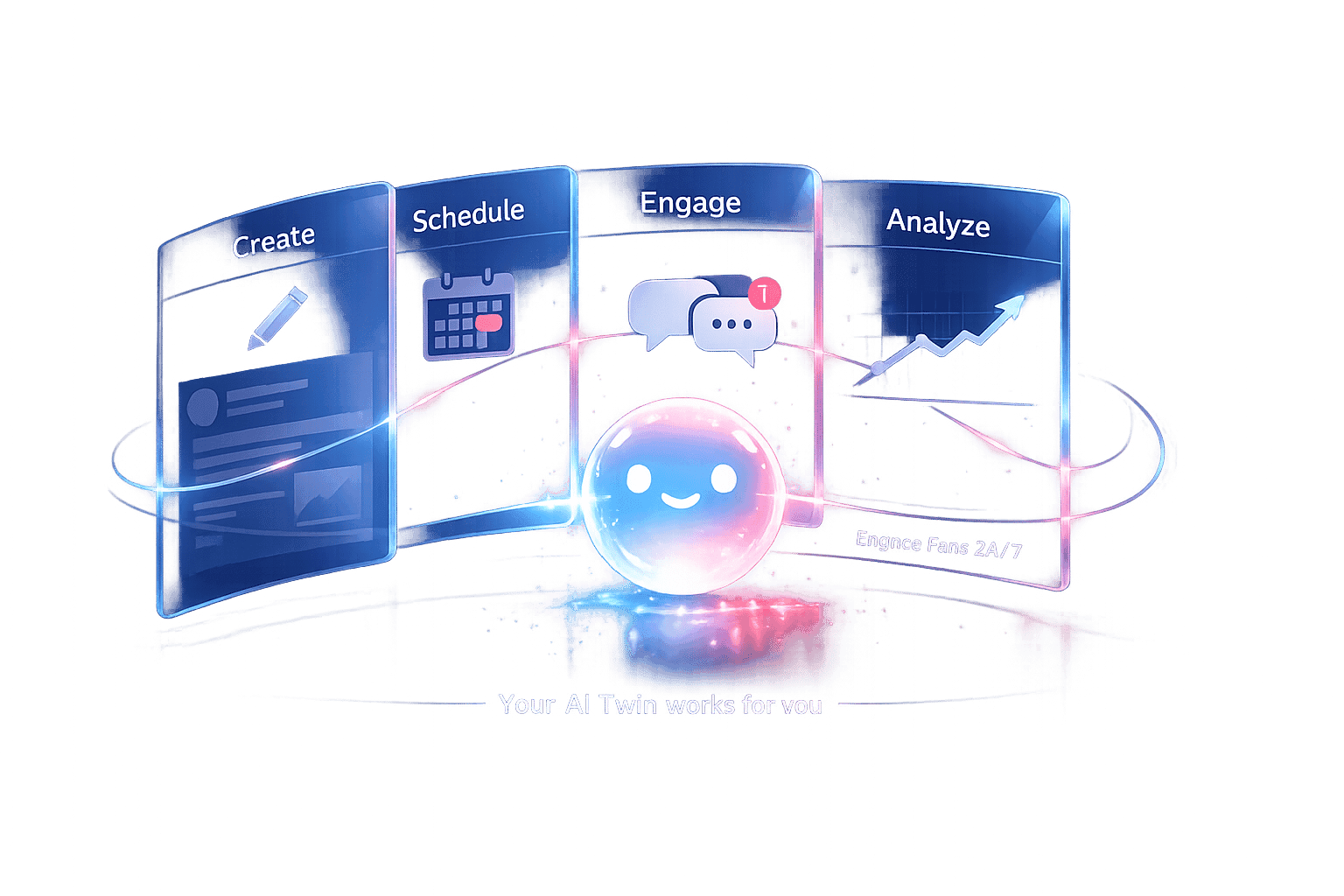
AI agents are changing how social media is managed. These tools, powered by large language models (LLMs), can handle repetitive tasks like content creation, audience engagement, and performance tracking. Unlike basic automation tools, AI agents can analyze data, make decisions, and improve over time. Here's why they matter:
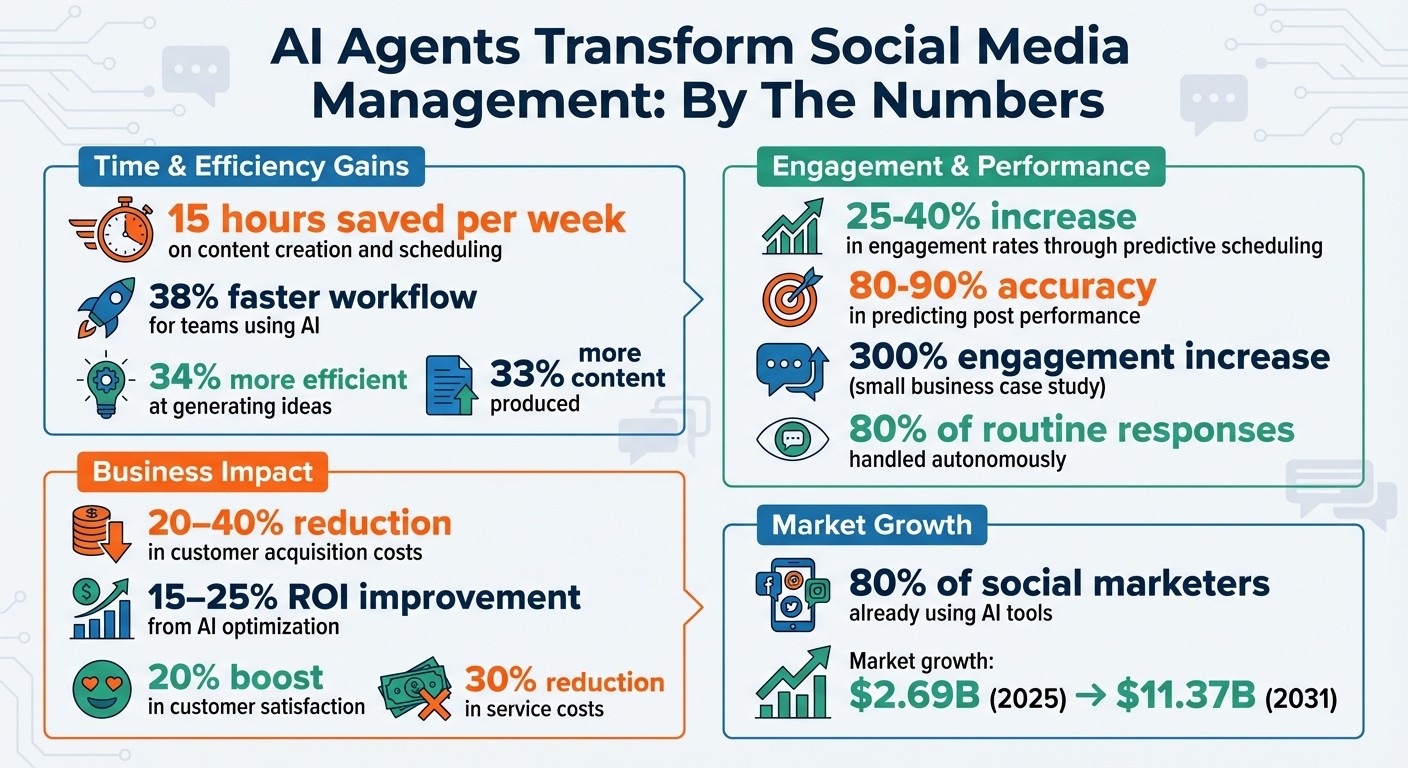
Time Savings: Teams save up to 15 hours per week on tasks like scheduling and responding to messages.
24/7 Availability: AI agents work round the clock, ensuring no comment or inquiry goes unanswered.
Better Results: Predictive analytics help optimize posting times, boosting engagement by 25–40%.
Cost Efficiency: Businesses report a 20–40% reduction in acquisition costs and improved ROI.
AI Agents for Social Media: Key Performance Metrics and Benefits
Create Your AI Social Media Agent in MINUTES! Zapier Agent Tutorial - Build AI Employees w/No Code
What AI Agents Can Do
AI agents are reshaping social media management by tackling three main areas: content creation and scheduling, audience engagement, and performance tracking. Let’s break down how they’re making a difference.
Content Scheduling and Automation
AI agents go beyond simply posting at set times - they predict the best times to post. By analyzing past engagement data, they identify peak activity periods, which can increase engagement rates by 25-40%.
One standout feature is their ability to adapt content across multiple platforms. For example, a single piece of long-form content can be transformed into a LinkedIn thread, an Instagram carousel, or even a TikTok script. This process saves an estimated 10-15 hours per week.
These agents also make real-time adjustments. If they detect sudden shifts, like negative feedback or breaking news, they can pivot your content strategy on the fly.
Audience Engagement and Response
AI agents are available around the clock to handle comments and direct messages. Using natural language processing, they understand the intent and tone behind messages - whether it’s a casual inquiry, a complaint, or a sales question.
They can autonomously manage up to 80% of routine responses, which has been shown to boost customer satisfaction by 20% and cut service costs by 30%. For instance, a small business saw a 300% increase in engagement within just three months of using AI for social media.
These tools also safeguard your brand by moderating toxic or spammy comments. At the same time, they flag high-priority interactions, such as emotionally charged complaints or promising sales leads, for human review.
Analytics and Performance Tracking
When it comes to analytics, AI agents offer predictive insights to help you make smarter decisions. They can forecast how a post will perform with up to 80-90% accuracy before it even goes live. This allows you to test variations of headlines or visuals and choose the one most likely to succeed - without wasting resources.
For example, a bakery using AI discovered that behind-the-scenes posts led to a 300% spike in engagement and a 43% rise in online orders.
AI agents also monitor competitors in real-time, analyzing their posting habits, content styles, and audience reactions. This helps uncover opportunities to refine your own strategy. Additionally, they analyze over 40 emotions in comments, even identifying sarcasm and subtle shifts in sentiment that could signal emerging trends or potential PR issues. Experts highlight how these tools can detect changes in audience behavior before they become major trends.
With these advanced tools, AI agents are becoming essential for crafting smarter, more effective social media strategies.
How to Use AI Agents Effectively
AI agents can do more than just automate tasks - they can transform how you work, but only if you approach them with intention. To get the most out of these tools, you need to focus on thoughtful setup and consistent fine-tuning.
Set Your Baseline Metrics
Start by tracking your current performance metrics, such as likes, shares, comments, saves, and impressions. This helps you understand which content resonates with your audience and gives you a benchmark to measure the impact of AI-driven strategies. Without this foundation, it’s impossible to know if AI is improving your results or just adding noise.
A great example of this approach comes from the Atlanta Hawks. In 2024, they used AI insights from Sprout Social to identify content themes that connected with fans during All-Star Weekend. By aligning their strategy with these audience preferences, they achieved a 170.1% growth in Facebook audience and a 127.1% boost in video views over three months. The key? They measured first, then optimized.
Customize AI for Your Brand
AI tools can churn out content quickly, but without customization, the results might not reflect your brand’s voice. To avoid this, create a detailed brand guide that outlines your tone, platform-specific rules, and response templates. Train your AI using materials like past high-performing posts, brand playbooks, and customer service scripts. The more specific the input, the better the output.
"AI assists but doesn't replace." - Tamilore Oladipo, Sr. Content Creator @ Buffer
During the initial phase, manually review every AI-generated post. This trial period helps you catch any missteps early and fine-tune the AI’s understanding of your brand. Additionally, set up escalation protocols so the AI knows when to hand off sensitive interactions to a human.
A retail brand, Stuckey’s, offers a great case study. In 2025, they used Hootsuite’s social tools to refine their posting strategy. By leveraging real-time analytics and smart scheduling, they saw a 750% increase in online sales. This success came from combining AI insights with a clear brand strategy.
Once your AI aligns with your brand, shift your focus to ongoing monitoring to maintain consistency and performance.
Monitor and Adjust Over Time
Even after setup, the work doesn’t stop. Regularly review your AI’s performance and audience sentiment to keep improving. Use automated tools to track metrics across platforms in one dashboard, making it easier to identify trends in engagement, reach, and impressions.
Schedule weekly or monthly audits to evaluate what’s working and what needs adjustment. For instance, tweak your posting schedule based on when your audience is most active. The goal isn’t to achieve perfection right away but to refine your approach over time.
"The future of social media isn't about working harder; it's about working smarter. You have a choice to make. You can keep up the frantic pace of doing everything manually, or you can elevate your role from a doer to a director." - Lyzr Team
Teams that integrate AI effectively report working 38% faster, generating ideas 34% more efficiently, and producing 33% more content. However, these gains only happen when AI is treated as a partner that requires guidance, not as a substitute for strategic thinking.
How to Choose the Right AI Agent
The challenge isn't finding an AI agent - it’s finding the one that fits your needs perfectly. The wrong choice can drain your resources, while the right one can streamline your workflow and boost efficiency.
What to Look for When Choosing
Start by defining your main priorities. Are you looking for a tool to tackle specific tasks, or do you need one that can handle entire workflows - like content creation, approval, publishing, and audience engagement? Tools that manage end-to-end processes are especially useful for growing teams.
Your budget and team size will also play a big role in narrowing down your options. For small businesses, entry-level solutions often start around $15 per month. Mid-sized teams might look at tools in the $19–$39 per month range, while enterprise-grade platforms can cost $149 per user per month or come with custom pricing. Also, ensure the platform supports all the social networks you use.
If your team works across multiple platforms like TikTok, Threads, or WhatsApp, check for compatibility. Multilingual support might also be a must-have depending on your audience.
As your team grows, security features become increasingly important. Look for role-based access controls, audit logs, and clear policies for handling data. These ensure every automated action is traceable. If you’re in a regulated industry like healthcare or government, make sure the agent complies with standards like HIPAA or FedRAMP.
Another key factor is maintaining consistent brand identity. The AI agent should support brand kits, voice guidelines, and human-in-the-loop approval systems to avoid off-brand or risky content. Maintaining your brand’s voice is critical. As Tim Hanson, CMO at Penfriend, explains:
"The brands seeing real results aren't those with fancy AI tools, but those who thoroughly understand their own processes and gradually implement AI in well-defined areas with clear success metrics."
– Tim Hanson, CMO at Penfriend
Test Before You Commit
Before fully committing, test the AI agent on a smaller scale to ensure it aligns with your brand. Many platforms offer free trials or pilot programs, which you can use to run a 30-to-60-day probationary period. During this time, manually review every AI-generated post, balancing AI vs. human moderation. Start with simple tasks, such as answering FAQs or moderating spam comments, on low-risk platforms.
Keep an eye out for errors, as AI-generated content can have hallucination rates ranging from 15% to 27%. Set confidence thresholds so the AI only acts autonomously when it's highly certain of its decisions. For uncertain cases, have the system escalate tasks to a human reviewer. A useful exercise is to simulate responses for different audience personas to anticipate engagement or backlash before a post goes live. As Kevin Baragona, Founder of Deep AI, puts it:
"A/B testing without going live"
is an effective way to measure performance.
Once you’re confident in the AI’s performance, start focusing on how it integrates with your existing tools.
Make Sure It Works with Your Tools
Smooth integration with your existing systems is essential for keeping your social strategy on track. Ensure the AI agent offers native integration with the tools you already use, such as your CRM, e-commerce platforms, or customer support systems. Relying solely on third-party connectors like Zapier or Make can add unnecessary complexity. For more tailored workflows, look for platforms that provide API access or no-code builders to connect social media APIs with your CMS or other databases.
Make sure the agent syncs seamlessly with your CRM and project management tools to maintain a unified source of data. Before integrating, take time to clean up your brand guidelines and content history - consistent, high-quality data will improve the AI’s performance. Also, test the system’s escalation logic to ensure it can hand off complex or sensitive queries to human operators, avoiding frustrating "bot loops".
Finally, if you’re using a custom-built agent, monitor token consumption carefully to avoid unexpected cost increases.
Conclusion
AI agents are no longer a luxury - they're a necessity for staying competitive. With 80% of social marketers already incorporating AI into their workflows, brands that hesitate risk falling behind.
The benefits are hard to ignore. Social media managers report saving an average of 15 hours per week just on content creation. Small businesses have seen up to a 300% increase in engagement within three months of adopting AI tools. Predictive scheduling alone can boost engagement rates by 25–40% and improve ROI by 15–25%.
But success with AI depends on thoughtful implementation. Focus on high-impact areas first, like content scheduling or automating FAQs, and gradually expand to more complex tasks. Keep human oversight in place for sensitive decisions and final approvals. As Tim Hanson, CMO at Penfriend, puts it:
"The counterintuitive truth is that properly implemented AI actually makes social media more human by handling administrative tasks".
For DTC brands and e-commerce teams, this means scaling social media efforts while freeing up resources for strategic and creative work. With the AI social media market projected to grow from $2.69 billion in 2025 to $11.37 billion by 2031, the real challenge isn't deciding whether to adopt AI - it's figuring out how quickly you can make it part of your workflow.
FAQs
How do AI tools figure out the best times to post on social media?
AI tools sift through massive amounts of data from past social media activity to pinpoint the best times to post. They consider key factors like engagement rates, when your audience is most active, and how your previous posts performed. This helps identify the moments when your followers are most likely to interact.
What’s more, these tools use real-time data and machine learning to adjust as audience behavior shifts. They factor in time zones, demographics, and even trending topics to refine posting schedules. By continuously adapting, AI helps ensure your content reaches your audience at the perfect moment, boosting both visibility and engagement.
What should I consider when selecting an AI agent for managing social media?
When picking an AI agent for social media management, it’s important to focus on how well it matches your objectives and simplifies your daily tasks. The ideal AI agent should be self-sufficient, capable of managing tasks like scheduling posts, engaging with your audience, and analyzing performance - all with minimal input from you. Tools that leverage machine learning can adjust based on results, helping to improve efficiency as they go.
Take a close look at the features available. Handy tools include content idea generation, automated post creation, sentiment analysis, and platform-specific optimizations for sites like Instagram or LinkedIn. These features can save you time and ensure your brand voice remains consistent across all your channels.
Finally, don’t overlook integration and dependability. The AI agent should work effortlessly with your existing tools, offer actionable insights, and still leave room for human input when necessary. The right choice can save time, boost engagement, and drive better results for your social media efforts.
How do AI agents ensure consistency with a brand's voice and identity when automating content?
AI agents help preserve a brand's voice and identity by analyzing its tone, style, and communication guidelines. They can review past content and audience preferences to craft messages that match the brand's personality - whether that's formal, casual, or playful.
By integrating brand guidelines into their processes, these systems ensure messaging remains consistent across various tasks, from social media updates to customer interactions. Additionally, they can track online sentiment and mentions, tailoring responses to align with the brand's core values. This approach allows businesses to expand their reach while staying true to their identity.