AI Agents for Customer Engagement and Sales
How to build a futureproof relationship with AI

AI agents are transforming how businesses connect with customers by automating tasks like product recommendations, customer support, and lead conversion. These tools streamline processes, reduce response times, and improve customer interactions across platforms like TikTok, Shopify, and Amazon. For example, Klarna's AI assistant reduced resolution times from 11 minutes to under 2 minutes, while businesses using AI agents report a 50% boost in customer acquisition and a 20% increase in upselling opportunities.
Key takeaways:
Customer Support: AI agents handle repetitive tasks (e.g., order tracking, returns) 24/7, cutting costs and improving satisfaction.
Product Recommendations: AI tailors suggestions based on user behavior, increasing revenue and repeat purchases.
Lead Conversion: Conversational AI qualifies leads, nurtures prospects, and schedules meetings without manual intervention.
Platforms like TwinTone take this further with AI-powered livestreams, shoppable videos, and automated content creation, helping brands engage customers more effectively while saving time and resources. By integrating AI into sales workflows, businesses can improve efficiency, personalize interactions, and drive measurable growth.
AI Agents in 2025: Transforming Every Customer Touchpoint
Types of AI Agents for Customer Engagement
AI agents designed for customer engagement can be grouped into three main categories, each addressing a specific phase of the buyer journey. These include support agents for post-purchase assistance, recommendation agents to boost sales during active shopping, and lead conversion agents that nurture potential customers at the top of the funnel. Let’s break these down further.
Over 60% of ecommerce teams now utilize AI agents to handle customer inquiries. Unlike traditional chatbots, these advanced systems can autonomously perform complex tasks - such as modifying orders, negotiating prices, or assembling personalized product bundles - without waiting for human input.
24/7 Customer Support Agents
These agents focus on managing repetitive tasks like order tracking (commonly referred to as "Where Is My Order?" or WISMO), returns, refunds, and product-related questions. They operate on platforms like WhatsApp, email, web chat, and social media, ensuring round-the-clock availability.
Resolving a single WISMO request manually costs about $12. AI-powered tools like Tidio's Lyro can handle up to 67% of customer requests without human involvement. For example, Loop Earplugs achieved a 357% ROI by replacing traditional chatbots with Ada's generative AI agents, while Cebu Pacific saw a 50% improvement in customer satisfaction scores after deploying Ada's multilingual AI agents.
Another innovative use case is TwinTone's AI-enabled livestreams, which act as support agents during live shopping events on platforms like TikTok and Shopify. These AI "Twins" can answer real-time questions about sizing, shipping, or product features, all while maintaining the creator's unique voice.
Now let’s explore how AI agents can drive revenue through personalized product recommendations.
Product Recommendation and Upsell Agents
These agents analyze user behavior - such as clicks, cart activity, and browsing patterns - to align product suggestions with shopper intent. They can create dynamic bundles, prompt cross-sell opportunities, and adjust recommendations based on inventory in real-time. Businesses leveraging AI-driven personalization see 40% higher revenue growth compared to their competitors.
For instance, a mid-sized fashion retailer experienced an 18% increase in average order value from accessory recommendations and a 30% boost in repeat purchases within 60 days by using AI agents for cart recovery and post-purchase upselling through SMS and email.
TwinTone enhances this category with shoppable videos and automated user-generated content (UGC). These AI Twins present products in engaging formats while tailoring each video to the viewer’s preferences, transforming static product pages into interactive shopping experiences that encourage conversions.
Lead Qualification and Conversion Agents
Instead of relying on static forms, lead qualification agents use conversational interfaces to engage visitors, assess their purchase intent, and nurture them through automated follow-ups. These agents ask qualifying questions, respond to inquiries, and even schedule meetings with sales teams - all without human involvement. Companies using these tools report 28% faster ticket resolution and 20–40% lower service costs. For example, a US homebuilder trained its AI on 500,000 transcripts, leading to tripled conversion rates and double the number of weekly appointments.
"The change isn't about replacing sellers. It's about giving them superpowers." – Trellus AI
TwinTone’s API allows brands to deploy lead conversion agents programmatically. By automating campaign content creation and sending personalized video messages based on user actions, TwinTone frees up sales teams to focus on high-value interactions while the AI manages initial engagement and nurturing.
Together, these AI agent categories demonstrate how TwinTone helps businesses deliver seamless, automated customer experiences across the buyer journey.
How TwinTone Powers AI-Driven Engagement
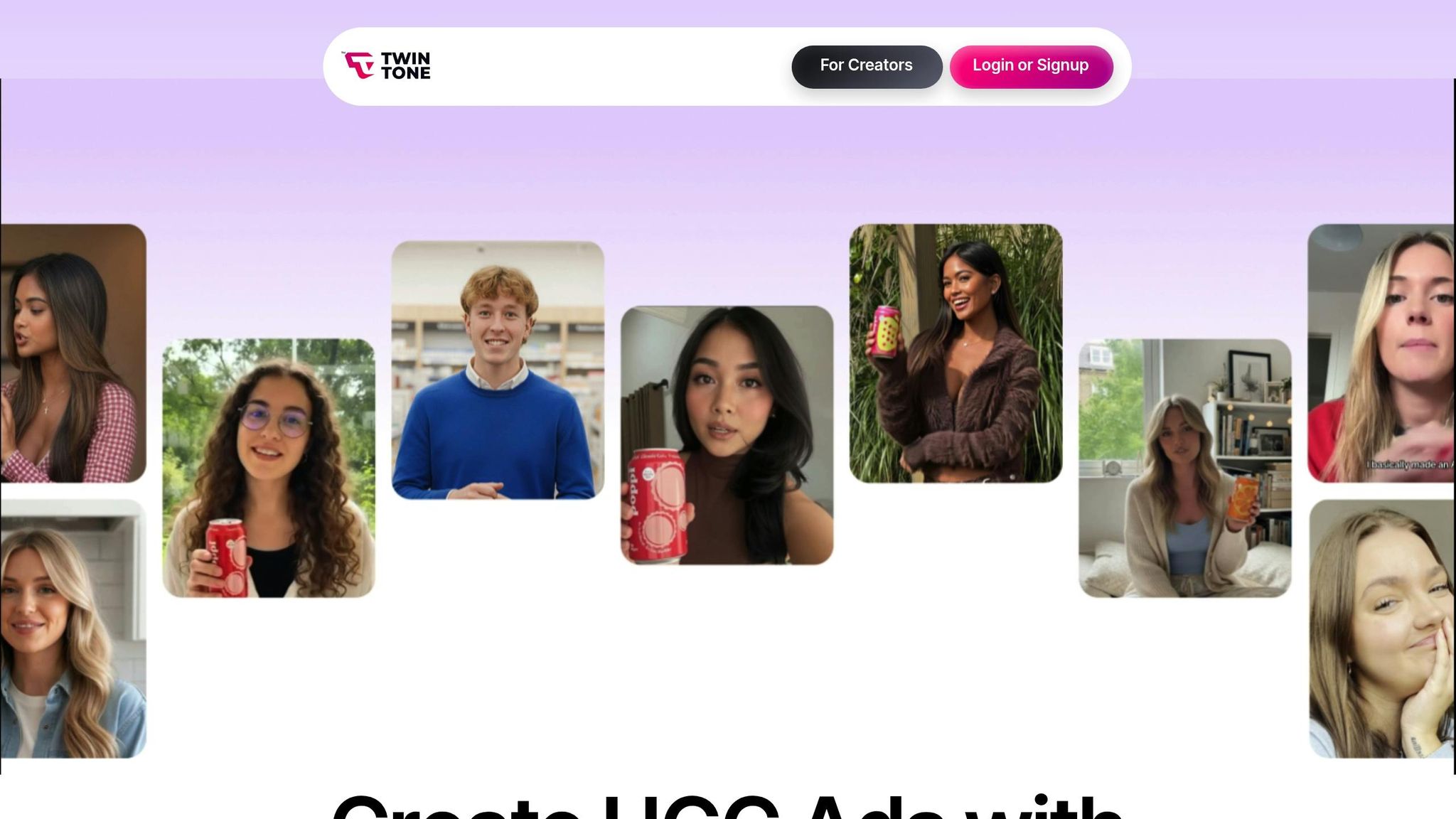
TwinTone is reshaping how DTC brands connect with their customers by introducing AI Twins - digital representations of real creators. These AI Twins handle 24/7 engagement across social commerce platforms, removing the delays of manual outreach and approvals. This approach bridges the gap between traditional sales tactics and modern AI-powered interactions, transforming shopping into an ongoing dialogue rather than a one-time event.
The platform’s AI agents take the lead in guiding customers through product options, answering their questions in real-time, and ensuring transactions align with shopper intent. TwinTone integrates seamlessly across platforms like TikTok, Amazon, YouTube, Shopify, and Twitch, creating a cohesive experience that goes beyond basic automation. Below are some of the standout features that redefine how brands engage with their customers.
AI Livestreaming and Shoppable Videos
With TwinTone, AI-powered livestreams bring shopping to life without requiring human hosts. Your AI Twin showcases products through live demonstrations, answers viewer questions about details like sizing or features, and interacts with comments in real-time. These livestreams connect directly to platforms like TikTok Shop, Amazon Live, and Shopify, turning static product pages into vibrant, interactive storefronts.
Shoppable videos take this concept a step further. AI Twins demonstrate products in engaging ways tailored to individual viewer preferences. Tools like AI-powered camera views allow customers to instantly discover similar items, making the shopping experience more intuitive and interactive compared to standard product listings.
Instant AI UGC Creation
TwinTone doesn’t just handle live interactions - it also simplifies content creation at scale. Forget the lengthy process of coordinating with creators. The platform generates user-generated content instantly, embedding all the key product details. With your AI Twin, you can create endless variations of content for your entire product lineup, testing different angles, messaging styles, and formats - all without additional filming costs.
Through its API, TwinTone enables programmatic content generation, perfect for creating videos for new products, seasonal promotions, or A/B testing. Supporting 40+ languages, the platform helps brands effortlessly reach global audiences without the need for multilingual creators. Pricing starts at $110/month for 10 AI UGC videos under the Starter plan, with Enterprise plans offering 50+ videos and exclusive access to AI livestreaming.
Performance Analytics and Tracking
TwinTone doesn’t just focus on engagement - it’s also about results. The platform tracks engagement rates, conversions, and ROI from AI-generated content. Its dashboard provides insights into opens, clicks, and content performance across platforms. Using reinforcement learning, TwinTone optimizes messaging and timing across channels.
Brands can even measure customer satisfaction scores and directly attribute revenue to specific AI Twin campaigns. This level of transparency replaces guesswork with clear, actionable data, showing exactly how AI-driven content contributes to sales compared to traditional methods.
TwinTone’s analytics-driven approach ensures brands can see the direct impact of their AI investments, making it easier to refine strategies and maximize results.
How to Add AI Agents to Your Sales Workflow
You don’t need to completely revamp your systems to bring AI agents into your sales process. Start by mapping out your customer journey and identifying areas where things slow down - like delayed responses, manual lead scoring, or repetitive inquiries about your products. These bottlenecks are prime opportunities for AI to step in and make a difference.
Next, connect your AI agents to your existing tools, such as your CRM, email platforms, and customer data systems. This integration allows AI agents to personalize interactions by leveraging real customer history. And personalization isn’t just a nice-to-have - 71% of consumers expect it. With this groundwork in place, you can smoothly incorporate TwinTone's automation tools into your workflow.
Using TwinTone's API for Automation
TwinTone's API simplifies content creation, turning what used to take weeks into an on-demand process. The API connects directly to your product feed, enabling you to generate AI-driven UGC videos for your entire catalog. Whether you’re launching new SKUs, testing different messaging, or creating localized content in over 40 languages, you can do it all without additional filming costs.
Here’s how it works: define your product parameters, pick your AI Twin, and choose your video style and length (up to 60 seconds on the Starter plan, priced at $110/month). For businesses with large product catalogs or frequent A/B testing needs, the Enterprise plan offers over 50 videos a month, along with priority support and custom training. This programmatic approach means you can launch campaigns faster and refine them based on performance data.
Improving Workflows with AI Agents
AI-driven workflows can dramatically improve your sales metrics. For example, a US homebuilder analyzed 500,000 sales transcripts to train AI agents modeled after their top-performing salespeople. The result? Conversion-to-appointment rates tripled, and weekly appointments doubled. Similarly, a European insurer revamped its sales process with AI agents for knowledge retrieval and call coaching. They saw conversion rates increase by 2 to 3 times and customer service call times drop by 25%.
AI agents excel at handling tasks like qualification, outreach, and scheduling. By eliminating manual handoffs, they keep prospects engaged when their interest is highest. This frees up your team to focus on meaningful conversations and strategic goals. Once your workflow is streamlined, the next step is tailoring these AI interactions to meet the expectations of US consumers.
Adapting AI for US Markets
Customizing your AI agents for US audiences is key to making them a natural part of your sales workflow. Start by ensuring they use US-specific formats - like dollars ($) for currency, MM/DD/YYYY for dates, and imperial units (inches, pounds, Fahrenheit). But it’s not just about formatting. American shoppers expect proactive engagement, and 76% feel frustrated when personalization is lacking. Train your AI to initiate contact based on customer behavior, such as abandoned carts or repeated product page visits, instead of waiting for customers to reach out.
Also, establish clear escalation protocols for more complex situations. For instance, a US airline used predictive AI to personalize compensation for flight disruptions, achieving a 210% improvement in targeting at-risk customers and an 800% boost in customer satisfaction. Setting up similar escalation rules ensures that high-value customers or intricate issues are quickly handed off to human agents, combining AI speed with the personal touch that US consumers appreciate.
Measuring AI Agent Performance and ROI
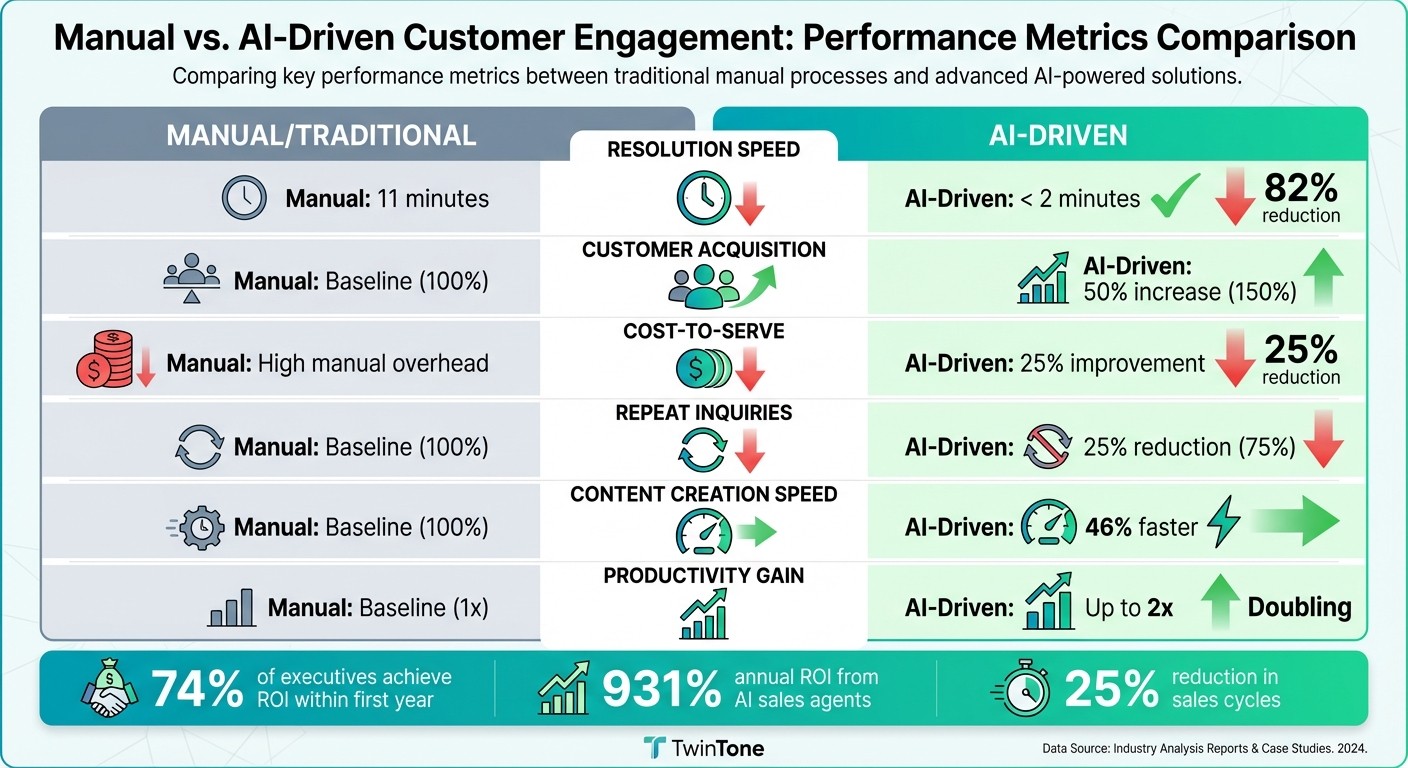
Manual vs AI-Driven Customer Engagement Performance Comparison
Measuring how well AI agents perform is crucial for improving their effectiveness and demonstrating clear returns on investment (ROI). TwinTone's analytics dashboard makes this process easier by providing real-time performance insights, directly linking AI activity to measurable outcomes.
To evaluate AI agents, focus on metrics like deal velocity, lead conversion rates, resolution speed, and repeat inquiry rates. Additionally, track cost-to-serve improvements and compare the gross margin of AI-assisted deals to manually handled ones. According to recent data, 74% of executives report achieving ROI from AI agents within the first year, and 39% have seen productivity gains at least double. Companies using AI for content creation also report creating content 46% faster and editing it 32% quicker.
Key Performance Metrics
Certain metrics can highlight both operational efficiency and revenue growth. Engagement rates and click-through rates (CTR) show how well AI-generated content connects with audiences. Tracking lead-to-conversion ratios for AI-assisted prospects versus manually managed ones offers deeper insights into effectiveness.
Revenue per employee is another telling metric. AI-focused companies often achieve 25 to 35 times more revenue per employee compared to traditional firms. For instance, a global telecommunications company used AI assistants to send over 40,000 personalized messages daily, leading to a fivefold increase in digital sales. TwinTone users can also monitor the number of AI-generated UGC content ideas and videos produced monthly and link these to spikes in engagement and conversion rates on shoppable content for actionable insights.
Comparing these metrics against traditional workflows emphasizes the efficiency and value of AI-driven processes.
Manual vs. AI-Driven Results
The difference between manual and AI-driven workflows is striking. AI agents eliminate inefficiencies, allowing teams to focus on high-impact tasks. For example, implementing AI sales agents can yield a 931% annual ROI, reduce sales cycles by 25%, and improve win rates by 15%.
Metric | Manual/Traditional Results | AI-Driven Results |
|---|---|---|
Resolution Speed | 11 minutes | < 2 minutes |
Customer Acquisition | Baseline | 50% increase |
Cost-to-Serve | High manual overhead | 25% improvement |
Repeat Inquiries | Baseline | 25% reduction |
Content Creation | Baseline | 46% faster |
Productivity Gain | Baseline | Up to 2x |
Using TwinTone's API, businesses can create AI-generated UGC videos on demand and track their performance in real time. The platform's analytics tools allow you to identify which AI Twins drive the most engagement, which product presentations convert best, and how shoppable livestreams perform on platforms like TikTok, Amazon, and Shopify. This data-driven approach not only refines your strategy but also provides hard numbers to showcase the ROI of your AI investment.
Conclusion
AI agents are reshaping how DTC brands and ecommerce teams drive sales. These tools go beyond basic support by tackling complex tasks like personalizing recommendations and managing returns, all while ensuring 24/7 customer engagement with minimal human input. The shift from reactive support to autonomous execution allows brands to deliver highly tailored interactions at scale, ensuring no sales opportunity slips through the cracks. This marks a major step forward in automated, impactful sales strategies.
Projections show that agentic AI will account for over 60% of marketing and sales value, with productivity gains ranging from 15% to 30%. By 2028, one-third of enterprises are expected to adopt such systems to enhance their operations.
TwinTone takes this evolution further by integrating AI-powered livestreaming, on-demand UGC, and shoppable videos across platforms like TikTok, Amazon, Shopify, and YouTube. This approach automates product demonstrations while connecting real-time analytics to engagement and conversion metrics. TwinTone's API enables brands to produce genuine product content at scale, cutting down traditional delays and improving efficiency. By adopting these advanced tools, businesses streamline operations and unlock significant revenue potential.
The key to success lies in effectively designing, managing, and scaling your AI agents. TwinTone's platform equips brands to turn autonomous engagement into measurable revenue, freeing up teams to focus on strategic priorities. With TwinTone's seamless AI integration, businesses can achieve smoother workflows and scalable growth.
FAQs
How can AI agents enhance customer engagement and boost sales?
AI agents are reshaping how businesses interact with customers and drive sales by automating personalized communication and streamlining the buying process. With advanced data analysis, these agents can anticipate customer needs, offer customized experiences, and respond instantly across multiple platforms. This ensures round-the-clock support while cutting down on response times.
For sales teams, AI agents are game-changers. They use predictive analytics and lead scoring to identify high-value prospects, helping teams focus on the right opportunities and close deals faster. On top of that, they analyze customer behavior to suggest relevant products or services, making upselling and cross-selling more effective. By integrating AI agents into daily operations, businesses can see higher conversion rates, happier customers, and stronger brand loyalty.
What are the main advantages of using AI for product recommendations?
AI-driven product recommendations transform shopping into a personalized journey, using real-time analysis of customer data, preferences, and behaviors. This enables businesses to offer suggestions that align with individual tastes, making it easier for customers to discover products they’re likely to love - and buy.
These systems also streamline the shopping experience by providing quick, accurate recommendations, cutting down on decision fatigue. Shoppers can find what they need faster, while the technology adjusts to their evolving preferences, ensuring the suggestions remain relevant. This approach not only encourages repeat purchases but also builds stronger customer loyalty by making the entire process feel tailored and effortless.
How can businesses calculate the ROI of AI agents in their sales processes?
Businesses can measure the ROI of AI agents in their sales processes by focusing on metrics that highlight growth, efficiency, and customer satisfaction. Key areas to evaluate include boosts in revenue per sales rep, shorter sales cycles, and lower operational expenses.
For instance, organizations often experience 3% to 15% revenue growth and 20% to 40% cost reductions when AI agents are seamlessly incorporated into their workflows. By monitoring these results alongside metrics like lead conversion rates and customer retention, businesses can clearly assess the impact AI agents have on their sales performance.