AI Agents in the Creator Economy Explained
How to build a futureproof relationship with AI
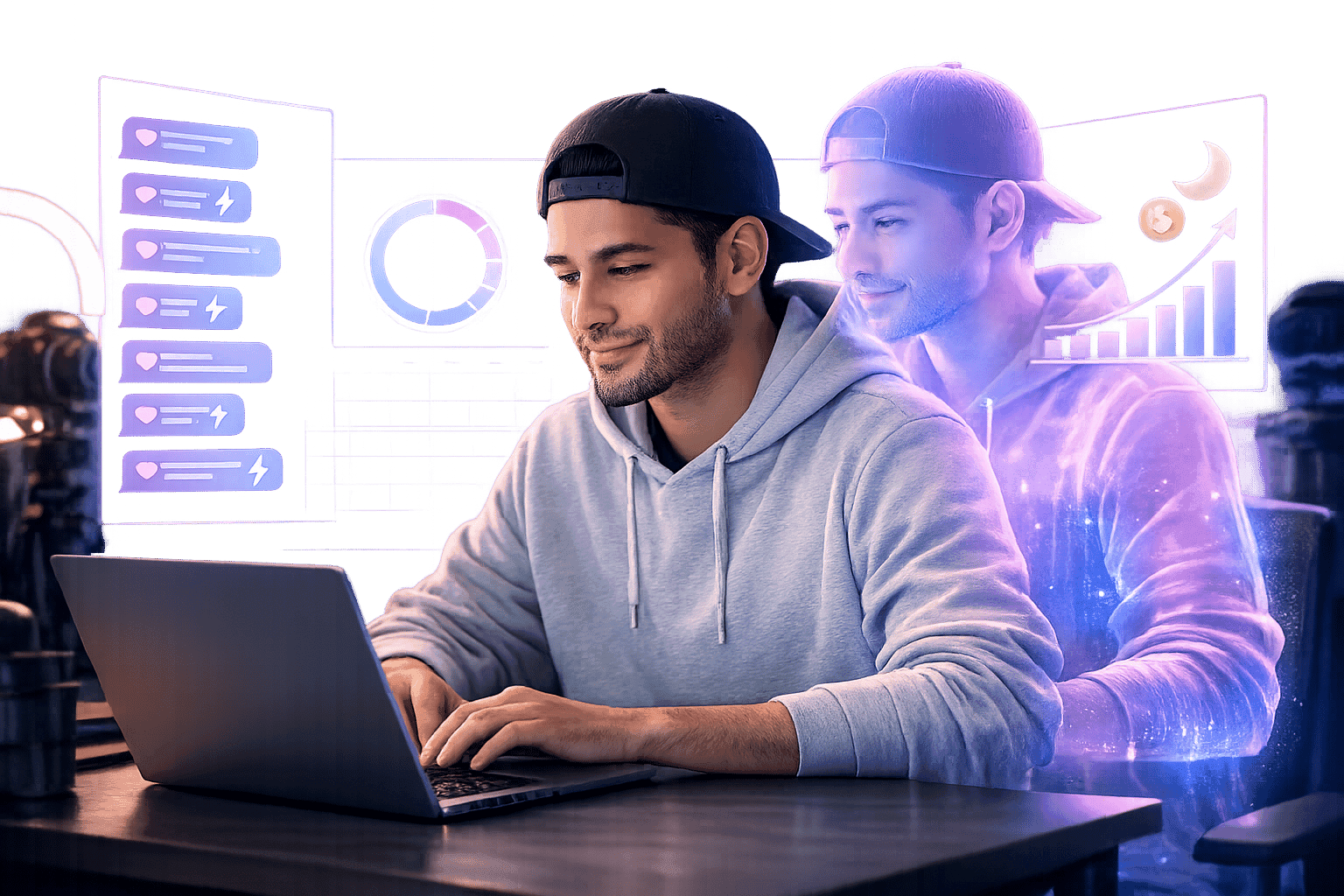
AI agents are changing how creators work. Unlike basic tools, these agents handle tasks like managing messages, scheduling, and live shopping streams without constant input. They mimic a creator's tone, making interactions feel personal, even when automated. By 2028, 33% of business software will include AI agents, up from just 1% in 2024. Creators are already seeing results - higher engagement, faster workflows, and new revenue streams.
Key Highlights:
Time-Saving: Automates repetitive tasks like replying to messages and editing content.
Engagement Boost: AI-driven live shopping streams achieve up to 12x higher engagement.
Revenue Growth: AI helps with lead qualification, upselling, and audience targeting.
Adoption Trends: 62% of creators plan to use generative AI in their operations.
AI agents simplify workflows and allow creators to focus on big-picture goals while maintaining a personal connection with their audience. However, challenges like cost, trust, and technical setup remain barriers to adoption.
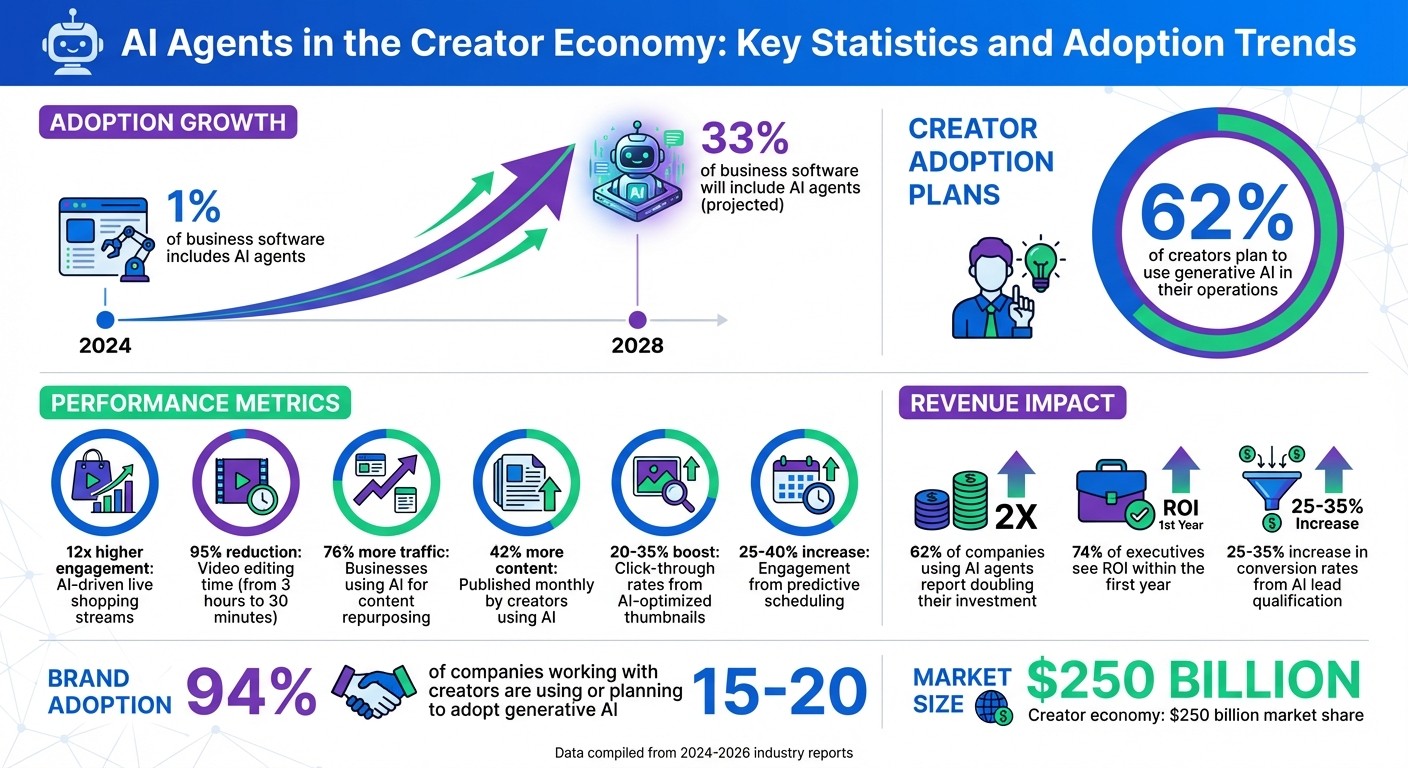
AI Agents in the Creator Economy: Key Statistics and Adoption Trends 2024-2028
What Are AI Agents and How Do They Work?
AI Agents in the Creator Economy: A Definition
AI agents are intelligent software systems designed to achieve goals and complete tasks for users. Unlike traditional tools that wait for user commands, these agents make independent decisions, adapt to new data, and work toward objectives with minimal oversight.
In the creator economy, AI agents take on tasks like managing messages, identifying those that need replies, crafting responses that match the creator's voice, and even handling follow-ups - all while the creator focuses on content creation or business deals. For instance, in June 2025, creators Elizabeth Gasiba, Paige Piskin, and Marcella Cortland used the platform Soopra to create "digital twins" by uploading personal journals and past writings. These agents learned their communication styles and autonomously managed fan interactions. As Elizabeth Gasiba noted:
"Even though they know it's not me typing in real time, the responses still feel like me. The vibe, the tone, the little expressions - it all matches how I talk."
AI agents function through four key components: a "brain" (a large language model for decision-making), "tools" (APIs or functions to interact with external systems), "memory" (both short-term context and long-term historical data), and a "persona" (a communication style learned from the creator's content) . These elements allow agents to break down complex tasks into smaller steps, choose the right tools, and execute workflows independently. This autonomy sets AI agents apart from standard tools, as explained below.
AI Agents vs. Standard AI Tools
The main difference between AI agents and standard AI tools is their level of independence and ability to handle complexity. Standard AI tools, like basic chat assistants, respond only to direct prompts and perform single tasks. In contrast, AI agents are proactive - they pursue broader goals, decide on next steps, and manage multi-step workflows with little to no human input .
Feature | AI Agent | AI Assistant | Standard Bot |
|---|---|---|---|
Autonomy | High; operates independently | Moderate; needs user direction | Low; follows rigid rules |
Complexity | Handles multi-step workflows | Best for single-turn tasks | Limited to basic interactions |
Interaction | Proactive and goal-oriented | Reactive; responds to requests | Reactive; fixed commands |
Learning | Learns and adapts over time | Limited learning capabilities | No learning capability |
This comparison highlights why creators are drawn to AI agents for managing complex, ongoing tasks. For example, while a standard AI assistant might draft a single response to a fan comment, an AI agent goes further - it monitors all messages, identifies those needing replies, crafts personalized responses in the creator's tone, sends them, and even follows up if the conversation continues. All of this happens without the creator needing to check their phone.
Many creators are already seeing the impact of AI on creator-fan relationships. As Paige Piskin shared:
"Without these tools, I really was at a bottleneck a few years ago and struggled to keep up with content creation while also producing client work... Now I have so many tools and creative pipelines, I can produce more content for my platform as well as for clients without getting burned out."
AI agents achieve this through what developers call an "execution loop" - a process where the agent continuously evaluates progress toward its goal, adjusts strategies, and iterates until the task is complete. This is a significant departure from traditional AI tools, which require manual input for each step of a complex task.
How AI Agents Improve Creator-Fan Interactions
Personalized Engagement at Scale
AI agents are transforming how creators connect with their fans by making interactions more personal and scalable. For creators juggling thousands of followers, maintaining meaningful engagement can feel impossible. This is where AI steps in, offering tools that go beyond basic chatbots. These agents don’t just follow pre-written scripts - they study a creator’s content, tone, and personality by analyzing everything from social media posts to interviews and even personal journals. The result? An "AI twin" that mirrors the creator’s authentic voice.
Marcella Cortland, a writer and film producer, shared her approach to creating such a persona:
"I do that by making a daily journal - these are my thoughts today, and that educates my persona".
This method ensures that responses feel personal, even when the creator isn’t available. For example, in December 2025, TwinTone helped over 2,000 creators develop their own AI Twins for social commerce. Some of these campaigns saw engagement rates soar up to 12 times higher than traditional human-led efforts. These AI Twins can handle constant interaction and even produce content, allowing creators to stay connected with their audience while also generating passive income. By tailoring every interaction, these tools help creators maintain an authentic connection with fans.
Virtual Assistants for Fan Communication
AI virtual assistants are another layer in improving real-time communication with fans. Platforms like Meta AI Studio let creators design custom AI avatars that engage followers through direct messages on apps like Instagram, Facebook, WhatsApp, and Messenger. Creators such as Paige Piskin use these assistants strategically, activating them during high-traffic periods while reserving personal interaction for key moments. Importantly, these AI assistants are always clearly labeled as automated systems.
What makes these tools stand out is their ability to maintain the creator’s tone and style in every interaction. Whether it’s an AI twin or a virtual assistant, the goal remains the same: to scale genuine engagement without losing the personal touch.
AI Agents for Content Creation and Workflow Automation
Automating Content Creation Tasks
AI agents are revolutionizing content production by tackling the most tedious and time-intensive tasks, freeing creators to focus on strategy and creativity. For instance, video editing, which can take up to 80% of production time, becomes far more efficient with AI. These tools can reduce a typical 3-hour editing session to just 30 minutes - a massive 95% cut in manual effort. They handle tasks like removing silences, cutting filler words, generating captions, and even switching camera angles based on who’s speaking.
When it comes to SEO, AI systems can research trending keywords instantly, creating optimized titles, descriptions, and tags in seconds - what used to take 20–30 minutes. These tools can also repurpose long-form content, like a podcast or video, into multiple content ideas and assets: short clips for TikTok or Instagram Reels, blog posts, and newsletters. This approach isn’t just efficient - it’s effective. Businesses using AI for content repurposing see 76% more traffic, and creators report publishing 42% more content each month while working fewer hours.
AI even lends a hand with thumbnail design, generating multiple variations and running A/B tests to find the most effective option. This can boost click-through rates by 20% to 35%. Unsurprisingly, 93% of marketers now rely on generative AI to speed up content creation. Beyond speeding up production, these tools ensure every part of the process is optimized.
Streamlining Workflow Management
AI agents don’t stop at content creation - they also simplify entire workflows by connecting specialized tools with minimal human intervention. For example, an orchestration agent can take a raw video upload, send it to an editing agent, pass the finished product to an SEO agent for metadata optimization, and then activate a publishing agent to schedule posts across platforms.
These tools also enhance communication management. They can sort through high volumes of fan messages, prioritize them, respond to FAQs, and flag VIP fans or high-value opportunities for personal attention. On the administrative side, AI agents handle tasks like scheduling consultation calls, syncing calendars, and managing brand deal logistics, including outreach and follow-ups. Creators using AI for such tasks report saving 15 to 20 hours per week.
The best way to get started? Focus on your most time-consuming task, automate that first, and gradually expand as you see consistent results from the AI agent.
AI agents = dream team for creators?
How AI Agents Drive Revenue Growth
AI agents aren't just tools for streamlining tasks - they're now pivotal in boosting revenue by fine-tuning engagement and managing diverse income streams.
Optimizing Audience Engagement and Timing
AI agents excel at understanding audience behavior, especially when it comes to timing. By analyzing past engagement data, they can determine the best times to post for different audience segments. The payoff? Predictive scheduling can increase engagement by 25-40% compared to static posting methods.
But timing is just the start. AI agents also test headlines, visuals, and messaging to discover what resonates most with users. This continuous optimization can lead to a 60% boost in click-through rates. They even track real-time sentiment in comments and direct messages, allowing businesses to quickly act on positive feedback or address potential issues. These insights directly shape revenue-focused strategies.
The results speak for themselves. Companies using AI-driven engagement report a 20% improvement in customer satisfaction and a 30% reduction in service costs. For creators, this means smarter allocation of resources while still delivering the quality interactions that drive purchases, memberships, and sponsorships. By nailing the timing and fine-tuning engagement, businesses set the stage for more diversified revenue streams.
Multi-Channel Revenue Strategies
AI agents don't just stop at engagement - they actively manage multiple revenue channels. These agents take on specialized roles: qualifying leads to schedule high-value sales calls, identifying upsell opportunities based on user behavior, and resolving support queries while flagging critical revenue issues.
The return on investment (ROI) is undeniable. 62% of companies using revenue-focused AI agents report doubling their investment, and 74% of executives see ROI within the first year when these agents are applied to revenue generation instead of just productivity. For instance, businesses using AI for lead qualification experience conversion rate increases of 25-35%. Even automating 20% of support tickets can result in an 8-point boost in repeat purchase rates within 28 days.
"Saving time doesn't create income. It just gives you more free time... Smart creators are using AI to earn faster." – Sharyph, The Digital Creator
The secret lies in identifying revenue leaks - missed leads, unnoticed churn, or untapped upsell opportunities - and deploying AI agents to plug those gaps. For creators, applying a 10:1 ROI rule is crucial: only keep AI agents that generate or protect revenue at least 10 times their maintenance cost within six months. This disciplined approach ensures that AI becomes a revenue powerhouse, not just a productivity tool.
Challenges in Adopting AI Agents
Even with the potential for revenue growth, creators face real obstacles when trying to implement AI agents. The technical demands alone can feel overwhelming, especially for smaller creators without dedicated tech teams.
Barriers to Adoption
Moving from simple, prompt-based tools to fully autonomous AI agents requires a lot of upfront effort. For example, training digital twins involves uploading personal writings, journals, and interview transcripts - a process that’s not only labor-intensive but also demands ongoing adjustments.
Security risks add another layer of concern. AI agents often have access to sensitive data, interact with potentially untrustworthy fan content, and communicate externally, creating vulnerabilities. A stark example of this came in January 2026, when the AI-agent social network Moltbook faced backlash after researchers found hundreds of cases where agents leaked API keys and conversation histories within days of its launch.
There’s also the issue of cost and consumer trust. Only 26% of people trust companies to use AI responsibly, and comfort levels with AI have dropped by 10.5% year-over-year. For creators working with brands, this skepticism can lead to lost opportunities. Jessica Tamsedge, CEO of Dentsu Creative UK, highlighted this trend:
"I've been surprised by how many advertisers and clients... are writing in, 'we do not want AI in use through the creative process,' and that applies to influencers as well".
On top of that, creators must navigate the technical architecture of AI systems. This includes choosing between expensive, high-performance models and cheaper, faster alternatives. They also face "context compression", where AI agents forget earlier interactions - an embarrassing flaw that disrupts the personalized experience fans expect. Managing multiple specialized agents introduces even more complexity, as creators must coordinate handoffs and maintain smooth conversations.
These hurdles highlight the importance of striking the right balance between automation and authenticity.
Balancing Automation with Authenticity
Beyond the technical challenges, maintaining genuine interactions is no small feat. AI analyst and ethicist Allison Harbin points out that after a few exchanges, AI responses can drift off-topic, potentially disengaging fans.
To address this, many creators follow an 80/20 rule: they let AI handle 80% of repetitive tasks while personally managing the final 20% - the parts that involve storytelling, creative decisions, and direct fan engagement. By training AI to mimic their communication style, creators ensure that responses still sound like them, even when fans know they’re interacting with a digital twin.
Transparency is key in this process. Some creators clearly label AI assistants so fans are aware when they’re speaking with a digital twin. Others use AI selectively, automating general interactions while personally managing branded or sponsored content to maintain trust with advertisers. This careful approach allows creators to scale their presence without losing their authentic voice.
The Future of the Creator Economy with AI Agents
AI Agents as a Growth Driver
Autonomous AI agents are becoming a key part of business software, with adoption projected to jump from just 1% in 2024 to 33% by 2028. For creators, this shift removes the challenges of manually managing fan engagement, opening up new possibilities.
Today, 62% of creators expect to use generative AI to support their business operations within the next year. This approach allows solo creators to handle large-scale, personalized interactions while focusing on bigger-picture strategies. Instead of being tied to constant content production, creators can step into a creative director role. AI tools take on tasks like idea generation, workflow streamlining, and audience management, giving creators more bandwidth to innovate.
On the brand side, 94% of companies working with creators are already using or planning to adopt generative AI. This trend gives creators who embrace such tools a significant edge. They not only achieve better engagement rates but also maintain a steady stream of content across various platforms. This fast-growing reliance on AI is reshaping how creators and brands approach social commerce.
Impact on Social Commerce
This AI-driven evolution is making waves in social commerce, a sector with enormous potential. The creator economy’s market share has already reached $250 billion and continues to grow rapidly. Platforms that leverage AI-powered content automation are at the forefront of this expansion.
Take TwinTone, for example. This platform showcases how AI can transform creator-brand collaborations. It allows brands to generate authentic user-generated content (UGC) videos and host AI-powered live streams featuring creator AI Twins. With this technology, brands can produce product demos and shoppable content instantly across platforms like TikTok, Shopify, Amazon, YouTube, and Meta. The result? Faster, scalable content creation that aligns with the future of digital marketing.
One of the biggest challenges in scaling content has been maintaining authenticity, but AI Twins solve this issue. By mimicking a creator's tone, style, and personality, these tools ensure fans still feel the personal connection they value. For brands, this means a steady flow of content, the ability to reach audiences in multiple languages, and access to performance analytics directly tied to ROI. By integrating these personalized AI tools with revenue-driven strategies, creators can expand their reach, deepen fan engagement, and enhance the overall experience - all while driving measurable growth.
FAQs
What makes AI agents different from traditional AI tools in the creator economy?
AI agents differ from traditional AI tools thanks to their autonomy and proactive nature. Unlike standard AI tools, such as chatbots that only respond when prompted, AI agents can take initiative. They perform tasks, make decisions, and manage workflows without needing constant human oversight.
For instance, AI agents can tackle tasks like replying to comments, organizing direct messages, scheduling appointments, or repurposing content - all while maintaining the creator's unique tone and brand identity. They also connect seamlessly with various tools to handle multi-step processes, making them far more adaptable than reactive tools. This proactive approach allows creators to save time, expand their reach, and simplify their operations.
What challenges do creators face when using AI agents in their work?
Creators often struggle to find the right balance between automation and authenticity when incorporating AI tools into their work. These tools can help simplify tasks like engaging with fans or producing content, but there’s often a concern about maintaining their personal touch. Fans may react differently to AI-driven interactions - some might welcome the efficiency, while others could feel disconnected if the engagement lacks a genuine, human feel.
Another significant challenge is the technical learning curve. Setting up and customizing AI tools to match a creator’s personality and brand isn’t always straightforward - it can take a lot of effort and time. On top of that, ethical questions come into play. Creators must decide how transparent they should be about AI’s role in their work and take steps to safeguard fan privacy. With AI technology advancing so quickly, it’s also a constant effort to stay informed and ensure these tools align with a creator’s personal values and goals.
How do AI agents help creators grow their income?
AI agents are transforming how creators grow their income by automating tasks like fan engagement, content management, and marketing. By taking over these time-consuming responsibilities, creators can focus on what they do best: producing top-notch content. Plus, these tools work around the clock, strengthening fan loyalty and unlocking new income opportunities like subscriptions, merchandise, and exclusive content.
These agents also serve as virtual assistants, tackling tasks such as lead generation, identifying collaboration opportunities, and managing promotional campaigns. Because they operate independently, creators can earn even outside typical working hours. This makes AI agents a game-changer for scaling income and driving long-term success in the creator economy.