What Are AI Agents? A Beginner’s Guide
How to build a futureproof relationship with AI
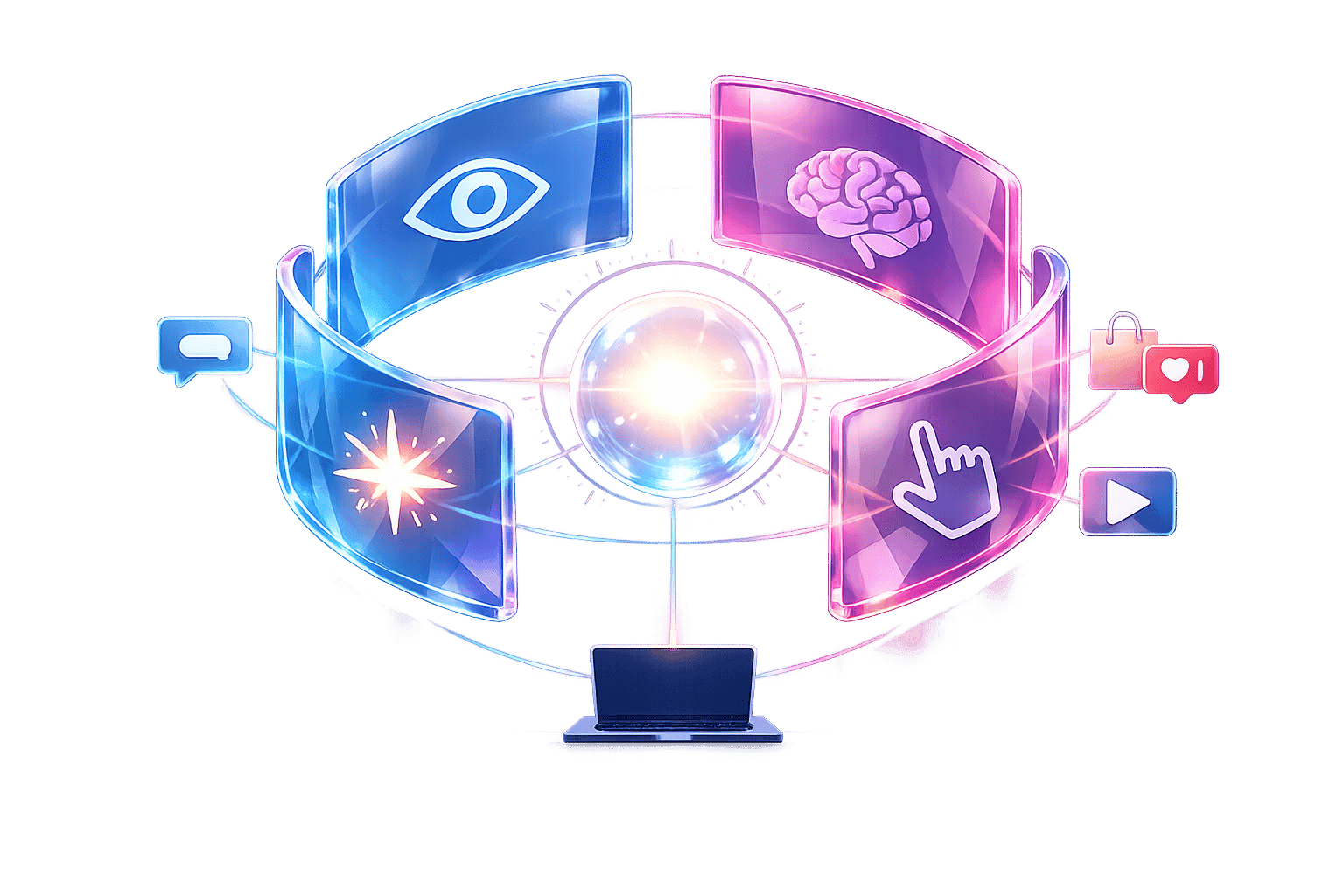
AI agents are independent software programs that can observe, decide, and act to complete tasks without constant human input. Unlike basic tools, they follow a three-step process - perception, reasoning, and action - to handle complex workflows. They also improve over time through learning.
These agents are transforming industries like ecommerce, social media, and content creation by automating tasks such as customer support, personalized recommendations, and multi-step workflows. For example, AI shopping assistants like Amazon's Rufus have served millions of users, while brands use AI to produce content faster and at lower costs.
Key Features:
Perception: Gather data from APIs, user inputs, and memory.
Reasoning: Use large language models to plan and break tasks into steps.
Action: Execute tasks through external tools like APIs.
Learning: Refine performance using feedback and reinforcement techniques.
Types of AI Agents:
Goal-Based Agents: Focus on achieving specific objectives (e.g., navigation systems).
Utility-Based Agents: Make decisions by weighing multiple factors (e.g., stock trading bots).
Learning Agents: Improve continuously through feedback (e.g., streaming recommendations).
AI agents are reshaping how businesses operate by increasing efficiency and reducing manual effort.
What are AI Agents? (A Beginners Guide)
How AI Agents Work
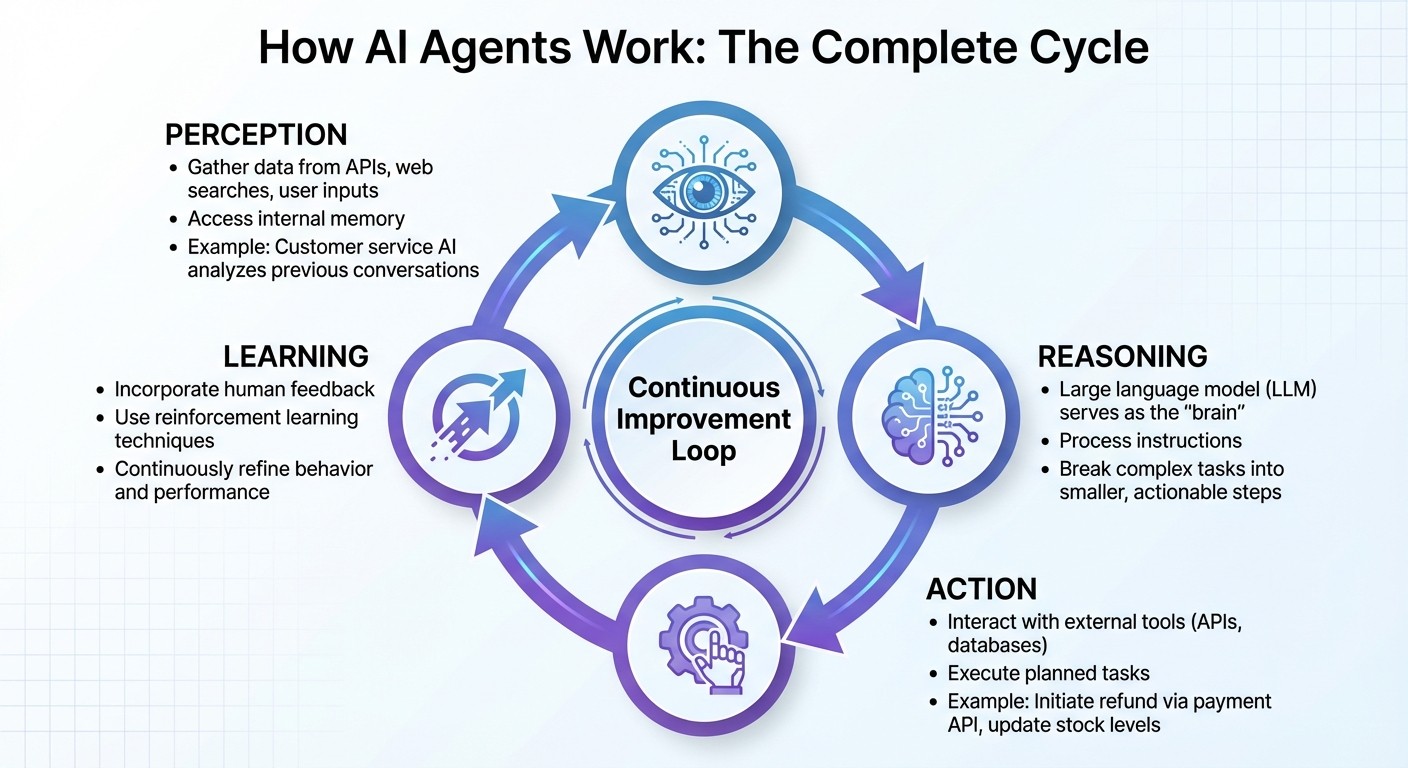
How AI Agents Work: The 4-Step Cycle of Perception, Reasoning, Action, and Learning
AI agents operate through a continuous cycle of gathering data, reasoning, taking action, and learning. This process allows them to work independently and refine their performance over time, making them much more advanced than basic automation tools.
Main Parts of AI Agents
AI agents are built on four essential components that function together to achieve their goals:
Perception
This is how agents collect data from their surroundings. They pull information from APIs, web searches, user inputs, and their internal memory. For instance, a customer service AI might analyze previous conversations before crafting a response.
Reasoning
Here, a large language model (LLM) serves as the agent's "brain." It processes instructions and breaks down complex tasks into smaller, actionable steps, ensuring tasks are tackled efficiently.
Action
Once a plan is in place, the agent interacts with external tools, such as APIs or databases, to carry out its tasks. For example, it could initiate a refund by triggering a payment API or update stock levels in response to a new order.
Learning
Agents improve over time by incorporating human feedback and using reinforcement learning techniques to fine-tune their behavior.
These elements work together to form the backbone of an AI agent's functionality.
AI Agent Workflow
The workflow begins when a task is assigned, either through a user prompt or an automated trigger. The agent first gathers context by accessing databases or retrieving stored information.
With the necessary context in hand, the agent plans its approach. Two common planning methods are:
ReAct (Reasoning and Action): The agent alternates between thinking, acting, and observing results, repeating this cycle until the task is complete.
ReWOO (Reasoning Without Observation): In this method, the agent plans the entire process upfront and executes it step by step, which can minimize computational demands.
After planning, the agent executes its tasks using the tools at its disposal. It then evaluates the results and adjusts its approach if needed. This ability to self-correct is what sets AI agents apart as autonomous systems.
"The reasoning layer is a defining feature of agentic AI, enabling agents to think about how they achieve their goals." - NVIDIA
Types of AI Agents
AI agents can be grouped based on how they make decisions and what drives their objectives. These categories help identify which type of agent fits specific tasks or challenges. By understanding these distinctions, it becomes clearer how different agents enhance workflows and solve problems.
Goal-Based Agents
Goal-based agents are all about achieving a specific target. They break down the main objective into smaller, manageable steps and use planning algorithms to determine the most efficient way to complete them. For example, a delivery robot might calculate the quickest route to its destination, or project management software could organize tasks to meet a tight deadline. These agents excel at executing tasks in a step-by-step manner to meet their goals.
Utility-Based Agents
Utility-based agents take decision-making a step further by evaluating multiple factors at once. Instead of just aiming for a goal, they assess which outcome offers the best overall benefit, using a utility function to measure factors like rewards or efficiency. A navigation system balancing fuel costs, toll fees, and travel time is a good example. These agents are especially useful when managing trade-offs, such as speed versus safety or cost versus quality. For instance, stock trading bots use this approach to continuously evaluate and maximize returns. This ability to weigh options dynamically makes them highly versatile.
Learning Agents
Learning agents are designed to improve over time. They rely on four key components: a learning element to acquire knowledge, a critic to provide feedback on performance, a performance element to make decisions, and a problem generator to test new strategies. Streaming platforms often use these agents to analyze user behavior and refine recommendations. As they gather more data, they become better at predicting user preferences and making smarter decisions.
Agent Type | Decision Driver | Common Applications |
|---|---|---|
Goal-Based | Achieving specific targets | Navigation systems, project planning |
Utility-Based | Maximizing rewards | Stock trading bots, travel search tools |
Learning | Experience and feedback | Personalized recommendations, chatbots |
Where AI Agents Are Used
AI agents are becoming a part of everyday digital life, managing customer inquiries, hosting live shopping events, and producing content on a large scale. Let’s take a closer look at how they’re transforming three major areas.
Ecommerce
Online shopping has embraced AI agents to guide customers through every stage of their purchase journey. These agents integrate with product catalogs, inventory systems, and order databases to deliver real-time answers. They tackle complex questions, recommend products based on a shopper’s history, handle returns, and even update shipping details - all without human help.
For instance, Amazon introduced Rufus, an AI shopping assistant, in February 2024. By October 2024, CEO Andy Jassy shared that Rufus had assisted over 250 million customers, with monthly active users increasing by 140% year-over-year. Similarly, Lowe's launched Mylow in March 2024, an AI assistant developed in collaboration with OpenAI. By November 2024, Lowe's CEO Marvin Ellison revealed that Mylow was fielding nearly 1 million questions per month about product details and project advice, easing the workload for human staff.
Consumer expectations are shifting, too. 73% of ecommerce leaders predict that customers will demand more AI-driven services in the next five years, while 78% of US adults reported AI played a role in their 2024 holiday shopping. Beyond just answering questions, these agents make shopping faster and more efficient. They’re also extending their influence to social media, where they fine-tune customer interactions.
Social Media and Social Commerce
On social platforms, AI agents work around the clock, responding to direct messages, comments, and customer inquiries. They also monitor conversations to identify trends, spot potential PR challenges, and adjust content strategies on the fly.
The market for AI in social media is expected to grow from $2.69 billion in 2025 to $11.37 billion by 2031. These agents don’t just respond - they optimize. By using intelligent scheduling, they’ve boosted engagement rates by 25-40%.
In the realm of social commerce, AI agents simplify the shopping process directly within chat interfaces. They answer product questions, recommend items based on browsing behavior, and enable customers to make purchases without leaving the app. Social platforms are evolving into complete shopping destinations, and AI agents are at the center of this transformation. Meanwhile, these tools are also reshaping how content is created.
Content Creation
AI agents are revolutionizing content workflows by automating repetitive tasks like summarizing research, drafting social media posts, and adapting content for various platforms. They break down complex projects into smaller steps and provide tailored feedback to match each creator’s style.
Take TwinTone's AI Twins as an example. These tools automate the production of user-generated content, including shoppable videos, product demonstrations, and livestreams that reflect the unique tone of individual creators. Brands can host always-on live shopping streams across platforms like TikTok, Amazon, YouTube, and Shopify without the need for manual coordination. With support for 40+ languages and API capabilities for programmatic content generation, AI agents handle the heavy lifting, allowing brand teams to focus on strategy and creativity.
These systems go beyond simple responses - they can now reason, plan, and adapt. Acting as a digital workforce, they manage multi-step workflows, from initial content creation to distribution and performance tracking. AI agents are no longer just tools; they’re becoming indispensable collaborators.
Conclusion
AI agents are reshaping how businesses navigate the digital world. Unlike traditional chatbots with rigid scripts, these agents tackle complex, multi-step tasks entirely on their own. They observe their surroundings, make informed decisions, take actions, and continuously learn from their outcomes. This ability to adapt and improve is driving noticeable efficiency gains across various industries.
The leap from basic automation to fully autonomous systems is already yielding clear results. For example, in 2025, a consumer goods company leveraged an AI agent to optimize global marketing campaigns. What previously required six analysts working for a week was accomplished by one employee and an AI agent in under an hour. Another company slashed content creation costs by 95% and boosted production speed by 50 times, reducing the timeline for publishing blog posts from four weeks to just one day.
The adoption of AI agents is accelerating. By 2025, 79% of senior executives reported their companies had already integrated AI agents into their operations, and 92% planned to increase AI investments over the following three years. With the market for AI agents projected to grow at a 45% compound annual growth rate (CAGR) over the next five years, their impact is undeniable.
From ecommerce and social media to content production, AI agents are stepping in to manage customer support, recommend products, and generate content at lightning speed. By automating repetitive tasks at scale, they allow teams to focus on strategic initiatives and creative problem-solving. This shift highlights their growing role as essential digital collaborators in streamlining operations across industries.
Key Takeaways
AI agents are independent software programs designed to achieve specific goals. They rely on four core abilities: perception to gather information, reasoning to make decisions, action to execute tasks, and learning to improve performance over time. Different types of agents serve different needs: goal-based agents aim for specific targets, utility-based agents prioritize optimal outcomes, and learning agents refine their behavior through feedback. In practice, AI agents are revolutionizing customer service in ecommerce, managing social media interactions, and accelerating content creation to levels previously unimaginable. Their standout feature is their capacity to handle intricate workflows autonomously, enabling businesses to scale without proportionally increasing their workforce.
FAQs
What makes AI agents different from traditional automation tools?
AI agents bring something different to the table compared to traditional automation tools: intelligence, flexibility, and autonomy. While traditional tools stick to rigid rules and predefined workflows to perform tasks as programmed, AI agents take it a step further. They use cutting-edge technologies like machine learning and natural language processing to analyze data, make decisions, and even improve over time.
What sets AI agents apart is their ability to tackle dynamic, complex tasks. They can interpret their surroundings and adjust their actions based on new information. Operating independently, they process inputs like text, voice, or video and adapt to changing conditions. This makes them perfect for roles such as virtual assistants, recommendation engines, and self-driving cars - situations where adaptability and decision-making aren't just helpful but necessary.
Which industries are being transformed the most by AI agents?
AI agents are transforming the way industries function by taking over repetitive tasks, making better decisions, and enabling smarter workflows. Take manufacturing as an example - AI is fine-tuning production lines, managing inventory with precision, and ensuring smoother operations. Over in logistics, these agents are simplifying supply chains and making deliveries faster and more reliable.
In healthcare, AI tools are stepping up by analyzing complex data, assisting in patient care, and even supporting accurate diagnostics. Meanwhile, in customer service, they’re answering questions, offering tailored support, and resolving problems much faster than traditional methods. These advancements are changing business dynamics, sparking new ideas, cutting costs, and boosting efficiency across the board.
How do AI agents get better at what they do?
AI agents get better over time by learning from data, feedback, and their own experiences. They rely on machine learning techniques like reinforcement learning, which allows them to adjust and make better decisions based on previous results.
For instance, a virtual assistant powered by AI might study user interactions to grasp preferences more accurately. Similarly, a recommendation system sharpens its suggestions by analyzing how users behave. This capacity to adapt and improve enables AI agents to handle their tasks with growing precision and efficiency.