Top Tools for Cross-Platform VR Media Distribution
How to build a futureproof relationship with AI

The VR industry is booming, with the market projected to grow to $435.36 billion by 2030. But distributing VR content across platforms like Meta Quest, PlayStation VR2, SteamVR, and Viveport can be challenging due to differing technical requirements and submission processes. This guide covers 10 tools that simplify cross-platform VR media distribution, helping creators save time, reach broader audiences, and maintain quality.
Key Tools for VR Distribution:
TwinTone: AI-powered digital twins for automated VR content creation and live streams.
Unity 3D: A leading VR development engine with cross-platform support.
Unreal Engine: High-quality visuals and easy deployment to multiple VR platforms.
Oculus Store: Meta Quest’s official platform with built-in monetization options.
SteamVR: A PC VR platform with access to a massive user base.
Viveport: HTC’s platform with subscription-based and one-time purchase options.
PlayCanvas: Browser-based VR engine for instant, app-free experiences.
Amazon Sumerian: A retired tool that influenced modern VR platforms with browser-based VR.
CLDXR: Cloud-native solution for streaming VR content across devices.
EchoAR: Cloud-based management for 3D/VR/AR assets with real-time updates.
Quick Comparison:
Tool | Platforms Supported | Pricing Model | Best For |
|---|---|---|---|
TwinTone | Major VR platforms | Subscription-based | AI-driven content and live streams |
Unity 3D | OpenXR, most VR devices | Free/Pro ($2,040/yr per seat) | Custom VR apps and games |
Unreal Engine | OpenXR, most VR devices | Free (5% royalty after $1M) | High-fidelity VR experiences |
Oculus Store | Meta Quest | Revenue share (70/30) | Consumer VR apps |
SteamVR | PC VR | Revenue share (70/30) | PC VR games |
Viveport | PC VR, Vive headsets | Subscription, direct sales | Subscription-based VR experiences |
PlayCanvas | Web-based | Free/Pro ($15+/mo) | Lightweight, browser VR |
CLDXR | VR/AR, web | Custom | Cloud VR content publishing |
EchoAR | VR/AR, web | Free/$49+/mo | 3D/VR/AR content management |
These tools address varying needs, from AI-driven automation (TwinTone) to high-quality visuals (Unreal Engine) and cloud-based solutions (CLDXR, EchoAR). Your choice will depend on your goals, budget, and technical expertise.
VR Creation to Distribution | Richard Broo | NAB 2016
1. TwinTone
TwinTone stands out in the VR media space by transforming real-world creators into AI-powered digital twins. Instead of just tackling the technical side of content distribution, this platform focuses on a key challenge in VR: delivering consistent, engaging content across platforms without needing creators to be available around the clock. It’s a smart way to blend technology with audience engagement.
Using high-quality video and audio, TwinTone captures a creator's likeness, voice, and mannerisms to build AI Twins. These AI-powered replicas can autonomously produce branded content and even host live streams across VR platforms like Meta Quest, SteamVR, and Viveport.
For brands, this opens up exciting possibilities. Imagine a fashion retailer using AI Twins to host virtual runway shows, complete with real-time product recommendations. TwinTone’s AI Live-shopping feature takes things further by enabling 24/7 streams in over 40 languages. It can even turn simple images into user-generated content-style ads or product demos, making global marketing faster and more efficient.
Brands benefit from constant, scalable content creation, while creators earn in U.S. dollars based on engagement or campaign performance. TwinTone also simplifies cross-platform distribution by using standardized media formats and APIs, eliminating the need for manual adjustments.
Pricing is flexible, with three tiers to choose from: Starter ($110 per user/month), Pro ($220 per user/month), and Enterprise (custom pricing). Enterprise clients gain additional perks, like access to the "21,000 Creators Distribution channel", which helps extend their reach even further.
2. Unity 3D
Unity 3D plays a central role in VR development, powering a large portion of VR applications across major headsets and platforms. This engine provides a full suite of tools for creating VR experiences, compatible with devices like Meta Quest, HTC Vive, PlayStation VR, and Windows Mixed Reality. Its comprehensive toolkit bridges the gap between development and distribution, making it a go-to choice for VR creators.
One of Unity's standout features is its cross-platform capability. With its "write-once, deploy-everywhere" approach, developers can create VR content once and easily export it to multiple platforms. This not only saves time but also reduces development costs significantly.
Unity also includes tools like the XR Interaction Toolkit, which simplifies the creation of VR interactions such as object grabbing, teleportation, and UI manipulation. Its support for OpenXR and platform-specific SDKs ensures compatibility and smooth performance across a variety of VR devices.
On the monetization side, Unity integrates tools for in-app purchases, advertising, and third-party payment systems. The Unity Asset Store allows developers to buy and sell VR assets, tools, and templates, creating a collaborative ecosystem. Additionally, Unity's built-in analytics suite provides insights into user behavior, session lengths, device performance, and in-app events, helping developers refine their monetization strategies.
To maintain high performance, Unity's Profiler tool helps identify and fix performance bottlenecks, ensuring smooth frame rates and reducing motion sickness risks. Adaptive rendering techniques further optimize visual quality based on the capabilities of the device, providing a consistent experience even on less powerful VR headsets.
Publishing VR content is straightforward with Unity. Official SDKs and plugins make it easy to package and submit applications directly to platforms like the Oculus Store, SteamVR, and Viveport.
Beyond the basics, Unity integrates advanced features like AI frameworks, cloud streaming, and real-time collaboration tools to enhance VR experiences. Partnerships with cloud streaming platforms also help reduce hardware requirements while maintaining high visual quality.
Unity's extensive documentation, active developer community, and flexible pricing options make it an essential tool for anyone looking to create and distribute high-quality VR content across multiple platforms.
3. Unreal Engine
Unreal Engine is a powerhouse when it comes to creating high-quality VR experiences across different platforms. Thanks to its broad cross-platform compatibility, developers can deploy their projects to popular VR headsets like Meta Quest, HTC Vive, Valve Index, PlayStation VR, and Windows Mixed Reality. By leveraging OpenXR, Unreal Engine ensures seamless compatibility with a wide range of hardware.
Its standout features, Nanite and Lumen, allow for real-time rendering of incredibly detailed environments. This means creators can build immersive, visually stunning worlds that run smoothly in VR. Additionally, the Blueprint visual scripting system makes VR development more accessible, enabling rapid prototyping and testing without requiring deep programming knowledge.
On the financial side, Unreal Engine is free to use upfront, with a 5% royalty charged only after a product earns its first $1 million annually. This monetization model, combined with direct publishing options and official SDKs and plugins, simplifies the process of bringing VR projects to market.
For those targeting lower-end devices, Unreal Engine supports cloud streaming through partners like Vagon Streams. This technology delivers high-quality VR experiences to mobile and web platforms, eliminating the need for expensive hardware.
Developers also benefit from advanced analytics, offering real-time insights into performance and user engagement. Meanwhile, the Unreal Engine Marketplace provides a treasure trove of VR assets, plugins, and templates, making it easier to build and monetize creative projects.
In enterprise applications, Unreal Engine has proven its value in industries like healthcare and manufacturing. For instance, in 2024, the VR training platform SimX used Unreal Engine to create immersive medical simulations, leading to a 30% improvement in training outcomes.
For creators aiming to deliver visually stunning and immersive VR experiences, Unreal Engine offers a robust set of tools and distribution options to connect with audiences across the VR landscape.
4. Oculus Store (Meta Quest Platform)
The Oculus Store serves as Meta's central hub for VR content, dominating the distribution landscape for Meta Quest devices. With over 10 million active devices in the U.S. as of 2025, Meta Quest holds a commanding share of VR headset usage, making the Oculus Store a key platform for developers to reach a massive audience.
The store operates on a dual model: a curated main store for polished apps and App Lab for early-stage projects. This setup allows developers to test and grow their audience before a full-scale release.
Monetization options include app sales, in-app purchases, subscriptions, and bundles, all priced in U.S. dollars. Developers keep 70% of their revenue, with Meta taking a 30% cut. There are no upfront listing fees, making it accessible for creators. The numbers speak for themselves: by early 2024, the Meta Quest Store had generated over $2 billion in content sales, with standout titles like Beat Saber earning more than $100 million in lifetime sales by 2023.
For creators focused on performance, the Oculus Store provides a developer dashboard packed with real-time analytics. These insights cover key metrics like downloads, sales, user ratings, session lengths, and geographic data. All information is presented in U.S. formats, such as MM/DD/YYYY for dates and USD for currency, ensuring clarity for American developers.
Meta's SDK simplifies the development process with built-in support for Unity and Unreal Engine. It enforces technical standards and opens the door to advanced features like cloud saves, social integration, and cross-buy functionality for users with multiple Meta devices. Once approved, apps can also benefit from these tools, making the integration process seamless.
The platform supports both standalone Quest and PC VR experiences via Oculus Link. Features like cloud streaming and AI-driven enhancements ensure smooth, high-quality gameplay, adapting to user needs in real time.
When it comes to pricing, apps typically fall between $9.99 and $39.99. A user rating system and curated featured sections help boost organic discovery, giving developers an added edge in sales.
Meta's efforts to expand into professional sectors - such as training, education, and business - create additional opportunities for developers to tap into non-entertainment markets.
5. SteamVR
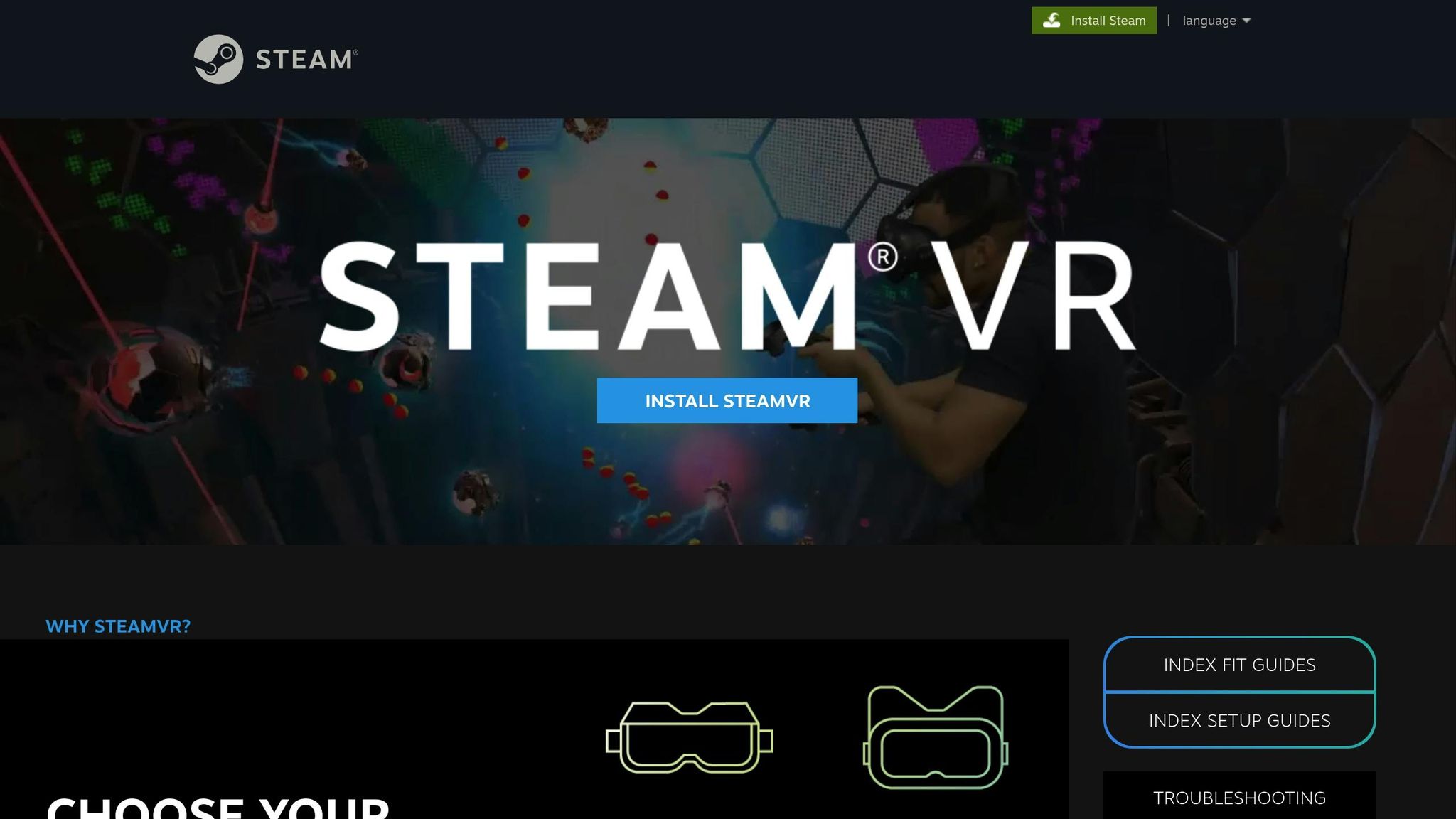
SteamVR stands as a major player in the PC VR ecosystem, providing a robust platform for VR content distribution. Created by Valve Corporation, it supports a variety of headsets, including the HTC Vive, Valve Index, Oculus Rift, Oculus Quest (via Link), and Windows Mixed Reality devices. Thanks to the OpenVR SDK, developers can integrate their projects seamlessly, bypassing hardware differences. This SDK also works well with popular development tools like Unity and Unreal Engine.
What makes SteamVR particularly appealing to creators is its integration with the Steam Store, one of the largest digital distribution platforms globally. This connection offers built-in tools for payment processing, customer support, and marketing, giving creators access to millions of potential users worldwide.
SteamVR operates on a 70/30 revenue-sharing model, with 70% going to creators and 30% to Valve. The platform supports various monetization methods, including direct sales, in-app purchases, downloadable content (DLC), and subscription options. Payments are processed in U.S. dollars and other major currencies, making it easier for creators to cater to a global audience.
For tracking performance, Steamworks analytics provides detailed insights. Developers can monitor downloads, active users, playtime, reviews, and geographic data - all formatted in U.S. conventions (e.g., MM/DD/YYYY for dates and USD for currency). This data helps creators understand their audience and refine their strategies.
Valve also offers extensive support for developers. Through its developer portal, creators can access detailed documentation, sample projects, and a vibrant community. The Steamworks SDK adds extra functionality, such as achievements, cloud saves, and multiplayer capabilities, making it easier to enhance the user experience.
SteamVR has already proven its value with blockbuster titles like Half-Life: Alyx and Beat Saber, which have reached millions of players and generated impressive revenue. These success stories highlight the platform's potential for creators aiming to make an impact in the VR space.
With VR hardware becoming more affordable and accessible, platforms like SteamVR are expected to drive broader adoption. For creators looking to break into VR, SteamVR offers a well-established user base, flexible monetization options, and a commitment to open standards that safeguard long-term investments.
6. Viveport

Viveport is HTC's digital platform for distributing virtual reality content. Acting as both a storefront and a subscription service, it’s designed to work seamlessly with major VR headsets, including those from HTC, Oculus, Valve, and Windows Mixed Reality. This broad compatibility means creators can connect with audiences across different VR ecosystems without being limited to a single hardware brand.
The platform offers multiple ways for creators to monetize their content. Alongside traditional one-time purchases, Viveport's standout feature is its subscription service, Viveport Infinity. For $12.99 per month or $99 annually, subscribers gain unlimited access to a library of over 1,000 VR titles. For developers, this model ensures ongoing revenue based on user engagement, providing a more stable income stream compared to one-off sales.
To support creators, Viveport includes a comprehensive analytics dashboard that tracks key metrics like downloads, session lengths, user engagement, geographic trends, and overall revenue. All data is presented using U.S. standards. The platform’s Developer Console simplifies tasks like uploading builds, setting pricing, and managing metadata. Developers can also work with popular VR engines like Unity and Unreal Engine, with detailed SDKs and documentation available to guide them through the process.
Viveport caters to both entertainment and enterprise audiences. Beyond games, the platform supports training simulations, educational tools, and corporate VR applications. Well-known titles like TheBlu and Superhot VR have achieved global reach through Viveport.
With millions of downloads and a growing audience spanning North America, Europe, and Asia, Viveport frequently organizes developer contests and promotional events to increase content visibility. Its compatibility with OpenXR ensures that the platform stays aligned with evolving VR standards. For creators aiming to distribute VR content across multiple devices while taking advantage of both direct sales and subscription-based models, Viveport provides a versatile solution backed by strong analytics and enterprise-level tools.
7. PlayCanvas

PlayCanvas is a cloud-hosted, browser-based game engine that’s changing the way creators deliver VR content. By operating entirely within web browsers, it allows users to experience VR instantly - no downloads or installations required. Powered by WebGL, PlayCanvas offers high-quality interactive 3D and VR experiences with ease.
One of its standout features is its broad compatibility. Whether you’re using a desktop, laptop, tablet, smartphone, or major VR headset, PlayCanvas works seamlessly. It supports devices like Meta Quest, HTC Vive, and Windows Mixed Reality headsets, as well as popular browsers such as Chrome, Firefox, and Edge. This flexibility means creators can reach audiences no matter what device or operating system they’re using, making it ideal for a variety of VR applications.
Take LEGO, for example. They used PlayCanvas to create a web-based VR showcase where users could explore new sets in immersive 3D. Similarly, BMW developed a virtual car configurator accessible through both browsers and VR headsets. These examples highlight how brands can create engaging, interactive experiences without requiring users to download specialized software.
PlayCanvas also shines in real-time collaborative editing. Developers can work together on the same project from anywhere in the world, thanks to its cloud-based setup. This approach, similar to Google Docs, speeds up development and makes it easier for teams spread across different locations and time zones to collaborate effectively.
Performance-wise, PlayCanvas delivers 60 FPS VR experiences with low latency and quick load times. Its cloud-hosting infrastructure ensures smooth performance, even on lower-end devices, which is critical for maintaining comfort and usability in VR environments.
While it doesn’t include a built-in marketplace, PlayCanvas gives creators the freedom to implement their own monetization strategies. Whether it’s through third-party payment gateways, advertising, or subscription models, the platform offers plenty of options. For instance, brands can embed e-commerce features or lead generation tools directly into their virtual showrooms or demos.
PlayCanvas also integrates seamlessly with popular 3D modeling tools like Blender, Maya, and 3ds Max using standard file formats such as FBX and glTF. Its APIs and SDKs make it easy to connect with analytics, back-end systems, and content management tools. Projects can be embedded in websites, shared via direct links, or incorporated into larger digital ecosystems for multi-channel distribution.
For U.S.-based creators, PlayCanvas simplifies deployment by supporting standard web technologies and compliance frameworks. You can easily incorporate U.S. dollar pricing, local date and time formats, and region-specific authentication systems. By relying on WebXR standards and secure web protocols, PlayCanvas ensures smooth, cross-platform experiences.
As demand grows for app-less VR experiences powered by WebXR, PlayCanvas offers a powerful solution for brands looking to provide frictionless access. With VR expanding into fields like education, retail, and corporate training, the ability to bypass app installations is becoming increasingly valuable for reaching wider audiences. PlayCanvas is well-positioned to meet this demand, making it a strong choice for web-based VR distribution.
8. Amazon Sumerian

Amazon Sumerian was a trailblazer in cloud-based VR, making it easier for creators to build and share VR content without needing to code. Although Amazon stopped offering Sumerian to new customers in 2021, its influence can still be seen in how modern VR platforms operate today.
By adopting WebGL and WebXR standards, Sumerian made it possible to run VR experiences directly in web browsers on both desktop and mobile devices. This meant users could access VR content instantly, without needing to download apps or software. It also supported major VR headsets like the Oculus Rift and HTC Vive, while maintaining compatibility with over 80% of VR-enabled devices in the U.S. market.
The platform’s drag-and-drop interface was a game-changer for businesses, educators, and marketers. It allowed them to quickly create VR content for training, marketing campaigns, or customer engagement without requiring technical expertise.
One of Sumerian’s standout features was its seamless integration with Amazon Web Services (AWS). This allowed developers to add advanced functionalities to their VR projects. For example, they could use Amazon Lex for conversational AI, Polly for text-to-speech, or Lambda for serverless computing. These tools enabled features like voice-controlled navigation and real-time data processing. AWS CloudWatch and Lambda also made it easy to track performance metrics.
Sumerian used a pay-as-you-go pricing model, with costs like ~$0.06 per GB of monthly storage and $1.50 per 1,000 scene views. While it didn’t match the graphical power of engines like Unity or Unreal Engine, it excelled in rapid prototyping and business-focused applications. It even supported real-time collaboration, letting teams work together on the same VR scene from different locations.
For monetization, creators could integrate AWS payment tools and embed Sumerian scenes into e-commerce sites or branded experiences. This opened up possibilities for virtual product showcases, sponsored content, and subscription-based training programs. The accessibility and cloud-based design of Sumerian laid the groundwork for many of the cross-platform VR tools available today.
9. CLDXR
CLDXR is a cloud-native VR distribution platform that breaks down the barriers between creators and their audiences. Unlike traditional platforms that require downloading large applications or investing in expensive hardware, CLDXR streams VR content directly from the cloud. This makes immersive experiences available to anyone with a basic internet connection.
The platform is compatible across multiple devices, supporting major VR headsets like Meta Quest, HTC Vive, and PlayStation VR, as well as web-based VR experiences. This cross-platform functionality allows creators to develop their content once and share it across nearly all VR-enabled devices, eliminating the need for separate versions. This broad compatibility also opens up a range of monetization opportunities.
CLDXR provides a flexible monetization system with options like pay-per-view access, subscription plans, and in-app purchases. For example, retail brands can use the platform to create virtual showrooms where customers explore products in VR, while educational institutions can offer premium training modules via subscription. Additionally, creators can benefit from advertising opportunities and branded sponsorships, giving them multiple ways to generate revenue.
A built-in analytics dashboard offers detailed insights into user behavior, tracking metrics such as session duration, geographic data, and device usage. Features like heatmaps and conversion tracking allow creators to fine-tune their VR experiences. These analytics help creators make data-driven decisions for future content improvements.
For developers using Unity or Unreal Engine, integrating with CLDXR is straightforward. The platform provides comprehensive SDKs, APIs, and detailed documentation to simplify uploading and managing content. This reduces development time for both individual creators and enterprise teams. Combined with its scalable cloud-based delivery, CLDXR streamlines the entire process.
The platform's cloud-based infrastructure offers several advantages over local hosting. Users don’t need high-end hardware to enjoy complex VR experiences, updates roll out instantly across devices, and the system scales automatically to handle large audiences during peak times. Whether it’s a brand launching a VR campaign or an educational institution deploying training programs, this scalability ensures consistent performance.
Security is a key focus for CLDXR. The platform uses encrypted data transmission, secure user authentication, and access controls to protect both content and user information. It complies with privacy regulations like GDPR and CCPA, ensuring user data is managed responsibly. These robust security measures meet industry standards, making CLDXR a trusted solution for seamless, cross-platform VR content.
10. EchoAR

EchoAR is a cloud-based platform designed to simplify the management of 3D assets, videos, and interactive experiences. It acts as a central hub where creators and brands can upload, organize, and update their content. The best part? Changes are reflected instantly across platforms, no redeployment needed. This feature alone can slash deployment time by up to 70%.
The platform supports a wide range of devices and development tools, thanks to its SDKs and APIs that work seamlessly with engines like Unity and Unreal Engine. Whether you're targeting Meta Quest, HTC Vive, Microsoft HoloLens, mobile AR on iOS and Android, or web-based XR experiences, EchoAR has you covered.
For those looking to monetize their content, EchoAR offers tools like paywalls, content gating, and payment processor integrations. These features allow creators to offer premium experiences, subscription access, or in-app purchases with ease.
The platform also provides an analytics dashboard that delivers real-time insights into user engagement, content usage, device distribution, and geographic reach. These data points help brands fine-tune their campaigns and make informed decisions. For example, L'Oréal USA used EchoAR in June 2025 to launch an AR campaign for a new skincare line. The campaign allowed users to visualize products in 3D across mobile, web, and Meta Quest headsets. The results? Over 1.2 million unique users in the first month, a 23% spike in online engagement, and a 15% boost in e-commerce sales - all thanks to real-time updates and actionable analytics.
Security and privacy are also priorities for EchoAR. The platform uses encrypted data transmission, access controls, and user authentication to safeguard information. It complies with GDPR and CCPA regulations, making it a solid choice for enterprise-level deployments.
EchoAR’s pricing is flexible, starting with a free plan for basic needs. Paid plans, which begin at $49 per month, include advanced features like detailed analytics, monetization tools, and enterprise integrations. By 2025, more than 40,000 developers and companies worldwide were using EchoAR, and it holds an impressive 4.7 out of 5 rating on major review platforms. Users frequently highlight its ease of use, seamless integrations, and excellent customer support. For creators and brands, EchoAR offers a streamlined solution for managing and deploying immersive content efficiently.
Tool Comparison Chart
Selecting the right content distribution tool depends on what you need, how much you're willing to spend, and your technical know-how. Below is a comparison of key tools for creators and brands looking to deliver immersive, interactive experiences or automated, AI-driven branded content.
Tool | Cross-Platform Compatibility | Monetization Options | Analytics Capabilities | Ease of Integration | Best For |
|---|---|---|---|---|---|
TwinTone | Very high (supports major VR platforms and APIs) | Subscription-based pricing | Built-in performance tracking | API-enabled integration | Branded content, AI-driven live streams, and on-demand UGC |
Unity 3D | Very high (supports OpenXR and major VR/AR devices) | Custom implementations, app stores, ads | Integration with third-party plugins | Moderate (requires development skills) | Custom VR apps, games, enterprise experiences |
Unreal Engine | Very high (supports OpenXR and major VR/AR devices) | Custom implementations, app stores, ads | Integration with third-party plugins | Moderate (requires development skills) | High-fidelity, interactive VR experiences |
Oculus Store | Limited to Meta devices (Meta Quest, Rift) | Built-in storefront options | Basic sales analytics | Easy (for Meta platforms) | Consumer VR apps for Meta devices |
SteamVR | PC VR (compatible with many headsets) | Built-in storefront options | Basic sales analytics | Easy (for PC VR) | PC VR games and applications |
Viveport | PC VR and Vive headsets | Built-in storefront and subscription models | Basic sales analytics | Easy (for Vive/PC VR) | Subscription-based VR experiences, enterprise solutions |
PlayCanvas | Web-based (runs in modern browsers) | Custom and web monetization models | Built-in and third-party solutions | Very easy (web-based, no installation) | Lightweight, browser-based immersive experiences |
Amazon Sumerian | Web and AWS ecosystem | Custom, based on AWS billing | Integrated AWS analytics | Moderate (requires AWS integration) | Enterprise, cloud-based immersive experiences |
CLDXR | Web, VR, and AR | Custom (enterprise-focused) | Built-in analytics | Very easy (cloud-based) | VR/AR content publishing and performance analytics |
EchoAR | Web, AR, and VR | Custom (enterprise-focused) | Built-in analytics | Very easy (cloud-based) | 3D/AR/VR content management and scalable analytics |
This chart provides an overview, but let’s break down the key differences.
Cross-platform compatibility is a standout factor. Unity 3D and Unreal Engine are ideal for immersive projects, supporting OpenXR and a wide range of VR/AR devices. On the other hand, platform-specific stores like the Oculus Store simplify distribution but limit compatibility to their ecosystems.
Monetization options also vary. Platform stores like SteamVR and Viveport follow a fixed revenue-sharing model (usually 30%), while game engines such as Unity and Unreal Engine allow for more flexibility with custom or third-party monetization solutions. For automated content creation and live product showcases, TwinTone uses a subscription model tailored to branded content.
Analytics capabilities range from basic sales tracking to more advanced engagement metrics. For instance, EchoAR and Amazon Sumerian offer built-in analytics dashboards, while Unity and Unreal Engine allow you to integrate analytics SDKs for deeper insights.
Ease of integration depends on the platform. Cloud-based tools like EchoAR and PlayCanvas make integration simple with REST APIs and web-based deployment. However, tools like Unity and Unreal Engine require more technical expertise, though they come with extensive documentation and community resources.
Pricing structures can also influence your choice. Unity 3D provides a free personal tier, with Pro plans costing $2,040 per year per seat. Unreal Engine is free until you earn over $1 million in revenue, after which a 5% royalty applies. For cloud-based platforms, EchoAR starts at $99 per month, while PlayCanvas Pro plans begin at $15 per month.
For creators looking to maximize reach and customization, Unity 3D and Unreal Engine are top choices, offering broad device support. If you need a quick, web-based solution, platforms like PlayCanvas and EchoAR eliminate the need for installations. Meanwhile, TwinTone stands out for its automated, AI-driven content creation and live engagement capabilities, making it a strong option for branded VR content.
As cloud streaming and AI reshape digital distribution, tools like TwinTone are leading the way in automating branded VR content and enhancing live interactions.
Final Thoughts
Choosing the right VR distribution tools depends on your goals and audience. For instance, Unity 3D powers over half of the world’s VR content, making it a dominant choice for developers. On the other hand, Unreal Engine stands out for its ability to deliver stunning, photorealistic visuals.
While development tools are crucial, hardware selection is equally important. If your focus is on consumer reach, the Meta Quest 3 - priced at $499.99 - provides an affordable and accessible option. For enterprise applications, devices like the Microsoft HoloLens 2, which costs $3,500, are better suited for advanced use cases.
The VR industry is evolving quickly, with trends pointing toward AI-driven content creation and cloud-based distribution. Companies like TwinTone are leading the way by automating content production to create live, branded VR experiences. These innovations not only engage audiences but also ensure fair compensation for creators.
Enterprise adoption of VR is expected to grow at an impressive rate of over 30% annually through 2028, fueled by applications in training, digital twins, and remote collaboration. This highlights the need to integrate multiple platforms for broader reach. Additionally, the blending of AR and VR technologies is paving the way for hybrid distribution methods.
Budget, technical expertise, and platform preferences are also key considerations. For example, Unity Pro costs $2,200 per seat annually, so you’ll need to weigh the benefits of custom development against the convenience of platform-specific storefronts.
Looking ahead, successful VR distribution strategies by 2025 will likely combine various platforms and leverage emerging technologies. Start with tools that address your immediate needs, and expand your reach as you gain experience and insights into your audience. Stay tuned to advancements in AI automation, 5G connectivity, and wireless streaming - these are transforming how VR content is delivered and can give early adopters a competitive edge.
Finally, don’t be afraid to experiment. The VR distribution landscape rewards those who adapt quickly and prioritize audience engagement, as discussed throughout this article.
FAQs
What are the different ways VR distribution platforms allow creators to earn money?
Monetization options for VR distribution platforms come in various forms, giving creators several ways to earn. Popular approaches include revenue sharing from paid content, subscription models, advertising opportunities, and in-app purchases. Additionally, some platforms allow creators to sell VR experiences or user-generated content directly.
These strategies aim to boost income while giving creators the freedom to select what aligns best with their audience and content style. It's essential to review the terms and features of each platform to find the right match for your monetization objectives.
What are the benefits of using cloud-based platforms for distributing VR content across multiple platforms?
Cloud-based platforms bring a host of benefits when it comes to distributing VR content across multiple platforms. One standout advantage is their ability to scale, letting creators handle and deliver large amounts of VR media without relying on heavy, local infrastructure. This frees you up to focus on crafting engaging content while the platform takes care of storage and delivery logistics.
Another major perk is their cross-platform compatibility. These platforms make it easier to adapt VR content for a variety of devices and operating systems, ensuring your audience enjoys a smooth experience no matter what platform they’re using. On top of that, many cloud-based solutions offer real-time updates, so you can tweak your content and roll out changes instantly across all platforms.
Using these tools, creators and brands can streamline their workflow, cut down on expenses, and effortlessly connect with a broader audience.
How can AI tools like TwinTone make VR content creation and distribution more effective?
AI-powered tools like TwinTone are reshaping how VR content is created and shared by automating labor-intensive processes and making it easier to scale. With TwinTone, creators can transform their likeness into AI Twins capable of producing branded content and hosting live streams around the clock. This means brands can offer engaging, consistent experiences across multiple platforms without skipping a beat.
TwinTone takes things a step further by enabling on-demand user-generated content (UGC) and 24/7 live product showcases. These features help brands connect with their audiences in a more dynamic way, boosting both engagement and sales. Plus, creators can generate income from their AI-driven content, creating a mutually beneficial setup for everyone involved.